
- Buy Crypto
- Markets
 Futures
- Spot
- Copy Trade
- Earn
- More
9 Crypto Terms Every Crypto Trader Should Know

Description: New to crypto? Learn the most important crypto terms—blockchain, smart contracts, DeFi, tokenomics, and more. Complete beginner's guide to understanding cryptocurrency.
Entering crypto can feel like learning a new language. The industry moves fast, and new terms pop up constantly. Whether you're just starting out or brushing up, knowing the fundamental crypto terms is essential for navigating this space safely.
Crypto has its own vocabulary. Concepts like blockchain, smart contracts, and private keys help you use crypto with fewer mistakes. Not all blockchains work the same—understanding Proof of Work vs. Proof of Stake, gas fees, and tokenomics explains why networks have different costs, speeds, and risks.
This guide breaks down 9 essential cryptocurrency terms every user should know.
1. Blockchain
At its core, a blockchain is a distributed, digital ledger that records transactions across a network of computers. Unlike a traditional bank ledger controlled by a single entity, a blockchain is decentralized, meaning it's maintained by multiple users instead of a central authority.
The data is stored in "blocks" that are linked together in a chronological "chain." Once information is recorded on the blockchain, it's extremely difficult to change, making the system transparent and secure against tampering.
Why it matters: Understanding blockchain helps you grasp why crypto is considered secure and transparent. Every cryptocurrency you trade relies on this underlying technology.
2. Decentralization
Decentralization refers to the transfer of control and decision-making from a centralized entity (individual, organization, or group) to a distributed network. In the context of crypto, decentralization aims to reduce trust issues and improve security.
For example, Bitcoin allows peer-to-peer transactions without intermediaries like banks. It's worth noting, however, that decentralization exists on a spectrum; some networks are more decentralized than others.
Why it matters: Decentralization is what makes crypto different from traditional finance. When you hear "not your keys, not your coins," that's decentralization in action.
3. Smart Contracts
Smart contracts are self-executing contracts with the terms of the agreement directly written into code. The most popular smart contracts run on highly programmable blockchains like Ethereum, BNB Chain, and Solana.
Think of a smart contract like a vending machine: if you insert the correct amount of money and select an item (the input), the machine automatically releases the product (the output) without a shopkeeper needing to be present. This automation enables the creation of all sorts of decentralized applications (DApps) and eliminates the need for middlemen in many processes.
Why it matters: Smart contracts power everything from DeFi lending to NFT marketplaces. They're the engine behind most crypto innovation.
4. Decentralized Finance (DeFi)
DeFi refers to an ecosystem of financial applications built on blockchain networks. The goal of DeFi is to create an open-source, permissionless, and transparent financial service ecosystem that is available to everyone and operates without any central authority.
DeFi users can engage in activities such as lending, borrowing, and trading directly with others or via smart contracts, rather than going through traditional intermediaries like banks.
Why it matters: DeFi has grown into a multi-billion dollar ecosystem offering yields, trading, and financial services to anyone with an internet connection. Understanding DeFi opens up new ways to use your crypto.
5. Tokenomics
Tokenomics (a combination of "token" and "economics") refers to the economic structure of a cryptocurrency, NFT, or any other digital asset. It's related to the supply and demand characteristics of a token.
Key aspects of tokenomics include:
- Total supply: The number of tokens that currently exist and are either in circulation or locked
- Circulating supply: The number of tokens currently available in the market
- Utility: What the token is used for (e.g., paying fees, governance voting)
- Distribution: How tokens are allocated to the team, investors, and the community
Why it matters: Understanding tokenomics helps investors evaluate the long-term sustainability of a project. A token with poor tokenomics can lose value even if the technology is sound.
6. Gas Fees
Gas fees are the payments made by users to compensate for the computing energy required to process and validate transactions on a blockchain. For example, on the Ethereum network, gas fees are paid in ether (ETH) and are denominated in gwei.
Gas prices fluctuate based on demand; when the network is busy, fees tend to go up. Understanding how gas fees work can help you time transactions better and avoid overpaying.
Why it matters: High gas fees can make small transactions impractical. Knowing when to trade can save you significant money over time.
7. Private Keys vs. Public Keys
These keys are cryptographic tools used to send and receive cryptocurrency.
- Public Key: Think of this as your bank account number or email address. You share this with others so they can send you funds.
- Private Key: This is like your password or PIN. It proves ownership of the funds associated with your public key. You must never share your private key with anyone. If someone gains access to your private key, they can steal your assets.
Why it matters: Your private key is the most important piece of information in crypto. Lose it, and you lose your funds. Share it, and someone else can take them.
8. Seed Phrase: The Master Key to Your Wallet
A seed phrase (or recovery phrase) is a sequence of 12 to 24 random words generated when you create a crypto wallet. It's the master backup for your entire wallet.
Here's the key difference: a private key unlocks a single specific address (like one Bitcoin account), while a seed phrase restores your whole wallet—including every account and private key derived from it.
If you lose your device, the seed phrase is the only way to recover your funds. But if anyone else finds it, they gain full access to everything in your wallet. Store it offline in a secure place and never share it with anyone.
Why it matters: Your seed phrase is the ultimate backup. Treat it like the keys to a vault—because that's exactly what it is.
9. Stablecoins
Stablecoins are cryptocurrencies designed to keep a relatively stable price, usually by tracking the value of a traditional currency like the US dollar (aiming to stay close to $1). Many people use stablecoins to move money between exchanges, avoid short-term price swings, or store value on-chain without converting their digital assets back to fiat.
There are different types of stablecoins:
- Fiat-backed stablecoins: Backed by reserves such as cash and short-term government debt. Users rely on the issuer to manage reserves properly.
- Crypto-backed stablecoins: Use cryptocurrency as collateral and often require over-collateralization. They can be more transparent on-chain but may be affected during high volatility.
- Algorithmic stablecoins: Use mechanisms like supply adjustments to maintain the peg. They can be more fragile and may fail during market stress.
Why it matters: Even though they're called "stable," stablecoins are not risk-free. They can depeg (move away from $1), face liquidity problems, or be impacted by regulation, reserves management, or smart contract vulnerabilities. Stick to reputable stablecoins with a proven track record.
How to Start Your Crypto Journey on WEEX
Now that you understand the essential crypto terms, you might be ready to put that knowledge into practice. WEEX offers a secure platform with zero fees and instant execution—perfect for beginners and experienced traders alike.
Step 1: Create Your WEEX Account
Visit the WEEX website or download the app. Sign up with email or phone, verify, and complete KYC.
Step 2: Deposit Funds
Go to "Assets" → "Deposit." Add funds via bank transfer, card payment, or send USDT from another wallet.
Step 3: Start Trading
Navigate to the trading section and explore hundreds of trading pairs. Use your new knowledge to make informed decisions.
Why WEEX? Zero fees, instant execution, deep liquidity, and institutional-grade security.
Final Thoughts: Knowledge Is Your Best Investment
Crypto becomes much clearer once you understand the core ideas. Concepts like blockchain, smart contracts, and consensus mechanisms explain how networks operate, while tokenomics and gas fees help you navigate costs and incentives.
On the security side, private keys and seed phrases are non-negotiable—lose them, and you lose access to your funds. Stablecoins and DeFi are also essential tools for trading, payments, and on-chain finance.
Keep learning the basics, stay security-conscious, and you'll navigate crypto with confidence.
Ready to start your crypto journey? WEEX makes it simple with zero fees, instant execution, and the security you need. Register on WEEX Now and Start Trading
Frequently Asked Questions About Crypto Terms
Q1: What is the most important crypto term for beginners?
A: Private key is arguably the most critical term. Your private key proves ownership of your funds—lose it, and you lose access to your crypto permanently.
Q2: What's the difference between Bitcoin and Ethereum?
A: Bitcoin primarily serves as digital gold—a store of value. Ethereum is a programmable blockchain that supports smart contracts and decentralized applications.
Q3: What does "gas" mean in crypto?
A: Gas fees are payments made to process transactions on a blockchain. They compensate miners or validators for the computing power required.
Q4: Are stablecoins really stable?
A: Stablecoins aim to maintain a fixed price (usually $1), but they can "depeg" during market stress. Choose reputable stablecoins with transparent reserves.
Q5: What's a seed phrase and why is it important?
A: A seed phrase is a 12-24 word backup that can restore your entire wallet. Never share it online or with anyone—it's the master key to all your funds.
You may also like
Buy Crypto with BCA on WEEX P2P – 0 Fee & 24/7 IDR Merchants
BCA is widely recognized in Indonesia as a trusted and reliable option for fast and seamless cryptocurrency purchases using IDR. With WEEX P2P, users can buy crypto directly through BCA with zero fees, access 24/7 verified merchants, and enjoy ultra-fast release times.
Compared with Binance, Bybit, and local OTC platforms, WEEX consistently offers better IDR exchange rates, safer escrow protection, and more available ads for BCA users.
As crypto adoption continues to rise in Indonesia, secure and convenient access to digital assets has become increasingly important. With WEEX P2P, users can buy USDT, BTC, or ETH via BCA with instant processing, 0% buyer fees, and professional merchant support.
What is P2P Trading?
Peer-to-Peer (P2P) trading allows users to buy and sell crypto directly with other users, while the platform acts as a secure intermediary.
On WEEX P2P:
Crypto is held in escrowSellers release assets only after payment is confirmedTrades are processed quickly and safelyThis ensures zero counterparty risk and allows users to pay via local banking methods for a seamless experience.
Why WEEX P2P is the Best Choice for BCA Users
WEEX P2P offers key advantages to users purchasing crypto with IDR via BCA:
0% buyer fees:Save 2–8% compared to competing platforms and maximize the value of every tradeFast release times :Funds are typically released within 1–3 minutes, ensuring a smooth and efficient buying experienceOfficial escrow protection:Platform-managed escrow guarantees 100% transaction safetyFlexible trade sizes:Supports everything from small purchases to large-volume transactionsBest IDR exchange rates for BCA users: Enjoy highly competitive pricing tailored for BCA paymentsThousands of merchants online 24/7: Deep liquidity and constant availability at any time of dayMore BCA ads than any competitor: Greater choice, faster matching, and higher deal completion ratesWhether you’re buying 1,000 IDR or 1,000,000 IDR, WEEX ensures fast, safe, and cost-efficient crypto purchases.
How to Buy Crypto with BCA on WEEX P2P
Buying crypto with BCA on WEEX is simple and fast. Follow these steps:
Register on WEEX and complete basic KYC verification Create your WEEX account and finish the basic identity verification process, which typically takes less than one minute to complete.Navigate to Buy Crypto → P2P Trading From the main menu, enter the P2P trading section and select IDR as your preferred fiat currency.Apply the “BCA” filter Enable the BCA payment filter to view only those merchant advertisements that support BCA.Select the most suitable merchant Review and compare available merchants based on key indicators, including:Exchange priceOrder completion rateTotal trading volumeReal-time online statusEnter the amount you wish to purchase Input your desired crypto amount, and the system will automatically calculate and display the exact payable amount in IDR.Complete the payment via BCA Transfer the displayed amount using BCA, following the bank details provided by the selected merchant.Confirm payment and notify the seller Click “Transferred, Notify Seller” after completing the transfer. The seller will then verify your payment and promptly release the cryptocurrency to your WEEX account.Your Crypto will arrive instantly in your WEEX wallet — safe, fast, and with zero fees.
Frequently Asked Questions (FAQ)
Q1: Are there any fees when paying with BCA? A: 0% fee for buyers. Only sellers pay a small fee.
Q2: How fast will I receive Crypto? A: Usually 1–5 minutes after marking payment as sent.
Q3: Is buying with BCA safe on WEEX? A: Yes. All trades use official escrow.
Q4: Do I need full KYC? A: Basic KYC is required for P2P trading.
Ready to Buy Crypto with BCA?
Start buying crypto in under 3 minutes — fast, safe, and 0% fee for buyers!
Start Buying Crypto on WEEX P2P with BCA Now!
Buy USDT with BCA on WEEX P2P – 0 Fee & 24/7 IDR Merchants
BCA is widely recognized in Indonesia as a trusted and reliable option for fast and seamless cryptocurrency purchases using IDR. With WEEX P2P, users can buy USDT directly through BCA with zero fees, access 24/7 verified merchants, and enjoy ultra-fast release times.
Compared with Binance, Bybit, and local OTC platforms, WEEX consistently offers better IDR exchange rates, safer escrow protection, and more available ads for BCA users.
As USDT adoption continues to rise in Indonesia, secure and convenient access to digital assets has become increasingly important. With WEEX P2P, users can buy USDT, BTC, or ETH via BCA with instant processing, 0% buyer fees, and professional merchant support.
What is P2P Trading?
Peer-to-Peer (P2P) trading allows users to buy and sell USDT directly with other users, while the platform acts as a secure intermediary.
On WEEX P2P:
USDT is held in escrowSellers release assets only after payment is confirmedTrades are processed quickly and safelyThis ensures zero counterparty risk and allows users to pay via local banking methods for a seamless experience.
Why WEEX P2P is the Best Choice for BCA Users
WEEX P2P offers key advantages to users purchasing USDT with IDR via BCA:
0% buyer fees:Save 2–8% compared to competing platforms and maximize the value of every tradeFast release times :Funds are typically released within 1–3 minutes, ensuring a smooth and efficient buying experienceOfficial escrow protection:Platform-managed escrow guarantees 100% transaction safetyFlexible trade sizes:Supports everything from small purchases to large-volume transactionsBest IDR exchange rates for BCA users: Enjoy highly competitive pricing tailored for BCA paymentsThousands of merchants online 24/7: Deep liquidity and constant availability at any time of dayMore BCA ads than any competitor: Greater choice, faster matching, and higher deal completion ratesWhether you’re buying 1,000 IDR or 1,000,000 IDR, WEEX ensures fast, safe, and cost-efficient USDT purchases.
How to Buy USDT with BCA on WEEX P2P
Buying USDT with BCA on WEEX is simple and fast. Follow these steps:
Register on WEEX and complete basic KYC verification Create your WEEX account and finish the basic identity verification process, which typically takes less than one minute to complete.Navigate to Buy USDT → P2P Trading From the main menu, enter the P2P trading section and select IDR as your preferred fiat currency.Apply the “BCA” filter Enable the BCA payment filter to view only those merchant advertisements that support BCA.Select the most suitable merchant Review and compare available merchants based on key indicators, including:Exchange priceOrder completion rateTotal trading volumeReal-time online statusEnter the amount you wish to purchase Input your desired USDT amount, and the system will automatically calculate and display the exact payable amount in IDR.Complete the payment via BCA Transfer the displayed amount using BCA, following the bank details provided by the selected merchant.Confirm payment and notify the seller Click “Transferred, Notify Seller” after completing the transfer. The seller will then verify your payment and promptly release the USDTcurrency to your WEEX account.Your USDT will arrive instantly in your WEEX wallet — safe, fast, and with zero fees.
Frequently Asked Questions (FAQ)
Q1: Are there any fees when paying with BCA? A: 0% fee for buyers. Only sellers pay a small fee.
Q2: How fast will I receive USDT? A: Usually 1–5 minutes after marking payment as sent.
Q3: Is buying with BCA safe on WEEX? A: Yes. All trades use official escrow.
Q4: Do I need full KYC? A: Basic KYC is required for P2P trading.
Ready to Buy USDT with BCA?
Start buying USDT in under 3 minutes — fast, safe, and 0% fee for buyers!
Start Buying USDT on WEEX P2P with BCA Now!
Buy BTC with BCA on WEEX P2P – 0 Fee & 24/7 IDR Merchants
BCA is widely recognized in Indonesia as a trusted and reliable option for fast and seamless cryptocurrency purchases using IDR. With WEEX P2P, users can buy BTC directly through BCA with zero fees, access 24/7 verified merchants, and enjoy ultra-fast release times.
Compared with Binance, Bybit, and local OTC platforms, WEEX consistently offers better IDR exchange rates, safer escrow protection, and more available ads for BCA users.
As BTC adoption continues to rise in Indonesia, secure and convenient access to digital assets has become increasingly important. With WEEX P2P, users can buy USDT, BTC, or ETH via BCA with instant processing, 0% buyer fees, and professional merchant support.
What is P2P Trading?
Peer-to-Peer (P2P) trading allows users to buy and sell BTC directly with other users, while the platform acts as a secure intermediary.
On WEEX P2P:
BTC is held in escrowSellers release assets only after payment is confirmedTrades are processed quickly and safelyThis ensures zero counterparty risk and allows users to pay via local banking methods for a seamless experience.
Why WEEX P2P is the Best Choice for BCA Users
WEEX P2P offers key advantages to users purchasing BTC with IDR via BCA:
0% buyer fees:Save 2–8% compared to competing platforms and maximize the value of every tradeFast release times :Funds are typically released within 1–3 minutes, ensuring a smooth and efficient buying experienceOfficial escrow protection:Platform-managed escrow guarantees 100% transaction safetyFlexible trade sizes:Supports everything from small purchases to large-volume transactionsBest IDR exchange rates for BCA users: Enjoy highly competitive pricing tailored for BCA paymentsThousands of merchants online 24/7: Deep liquidity and constant availability at any time of dayMore BCA ads than any competitor: Greater choice, faster matching, and higher deal completion ratesWhether you’re buying 1,000 IDR or 1,000,000 IDR, WEEX ensures fast, safe, and cost-efficient BTC purchases.
How to Buy BTC with BCA on WEEX P2P
Buying BTC with BCA on WEEX is simple and fast. Follow these steps:
Register on WEEX and complete basic KYC verification Create your WEEX account and finish the basic identity verification process, which typically takes less than one minute to complete.Navigate to Buy BTC → P2P Trading From the main menu, enter the P2P trading section and select IDR as your preferred fiat currency.Apply the “BCA” filter Enable the BCA payment filter to view only those merchant advertisements that support BCA.Select the most suitable merchant Review and compare available merchants based on key indicators, including:Exchange priceOrder completion rateTotal trading volumeReal-time online statusEnter the amount you wish to purchase Input your desired BTC amount, and the system will automatically calculate and display the exact payable amount in IDR.Complete the payment via BCA Transfer the displayed amount using BCA, following the bank details provided by the selected merchant.Confirm payment and notify the seller Click “Transferred, Notify Seller” after completing the transfer. The seller will then verify your payment and promptly release the BTCcurrency to your WEEX account.Your BTC will arrive instantly in your WEEX wallet — safe, fast, and with zero fees.
Frequently Asked Questions (FAQ)
Q1: Are there any fees when paying with BCA? A: 0% fee for buyers. Only sellers pay a small fee.
Q2: How fast will I receive BTC? A: Usually 1–5 minutes after marking payment as sent.
Q3: Is buying with BCA safe on WEEX? A: Yes. All trades use official escrow.
Q4: Do I need full KYC? A: Basic KYC is required for P2P trading.
Ready to Buy BTC with BCA?
Start buying BTC in under 3 minutes — fast, safe, and 0% fee for buyers!
Start Buying BTC on WEEX P2P with BCA Now!
Do You Pay Tax on Crypto? Trading, Staking and Airdrops Explained
TL;DR
Do you pay tax on crypto without selling? Yes, in most cases, you owe crypto tax even if you don’t cash out.Do you pay tax on crypto trading? Yes. Buying, selling, or swapping crypto (ETH to BTC) can trigger capital gains tax.How is crypto trading taxed? Profits are usually taxed as capital gains, but frequent trading or futures trading may be treated as business income.Is staking taxable? Yes. Crypto staking rewards are taxed as income when received, and taxed again as capital gains when sold.Are crypto airdrops taxable? Yes. Airdrops are taxable income at the time you receive them, even if you don’t sell.When do you owe crypto taxes? When you trade, earn, or receive crypto — not just when you withdraw to fiat.What are common crypto tax mistakes? Not tracking trades, ignoring staking rewards, and assuming no tax without withdrawal.How to report crypto taxes easily? Export your data from WEEX and use crypto tax software like KoinX to generate reports.Most crypto users assume one thing: If you haven't withdrawn your funds, you don't owe any tax.
It sounds logical , but in most cases, it's wrong.
As crypto markets evolve, tax rules have become clearer and stricter. What matters is not whether you cash out, but how you interact with your assets. Trading, earning, or even receiving tokens can all trigger taxable events, often without you realizing it.
So when exactly do you pay tax on crypto? The answer depends on what you do.
Do You Pay Tax on Crypto Trading? Even Without Cashing OutThe most common misconception is that taxes only apply when you convert crypto into fiat.
In reality, tax authorities in many countries treat any disposal of crypto as a taxable event. This includes not only selling for cash, but also swapping one asset for another.
If you trade ETH for BTC, you may still need to calculate your gain — even though no money ever leaves the crypto ecosystem.
What matters is whether you realized a profit.
If the value of your asset increased between the time you acquired it and the time you traded or sold it, that difference is typically taxed as a gain. Losses may also be recognized, depending on local rules.
For active traders, especially those using futures or trading frequently, things can become more complex. In some cases, trading activity may even be treated as business income rather than capital gains, which can significantly change how it is taxed.
Is Staking Taxable? When and How Rewards Are TaxedStaking is often described as passive income, but from a tax perspective, it’s rarely that simple.
In most jurisdictions, staking rewards are treated as income at the moment you receive them, based on their market value at that time.
This means you may owe tax even if you never sell your rewards.
And that’s only the first layer.
If you later sell those tokens at a higher price, the additional profit is taxed again — this time as a capital gain.
This dual structure — income first, gains later — is one of the most commonly misunderstood aspects of crypto taxation, and a frequent source of reporting errors.
Are Crypto Airdrops Taxable? What Counts as IncomeAirdrops feel like free money. From a tax perspective, they usually aren’t.
In many cases, airdropped tokens are treated as income once you have control over them and they have a measurable market value.
That means the moment you can claim or access the tokens, their value may already be taxable — regardless of whether you sell them.
If you later sell at a higher price, the difference is taxed again as a gain.
Like staking, airdrops often create two separate tax events:
one when you receive the tokens, and another when you dispose of them.
Crypto Tax Mistakes That Can Cost You MoneyThe rules themselves are not always complicated — but applying them correctly can be.
Many users assume that staying within crypto avoids tax, overlook income from staking or airdrops, or fail to track the original cost of their assets across multiple trades.
As activity increases, especially across different assets and strategies, keeping accurate records becomes significantly harder. Without proper tracking, it’s easy to either underreport — or overpay.
When Do You Actually Owe Crypto Taxes? Key TakeawaysCrypto taxation is not just about how much you earn. It’s about when and how those earnings are realized.
Trading, staking, and airdrops are taxed in different ways, often at different points in time. And in many cases, tax obligations arise long before any funds are withdrawn.
The key takeaway is simple:
If you are actively participating in the crypto market, you are very likely generating taxable events — whether you notice them or not.
Understanding this early makes it easier to stay compliant, avoid costly mistakes, and make better decisions as your trading activity grows.
How to Report Crypto Taxes on WEEX: A Simple Step-by-Step GuideUnderstanding how crypto is taxed is only half the process — reporting it correctly is where it gets more complex.
As your activity grows, especially across trading, staking, and rewards, keeping track of every transaction manually can quickly become overwhelming. Using a platform where your trading history is organized and easily exportable can make a meaningful difference when it comes to filing.
For a step-by-step guide on how to track and report your crypto taxes, read the full tutorial here:
WEEX Crypto Tax Guide: How to Export Trading Data and Generate a Tax Report with KoinX
About WEEXFounded in 2018, WEEX has developed into a global crypto exchange with over 6.2 million users across more than 150 countries. The platform emphasizes security, liquidity, and usability, providing over 1,200 spot trading pairs and offering up to 400x leverage in crypto futures trading. In addition to the traditional spot and derivatives markets, WEEX is expanding rapidly in the AI era — delivering real-time AI news, empowering users with AI trading tools, and exploring innovative trade-to-earn models that make intelligent trading more accessible to everyone. Its 1,000 BTC Protection Fund further strengthens asset safety and transparency, while features such as copy trading and advanced trading tools allow users to follow professional traders and experience a more efficient, intelligent trading journey.
Follow WEEX on social media:
· Instagram: @WEEX Exchange
· X: @WEEX_Official
· Tiktok: @weex_global
· Youtube: @WEEX_Global
· Discord: WEEX Community
· Telegram: WeexGlobal Group
How to Withdraw Funds from WEEX on Mobile Device: Complete Guide for Beginners
Withdrawing your assets securely and efficiently is essential for every crypto trader. Whether you're cashing out profits after a successful trade or moving funds to an external wallet for long-term storage, knowing how to withdraw funds from WEEX is a fundamental skill.
This step-by-step guide will walk you through how to complete a withdrawal on the WEEX exchange—from logging into your account to confirming the transaction. Learn the process, avoid common mistakes, and manage your crypto with confidence using WEEX's user-friendly platform.
Step-by-Step Guide: How to Withdraw Funds from WEEXStep 1: Log Into Your WEEX AccountGo to WEEX offcial website and Install the WEEX appSelect the Login optionEnter your login information and verify your accountStep 2: Navigate to the Withdrawal SectionOnce logged in:
On the WEEX homepage, navigate to your Spot Account (where your funds are held)Click the Withdraw button in the menu to start the processAlternatively, go to the Wallet section and choose Withdraw or Withdraw FundsStep 3: Select the Token to WithdrawWEEX supports a broad range of tokens, including:
BTC (Bitcoin)ETH (Ethereum)USDT (Tether)WXT (WEEX Token)And many other cryptocurrenciesIn the Withdraw section:
Select the cryptocurrency or token you want to withdraw (e.g., BTC, ETH, USDT)Verify that your Spot Account has sufficient balance for the desired withdrawal amountStep 4: Enter Withdrawal DetailsAfter selecting your token, enter the transaction details carefully:
Withdrawal Address:
Input the destination address for your tokensDouble-check every character—crypto transactions are irreversibleEnsure the receiving wallet supports the chosen tokenNetwork Selection:
For USDT, select the correct network (e.g., TRC-20, ERC-20, BEP-20)Using the wrong network can result in permanent loss of fundsMatch the network to your destination wallet's capabilitiesAmount:
Enter the number of tokens you want to withdrawNote that some tokens have minimum withdrawal limitsNetwork fees will be deducted from your totalStep 5: Review and SubmitBefore finalizing:
Carefully review the withdrawal address, network, and amountCheck the handling fee displayedIf everything is correct, click Withdraw or Confirm to proceedComplete any additional security verification (2FA, email confirmation)Step 6: Track Your Withdrawal StatusAfter submitting:
Visit the Withdrawal History section in your WEEX accountCheck whether the transaction is Pending or CompletedWithdrawal times vary by network and congestion:USDT on TRC-20: usually minutesBTC and ETH: may take longer depending on network activityStep 7: Verify Funds in Your Destination WalletOnce the transaction is confirmed on the blockchain:
Check your receiving wallet to confirm the funds arrivedIf tokens don't appear immediately, allow time for network confirmationsFor delays, you can track the transaction using a blockchain explorerIf you still have questions about the withdrawal process, check out the tutorial video below to help you safely withdraw your assets.
Why Choose WEEX for Your Crypto Trading?WEEX offers numerous advantages for crypto traders, starting with zero fees on many transactions—features like the We-Launch event allow users to deposit and earn rewards without any transaction costs. The platform also provides access to promising projects through events where you can commit WXT tokens and earn airdrop rewards from high-quality crypto initiatives.
With a wide range of supported cryptocurrencies, WEEX makes it easy to build and diversify your portfolio. Above all, every deposit and withdrawal is processed with the highest level of security, including cold storage for most funds and regular security audits, giving you complete peace of mind.
FAQQ1: How long does a WEEX withdrawal take?Withdrawal times vary by cryptocurrency and network activity. USDT on TRC-20 typically takes minutes, while BTC and ETH may take 10-60 minutes depending on network congestion.
Q2: Are there withdrawal fees on WEEX?WEEX does not charge its own withdrawal fees, but blockchain network fees apply. These fees go to miners/validators, not to WEEX.
Q3: Can I Cancel a Withdrawal?Once confirmed, withdrawals cannot be canceled. Always verify details before submitting.
Q4: Can I cancel a withdrawal after submitting?No. Once a withdrawal is confirmed and submitted to the blockchain, it cannot be canceled. Always verify details before confirming.

With OpenClaw taking the world by storm, what can the Agentic economy bring to Web3?
Goodbye Agent, hello OpenClaw
“It is now the largest, most popular and most successful open-source project in human history. This is definitely the next ChatGPT.”
This isn’t the wild claim of some tech enthusiast, but rather NVIDIA CEO Jensen Huang’s assessment of OpenClaw in an interview this Tuesday.
This open-source AI agent, released by a former Apple developer, saw its GitHub stars skyrocket to 320,000 within three months, surpassing Linux and React. Because its logo bears a striking resemblance to a lobster, the Chinese community has dubbed it ‘龙虾’, referring to lobster in Chinese.
However, the viral success of OpenClaw is not merely another AI tool craze, but rather the prelude to the agentic economy—a pivotal turning point where AI evolves from ‘talking’ to ‘doing’.
From chatbots to digital employees: this time it’s different
Over the past two years, the term “AI agent” has been bandied about repeatedly, yet it remained confined to presentation slides. It wasn’t until the emergence of OpenClaw that this impasse was truly broken.
Its core distinction lies in execution rather than conversation.
Traditional products like ChatGPT and Claude are, at their core, tools for answering questions—you ask, it answers, and the next step is still up to you. The new generation of agents represented by OpenClaw operates on a completely different logic: OpenClaw is authorised to take control of the operating system, autonomously invoking browsers, code executors, APIs, iMessage and more, planning, executing and adjusting its course of action independently until the task is completed.
Of course, this fully managed approach carries inherent risks, but that is a story for another time.
Many have likened this moment to the ChatGPT moment of 2022, but I believe a more accurate analogy might be that distant afternoon years ago when Steve Jobs unveiled the iPhone.
Innovation shows no signs of stopping; OpenClaw’s official skills marketplace, ClawHub, currently offers over 27,000 skills for various AI agents to access free of charge—meaning these digital employees are capable of handling an ever-increasing range of tasks.
Looking further ahead, OpenClaw’s popularity is not merely a repeat of past AI tool fads, but rather the prelude to the agentic Economy, for which Web3 is the natural breeding ground.
Why is Web3 the most natural economic vehicle for AI agents?
On the surface, this OpenClaw appears to be merely a slightly intelligent executor: automatically checking emails, booking tickets, managing files, and even posting across platforms. But dig deeper, and it is precisely the true catalyst for the agentic economy—and Web3 is the most suitable ‘ocean’ for this lobster once it has crawled ashore.
Moreover, the integration of blockchain and the OpenClaw possesses inherent advantages that amplify its impact:
The x402 protocol enables agents to autonomously pay fees and switch AI model providers using a single wallet, without the need for manual review;The ERC-8004 protocol grants agents a portable reputation system and legal identity;Clawpay, ClawCredit and ClawRouter facilitate private payments, native credit and autonomous routing;Stablecoins (USDT/USDC) serve as the agent’s 24/7 bank, perfectly aligning with code-driven settlement requirements.In summary, the automatic execution of smart contracts, permissionless on-chain interactions, and the instant global settlement enabled by stablecoins—these characteristics can significantly address the bottlenecks faced by traditional AI agents in areas such as payment closed-loop systems, identity and reputation, and contract execution.
Further innovative use cases are on the horizon:
Circle’s open-source Circle Skills already enable AI agents to directly generate USDC payments, cross-chain transfers and smart contract logic;MistTrack Skills from SlowMist provide agents with on-chain AML risk analysis capabilities, automatically performing security checks prior to transfers;RootData, meanwhile, has packaged databases of thousands of crypto projects, funding data, token economics and social engagement metrics into Skills, boosting content creation efficiency tenfold.We therefore have every reason to believe that OpenClaw’s explosive popularity is merely the beginning; once integrated into Web3, the Agentic economy will unleash astonishing potential.
The Agentic concept project at the forefront of the trend
KITE
KiteAI is a PoAI L1 blockchain dedicated to agents, working in close synergy with the OpenClaw ecosystem: it supports OpenClaw developer activities and enables agents to independently pay for computing resources and API calls.
Currently, KiteAI has joined the Agentic AI Foundation, in partnership with OpenAI, Google and others, and serves as a key piece of infrastructure for the agentic economy
PIEVERSE
The on-chain payment protocol Pieverse recently launched Purr-Fect Claw, transforming OpenClaw into a fully on-chain tool. Users can now deploy agents directly within Web2 applications such as Line, Kakao and WhatsApp, enabling gasless on-chain transactions and operations.
GPS
GoPlus Security has launched SafuSkill—a security-first Skills marketplace built on the BNB Chain, integrating a skills marketplace, an automated security scanning engine and developer tools to help users filter for secure AI agent skills.
Lobster
This is not an AI agent, but rather a Chinese meme coin originated from OpenClaw. Like many similarly named meme coins that capitalise on trending events, ‘Lobster’ has also been hyped due to OpenClaw’s viral popularity.
CLAWD
‘clawd.atg.eth’ is a self-hosted personal AI assistant deployed by Ethereum developer Austin Griffith based on the open-source clawd.bot. The agent can independently write, test and deploy dApps to the Ethereum/Base mainnet, and has already produced over 14 production-grade applications, such as the ClawFomo game, PFP prediction markets and the Incinerator burning mechanism.
KELLYCLAUDE
KellyClaude is a personal AI executive assistant created by Austen Allred. Running on the Claude model, it can proactively manage tasks such as schedules, emails and travel, and actively shares experiences within agent communities such as Moltbook.
CLUDE
Clude.io, meanwhile, focuses on an independent memory layer, separating memory from the model to achieve a persistent, private, and cross-model portable brain-like system, perfectly addressing the pain points of memory and privacy sovereignty for agents.
Last but not least
In 2023, the arrival of ChatGPT ignited the AI data sector, represented by Fetch.ai (FET), SingularityNET (AGIX) and Ocean Protocol (OCEAN), as well as the early AI+DePIN sector, represented by Render (RNDR), Akash (AKT) and io (IO);
By the end of 2024, TURBO, GOAT and Fartcoin triggered an AI meme frenzy, shifting AI’s focus from utility to culture and speculation;
In 2025, the market’s focus shifted to AI agents as economic entities, with projects such as Bittensor (TAO) and The Graph (GMT) pivoting towards supporting data queries and autonomous transactions for AI agents, whilst projects like SkyAI emphasised multi-agent collaboration;
Now, OpenClaw is taking the next step in enabling s to truly carry out 24/7 trading, collaboration and entrepreneurship, thereby fuelling massive on-chain traffic and new DeFi narratives. This marks our transition into the agentic era.
The lobster has been launched, and the vast ocean of Web3 awaits it.
Are you ready for the new generation?

Risk Management in Crypto Trading 2026: Complete Guide
In crypto trading, managing risk is not just a skill—it's survival. Unlike traditional markets, digital assets can fluctuate by double digits in a single day, amplifying both opportunity and danger. This volatility attracts traders, but without a plan, it also leads to quick losses.
That's why professional traders treat risk management as the foundation of every strategy, not an afterthought. Tools like stop-loss, take-profit, and position sizing help them control exposure and preserve capital while staying active in fast-moving markets.
In this guide, we'll cover seven practical rules that every trader should know to manage risk effectively and trade crypto with confidence.
What Is Risk Management in Crypto Trading?Risk management in crypto trading means protecting your capital by controlling how much you expose to the market and defining when to exit a position. It's not about avoiding losses—every trader experiences them—but about keeping those losses small enough to recover from.
This principle applies across both spot trading and futures trading, where high volatility and leverage can quickly magnify gains or wipe out an account. A disciplined trader sets predefined loss limits before entering a trade, using tools like stop-loss orders and margin controls to prevent emotional decisions.
Whether you're long on Bitcoin or scalping altcoins, risk management ensures that no single position can damage your overall portfolio, allowing you to trade strategically instead of reactively.
Never Risk More Than You Can Afford to LoseThe first rule of trading is simple: protect your capital.
Every professional trader limits risk per trade to a small fraction of their account, typically 1–2% . This ensures that even a series of losing trades doesn't cripple the portfolio. For instance, with a $1,000 account, risking $20 per trade keeps potential losses manageable and gives you room to recover. This approach creates consistency and reduces emotional pressure when markets move sharply.
Position sizing is the single most important risk management decision you make before each trade. A common rule is to risk no more than 1-2% of your total trading capital on any single trade. This means that even ten consecutive losing trades—which does happen—does not destroy your account. It gives you enough runway to learn and improve.
The goal is to survive volatility long enough to benefit from it, not to overexpose yourself in a single position. Small, controlled risks are what keep traders in the game when others get wiped out.
Always Use Stop-Loss OrdersSuccessful traders rely on automation. A stop-loss closes your position at a preset level—set it before you enter, not after. A take-profit locks in gains when your target hits.
Example: BTC long at $100,000 with stop-loss at $97,000 and take-profit at $105,000 defines your risk and reward upfront.
Diversify and Avoid Over-LeverageDiversification is the foundation of smart risk management. Spread capital across multiple assets and strategies—spot trading for stability, futures for opportunities—so a loss in one position can be offset by gains in another.
Equally important is avoiding excessive leverage. Treat leverage as a risk tool, not a profit accelerator. Experienced traders stick to 2x–5x leverage because the cost of liquidation outweighs potential gains. Using 50x or 100x magnifies losses and can wipe you out in seconds.
Responsible diversification plus controlled leverage keeps you in the game longer and helps manage volatility effectively.
Plan Each Trade and Stick to ItBehind every consistent trader is a clear plan. Before placing any order, define your:
Entry priceStop-loss levelTake-profit targetPosition sizeReasoning behind the tradeThis checklist keeps decisions grounded in logic rather than emotion. For example, if you plan to buy ETH/USDT at $3,000 with a stop-loss at $2,940 and a take-profit at $3,150, you've already outlined your risk-to-reward before execution. If the market doesn't behave as expected, you exit without hesitation.
Keep a trading journal to record results and reflections. Over time, you'll see which setups perform best. The key isn't to win every trade, but to stay consistent with your strategy.
Control Emotions and Avoid Revenge TradingEmotions can turn a good trader into a gambler. After a loss, it's tempting to double your position or chase the market to recover quickly—a reaction called revenge trading. Instead of cutting losses, traders often dig a deeper hole.
Imagine losing 3% of your account on a BTC/USDT short, then immediately opening a larger trade hoping to "win it back." If the next move goes wrong, that small loss can snowball into a 15% drawdown.
The smart approach is to step back and reset. Set daily loss limits, take breaks when frustration builds, and focus on data, not emotion.
Trading psychology isn't about avoiding emotion; it's about mastering it before it masters you.
Keep Learning and Adjusting StrategiesThe best traders treat risk management as a skill that's always evolving. Market dynamics, volatility, and sentiment change constantly, which means your strategies should too. Regularly review your trading history, identify what worked, and refine your approach through back-testing and data analysis.
Even small improvements in execution or timing can make a big difference over the long run. The key is consistency—keep learning, adapting, and testing.
Conclusion: Master Risk, Master TradingMastering risk management is what separates traders who survive from those who burn out. Crypto markets move fast, and no amount of analysis can replace disciplined control over exposure, leverage, and emotion.
By following these rules—limiting losses, using stop-losses, maintaining a solid risk-to-reward ratio, and planning every trade—you build consistency and confidence over time.
Remember, success in trading isn't about predicting every move but about protecting capital so you can stay in the game. Smart risk management keeps you prepared for every opportunity the market offers.
Ready to trade with discipline? Start applying these rules today and trade with confidence.
Register on WEEX Now and Start Trading
Further ReadingHow to Buy the Dip in Crypto: Best Proven Strategies for 2026What Are Crypto Signals and How to Use them?Is Gold Still a Good Investment in 2026? Everything You Need to KnowDisclaimer: The opinions expressed in this article are for informational purposes only. This article does not constitute an endorsement of any of the products and services discussed or investment, financial, or trading advice. Qualified professionals should be consulted prior to making financial decisions.
How to Gain Profit on WEEX 2026: Complete Guide for Beginners
If you've been holding crypto and wondering how to make your assets work harder, you're asking the right question. In 2026, simply holding isn't enough—smart investors are using multiple strategies to generate returns from their digital assets.
WEEX Exchange offers four primary ways to gain profit:
Crypto Staking — Earn passive income by locking your assetsAuto Earn — Automated yield strategies with competitive APRsFutures Trading — Amplify gains with leverage (and manage the risks)Spot Trading — Buy low, sell high with 3,000+ pairsThis guide breaks down each method, how to get started, and why WEEX is the ideal platform for both beginners and experienced traders.
WEEX StakingWhat is crypto staking? In simple terms, it's locking up your digital assets to support a blockchain network in exchange for rewards—think of it like earning interest on a savings account.
Instead of letting your tokens sit idle, staking puts them to work generating regular returns. It's one of the most popular ways to earn passive income in crypto, especially for assets like Ethereum and Solana.
Staking Crypto Examples: How Rewards Actually WorkLet's look at some staking crypto examples to make this real. With a blockchain offering 5% annual rewards, staking 1,000 tokens could earn you about 50 tokens over a year, distributed daily or weekly.
WEEX exchange simplifies things—you deposit tokens, they handle the validators, and you receive a clear APR. No technical know-how needed.
You'll find two main options:
Flexible staking — Withdraw anytime, lower rewardsFixed staking — Lock for 30–60 days, higher potential returnsWEEX Auto EarnAuto Earn is WEEX's automated yield product designed to maximize your returns with minimal effort. Unlike manual staking where you choose specific terms, Auto Earn automatically optimizes your assets across various yield strategies.
How Auto Earn WorksYou deposit your crypto into an Auto Earn product, and WEEX's system automatically allocates it to the highest-yielding opportunities available—whether that's staking, lending, or other DeFi strategies.
Key benefits of Auto Earn:
Hands-off earning — Set it and forget itCompetitive APRs — Often higher than standard stakingFlexible withdrawals — Access your funds when neededAutomated compounding — Your rewards earn rewardsSpot Trading on WEEX: Buy Low, Sell HighSpot trading is the most straightforward way to profit in crypto. You buy an asset when the price is low and sell when it's high. Simple in concept, but execution requires research and discipline.
Why Trade Spot on WEEX?3,000+ trading pairs — From Bitcoin to emerging altcoinsDeep liquidity — Minimal slippage on ordersZero-fee promotions — Regular events with no trading feesUser-friendly interface — Perfect for beginnersFutures Trading on WEEXFutures trading allows you to speculate on price movements with leverage, meaning you can control larger positions with less capital. This amplifies both potential gains and potential losses.
Why WEEX Is the Best Platform for ProfitMultiple Earning Methods in One Place: Stake, auto earn, spot trade, and trade futures—all from a single account. No jumping between platforms.Competitive Rates and Low Fees: Spot fees start at 0.1%. Futures fees are 0.02% maker / 0.08% taker, with VIP discounts available.Institutional-Grade Security: Your assets are protected by cold storage (95% offline), a 1,000 BTC protection fund, regulatory compliance, and 2FA.User-Friendly for Beginners: Intuitive interface, educational resources, 24/7 support, and demo trading to practice risk-free.Regular Promotions and Bonuses: Enjoy zero-fee events, welcome bonuses, deposit rewards, and trading competitions with prize pools.How to Get Started on WEEXStep 1: Create Your AccountVisit the WEEX official website or download the mobile app. Click "Sign Up" and register using your email or phone number. Complete verification to unlock full features.
Step 2: Deposit FundsNavigate to "Assets" → "Deposit" Choose your preferred funding method:
Fiat deposit — Bank transfer, card paymentCrypto deposit — Send BTC, USDT, or other assetsStep 3: Start EarningFor staking/auto earn : Go to "Earn" → select product → confirmFor spot trading : Go to "Trade" → "Spot" → place orderFor futures trading : Go to "Trade" → "Futures" → set leverage → place orderFinal Thoughts: Gain Profit on WEEX ExchangeWhether you're seeking passive income through staking, hands-off Auto Earn, active spot trading, or leveraged futures, WEEX has you covered under one roof.
Why WEEX stands out. You get competitive APRs, low trading fees, and institutional-grade security—including cold storage and a 1,000 BTC protection fund. The platform is beginner-friendly yet powerful for pros, plus regular promotions give you extra ways to earn.
The best strategy? Combine methods: stake long-term holdings, use Auto Earn for stablecoins, and actively trade a portion of your portfolio. It's a balanced way to maximize returns while managing risk.
Ready to start earning? Register on WEEX today and turn your crypto into profit. Register on WEEX Now and Start Earning
FAQQ1: What is the best way to earn passive income on WEEX?A: For beginners, staking and Auto Earn are the simplest ways to earn passive income. Both require minimal effort and offer competitive APRs across multiple assets.
Q2: Is futures trading safe for beginners?A: Futures trading carries significant risk due to leverage. Beginners should start with low leverage (2-5x) , use stop-losses, and never risk more than they can afford to lose.
Q3: How do I start with Auto Earn?A: Go to the "Earn" section on WEEX, select "Auto Earn," choose your asset, enter the amount, and confirm. The system handles the rest.
Q4: Can I use multiple profit methods at once?A: Absolutely. Many users stake long-term holdings while actively trading with a portion of their portfolio. WEEX supports all methods simultaneously.
Q5: What is the maximum leverage on WEEX futures?A: WEEX offers up to 400x leverage on selected contracts. However, higher leverage significantly increases liquidation risk.

What Is Break Even Price (BEP)? Understand Your Profit at a Glance with WEEX
If you’ve ever opened a crypto trade and felt that small moment of excitement when the price moved in your favor—only to later realize the profit wasn’t quite real—you’ve already brushed up against one of the most important concepts in trading: Break-Even Price.
That’s why so many beginners keep searching what is Break-Even Price, what is break-even price in trading, and even tools like a break even price calculator. It feels like there’s a hidden line in every trade, and until you understand it, you’re not really in control.
Today, we’re going to make that invisible line visible. We’ll break down what is Break-Even Price, explain the break even price formula in a way that actually makes sense, explore how it works across markets like futures and what is break even price options, and most importantly, show how the WEEX break even price New feature brings this concept directly onto your chart.
What Is Break-Even Price in Trading and Why It Feels Like a “Hidden Line”Let’s start with the question everyone asks: what is Break-Even Price?
The Break-Even Price is the exact price where your trade moves from loss to true profitability. Not “it looks green,” but genuinely profitable after every cost is included.
Think of it like ordering food with delivery fees. If you paid $20 for the meal and $2 for delivery, selling it for $20 still leaves you at a loss. You only break even at $22.
That’s exactly how what is break even price in trading works.
When you trade assets like Bitcoin or Ethereum, your entry price is just the starting point. Your Break-Even Price includes trading fees, funding costs, and execution impact.
So the real question isn’t “Is the price higher than my entry?”
It’s “Has the price crossed my Break-Even Price?”
Once you understand what is Break-Even Price, the next step is understanding how it’s calculated.
The break even price formula may sound complex, but the idea is simple:
your trade must earn enough to cover all costs.
At a deeper level, the break even price formula used in real trading environments includes:
Entry feesAlready paid funding feesExpected closing feesPosition size and directionThis is why many traders rely on a break even price calculator, especially in fast-moving markets.
But here’s something important most beginners don’t realize:
the break even price formula is dynamic.
Every time funding fees are settled or you adjust your position, your Break-Even Price changes. That’s why constantly recalculating with a break even price calculator can feel exhausting.
What Is Break Even Price Options vs Futures TradingAnother common question is what is break even price options.
In options trading, the concept is similar but slightly different. The break even price formula usually adds the premium to the strike price. That means the asset must move enough to cover the premium before you profit.
In futures trading, especially perpetual contracts, the Break-Even Price includes funding fees as well. That makes it more dynamic and harder to track manually, increasing reliance on a break even price calculator.
So whether you’re exploring what is break even price options or what is break even price in trading, the idea stays consistent:
Break-Even Price is your true starting point of profit.
Why Most Beginners Misjudge Profit Without Break-Even PriceHere’s where things get interesting.
Many traders believe they’re profitable as soon as their position turns green. But without understanding what is Break-Even Price, that assumption can be misleading.
Imagine entering a trade at $22,200. The price rises to $22,210, and you feel confident. But after fees and funding, your Break-Even Price might actually be $22,216.
You’re still not in profit.
This is why searches like what is break even price in trading and break even price calculator continue to grow globally. Traders want clarity, not guesswork.
WEEX Break Even Price New Feature: Making Break-Even Price VisibleNow imagine if you didn’t have to calculate anything.
This is exactly what the WEEX break even price New feature solves.
In the past, traders had to rely on a break even price calculator or manually apply the break even price formula. It created friction, especially during volatile markets.
The WEEX break even price New feature removes that friction completely.
It overlays your Break-Even Price directly onto the K-line chart. The moment you open a position, your break-even level appears as a clear visual line. As funding fees settle or positions change, the system recalculates automatically.
This means you’re no longer guessing what is Break-Even Price—you’re seeing it.
How the WEEX Break Even Price New Feature Actually Works in Real TradingBehind the scenes, the WEEX break even price New feature uses a precise version of the break even price formula.
It calculates your Break-Even Price by including:
All opening feesAny partially realized closing feesSettled funding feesExpected closing feesIt does not simulate slippage, ensuring the calculation reflects actual trading mechanics rather than hypothetical execution.
The result is a highly accurate Break-Even Price that updates whenever:
A new position is openedFunding fees are settledYou add to a positionYou partially close a positionInstead of refreshing a break even price calculator, the system pushes updates in real time.
A Real Example That Makes Break-Even Price Click InstantlyLet’s make this real.
Imagine you build a position in Bitcoin across multiple entries. After calculating your average entry and costs, your Break-Even Price becomes around $22,216.
Now the price moves to $22,210.
Without understanding what is Break-Even Price, you might think you’re winning. But the truth is you haven’t reached profitability yet.
Later, you partially close your position. New fees are added, your position size changes, and your Break-Even Price shifts slightly higher.
This dynamic behavior is exactly why relying only on a break even price calculator is not enough in real trading.
WEEX Break Even Price New Feature vs Traditional Break Even Price CalculatorThink of it this way.
Using a break even price calculator is like manually checking your GPS coordinates while driving.
The WEEX break even price New feature is like having real-time navigation built into your car.
Instead of calculating, you simply glance at the chart.
That’s the difference between knowing what is Break-Even Price in theory and actually using it in practice.
Why Break-Even Price Is Trending Across Google and TwitterAcross search engines, queries like what is Break-Even Price, what is break even price in trading, and break even price formula are seeing consistent growth.
On social platforms, traders increasingly discuss “fake profits” and the importance of real cost awareness. Many highlight how visual tools—especially features like the WEEX break even price New feature—remove emotional decision-making.
The conversation is shifting from “Did price move?” to “Am I actually profitable?”
That shift is what makes Break-Even Price such a powerful concept today.
WEEX Break Even Price New Feature: A Subtle Upgrade That Builds Real ConfidenceWhat makes the WEEX break even price New feature stand out isn’t just its calculation accuracy. It’s the way it simplifies decision-making.
By turning the break even price formula into a visible line, it removes the need for constant calculation. It replaces uncertainty with clarity.
For beginners learning what is Break-Even Price, this is a game changer. Instead of memorizing formulas or relying on a break even price calculator, they can learn visually.
And that’s where real confidence begins.
Final Thoughts: From Understanding Break-Even Price to Seeing ItOnce you truly understand what is Break-Even Price, everything about trading changes.
You stop reacting to price movement and start thinking in terms of real profitability.
Whether you’re exploring what is break even price options, applying the break even price formula, or searching for a better break even price calculator, the goal is always the same:
Find the point where you actually start making money.
With the WEEX break even price New feature, that point is no longer hidden.
It’s right there on your chart.
Conflict Escalates, Oil Prices Moon: How Will Crypto React?
History tells us that geopolitical shocks are often shown as a case of "short-term pain for long-term gain."
Trade here:
CRUDEOIL: Brent Crude (Tokenized)USOON: US Oil (Ondo/Tokenized)XAUT: Tether Gold(Tokenized)The Chaos of the Last Few Days
On February 28, the U.S. and Israel launched a joint military operation codenamed "Epic Fury." A massive airstrike on Iran wiped out core leadership, including Supreme Leader Khamenei. Iran retaliated instantly, moving to choke off the Strait of Hormuz.
There is no secret that the Strait of Hormuz is the world’s most important oil artery, carrying about 20% of global supply. In the world of energy, when the Strait closes, prices go parabolic.
Within just one week: Brent Crude jumped 28% to $92.69; WTI crude skyrocketed 36% to $90.90, marking its biggest weekly gain since 1983.
By March 9, the situation went from bad to worse. A drone strike took out Saudi Arabia's largest refinery, Kuwait slashed production, and Iraq’s daily output dropped by 1.5 million barrels. Oil smashed through the $100 barrier. Iran even upped the ante, warning that if Trump isn't reined in, oil could hit a record-breaking $200.
On March 10, Trump declared that the war was "basically over". Coupled with the G7’s plan to tap into strategic oil reserves and hints from the IRGC about reopening the Strait, these glimmers of hope helped stock markets claw back some losses. Oil began to cool off, with Brent crude retreating to the $85 mark.
By March 11, the time of writing, the International Energy Agency (IEA) proposed the largest emergency oil release in its history, sending Brent crude further down toward $80 per barrel.
The key takeaway: Last week’s "decapitation strike" did not actually rattle oil prices that much. What really sent the market into a tailspin was the realization that Trump’s "quick fix" rhetoric was spinning out of control. That’s when the panic-buying truly began.
Crypto Markets: Dip, Bounce, Dip Again
When the conflict first broke out over the weekend, Bitcoin did what it always does in a crisis — panicked first, recovered second. The whipsaw has been covered in detail in "US-Iran Tensions Boil Over: How War Rewires the Crypto Market".
Then came the plot twist. Instead of winding down after the targeted strikes, the Middle East conflict escalated further, forcing Trump to admit the military operation would drag on for 4 to 5 weeks. Markets took one look at that headline and sold off again.
This "dip to bounce to dip" pattern is practically a playbook at this point. Every major geopolitical shock runs the same script.
Here is a cruel truth regarding Bitcoin: it would not be trade like gold. It trades like a leveraged bet on dollar liquidity.
The "digital gold" narrative has stuck around for years, but when real chaos hits, Bitcoin's first instinct is pure risk-off panic, instead of safety. This also happened on March 12, 2020, with COVID fear wiping out 50% in a day, and on August 5, 2024 while the JPY carrying trade unwinds, Bitcoin cratered alongside the Nasdaq.
Same story this time. On February 28th, as the conflict erupted, Bitcoin flash-crashed toward $63,000. Weekend + war headlines = no liquidity with maximum fear.
The short-term read: War is noisy. Between Trump's contradictory statements, shifting military objectives, and oil supply headlines dropping every few hours, calling the next move is mostly a coin flip. What is predictable: volatility stays elevated. Buckle up.
On the macro side, the market currently anticipates a 97.4% probability that the Federal Reserve will maintain interest rates unchanged in March, with the timing of the first rate cut in 2026 now delayed from the initial expectation of March to the latter half of the year. High oil would lead to sticky inflation, causing the Fed to hold the rate remain. That is a tough environment for Bitcoin as well as other cryptos.
Opportunity in Crisis
While many observers are focusing on painting a doomsday scenario, yet the clues noted are less gloomy..
The first note would be Bitcoin’s drawdown, which is holding up much better than most would have expected.
The relevant observations have already been detailed in WEEX's previous article, US-Iran Tensions Boil Over: How War Rewires the Crypto Market, without further elaboration.
Second, how will the market price change once the dust settles?
History shows that while Bitcoin’s gut reaction to geopolitical shocks is usually a wave of forced liquidations, its long-term trajectory almost always runs counter to that initial panic. In a nutshell, the "dump-then-pump" logic remains undefeated.
Third, what if the war continues?
If the conflict in the Middle East becomes a prolonged affair, the focus will shift to the duration and intensity of the hostilities, as well as the actual recovery of shipping through the Strait of Hormuz. Crucially, if the global economy takes a significant hit, it would pave the way for the Fed to pivot toward more dovish monetary policies—which, ironically, would be a massive tailwind for Bitcoin.
This is the "counter-intuitive" bull case that Arthur Hayes recently highlighted. It is a complex domino effect with plenty of "if", but history proves that it has been a path the market traveled before.
The Future of On-Chain Narratives
Every upheaval in the established order presents a prime opportunity for decentralised assets to demonstrate their worth.
Interestingly, the biggest winner of this conflict is not Bitcoin, but stablecoins and RWA (Real World Assets).
During wartime, straits are alternately blockaded and opened. Nations impose price controls or deliberate on releasing oil reserves. Ordinary citizens bought gold and crude oil, or began transferring assets.
This is where stablecoins and on-chain protocols prove their worth. Their value is simple but profound: Permissionless, Trustless, Borderless, and 24/7.
Ultimately, this Middle East conflict has emphasised the dual nature of crypto. Bitcoin remains a high-beta play that swings with global liquidity. However, stablecoins and RWAs have proven themselves to be the Pragmatic Tools of Decentralization in times of chaos.
At this stage, "cautious optimism" beats "blind pessimism". After all, markets eventually stop pricing in the fear itself and start pricing in the recovery.

What is the Funding Rate and Why Funding Rate Matters?
If you've traded perpetual futures on WEEX, you've encountered the funding rate—a recurring fee between long and short traders. It keeps the contract price aligned with the spot market.
When the rate is positive, longs pay shorts. When negative, shorts pay longs. This mechanism prevents price drift and balances market sentiment.
Understanding funding rates helps you manage costs, gauge market mood, and trade smarter—whether on WEEX or elsewhere.
How Does the Funding Rate Work?Understanding how funding rate works is essential for anyone trading perpetual futures. In perpetual contracts, the contract price often deviates from the spot price. When this happens, the funding rate mechanism kicks in to restore balance.
Positive Funding RateWhen the contract price is higher than the spot price, the funding rate is positive. In this scenario:
Long position holders pay a funding fee to short position holdersThis incentivizes traders to take short positions or close longsThe selling pressure pushes the contract price closer to the spot priceNegative Funding RateWhen the contract price is lower than the spot price, the funding rate is negative. Here's what happens:
Short position holders pay the funding fee to long position holdersThis encourages buying activity and short coveringThe buying pressure pulls the contract price back up toward the spot priceThis fee mechanism keeps perpetual contract prices aligned with the actual market price, preventing the kind of wild divergences that could make futures trading purely speculative.
How to Check the Funding Rate on WEEX ExchangeIf you're trading on WEEX, checking the current funding rate is straightforward. The perpetual contract interface shows:
The current funding rate value for each trading pairA countdown timer to the next funding rate settlementHistorical funding rate data for analysisTo find detailed records of funding rates you've paid or received:
Navigate to [Assets] in your WEEX accountSelect Contract [Bill]Look for "Funds cost" or funding rate entriesThis transparency helps you track exactly how much the funding rate is impacting your trading P&L.
How Does the Funding Rate Impact Trading Strategies?The funding rate directly affects trading costs and can significantly influence your strategy, especially for positions held over multiple settlement periods.
For Long TradersIf the funding rate stays positive over extended periods:
Long traders face higher holding costsConsider reducing leverage or shortening holding timeHigh positive rates can signal overheated bullish sentimentFor Short TradersIf the funding rate stays negative:
Short traders pay fees to longsPersistent negative rates may indicate strong bearish pressureFactor these costs into your risk calculationsWhy Funding Rates Matter for TradersThe significance of what funding rate is goes beyond just a tiny transaction fee. These rates play a pivotal role in the crypto trading ecosystem.
Price ParityFunding rates ensure that perpetual futures prices stay aligned with spot prices, preventing wild discrepancies that could distort the market.
Market Sentiment IndicatorA consistently positive funding rate often signals bullish sentiment, with more traders betting on rising prices. A negative rate might hint at bearish outlooks. Monitoring these rates gives you insight into crowd psychology.
Cost ManagementFor positions held across multiple settlement periods, funding rates can significantly impact profitability. Understanding them helps you decide when to enter, adjust, or exit positions based on both cost and market conditions.
Incentive MechanismWhen prices drift apart, higher funding rates encourage traders to take positions that help restore equilibrium. It's the market's way of self-correcting.
How to Use Funding Rates in Your Trading StrategyLet's talk practical strategy. Knowing what funding rate is and how it behaves can directly influence your trading decisions.
Monitor Funding Rate TrendsBefore entering a position, check the current funding rate and its recent history. Extremely high rates often precede reversals as traders adjust to avoid costs.
Time Your Entries and ExitsConsider timing your trades around funding settlement periods. Entering a short position just before a high positive rate payment could earn you fees rather than paying them.
Final ThoughtsUnderstanding funding rates isn't just technical knowledge—it's a practical tool for smarter trading. Whether on WEEX or elsewhere, funding rates directly impact your P&L, especially for positions held across multiple settlements.
Monitoring them gives you insight into market sentiment, helps manage costs, and can even reveal arbitrage opportunities. Extreme rates often signal crowded trades and potential reversals, giving you an edge in timing entries and exits.
They're neither good nor bad—just a mechanism that keeps futures markets functioning. The key is understanding them and factoring them into your decisions.
Ready to put this knowledge into practice? WEEX offers transparent funding rate displays, user-friendly futures trading, and a 20 USDT welcome bonus for new users. Register on WEEX Now and Start Trading Futures
FAQQ1: What is funding rate in crypto futures?A: The funding rate is a periodic fee exchanged between long and short traders in perpetual futures markets. It keeps the contract price aligned with the spot price.
Q2: How is the funding rate calculated?A: The funding rate is based on two components: the interest rate (a small stable percentage) and the premium index (which measures price deviation between futures and spot).
Q3: When is funding rate charged on WEEX?A: On WEEX, funding is settled at 00:00, 08:00, and 16:00 UTC (07:00, 15:00, 23:00 UTC+8).
Q4: Do I pay funding rate if I hold a position for less than 8 hours?A: If you close your position before a settlement time, you won't pay or receive funding for that period. Funding only applies to positions held through settlement.

Cold Wallet 2026: What Is a Crypto Cold Wallet and How Does It Work?
The rapid growth of cryptocurrency adoption has made secure storage a major concern for investors in 2026. With high-profile exchange failures and increasingly sophisticated hacking attempts, protecting digital assets has never been more critical. Many users now move part of their assets into cold wallets to reduce the risk of hacks and exchange failures.
Understanding how cold wallets work is essential before deciding whether to store crypto offline. This guide covers everything you need to know about crypto cold wallets, from basic concepts to practical security considerations.
What Is a Cold Wallet for Crypto?A cold wallet is a cryptocurrency storage method where private keys are kept offline instead of on an internet-connected device. Private keys are the credentials that prove ownership of digital assets such as Bitcoin, Ethereum, or other tokens. Because they remain disconnected from the internet, cold wallets significantly reduce exposure to hacking attempts.
In practice, a cold wallet isolates sensitive information from online systems. Even if a user's computer becomes infected with malware, the private keys stored offline cannot be accessed remotely. For this reason, long-term investors, institutions, and crypto funds frequently use cold storage to protect large holdings.
The fundamental principle is simple: if your private keys never touch the internet, they cannot be stolen through online attacks. This makes cold wallets the gold standard for securing cryptocurrency.
How Does a Crypto Cold Wallet Work?Understanding how a cold wallet works is crucial for anyone serious about crypto security. A cold wallet generates and stores private keys in an environment that is not connected to the internet. When a user wants to send cryptocurrency, a transaction is created on an online device but signed on the offline device holding the keys.
The simplified process usually looks like this:
A transaction is prepared on an online device (like a computer or phone)The unsigned transaction is transferred to the cold wallet (via USB, QR code, or manual entry)The cold wallet signs the transaction using the private key stored offlineThe signed transaction is returned to an online device and broadcast to the blockchainBecause the signing step occurs offline, attackers cannot steal the private keys through the internet. This air-gapped approach ensures that even if your online device is compromised, your funds remain secure.
Types of Crypto Cold WalletsThere are several forms of cold wallets available today. Each offers different levels of convenience and security, allowing users to choose based on their specific needs and technical comfort.
Hardware WalletsHardware wallets are physical devices built specifically to protect crypto private keys. They are the most popular type of cold wallet for individual investors in 2026. These devices typically connect through USB or use QR codes and include built-in screens that allow users to verify transactions securely.
Many modern devices also include secure chips, PIN codes, and recovery seed phrases. These features protect assets even if the wallet device is lost or stolen. Leading examples include Ledger and Trezor, which have become household names in the crypto security space.
Hardware wallets strike an excellent balance between security and usability, making them the recommended choice for most long-term holders.
Offline Software WalletsOffline software wallets operate on computers that are permanently disconnected from the internet. This setup is sometimes called an air-gapped wallet. A dedicated laptop or computer is used exclusively for generating and signing transactions, with no network connectivity.
While secure, this approach requires more technical knowledge and careful operational procedures. It is usually preferred by advanced users or institutions with significant technical resources.
Paper WalletsA paper wallet is simply a printed private key or QR code stored physically. It was one of the earliest forms of cold storage and remains conceptually simple. Users generate a key pair on an offline computer, print the keys, and store the paper securely.
However, paper wallets are now considered risky because they can easily be destroyed, stolen, or misplaced. Many modern security guides discourage their use in favor of more robust solutions like hardware wallets.
Metal WalletsMetal wallets store seed phrases engraved on durable metal plates. These are primarily used as backups rather than active wallets. They are resistant to fire, water damage, and physical wear, which makes them useful for long-term recovery storage.
A metal wallet doesn't store your crypto directly but protects the recovery phrase needed to restore your funds if your primary wallet is lost or damaged.
Sound WalletsSound wallets encode private keys as audio files stored on physical media such as USB drives or discs. While innovative, they are rarely used in practice and require specialized tools to decode. This approach remains largely experimental.
Should I Put My Crypto Assets in a Cold Wallet?Whether to use a cold wallet depends largely on how you manage your cryptocurrency. Investors who hold assets long term often store a large percentage of their holdings offline.
Cold wallets are especially useful when:
Holding large amounts of crypto—the more you have, the more you stand to lose in a hackStoring assets for months or years—long-term holdings don't need frequent accessProtecting funds from exchange risks—cold storage eliminates counterparty riskHowever, traders who move assets frequently may still rely on hot wallets for convenience. A common strategy is to keep small trading balances in hot wallets while storing the majority of long-term holdings in cold storage.
Is a Cold Wallet 100% Safe?Cold wallets are among the safest crypto storage methods, but they are not completely risk-free. Their main advantage is protection from online attacks, which are the most common form of crypto theft. When implemented correctly, cold storage makes remote hacking virtually impossible.
However, offline storage introduces other risks that users must understand:
Losing the recovery phrase—if your seed phrase is lost, your funds are gone foreverPhysical damage—fire, water, or simple wear can destroy a hardware walletTheft—if someone steals your wallet and knows your PIN, funds could be at riskHuman error—mistakes in transaction signing or backup procedures can lead to lossSecurity experts generally recommend a layered approach. Many investors keep smaller trading balances in hot wallets while storing long-term holdings in cold storage. This strategy provides both convenience and security.
Cold Wallet vs Hot WalletUnderstanding the difference between hot wallets and cold wallets is key to smart crypto storage.
Hot wallets stay connected to the internet—think exchange accounts, MetaMask, or mobile apps. They're convenient for daily trades but vulnerable to online attacks.
Cold wallets stay offline. They're less convenient but offer far stronger protection against hackers.
That's why many investors split their funds: keep 5–10% in hot wallets for trading, and store the other 90–95% in cold storage for long-term security. Best of both worlds.
Read More: Hot Wallet vs. Cold Wallet: Which is Better for You?
Final Thoughts: Securing Your Crypto with Cold WalletsAs crypto adoption grows in 2026, so do online risks. Cold wallets offer the strongest protection for serious investors—keeping private keys offline is the core principle.
Yes, they require more care than hot wallets, but the security benefits far outweigh the inconvenience. For long-term holders and significant balances, cold storage isn't just recommended—it's essential.
Ready to start securing your crypto? WEEX offers a secure platform for buying and trading, but remember—for long-term storage, consider moving your assets to a cold wallet. Register on WEEX Now and Start Trading!
FAQQ1: What is a cold wallet in crypto?A: A cold wallet is a cryptocurrency wallet that stores private keys offline, protecting funds from online hacks and malware. It's the most secure way to store crypto for long periods.
Q2: How does a cold wallet work?A: A cold wallet generates and stores private keys offline. Transactions are created online but signed on the offline device, then broadcast to the network. The private keys never touch the internet.
Q3: Is a cold wallet safer than a hot wallet?A: Yes, cold wallets are generally safer because they remain disconnected from the internet, reducing exposure to cyberattacks. Hot wallets offer more convenience but greater risk.
Q4: Do I need a cold wallet for crypto?A: If you hold large amounts of cryptocurrency or plan long-term storage, using a cold wallet can significantly improve security. Small amounts held for trading may be fine in hot wallets.
Buy Crypto with OVO on WEEX P2P – 0 Fee & Ultra-Fast IDR Trades
OVO is a top-choice option in Indonesia, offering users a fast and reliable way to buy crypto using IDR. With WEEX P2P, users can buy crypto directly through OVO with zero fees, access 24/7 verified merchants, and enjoy ultra-fast release times.
Compared with Binance, Bybit, and local OTC platforms, WEEX consistently offers better IDR exchange rates, safer escrow protection, and more available ads for OVO users.
With crypto adoption rising across Indonesia, reliable and fast access to digital assets has turned into a key requirement for users. With WEEX P2P, users can buy USDT, BTC, or ETH via OVO with instant processing, 0% buyer fees, and professional merchant support.
What is P2P Trading?
Peer-to-Peer (P2P) trading allows users to buy and sell crypto directly with other users, while the platform acts as a secure intermediary.
On WEEX P2P:
Crypto is held in escrowSellers release assets only after payment is confirmedTrades are processed quickly and safelyThis ensures zero counterparty risk and allows users to pay via local banking methods for a seamless experience.
Why WEEX P2P is the Best Choice for OVO Users
WEEX P2P offers key advantages to users purchasing crypto with IDR via OVO:
0% fee for buyers (save 2-8% vs competitors)Fast release times (1–3 minutes on average)Official escrow protection – 100% safeSupport from small amounts to large-volume tradesBest IDR exchange rates for OVO usersThousands of merchants online 24/7More OVO ads than any competing platformWhether you’re buying 1,000 IDR or 1,000,000 IDR, WEEX ensures fast, safe, and cost-efficient crypto purchases.
How to Buy Crypto with OVO on WEEX P2P
Buying crypto with OVO on WEEX is simple and fast. Follow these steps:
Register on WEEX and complete basic KYC Takes less than 1 minute.Go to Buy Crypto → P2P Trading Select IDR as your fiat currency.Filter by “OVO” You will now only see advertisements that support OVO transfers.Select the best merchant Compare based on:PriceCompletion rateVolumeOnline statusEnter the amount you want to buy The system will show your exact cost in IDR.Make the payment via OVO Transfer the amount shown using the merchant’s bank details.Tap “Transferred, Notify Seller” The seller will verify your payment and release crypto.Your Crypto will arrive instantly in your WEEX wallet — safe, fast, and with zero fees.
Frequently Asked Questions (FAQ)
Q1: Are there any fees when paying with OVO? A: 0% fee for buyers. Only sellers pay a small fee.
Q2: How fast will I receive Crypto? A: Usually 1–5 minutes after marking payment as sent.
Q3: Is buying with OVO safe on WEEX? A: Yes. All trades use official escrow.
Q4: Do I need full KYC? A: Basic KYC is required for P2P trading.
Ready to Buy Crypto with OVO?
Start buying crypto in under 3 minutes — fast, safe, and 0% fee for buyers!
Start Buying Crypto on WEEX P2P with OVO Now!
Buy BTC with OVO on WEEX P2P – 0 Fee & Ultra-Fast IDR Trades
OVO is a top-choice option in Indonesia, offering users a fast and reliable way to buy BTC using IDR. With WEEX P2P, users can buy BTC directly through OVO with zero fees, access 24/7 verified merchants, and enjoy ultra-fast release times.
Compared with Binance, Bybit, and local OTC platforms, WEEX consistently offers better IDR exchange rates, safer escrow protection, and more available ads for OVO users.
With BTC adoption rising across Indonesia, reliable and fast access to digital assets has turned into a key requirement for users. With WEEX P2P, users can buy USDT, BTC, or ETH via OVO with instant processing, 0% buyer fees, and professional merchant support.
What is P2P Trading?
Peer-to-Peer (P2P) trading allows users to buy and sell BTC directly with other users, while the platform acts as a secure intermediary.
On WEEX P2P:
BTC is held in escrowSellers release assets only after payment is confirmedTrades are processed quickly and safelyThis ensures zero counterparty risk and allows users to pay via local banking methods for a seamless experience.
Why WEEX P2P is the Best Choice for OVO Users
WEEX P2P offers key advantages to users purchasing BTC with IDR via OVO:
0% fee for buyers (save 2-8% vs competitors)Fast release times (1–3 minutes on average)Official escrow protection – 100% safeSupport from small amounts to large-volume tradesBest IDR exchange rates for OVO usersThousands of merchants online 24/7More OVO ads than any competing platformWhether you’re buying 1,000 IDR or 1,000,000 IDR, WEEX ensures fast, safe, and cost-efficient BTC purchases.
How to Buy BTC with OVO on WEEX P2P
Buying BTC with OVO on WEEX is simple and fast. Follow these steps:
Register on WEEX and complete basic KYC Takes less than 1 minute.Go to Buy BTC → P2P Trading Select IDR as your fiat currency.Filter by “OVO” You will now only see advertisements that support OVO transfers.Select the best merchant Compare based on:PriceCompletion rateVolumeOnline statusEnter the amount you want to buy The system will show your exact cost in IDR.Make the payment via OVO Transfer the amount shown using the merchant’s bank details.Tap “Transferred, Notify Seller” The seller will verify your payment and release BTC.Your BTC will arrive instantly in your WEEX wallet — safe, fast, and with zero fees.
Frequently Asked Questions (FAQ)
Q1: Are there any fees when paying with OVO? A: 0% fee for buyers. Only sellers pay a small fee.
Q2: How fast will I receive BTC? A: Usually 1–5 minutes after marking payment as sent.
Q3: Is buying with OVO safe on WEEX? A: Yes. All trades use official escrow.
Q4: Do I need full KYC? A: Basic KYC is required for P2P trading.
Ready to Buy BTC with OVO?
Start buying BTC in under 3 minutes — fast, safe, and 0% fee for buyers!
Start Buying BTC on WEEX P2P with OVO Now!
Buy USDT with OVO on WEEX P2P – 0 Fee & Ultra-Fast IDR Trades
OVO is a top-choice option in Indonesia, offering users a fast and reliable way to buy crypto using IDR. With WEEX P2P, users can buy crypto directly through OVO with zero fees, access 24/7 verified merchants, and enjoy ultra-fast release times.
Compared with Binance, Bybit, and local OTC platforms, WEEX consistently offers better IDR exchange rates, safer escrow protection, and more available ads for OVO users.
With crypto adoption rising across Indonesia, reliable and fast access to digital assets has turned into a key requirement for users. With WEEX P2P, users can buy USDT, BTC, or ETH via OVO with instant processing, 0% buyer fees, and professional merchant support.
What is P2P Trading?
Peer-to-Peer (P2P) trading allows users to buy and sell crypto directly with other users, while the platform acts as a secure intermediary.
On WEEX P2P:
Crypto is held in escrowSellers release assets only after payment is confirmedTrades are processed quickly and safelyThis ensures zero counterparty risk and allows users to pay via local banking methods for a seamless experience.
Why WEEX P2P is the Best Choice for OVO Users
WEEX P2P offers key advantages to users purchasing crypto with IDR via OVO:
0% fee for buyers (save 2-8% vs competitors)Fast release times (1–3 minutes on average)Official escrow protection – 100% safeSupport from small amounts to large-volume tradesBest IDR exchange rates for OVO usersThousands of merchants online 24/7More OVO ads than any competing platformWhether you’re buying 1,000 IDR or 1,000,000 IDR, WEEX ensures fast, safe, and cost-efficient crypto purchases.
How to Buy Crypto with OVO on WEEX P2P
Buying crypto with OVO on WEEX is simple and fast. Follow these steps:
Register on WEEX and complete basic KYC Takes less than 1 minute.Go to Buy Crypto → P2P Trading Select IDR as your fiat currency.Filter by “OVO” You will now only see advertisements that support OVO transfers.Select the best merchant Compare based on:PriceCompletion rateVolumeOnline statusEnter the amount you want to buy The system will show your exact cost in IDR.Make the payment via OVO Transfer the amount shown using the merchant’s bank details.Tap “Transferred, Notify Seller” The seller will verify your payment and release crypto.Your Crypto will arrive instantly in your WEEX wallet — safe, fast, and with zero fees.
Frequently Asked Questions (FAQ)
Q1: Are there any fees when paying with OVO? A: 0% fee for buyers. Only sellers pay a small fee.
Q2: How fast will I receive Crypto? A: Usually 1–5 minutes after marking payment as sent.
Q3: Is buying with OVO safe on WEEX? A: Yes. All trades use official escrow.
Q4: Do I need full KYC? A: Basic KYC is required for P2P trading.
Ready to Buy Crypto with OVO?
Start buying crypto in under 3 minutes — fast, safe, and 0% fee for buyers!
Start Buying Crypto on WEEX P2P with OVO Now!
Buy USDC with OVO on WEEX P2P – 0 Fee & Ultra-Fast IDR Trades
OVO is a top-choice option in Indonesia, offering users a fast and reliable way to buy USDC using IDR. With WEEX P2P, users can buy USDC directly through OVO with zero fees, access 24/7 verified merchants, and enjoy ultra-fast release times.
Compared with Binance, Bybit, and local OTC platforms, WEEX consistently offers better IDR exchange rates, safer escrow protection, and more available ads for OVO users.
With USDC adoption rising across Indonesia, reliable and fast access to digital assets has turned into a key requirement for users. With WEEX P2P, users can buy USDT, BTC, or ETH via OVO with instant processing, 0% buyer fees, and professional merchant support.
What is P2P Trading?
Peer-to-Peer (P2P) trading allows users to buy and sell USDC directly with other users, while the platform acts as a secure intermediary.
On WEEX P2P:
USDC is held in escrowSellers release assets only after payment is confirmedTrades are processed quickly and safelyThis ensures zero counterparty risk and allows users to pay via local banking methods for a seamless experience.
Why WEEX P2P is the Best Choice for OVO Users
WEEX P2P offers key advantages to users purchasing USDC with IDR via OVO:
0% fee for buyers (save 2-8% vs competitors)Fast release times (1–3 minutes on average)Official escrow protection – 100% safeSupport from small amounts to large-volume tradesBest IDR exchange rates for OVO usersThousands of merchants online 24/7More OVO ads than any competing platformWhether you’re buying 1,000 IDR or 1,000,000 IDR, WEEX ensures fast, safe, and cost-efficient USDC purchases.
How to Buy USDC with OVO on WEEX P2P
Buying USDC with OVO on WEEX is simple and fast. Follow these steps:
Register on WEEX and complete basic KYC Takes less than 1 minute.Go to Buy USDC → P2P Trading Select IDR as your fiat currency.Filter by “OVO” You will now only see advertisements that support OVO transfers.Select the best merchant Compare based on:PriceCompletion rateVolumeOnline statusEnter the amount you want to buy The system will show your exact cost in IDR.Make the payment via OVO Transfer the amount shown using the merchant’s bank details.Tap “Transferred, Notify Seller” The seller will verify your payment and release USDC.Your USDCC will arrive instantly in your WEEX wallet — safe, fast, and with zero fees.
Frequently Asked Questions (FAQ)
Q1: Are there any fees when paying with OVO? A: 0% fee for buyers. Only sellers pay a small fee.
Q2: How fast will I receive USDC? A: Usually 1–5 minutes after marking payment as sent.
Q3: Is buying with OVO safe on WEEX? A: Yes. All trades use official escrow.
Q4: Do I need full KYC? A: Basic KYC is required for P2P trading.
Ready to Buy USDCC with OVO?
Start buying USDC in under 3 minutes — fast, safe, and 0% fee for buyers!
Start Buying USDC on WEEX P2P with OVO Now!
Buy ETH with OVO on WEEX P2P – 0 Fee & Ultra-Fast IDR Trades
OVO is a top-choice option in Indonesia, offering users a fast and reliable way to buy ETH using IDR. With WEEX P2P, users can buy ETH directly through OVO with zero fees, access 24/7 verified merchants, and enjoy ultra-fast release times.
Compared with Binance, Bybit, and local OTC platforms, WEEX consistently offers better IDR exchange rates, safer escrow protection, and more available ads for OVO users.
With ETH adoption rising across Indonesia, reliable and fast access to digital assets has turned into a key requirement for users. With WEEX P2P, users can buy USDT, BTC, or ETH via OVO with instant processing, 0% buyer fees, and professional merchant support.
What is P2P Trading?
Peer-to-Peer (P2P) trading allows users to buy and sell ETH directly with other users, while the platform acts as a secure intermediary.
On WEEX P2P:
ETH is held in escrowSellers release assets only after payment is confirmedTrades are processed quickly and safelyThis ensures zero counterparty risk and allows users to pay via local banking methods for a seamless experience.
Why WEEX P2P is the Best Choice for OVO Users
WEEX P2P offers key advantages to users purchasing ETH with IDR via OVO:
0% fee for buyers (save 2-8% vs competitors)Fast release times (1–3 minutes on average)Official escrow protection – 100% safeSupport from small amounts to large-volume tradesBest IDR exchange rates for OVO usersThousands of merchants online 24/7More OVO ads than any competing platformWhether you’re buying 1,000 IDR or 1,000,000 IDR, WEEX ensures fast, safe, and cost-efficient ETH purchases.
How to Buy ETH with OVO on WEEX P2P
Buying ETH with OVO on WEEX is simple and fast. Follow these steps:
Register on WEEX and complete basic KYC Takes less than 1 minute.Go to Buy ETH → P2P Trading Select IDR as your fiat currency.Filter by “OVO” You will now only see advertisements that support OVO transfers.Select the best merchant Compare based on:PriceCompletion rateVolumeOnline statusEnter the amount you want to buy The system will show your exact cost in IDR.Make the payment via OVO Transfer the amount shown using the merchant’s bank details.Tap “Transferred, Notify Seller” The seller will verify your payment and release ETH.Your ETHC will arrive instantly in your WEEX wallet — safe, fast, and with zero fees.
Frequently Asked Questions (FAQ)
Q1: Are there any fees when paying with OVO? A: 0% fee for buyers. Only sellers pay a small fee.
Q2: How fast will I receive ETH? A: Usually 1–5 minutes after marking payment as sent.
Q3: Is buying with OVO safe on WEEX? A: Yes. All trades use official escrow.
Q4: Do I need full KYC? A: Basic KYC is required for P2P trading.
Ready to Buy ETHC with OVO?
Start buying ETH in under 3 minutes — fast, safe, and 0% fee for buyers!
Start Buying ETH on WEEX P2P with OVO Now!
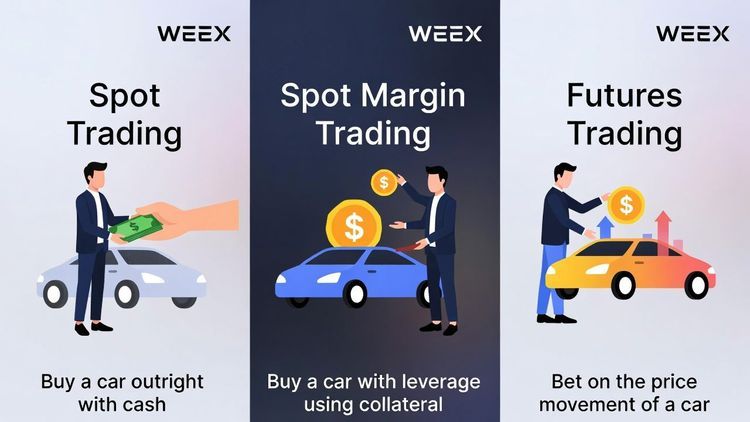
Spot vs Futures vs Margin Trading: Key Differences Every Crypto Beginner Should Know
For anyone entering the world of cryptocurrency, one of the first questions that appears is simple but confusing: what is the difference between spot trading, spot margin trading, and futures trading?
If you have ever opened a crypto exchange and seen buttons labeled Spot, Margin, or Futures, you probably wondered whether they are just different names for the same thing. In reality, they represent three very different ways of participating in the crypto market.
Understanding the difference between spot trading, spot margin trading, and futures trading is essential because each method changes how you manage risk, how much capital you need, and how you profit from market movements.
Think of it like transportation. Spot trading is like buying a car outright. Spot margin trading is like buying the car with a loan. Futures trading is more like making a bet on whether car prices will go up or down in the future.
Once you see the market through that lens, the structure becomes much easier to understand.
What Is Spot Trading? The Simplest Way to Buy and Sell CryptoSpot trading is the most straightforward way to buy and sell cryptocurrency. When you participate in spot trading, you purchase a cryptocurrency and own the asset immediately.
If you buy Bitcoin through spot trading, the Bitcoin goes directly into your wallet or exchange account. There are no loans, no leverage, and no expiration dates. What you own is real crypto that you can hold, transfer, or sell whenever you choose.
Because of this simplicity, spot trading is often compared to buying stocks or commodities. You exchange your funds for an asset at the current market price, also known as the spot price.
Imagine buying Bitcoin at $60,000 through spot trading. If the price later rises to $70,000, you can sell the Bitcoin and keep the profit. If the price falls, your asset value decreases, but you still own the Bitcoin itself.
This is why spot trading is widely considered the most beginner-friendly method in the crypto market. There is no borrowing, no liquidation risk, and no complex mechanics behind the trade.
Many newcomers start their journey through spot trading before exploring more advanced instruments.
What Is Spot Margin Trading? A Leveraged Way to Increase Buying PowerWhile spot trading requires you to use only the funds you already own, spot margin trading introduces borrowing.
In spot margin trading, traders can borrow funds from the platform in order to increase their buying power. This borrowed capital allows traders to open larger positions than their current balance would normally allow.
Imagine you have $100 but want to open a $500 trade. With spot margin trading, the platform can lend you the additional funds needed to complete the trade. This creates leverage, meaning your profits and losses become amplified.
If the market moves in your favor, spot margin trading can significantly increase your returns. However, if the market moves against you, the losses also grow faster.
The key difference between spot trading and spot margin trading lies in the use of borrowed funds. When borrowing is involved, the platform requires collateral and charges interest on the borrowed amount.
Because of this, spot margin trading introduces the possibility of liquidation. If the value of your collateral falls below a certain threshold, the system may automatically close your position to repay the borrowed funds.
Despite the additional risk, spot margin trading remains popular among traders who want greater exposure to market movements while still trading directly in the spot market.
What Is Futures Trading? How Traders Profit from Crypto Price MovementsWhile spot trading and spot margin trading involve actual cryptocurrency ownership, futures trading works differently. Instead of buying the asset itself, traders are speculating on the future price of that asset.
In futures trading, you are essentially entering a contract that reflects the price movement of a cryptocurrency such as Bitcoin or Ethereum. The trader does not necessarily own the underlying asset.
One of the biggest advantages of futures trading is the ability to profit whether the market rises or falls. Traders can open a long position if they believe prices will increase or a short position if they believe prices will decrease.
This makes futures trading especially attractive in volatile crypto markets where prices can move dramatically in both directions.
Another defining feature of futures trading is leverage. Futures platforms often allow traders to open positions worth many times their initial capital. For example, with 10× leverage, a $100 margin can control a $1,000 position.
However, leverage also increases risk. If the market moves against the trader, losses can accumulate quickly and may trigger liquidation.
Within futures trading, there are two main contract types: futures contracts with expiration dates and perpetual contracts without expiration.
Traditional futures contracts settle at a predetermined time, while perpetual contracts allow traders to keep positions open indefinitely.
Comparison Between Spot Trading, Spot Margin Trading, and Futures Trading
Spot Trading
Spot Margin Trading
Futures Trading
Futures Contracts
Perpetual Contracts
Market
Spot Market
Spot Market
Futures Market
Perpetual Market
Expiration Date
N/A
N/A
The expiration date ranges from daily to quarterly depending on the contract.
No expiration date, allowing positions to be held indefinitely.
Trading Fee
Spot trading fee
Spot trading fee, interest on borrowed funds, and repayment handling fees if auto-repayment is triggered
Futures trading fee and settlement fee
Perpetual trading fee and funding fee
Leverage
Leverage is not supported. To acquire assets worth 100 USDT, you must have 100 USDT.
Leverage allows traders to borrow funds. For example, with 10× leverage and 10 USDT, a trader can open a position worth 100 USDT.
Leverage allows positions to be opened with smaller capital. For example, a 100 USDT position with 10× leverage requires only 10 USDT as initial margin.
Same leverage mechanics as futures contracts, but without expiration constraints.
Maximum Leverage
N/A
Up to 10×
Typically 25× to 125× depending on the trading pair
Typically 25× to 125× depending on the trading pair
Borrowing
Not supported
Traders borrow funds from the platform and interest is charged hourly
Borrowing may apply depending on account structure
Borrowing conditions may apply depending on account structure
Collateral
Not required
Margin assets act as collateral
Initial margin acts as collateral for opening a position
Initial margin acts as collateral
Source of Profit
Profit comes from asset price appreciation
Profit comes from amplified price movements using borrowed funds
Traders can profit from both rising and falling markets
Traders can profit from both directions with no expiration constraint
Liquidation Risk
No
Yes
Yes
Yes
Which One Should Beginners Use?
For most newcomers entering the cryptocurrency market, spot trading is usually the safest and most intuitive place to start. Because spot trading does not involve borrowing or leverage, traders can focus on understanding price movements and market behavior without the additional pressure of liquidation risk.
After gaining experience with spot trading, some traders begin exploring spot margin trading to increase their exposure to market opportunities. This step requires careful risk management because borrowing introduces additional volatility.
More advanced traders often move toward futures trading, where leverage and the ability to short the market create more complex strategies.
Platforms like WEEX provide a comprehensive trading environment where users can move smoothly between spot trading, spot margin trading, and futures trading depending on their experience level. With professional-grade infrastructure, deep liquidity, and advanced risk-management tools, WEEX has become a trusted platform for both beginners and experienced crypto traders looking to explore different trading strategies in one unified ecosystem.
Final Thoughts: Understanding the Difference Between Spot, Margin, and FuturesThe difference between spot trading, spot margin trading, and futures trading ultimately comes down to ownership, leverage, and risk.
Spot trading focuses on direct ownership of cryptocurrency. Spot margin trading expands that exposure by introducing borrowed funds. Futures trading moves beyond ownership entirely, allowing traders to speculate on price direction through leveraged contracts.
Each method plays an important role in the modern crypto market. For beginners, starting with spot trading builds a strong foundation. As knowledge grows, spot margin trading and futures trading can offer additional flexibility and strategy options.
Understanding these differences not only improves trading decisions but also helps traders navigate the rapidly evolving cryptocurrency ecosystem with greater confidence.
Buy Crypto with BCA on WEEX P2P – 0 Fee & 24/7 IDR Merchants
BCA is widely recognized in Indonesia as a trusted and reliable option for fast and seamless cryptocurrency purchases using IDR. With WEEX P2P, users can buy crypto directly through BCA with zero fees, access 24/7 verified merchants, and enjoy ultra-fast release times.
Compared with Binance, Bybit, and local OTC platforms, WEEX consistently offers better IDR exchange rates, safer escrow protection, and more available ads for BCA users.
As crypto adoption continues to rise in Indonesia, secure and convenient access to digital assets has become increasingly important. With WEEX P2P, users can buy USDT, BTC, or ETH via BCA with instant processing, 0% buyer fees, and professional merchant support.
What is P2P Trading?
Peer-to-Peer (P2P) trading allows users to buy and sell crypto directly with other users, while the platform acts as a secure intermediary.
On WEEX P2P:
Crypto is held in escrowSellers release assets only after payment is confirmedTrades are processed quickly and safelyThis ensures zero counterparty risk and allows users to pay via local banking methods for a seamless experience.
Why WEEX P2P is the Best Choice for BCA Users
WEEX P2P offers key advantages to users purchasing crypto with IDR via BCA:
0% buyer fees:Save 2–8% compared to competing platforms and maximize the value of every tradeFast release times :Funds are typically released within 1–3 minutes, ensuring a smooth and efficient buying experienceOfficial escrow protection:Platform-managed escrow guarantees 100% transaction safetyFlexible trade sizes:Supports everything from small purchases to large-volume transactionsBest IDR exchange rates for BCA users: Enjoy highly competitive pricing tailored for BCA paymentsThousands of merchants online 24/7: Deep liquidity and constant availability at any time of dayMore BCA ads than any competitor: Greater choice, faster matching, and higher deal completion ratesWhether you’re buying 1,000 IDR or 1,000,000 IDR, WEEX ensures fast, safe, and cost-efficient crypto purchases.
How to Buy Crypto with BCA on WEEX P2P
Buying crypto with BCA on WEEX is simple and fast. Follow these steps:
Register on WEEX and complete basic KYC verification Create your WEEX account and finish the basic identity verification process, which typically takes less than one minute to complete.Navigate to Buy Crypto → P2P Trading From the main menu, enter the P2P trading section and select IDR as your preferred fiat currency.Apply the “BCA” filter Enable the BCA payment filter to view only those merchant advertisements that support BCA.Select the most suitable merchant Review and compare available merchants based on key indicators, including:Exchange priceOrder completion rateTotal trading volumeReal-time online statusEnter the amount you wish to purchase Input your desired crypto amount, and the system will automatically calculate and display the exact payable amount in IDR.Complete the payment via BCA Transfer the displayed amount using BCA, following the bank details provided by the selected merchant.Confirm payment and notify the seller Click “Transferred, Notify Seller” after completing the transfer. The seller will then verify your payment and promptly release the cryptocurrency to your WEEX account.Your Crypto will arrive instantly in your WEEX wallet — safe, fast, and with zero fees.
Frequently Asked Questions (FAQ)
Q1: Are there any fees when paying with BCA? A: 0% fee for buyers. Only sellers pay a small fee.
Q2: How fast will I receive Crypto? A: Usually 1–5 minutes after marking payment as sent.
Q3: Is buying with BCA safe on WEEX? A: Yes. All trades use official escrow.
Q4: Do I need full KYC? A: Basic KYC is required for P2P trading.
Ready to Buy Crypto with BCA?
Start buying crypto in under 3 minutes — fast, safe, and 0% fee for buyers!
Start Buying Crypto on WEEX P2P with BCA Now!
Buy USDT with BCA on WEEX P2P – 0 Fee & 24/7 IDR Merchants
BCA is widely recognized in Indonesia as a trusted and reliable option for fast and seamless cryptocurrency purchases using IDR. With WEEX P2P, users can buy USDT directly through BCA with zero fees, access 24/7 verified merchants, and enjoy ultra-fast release times.
Compared with Binance, Bybit, and local OTC platforms, WEEX consistently offers better IDR exchange rates, safer escrow protection, and more available ads for BCA users.
As USDT adoption continues to rise in Indonesia, secure and convenient access to digital assets has become increasingly important. With WEEX P2P, users can buy USDT, BTC, or ETH via BCA with instant processing, 0% buyer fees, and professional merchant support.
What is P2P Trading?
Peer-to-Peer (P2P) trading allows users to buy and sell USDT directly with other users, while the platform acts as a secure intermediary.
On WEEX P2P:
USDT is held in escrowSellers release assets only after payment is confirmedTrades are processed quickly and safelyThis ensures zero counterparty risk and allows users to pay via local banking methods for a seamless experience.
Why WEEX P2P is the Best Choice for BCA Users
WEEX P2P offers key advantages to users purchasing USDT with IDR via BCA:
0% buyer fees:Save 2–8% compared to competing platforms and maximize the value of every tradeFast release times :Funds are typically released within 1–3 minutes, ensuring a smooth and efficient buying experienceOfficial escrow protection:Platform-managed escrow guarantees 100% transaction safetyFlexible trade sizes:Supports everything from small purchases to large-volume transactionsBest IDR exchange rates for BCA users: Enjoy highly competitive pricing tailored for BCA paymentsThousands of merchants online 24/7: Deep liquidity and constant availability at any time of dayMore BCA ads than any competitor: Greater choice, faster matching, and higher deal completion ratesWhether you’re buying 1,000 IDR or 1,000,000 IDR, WEEX ensures fast, safe, and cost-efficient USDT purchases.
How to Buy USDT with BCA on WEEX P2P
Buying USDT with BCA on WEEX is simple and fast. Follow these steps:
Register on WEEX and complete basic KYC verification Create your WEEX account and finish the basic identity verification process, which typically takes less than one minute to complete.Navigate to Buy USDT → P2P Trading From the main menu, enter the P2P trading section and select IDR as your preferred fiat currency.Apply the “BCA” filter Enable the BCA payment filter to view only those merchant advertisements that support BCA.Select the most suitable merchant Review and compare available merchants based on key indicators, including:Exchange priceOrder completion rateTotal trading volumeReal-time online statusEnter the amount you wish to purchase Input your desired USDT amount, and the system will automatically calculate and display the exact payable amount in IDR.Complete the payment via BCA Transfer the displayed amount using BCA, following the bank details provided by the selected merchant.Confirm payment and notify the seller Click “Transferred, Notify Seller” after completing the transfer. The seller will then verify your payment and promptly release the USDTcurrency to your WEEX account.Your USDT will arrive instantly in your WEEX wallet — safe, fast, and with zero fees.
Frequently Asked Questions (FAQ)
Q1: Are there any fees when paying with BCA? A: 0% fee for buyers. Only sellers pay a small fee.
Q2: How fast will I receive USDT? A: Usually 1–5 minutes after marking payment as sent.
Q3: Is buying with BCA safe on WEEX? A: Yes. All trades use official escrow.
Q4: Do I need full KYC? A: Basic KYC is required for P2P trading.
Ready to Buy USDT with BCA?
Start buying USDT in under 3 minutes — fast, safe, and 0% fee for buyers!
Start Buying USDT on WEEX P2P with BCA Now!
Buy BTC with BCA on WEEX P2P – 0 Fee & 24/7 IDR Merchants
BCA is widely recognized in Indonesia as a trusted and reliable option for fast and seamless cryptocurrency purchases using IDR. With WEEX P2P, users can buy BTC directly through BCA with zero fees, access 24/7 verified merchants, and enjoy ultra-fast release times.
Compared with Binance, Bybit, and local OTC platforms, WEEX consistently offers better IDR exchange rates, safer escrow protection, and more available ads for BCA users.
As BTC adoption continues to rise in Indonesia, secure and convenient access to digital assets has become increasingly important. With WEEX P2P, users can buy USDT, BTC, or ETH via BCA with instant processing, 0% buyer fees, and professional merchant support.
What is P2P Trading?
Peer-to-Peer (P2P) trading allows users to buy and sell BTC directly with other users, while the platform acts as a secure intermediary.
On WEEX P2P:
BTC is held in escrowSellers release assets only after payment is confirmedTrades are processed quickly and safelyThis ensures zero counterparty risk and allows users to pay via local banking methods for a seamless experience.
Why WEEX P2P is the Best Choice for BCA Users
WEEX P2P offers key advantages to users purchasing BTC with IDR via BCA:
0% buyer fees:Save 2–8% compared to competing platforms and maximize the value of every tradeFast release times :Funds are typically released within 1–3 minutes, ensuring a smooth and efficient buying experienceOfficial escrow protection:Platform-managed escrow guarantees 100% transaction safetyFlexible trade sizes:Supports everything from small purchases to large-volume transactionsBest IDR exchange rates for BCA users: Enjoy highly competitive pricing tailored for BCA paymentsThousands of merchants online 24/7: Deep liquidity and constant availability at any time of dayMore BCA ads than any competitor: Greater choice, faster matching, and higher deal completion ratesWhether you’re buying 1,000 IDR or 1,000,000 IDR, WEEX ensures fast, safe, and cost-efficient BTC purchases.
How to Buy BTC with BCA on WEEX P2P
Buying BTC with BCA on WEEX is simple and fast. Follow these steps:
Register on WEEX and complete basic KYC verification Create your WEEX account and finish the basic identity verification process, which typically takes less than one minute to complete.Navigate to Buy BTC → P2P Trading From the main menu, enter the P2P trading section and select IDR as your preferred fiat currency.Apply the “BCA” filter Enable the BCA payment filter to view only those merchant advertisements that support BCA.Select the most suitable merchant Review and compare available merchants based on key indicators, including:Exchange priceOrder completion rateTotal trading volumeReal-time online statusEnter the amount you wish to purchase Input your desired BTC amount, and the system will automatically calculate and display the exact payable amount in IDR.Complete the payment via BCA Transfer the displayed amount using BCA, following the bank details provided by the selected merchant.Confirm payment and notify the seller Click “Transferred, Notify Seller” after completing the transfer. The seller will then verify your payment and promptly release the BTCcurrency to your WEEX account.Your BTC will arrive instantly in your WEEX wallet — safe, fast, and with zero fees.
Frequently Asked Questions (FAQ)
Q1: Are there any fees when paying with BCA? A: 0% fee for buyers. Only sellers pay a small fee.
Q2: How fast will I receive BTC? A: Usually 1–5 minutes after marking payment as sent.
Q3: Is buying with BCA safe on WEEX? A: Yes. All trades use official escrow.
Q4: Do I need full KYC? A: Basic KYC is required for P2P trading.
Ready to Buy BTC with BCA?
Start buying BTC in under 3 minutes — fast, safe, and 0% fee for buyers!
Start Buying BTC on WEEX P2P with BCA Now!
Do You Pay Tax on Crypto? Trading, Staking and Airdrops Explained
TL;DR
Do you pay tax on crypto without selling? Yes, in most cases, you owe crypto tax even if you don’t cash out.Do you pay tax on crypto trading? Yes. Buying, selling, or swapping crypto (ETH to BTC) can trigger capital gains tax.How is crypto trading taxed? Profits are usually taxed as capital gains, but frequent trading or futures trading may be treated as business income.Is staking taxable? Yes. Crypto staking rewards are taxed as income when received, and taxed again as capital gains when sold.Are crypto airdrops taxable? Yes. Airdrops are taxable income at the time you receive them, even if you don’t sell.When do you owe crypto taxes? When you trade, earn, or receive crypto — not just when you withdraw to fiat.What are common crypto tax mistakes? Not tracking trades, ignoring staking rewards, and assuming no tax without withdrawal.How to report crypto taxes easily? Export your data from WEEX and use crypto tax software like KoinX to generate reports.Most crypto users assume one thing: If you haven't withdrawn your funds, you don't owe any tax.
It sounds logical , but in most cases, it's wrong.
As crypto markets evolve, tax rules have become clearer and stricter. What matters is not whether you cash out, but how you interact with your assets. Trading, earning, or even receiving tokens can all trigger taxable events, often without you realizing it.
So when exactly do you pay tax on crypto? The answer depends on what you do.
Do You Pay Tax on Crypto Trading? Even Without Cashing OutThe most common misconception is that taxes only apply when you convert crypto into fiat.
In reality, tax authorities in many countries treat any disposal of crypto as a taxable event. This includes not only selling for cash, but also swapping one asset for another.
If you trade ETH for BTC, you may still need to calculate your gain — even though no money ever leaves the crypto ecosystem.
What matters is whether you realized a profit.
If the value of your asset increased between the time you acquired it and the time you traded or sold it, that difference is typically taxed as a gain. Losses may also be recognized, depending on local rules.
For active traders, especially those using futures or trading frequently, things can become more complex. In some cases, trading activity may even be treated as business income rather than capital gains, which can significantly change how it is taxed.
Is Staking Taxable? When and How Rewards Are TaxedStaking is often described as passive income, but from a tax perspective, it’s rarely that simple.
In most jurisdictions, staking rewards are treated as income at the moment you receive them, based on their market value at that time.
This means you may owe tax even if you never sell your rewards.
And that’s only the first layer.
If you later sell those tokens at a higher price, the additional profit is taxed again — this time as a capital gain.
This dual structure — income first, gains later — is one of the most commonly misunderstood aspects of crypto taxation, and a frequent source of reporting errors.
Are Crypto Airdrops Taxable? What Counts as IncomeAirdrops feel like free money. From a tax perspective, they usually aren’t.
In many cases, airdropped tokens are treated as income once you have control over them and they have a measurable market value.
That means the moment you can claim or access the tokens, their value may already be taxable — regardless of whether you sell them.
If you later sell at a higher price, the difference is taxed again as a gain.
Like staking, airdrops often create two separate tax events:
one when you receive the tokens, and another when you dispose of them.
Crypto Tax Mistakes That Can Cost You MoneyThe rules themselves are not always complicated — but applying them correctly can be.
Many users assume that staying within crypto avoids tax, overlook income from staking or airdrops, or fail to track the original cost of their assets across multiple trades.
As activity increases, especially across different assets and strategies, keeping accurate records becomes significantly harder. Without proper tracking, it’s easy to either underreport — or overpay.
When Do You Actually Owe Crypto Taxes? Key TakeawaysCrypto taxation is not just about how much you earn. It’s about when and how those earnings are realized.
Trading, staking, and airdrops are taxed in different ways, often at different points in time. And in many cases, tax obligations arise long before any funds are withdrawn.
The key takeaway is simple:
If you are actively participating in the crypto market, you are very likely generating taxable events — whether you notice them or not.
Understanding this early makes it easier to stay compliant, avoid costly mistakes, and make better decisions as your trading activity grows.
How to Report Crypto Taxes on WEEX: A Simple Step-by-Step GuideUnderstanding how crypto is taxed is only half the process — reporting it correctly is where it gets more complex.
As your activity grows, especially across trading, staking, and rewards, keeping track of every transaction manually can quickly become overwhelming. Using a platform where your trading history is organized and easily exportable can make a meaningful difference when it comes to filing.
For a step-by-step guide on how to track and report your crypto taxes, read the full tutorial here:
WEEX Crypto Tax Guide: How to Export Trading Data and Generate a Tax Report with KoinX
About WEEXFounded in 2018, WEEX has developed into a global crypto exchange with over 6.2 million users across more than 150 countries. The platform emphasizes security, liquidity, and usability, providing over 1,200 spot trading pairs and offering up to 400x leverage in crypto futures trading. In addition to the traditional spot and derivatives markets, WEEX is expanding rapidly in the AI era — delivering real-time AI news, empowering users with AI trading tools, and exploring innovative trade-to-earn models that make intelligent trading more accessible to everyone. Its 1,000 BTC Protection Fund further strengthens asset safety and transparency, while features such as copy trading and advanced trading tools allow users to follow professional traders and experience a more efficient, intelligent trading journey.
Follow WEEX on social media:
· Instagram: @WEEX Exchange
· X: @WEEX_Official
· Tiktok: @weex_global
· Youtube: @WEEX_Global
· Discord: WEEX Community
· Telegram: WeexGlobal Group
How to Withdraw Funds from WEEX on Mobile Device: Complete Guide for Beginners
Withdrawing your assets securely and efficiently is essential for every crypto trader. Whether you're cashing out profits after a successful trade or moving funds to an external wallet for long-term storage, knowing how to withdraw funds from WEEX is a fundamental skill.
This step-by-step guide will walk you through how to complete a withdrawal on the WEEX exchange—from logging into your account to confirming the transaction. Learn the process, avoid common mistakes, and manage your crypto with confidence using WEEX's user-friendly platform.
Step-by-Step Guide: How to Withdraw Funds from WEEXStep 1: Log Into Your WEEX AccountGo to WEEX offcial website and Install the WEEX appSelect the Login optionEnter your login information and verify your accountStep 2: Navigate to the Withdrawal SectionOnce logged in:
On the WEEX homepage, navigate to your Spot Account (where your funds are held)Click the Withdraw button in the menu to start the processAlternatively, go to the Wallet section and choose Withdraw or Withdraw FundsStep 3: Select the Token to WithdrawWEEX supports a broad range of tokens, including:
BTC (Bitcoin)ETH (Ethereum)USDT (Tether)WXT (WEEX Token)And many other cryptocurrenciesIn the Withdraw section:
Select the cryptocurrency or token you want to withdraw (e.g., BTC, ETH, USDT)Verify that your Spot Account has sufficient balance for the desired withdrawal amountStep 4: Enter Withdrawal DetailsAfter selecting your token, enter the transaction details carefully:
Withdrawal Address:
Input the destination address for your tokensDouble-check every character—crypto transactions are irreversibleEnsure the receiving wallet supports the chosen tokenNetwork Selection:
For USDT, select the correct network (e.g., TRC-20, ERC-20, BEP-20)Using the wrong network can result in permanent loss of fundsMatch the network to your destination wallet's capabilitiesAmount:
Enter the number of tokens you want to withdrawNote that some tokens have minimum withdrawal limitsNetwork fees will be deducted from your totalStep 5: Review and SubmitBefore finalizing:
Carefully review the withdrawal address, network, and amountCheck the handling fee displayedIf everything is correct, click Withdraw or Confirm to proceedComplete any additional security verification (2FA, email confirmation)Step 6: Track Your Withdrawal StatusAfter submitting:
Visit the Withdrawal History section in your WEEX accountCheck whether the transaction is Pending or CompletedWithdrawal times vary by network and congestion:USDT on TRC-20: usually minutesBTC and ETH: may take longer depending on network activityStep 7: Verify Funds in Your Destination WalletOnce the transaction is confirmed on the blockchain:
Check your receiving wallet to confirm the funds arrivedIf tokens don't appear immediately, allow time for network confirmationsFor delays, you can track the transaction using a blockchain explorerIf you still have questions about the withdrawal process, check out the tutorial video below to help you safely withdraw your assets.
Why Choose WEEX for Your Crypto Trading?WEEX offers numerous advantages for crypto traders, starting with zero fees on many transactions—features like the We-Launch event allow users to deposit and earn rewards without any transaction costs. The platform also provides access to promising projects through events where you can commit WXT tokens and earn airdrop rewards from high-quality crypto initiatives.
With a wide range of supported cryptocurrencies, WEEX makes it easy to build and diversify your portfolio. Above all, every deposit and withdrawal is processed with the highest level of security, including cold storage for most funds and regular security audits, giving you complete peace of mind.
FAQQ1: How long does a WEEX withdrawal take?Withdrawal times vary by cryptocurrency and network activity. USDT on TRC-20 typically takes minutes, while BTC and ETH may take 10-60 minutes depending on network congestion.
Q2: Are there withdrawal fees on WEEX?WEEX does not charge its own withdrawal fees, but blockchain network fees apply. These fees go to miners/validators, not to WEEX.
Q3: Can I Cancel a Withdrawal?Once confirmed, withdrawals cannot be canceled. Always verify details before submitting.
Q4: Can I cancel a withdrawal after submitting?No. Once a withdrawal is confirmed and submitted to the blockchain, it cannot be canceled. Always verify details before confirming.
With OpenClaw taking the world by storm, what can the Agentic economy bring to Web3?
Goodbye Agent, hello OpenClaw
“It is now the largest, most popular and most successful open-source project in human history. This is definitely the next ChatGPT.”
This isn’t the wild claim of some tech enthusiast, but rather NVIDIA CEO Jensen Huang’s assessment of OpenClaw in an interview this Tuesday.
This open-source AI agent, released by a former Apple developer, saw its GitHub stars skyrocket to 320,000 within three months, surpassing Linux and React. Because its logo bears a striking resemblance to a lobster, the Chinese community has dubbed it ‘龙虾’, referring to lobster in Chinese.
However, the viral success of OpenClaw is not merely another AI tool craze, but rather the prelude to the agentic economy—a pivotal turning point where AI evolves from ‘talking’ to ‘doing’.
From chatbots to digital employees: this time it’s different
Over the past two years, the term “AI agent” has been bandied about repeatedly, yet it remained confined to presentation slides. It wasn’t until the emergence of OpenClaw that this impasse was truly broken.
Its core distinction lies in execution rather than conversation.
Traditional products like ChatGPT and Claude are, at their core, tools for answering questions—you ask, it answers, and the next step is still up to you. The new generation of agents represented by OpenClaw operates on a completely different logic: OpenClaw is authorised to take control of the operating system, autonomously invoking browsers, code executors, APIs, iMessage and more, planning, executing and adjusting its course of action independently until the task is completed.
Of course, this fully managed approach carries inherent risks, but that is a story for another time.
Many have likened this moment to the ChatGPT moment of 2022, but I believe a more accurate analogy might be that distant afternoon years ago when Steve Jobs unveiled the iPhone.
Innovation shows no signs of stopping; OpenClaw’s official skills marketplace, ClawHub, currently offers over 27,000 skills for various AI agents to access free of charge—meaning these digital employees are capable of handling an ever-increasing range of tasks.
Looking further ahead, OpenClaw’s popularity is not merely a repeat of past AI tool fads, but rather the prelude to the agentic Economy, for which Web3 is the natural breeding ground.
Why is Web3 the most natural economic vehicle for AI agents?
On the surface, this OpenClaw appears to be merely a slightly intelligent executor: automatically checking emails, booking tickets, managing files, and even posting across platforms. But dig deeper, and it is precisely the true catalyst for the agentic economy—and Web3 is the most suitable ‘ocean’ for this lobster once it has crawled ashore.
Moreover, the integration of blockchain and the OpenClaw possesses inherent advantages that amplify its impact:
The x402 protocol enables agents to autonomously pay fees and switch AI model providers using a single wallet, without the need for manual review;The ERC-8004 protocol grants agents a portable reputation system and legal identity;Clawpay, ClawCredit and ClawRouter facilitate private payments, native credit and autonomous routing;Stablecoins (USDT/USDC) serve as the agent’s 24/7 bank, perfectly aligning with code-driven settlement requirements.In summary, the automatic execution of smart contracts, permissionless on-chain interactions, and the instant global settlement enabled by stablecoins—these characteristics can significantly address the bottlenecks faced by traditional AI agents in areas such as payment closed-loop systems, identity and reputation, and contract execution.
Further innovative use cases are on the horizon:
Circle’s open-source Circle Skills already enable AI agents to directly generate USDC payments, cross-chain transfers and smart contract logic;MistTrack Skills from SlowMist provide agents with on-chain AML risk analysis capabilities, automatically performing security checks prior to transfers;RootData, meanwhile, has packaged databases of thousands of crypto projects, funding data, token economics and social engagement metrics into Skills, boosting content creation efficiency tenfold.We therefore have every reason to believe that OpenClaw’s explosive popularity is merely the beginning; once integrated into Web3, the Agentic economy will unleash astonishing potential.
The Agentic concept project at the forefront of the trend
KITE
KiteAI is a PoAI L1 blockchain dedicated to agents, working in close synergy with the OpenClaw ecosystem: it supports OpenClaw developer activities and enables agents to independently pay for computing resources and API calls.
Currently, KiteAI has joined the Agentic AI Foundation, in partnership with OpenAI, Google and others, and serves as a key piece of infrastructure for the agentic economy
PIEVERSE
The on-chain payment protocol Pieverse recently launched Purr-Fect Claw, transforming OpenClaw into a fully on-chain tool. Users can now deploy agents directly within Web2 applications such as Line, Kakao and WhatsApp, enabling gasless on-chain transactions and operations.
GPS
GoPlus Security has launched SafuSkill—a security-first Skills marketplace built on the BNB Chain, integrating a skills marketplace, an automated security scanning engine and developer tools to help users filter for secure AI agent skills.
Lobster
This is not an AI agent, but rather a Chinese meme coin originated from OpenClaw. Like many similarly named meme coins that capitalise on trending events, ‘Lobster’ has also been hyped due to OpenClaw’s viral popularity.
CLAWD
‘clawd.atg.eth’ is a self-hosted personal AI assistant deployed by Ethereum developer Austin Griffith based on the open-source clawd.bot. The agent can independently write, test and deploy dApps to the Ethereum/Base mainnet, and has already produced over 14 production-grade applications, such as the ClawFomo game, PFP prediction markets and the Incinerator burning mechanism.
KELLYCLAUDE
KellyClaude is a personal AI executive assistant created by Austen Allred. Running on the Claude model, it can proactively manage tasks such as schedules, emails and travel, and actively shares experiences within agent communities such as Moltbook.
CLUDE
Clude.io, meanwhile, focuses on an independent memory layer, separating memory from the model to achieve a persistent, private, and cross-model portable brain-like system, perfectly addressing the pain points of memory and privacy sovereignty for agents.
Last but not least
In 2023, the arrival of ChatGPT ignited the AI data sector, represented by Fetch.ai (FET), SingularityNET (AGIX) and Ocean Protocol (OCEAN), as well as the early AI+DePIN sector, represented by Render (RNDR), Akash (AKT) and io (IO);
By the end of 2024, TURBO, GOAT and Fartcoin triggered an AI meme frenzy, shifting AI’s focus from utility to culture and speculation;
In 2025, the market’s focus shifted to AI agents as economic entities, with projects such as Bittensor (TAO) and The Graph (GMT) pivoting towards supporting data queries and autonomous transactions for AI agents, whilst projects like SkyAI emphasised multi-agent collaboration;
Now, OpenClaw is taking the next step in enabling s to truly carry out 24/7 trading, collaboration and entrepreneurship, thereby fuelling massive on-chain traffic and new DeFi narratives. This marks our transition into the agentic era.
The lobster has been launched, and the vast ocean of Web3 awaits it.
Are you ready for the new generation?


 App
App