
- Buy Crypto
- Markets
 Futures
- Spot
- Copy Trade
 Earn
Earn- More
2024 & 2025, BTC's last mega cycle - BTC's value and price theory

Original title: "2024 & 2025, the last mega cycle of BTC - the value and price of BTC"
Original source: Long Ye @x Element
Abstract of this article
At the moment of writing this article, 2024Q4 is the beginning of a new round of bull market in the cryptocurrency circle. In the macro field, the value of BTC is analogous to bonds and stocks in financial history, and is the "fuel" for the new round of development of human technology; in the meso field, it is the currency and index of the digital world that humans will inevitably enter in the future; in the micro field, it is the implementation of a new round of legal supervision, the compliance of currency issuance, and thus siphoning private investment demand around the world. This may be the last "grassroots" cycle belonging to the crypto industry, and it is also the last mega cycle in which BTC has a huge beta increase. This means that after this cycle, BTC's beta will be greatly reduced, but it does not mean that there will be no 100-fold alpha opportunities in the broad token issuance market. The top of this round of BTC bull market will appear in Q4 2025, with a high point of 160,000-220,000 US dollars. Before that, in addition to the "first wave" that has already occurred, there are two more significant bull market mid-term trends. Now is 1999 in the Internet era, that is to say, after the bull market reaches its peak in the next 12-18 months, the crypto industry will usher in a long winter like the bursting of the Internet bubble in 2000-2001. Of course, this is also an opportunity for the industry to reshuffle and reorganize. I am looking forward to it.
When I feel the bull market is coming, it is the time when the article output is the highest.
About 4 years ago, at the beginning of the last bull market, I wrote 《2021 How should we invest in digital currencies?"》. When we talk about the entire digital currency industry, it is inevitable to mention the value and price of BTC first.
If you already believe in the value of Bitcoin, you might as well jump directly to the fifth part, which is the expectation of Bitcoin's future price trend.
壹
From the perspective of industry, I would like to discuss the value of BTC from three levels: macro, meso and micro. From a macro perspective, BTC represents the risk aversion expectations of the entire financial market of mankind, and the third "financial medium" that can be capitalized after bonds and stocks in human history; from a meso perspective, BTC is the "digital age" that humans will inevitably enter in the future, that is, the "index" with the best output value in the web3 world; from a micro perspective, BTC is gradually improving in terms of compliance supervision, and will attract a large amount of "traditional old money" in mainstream countries such as the United States. In third world countries, it siphons off the unmet private investment needs of the local area.
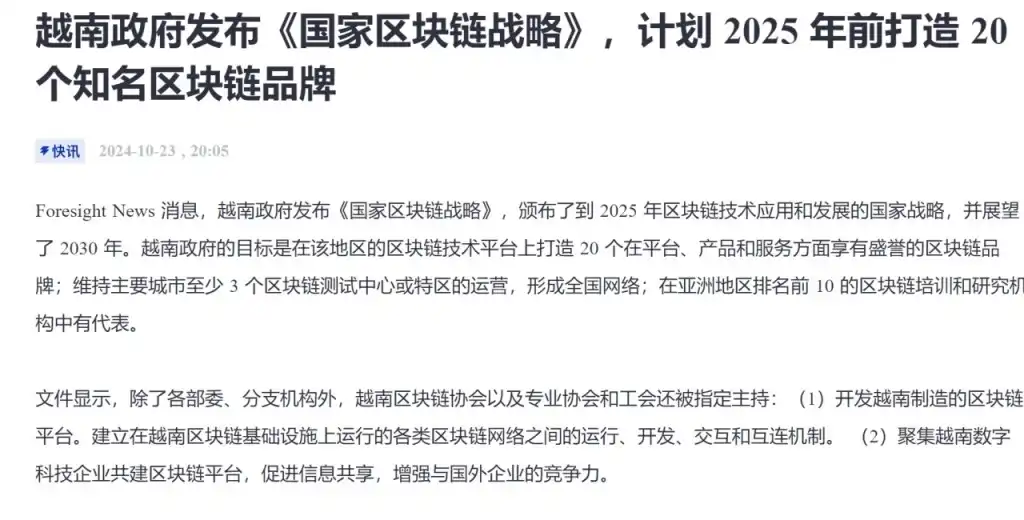
At the macro level, we regard Bitcoin as an epoch-making asset in the history of human finance, so the most important thing is to understand the changes in financial history. In "How should we invest in digital currency in 2021?" Part 1 of the Four Parts", the status of digital currency is corrected from the perspective of scientific and technological history. Behind every technological revolution, there are important financial infrastructures and brand-new financial "mediums".
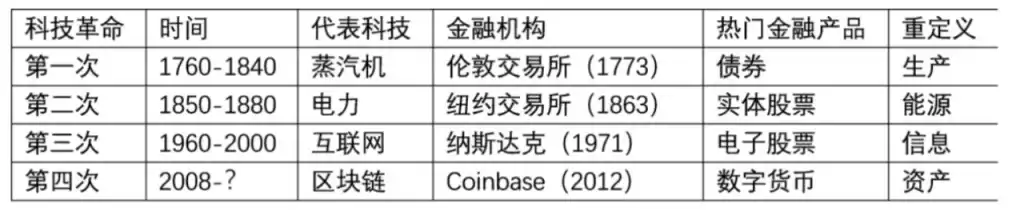
Behind finance is the change of the times. Standing at the present moment, it may be the most confusing moment of the global political and economic situation in the past thirty years, and it is also the moment when the traditional financial order is the most fragile and most likely to undergo a major reshuffle. Now I can no longer trace whether there were financial venues similar to the London Stock Exchange and the New York Stock Exchange when the famous financial bubbles such as the "Dutch tulips" appeared hundreds of years ago, or whether the Dutch vendors were accustomed to offline transactions, but only hyped but did not establish rules and order, so that this bubble finally turned into a bubble. However, in the long river of history, every technological innovation that has been remembered by mankind has a change in the financial paradigm behind it, and the change in the financial paradigm is the inevitable product of the change of the times. These are mutually causal, but also complement each other, and finally wrote a bold and colorful stroke in human history. I also have no way of predicting whether the Second Industrial Revolution would have started in Britain but eventually flourished in the United States and become a milestone if the Civil War had not brought about a dramatic change in the American social structure, reshaping the social class and thus encouraging technological innovation to enter industry.
At the same time, I have a more radical point of view: when everyone is talking about the economic downturn and how to find a viable business model, why does business itself need a business model? Has the word "business model" lost its meaning?
Here are more of my thoughts, which are a bit complicated. I will not repeat them here. I will expand them as the most important part in my future article "The Four Parts of Crypto Capital Theory: Extra - Philosophical Talks on Business and Investment". (Related reading: "The Four Parts of Crypto Capital Theory: Token Issuance, a New Paradigm of Financing")
【Excerpt: In the contemporary business and financial environment, the context behind the discussion of business models refers to the general path developed by the mainstream business entities with "corporate system" in the past 100 years: by expanding the market scale, increasing the number of employees, and finally going public, the whole system of stock pricing in the form of profit*PE. This path may not be established in the future.
Of the value of today's "social capital" (or "private economy"), equity companies may account for 95%, and listed companies with stocks as value anchors account for most of the capital value. But in the future, these values may exist more in "business" (why not limited partnership) and "token" (foundation). 】
贰
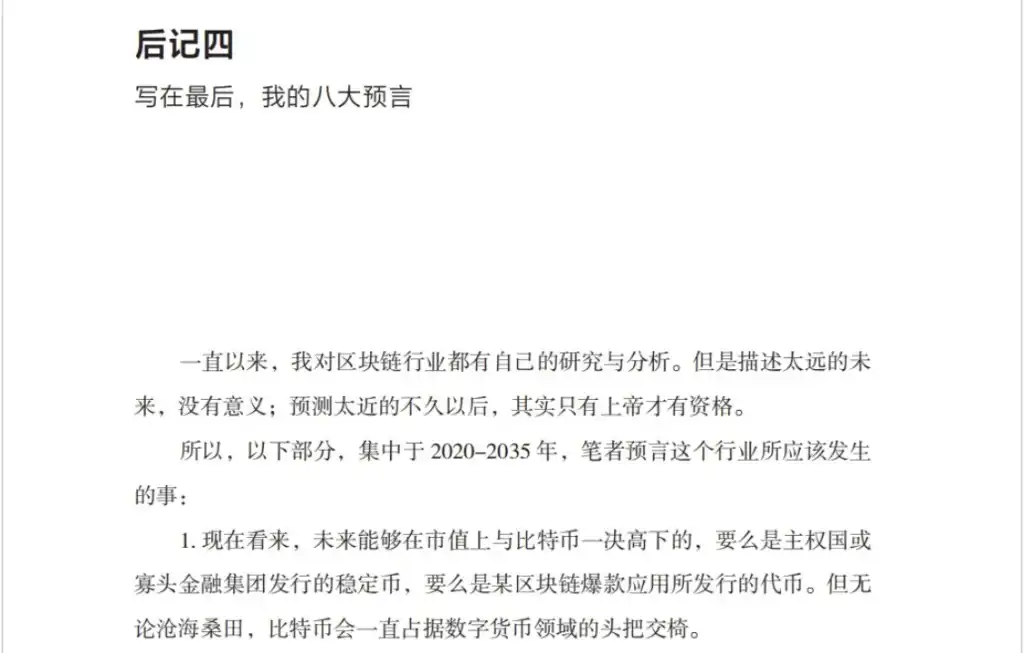
Spend more time talking about BTC's industry perspective. At the end of the book I wrote in 2021, the first of the eight predictions mentioned that BTC is unbeatable. Refer to the electronic version of my book "Unlocking the New Password - From Blockchain to Digital Currency" Postscript 4 –
From the perspective of the technology industry, web3 is an inevitable trend in the future, and Bitcoin is the core asset of the entire web3 world, or in economics, it should be called "currency". In the ancient times of barter, gold was the most common "currency". After the development of modern national systems and financial systems, national currencies are the most common "currency". In the future, with the advent of the digital age, in the virtual space of the metaverse, all life in the digital world will require a new "currency".
Therefore, it is meaningless for some people to keep harping on "how come you are investing in a token". Blockchain and crypto need "+", just like when someone asks you what track to invest in, you say "I want to invest in equity companies" or "I want to invest in an Internet company". Web3, as a special industry, and crypto, as a new market means and financial medium, are gradually combining with other industries - blockchain + AI = DeAI, blockchain + finance = Defi, blockchain + entertainment/art = NFT + metaverse, blockchain + scientific research = Desci, blockchain + physical infrastructure = Depin...
The trend is clear, but what does it have to do with us? In other words, how can we gain wealth appreciation after seeing the trend clearly?
Then let's turn our attention to AI.
The main theme of the commercial society in recent years is one in the open and one in the dark. AI is undoubtedly a hot topic that capital has been pursuing and can be put on the table. Crypto is where all kinds of legends and myths of getting rich quickly gather, but it is also a place with many restrictions that makes it out of reach for many people.
The potential of the AI market is indeed widely believed to be at the trillion level, especially in the fields of generative AI, AI chips, and related infrastructure. However, for investors, everyone believes that AI is a sunrise industry and is willing to invest their money in it, but what to invest in? Can you invest in AI ETF index funds now to fully cover the AI ecosystem to effectively track industry growth?
No. Nvidia's stock price rose nearly 3 times in 2024, while the performance of most AI-themed ETFs in the same period was mediocre. And looking further ahead, Nvidia's stock price performance will not be positively correlated with the overall growth of AI output value-chip companies will never be the only Nvidia.
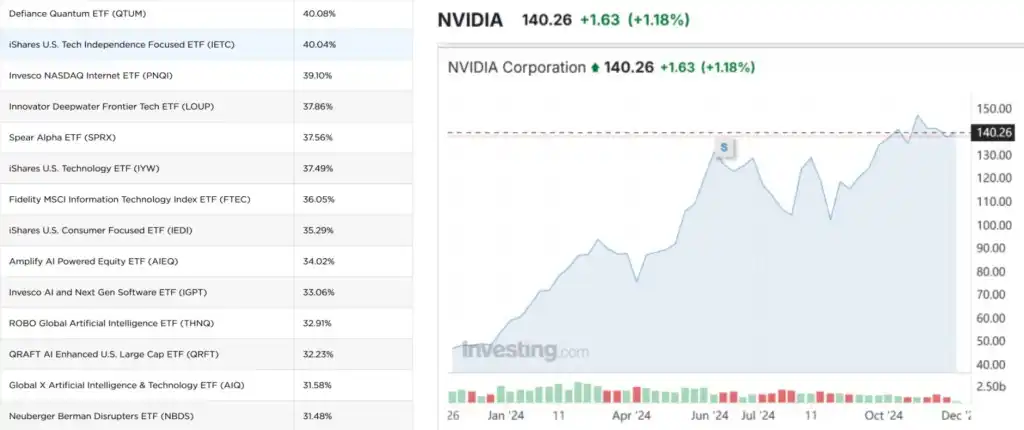
Comparison of mainstream AI ETFs and Nvidia stock performance in 2024
AI is the main theme, but will there be a product that can anchor the future market value development of the AI industry? Will the value of this ETF increase as the output value of the entire AI industry increases? Just like the Dow Jones Index/S&P 500 ETF represents the development of Web0 (equity companies), the Nasdaq ETF represents Web1, and the investment opportunities of web2 are not presented in an indexed way. The most suitable index for the Web3 world, or the value of the entire digital world of mankind in the future, is BTC.
Why must the value of the Web3 world be measured by BTC?
Because, since the birth of computers and the Internet, humans are destined to spend more and more time in the virtual world rather than the real world. In the future, we can wear VR/AR glasses and go to Yellowstone Park at home, return to the Tang Dynasty in China to experience the palace, enter the virtual conference room you set up and drink coffee face to face with friends on the other side of the earth... The boundary between reality and virtuality will become more and more blurred. This is what the future digital world, or metaverse, will look like. And there, if you want to decorate the virtual space, and if you want the digital people there to dance for you, you always need to pay - this cannot be US dollars, RMB, or even physical assets. The most suitable and the only thing I can think of that can be accepted by the entire digital world is Bitcoin.
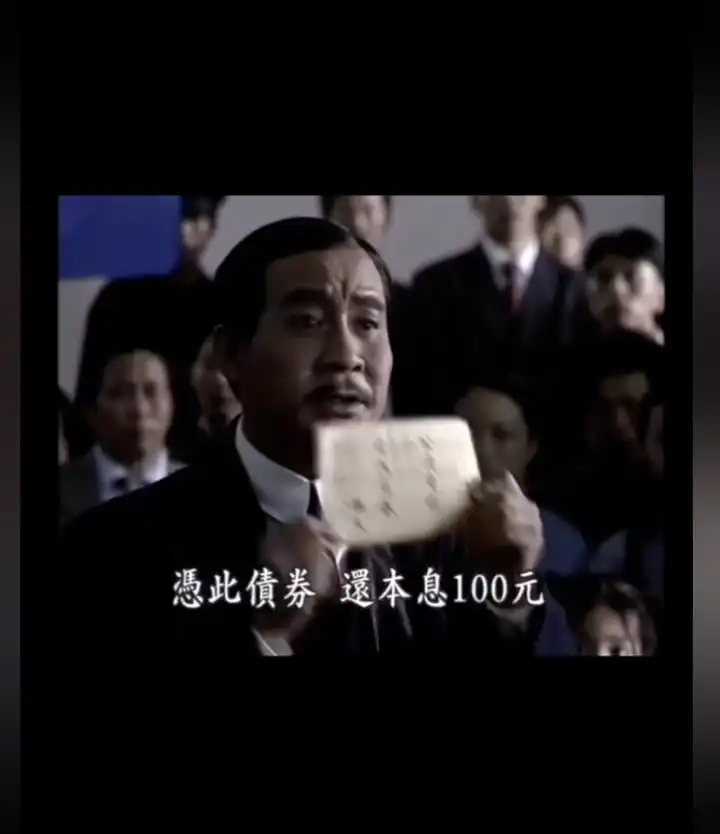
I remember in the movie "The Revolution of 1911", Mr. Sun Yat-sen held up a 10-yuan bond: "When the revolution succeeds, this bond can be exchanged for 100 yuan."
三
Back to the present.
We live in a country with a stable economy, and legal tender can be trusted. But this is far from saying that the world's financial system is as stable as the society we live in: the first thing the new president of Argentina did when he took office was to announce the abolition of Argentina's legal tender system-anyway, no one in Argentina trusts the government-issued legal tender, so why bother. Turkey's inflation rate in 2023 reached +127%, and correspondingly, its citizens' digital currency ownership rate was as high as 52%. Especially in third world countries, in the process of gradual improvement of information technology infrastructure in recent years, its traditional legal tender mobile terminal payment and digital currency payment methods have developed almost simultaneously. In contrast, just like around 2010, when China's information technology was booming, it skipped the 1.0 era of POS and bank card payment and directly entered the 2.0 era of mobile payment. Third world countries have begun to develop in recent years, and digital currency payment in the 3.0 era has directly replaced the mobile payment method in the 2.0 era, making digital currency payment a common scene in daily payment.
Here is an interesting debate. Bitcoin has no controller. If it is used as a currency or "currency", it cannot realize the government's macro-control function of legal currency. In fact, the US dollar is also issued by enterprises, so the so-called government macro-control must give way to the interest groups behind it, and capital power is the driving force of the world. If you must say that legal currency has macro-control, then the interest groups of Bitcoin mining are the biggest regulators.
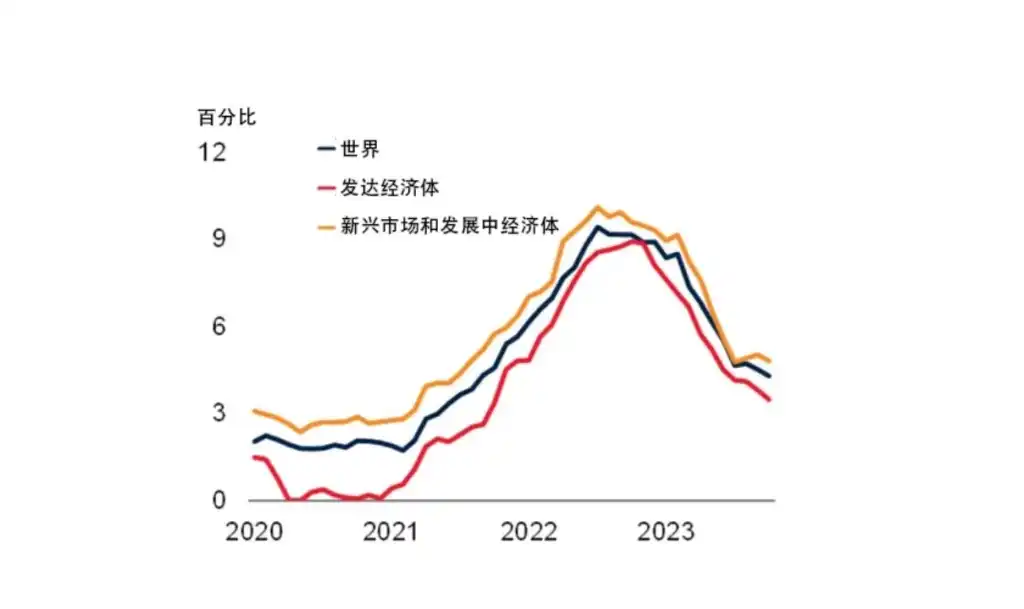
Changes in inflation rates of major economies in recent years
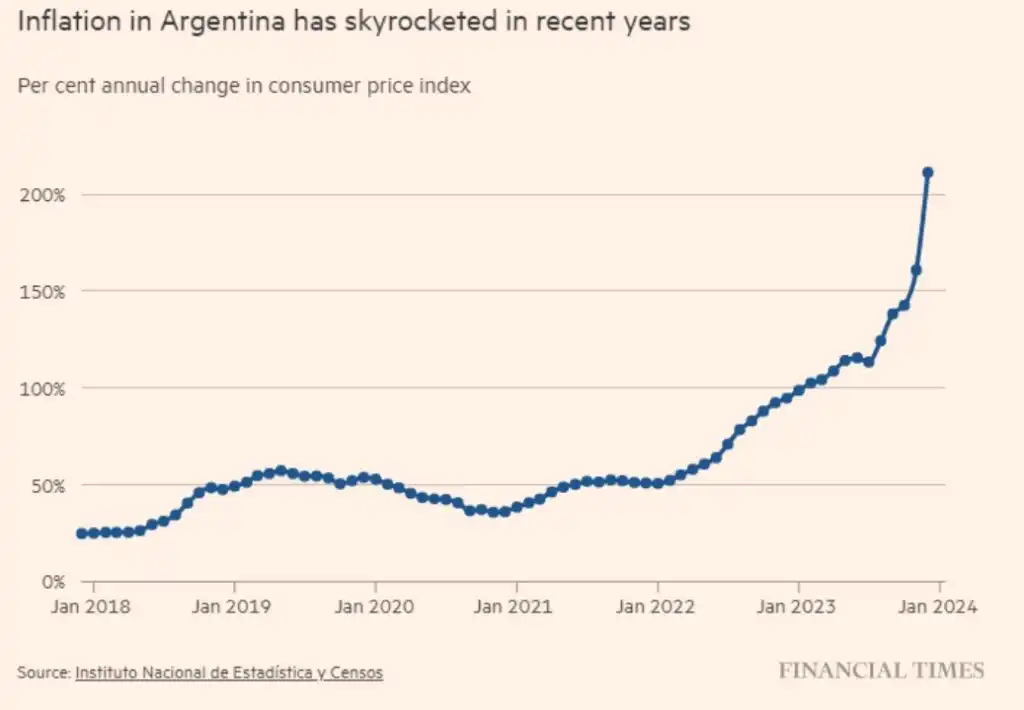
Changes in inflation rates in Argentina in recent years
From a micro perspective, as the speed of capital flow accelerates, the technology and financial cycles are becoming shorter and shorter. In an environment with weak economic anti-fragility, the traditional equity market requires an 8-10 year lock-up period. This long-term investment feature causes many people to worry about liquidity issues. Currency rights provide the possibility of early cashing out, which can not only attract more retail funds to enter, but also provide early investors with more flexible exit expectations.
In the traditional equity market, angel round or early investors usually seek to partially exit through equity transfer or corporate repurchase about 5 years after the establishment of the company, that is, when the company has entered a relatively mature development stage but is still some time away from IPO or acquisition (usually 8-10 years). This model can effectively alleviate the time cost of investment, but its liquidity is obviously more limited compared with currency rights.
The appeal of the currency-right model is that it allows early investors to realize capital recovery earlier through the issuance or circulation of tokens, while attracting a wider range of market participants. This flexibility may have a profound impact on the pattern of the traditional equity market. In this regard, you can refer to "Crypto Capital Theory Four Parts 2 (Part 2): A Battlefield Without Gunsmoke - VC or Token Fund? ".
On the other hand, the financial markets of most sovereign countries in the world are extremely fragmented and lack liquidity, and the inherent global financial characteristics of crypto have greatly attracted this batch of funds, including South Korea, Argentina, Russia, etc. The stock market development of some Southeast Asian countries, mainly Vietnam, cannot keep up with the speed of wealth accumulation of the middle class, and it has made these emerging classes skip the stage of local financial markets and complete the transition to crypto in terms of participation in the financial market. In the context of global digital currency compliance and integration with mainstream financial markets, the investment demand for private assets in these countries cannot be met by the weak local financial infrastructure - there are more than 2,500 listed companies in the Korean stock market (KOSPI) and the start-up market (KOSDAQ), but 80% of the companies have a market value of less than US$100 million, and the daily trading volume is negligible. The digital currency market, which has attracted global retail funds, has the most sufficient liquidity and has become the best target for them to participate in investment.
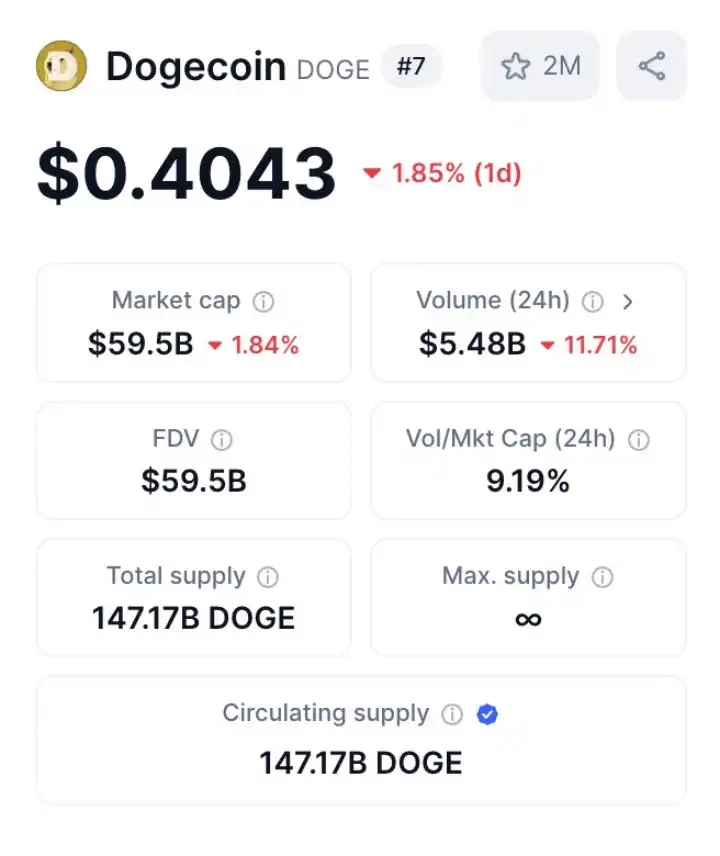
Doge current market value and trading volume
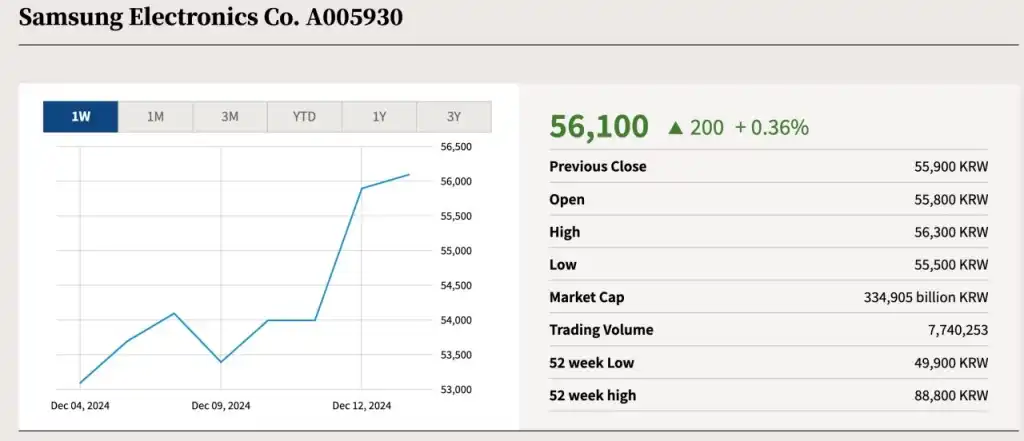
Samsung current market value and trading volume
Note: As can be seen from the figure, Doge's current market value is about 60B US dollars, and Samsung's market value is about 234B US dollars, which is about 4 times that of Doge. However, the 24h trading volume of Doge has reached 5.5B, which is tens of thousands of times that of Samsung.
In the strategic location of the global digital currency market, the United States, in 2025 is likely to usher in a new cryptocurrency legal system reform. The two most important bills, FIT21 and DAMS, will affect the future fate of the currency circle. The core of these two blockchain bills, which are regulated by the Commodity Futures Trading Commission (CFTC) rather than the Securities and Exchange Commission (SEC), is to treat token issuance (coin issuance) as commodity trading rather than securities issuance, and thus be managed by the CFTC. Considering that these two bills were proposed by the Republicans and the current SEC Chairman Gary Gensler represents the Democratic position, the bills face great resistance. However, with Trump re-elected as president, the possibility of the bill passing has increased significantly because the Republicans have the dominant power.
To explain this bill, in layman's terms, the issuance of coins is treated as a commodity and is regulated by the CFTC to be legalized, which can greatly promote the enthusiasm for coin issuance financing. Enterprises can raise funds through coin issuance legally and compliantly, attracting more capital to flow into the currency circle. In addition, with a stable channel for long-term compliant development, more people will continue to work in this industry after making money for a long time. Most importantly, after the United States took the lead in introducing this bill, it will officially open up the global digital currency financial market, blockchain technology market, and competition between countries. "Grabbing projects" and "grabbing talents" may happen further in the future in the completely globalized and free-flowing currency circle. If the US policy is more friendly, even if the issuance of coins is no longer a gray industry but a more prestigious financial innovation, the founders who live in Singapore, Switzerland and other relatively crypto-friendly countries will soon have a large migration.
Four
Looking back to 2016, when the types of crypto in the world could be counted on one's fingers, BTC was like a game coin, and RMB could be used to directly enter the exchange for "recharge and purchase", we, the natives of the token circle, hoped for the future. (For details, please refer to the end of "How should we invest in digital currency in 2021?" Part 1 of the Four Parts")
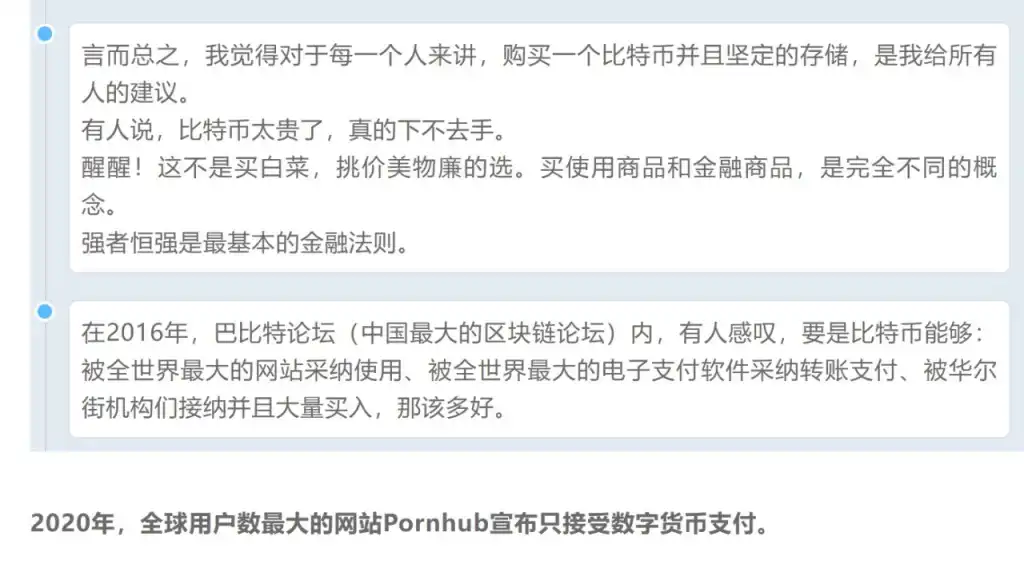
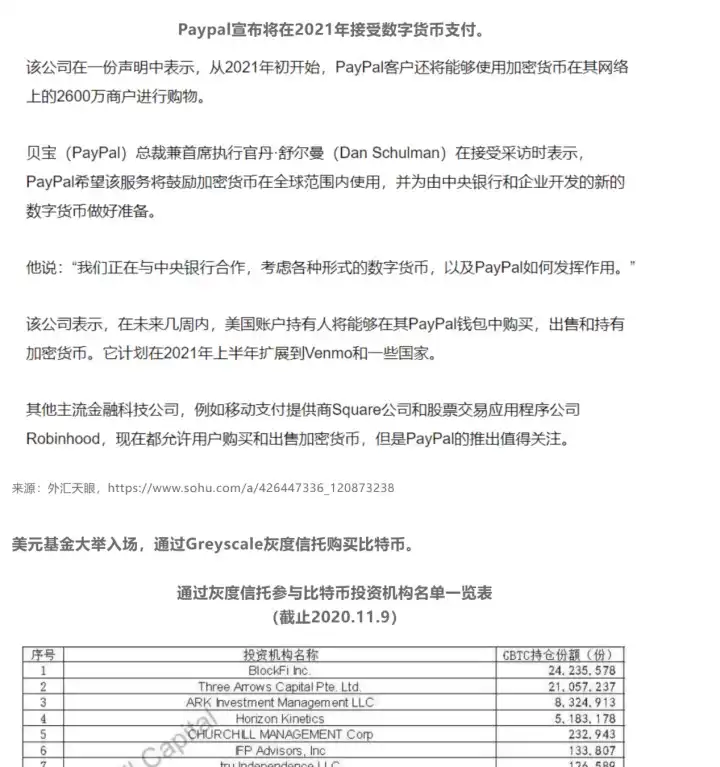
That is also my dream.
Originally, I envisioned that these goals would take 8-10 years to achieve.
However, it only took us four years.
It was at that time that I had a new dream - since Bitcoin has been gradually accepted by mainstream society as a monetary asset, other digital currencies, or tokens, in addition to digital equity, should also play the role of digital commodities, so that in the future digital world of mankind, in addition to financial value, they should also generate utility, so that humans can better enter the digital world.
Oh yes, this thing, later everyone gave it a new name - NFT.
"Digital commodities in the metaverse era" is my definition of the future end of NFT, and it is also the most important part of truly realizing the web3ization and digitization of "commodities in the Internet era" and thus mass adoption.
For this reason, I resolutely built the NFT industry in early 2021. In the "The Road to the Future - Web3 Five Parts" series of articles, there is my description of its future.
五
Of course, the most intuitive way to attract people, or even to make more people willing to read the articles I write, naturally depends on the increase in BTC.
It's time to talk about the key points. It is necessary to mention my prediction for the BTC market: the peak of this round of BTC will appear at the end of 2025, and the reasonable range should be between 160,000 and 220,000 US dollars. After that, in 2026, it is recommended that everyone go short and recuperate.
In my paper written on January 1, 2019 "Bitcoin Valuation Model under Miner Market Equilibrium - Based on Derivative Pricing Theory", the bottom of the four-year cycle from 2018 to 2021 is mentioned.
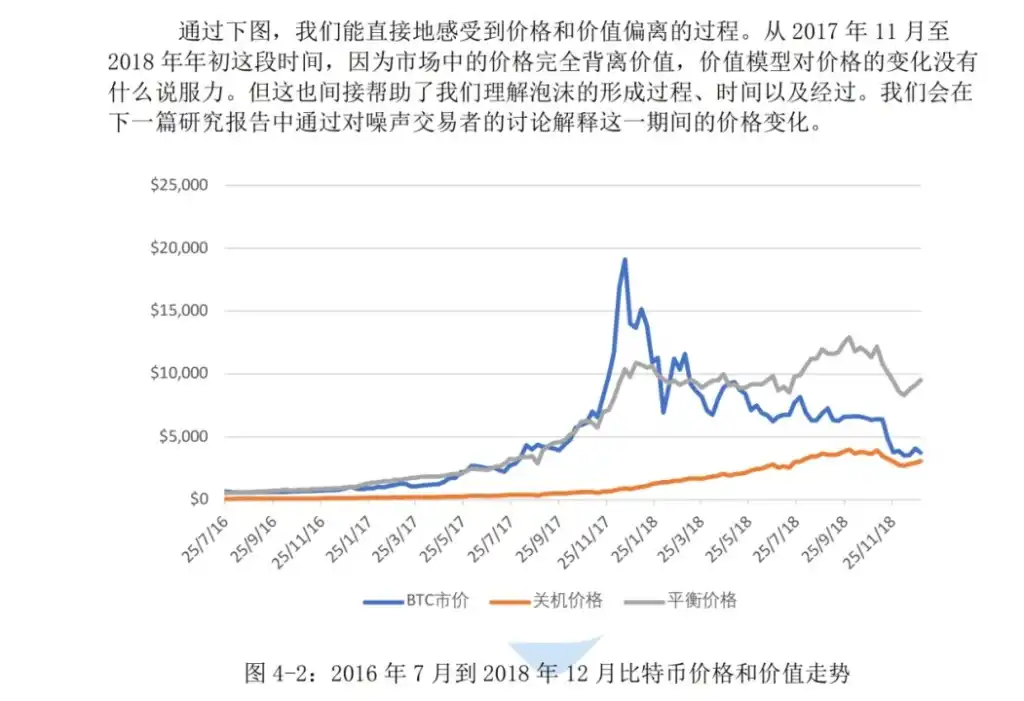
And the bottom of the four-year cycle of 2022-2025 that I mentioned in 2022.
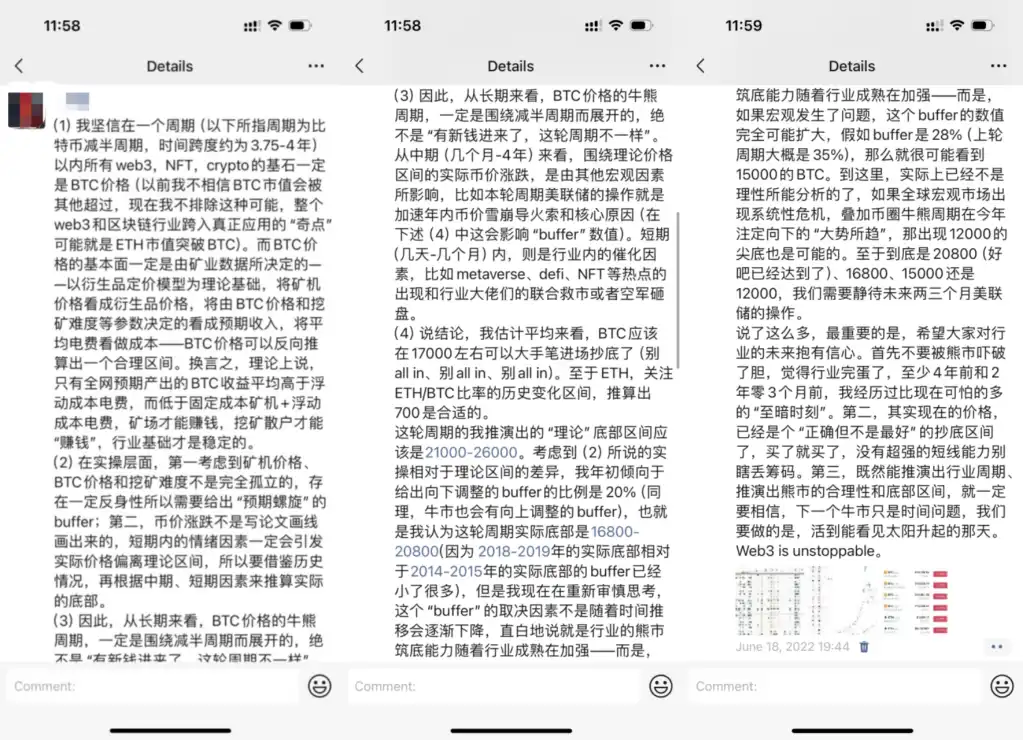
From the current perspective, the entire currency circle is at a critical crossroads. Today's digital currency industry is like the Internet industry at the turn of the century. In the next 1 to 2 years, the bubble burst is not far away. With the passage of crypto-friendly laws such as FIT21 in the United States, the compliance supervision of assets such as currency rights has been completed. A large number of very traditional old money that once lacked understanding of crypto and even completely sneered at it will begin to accept BTC and make configurations at the 1%-10% level. However, after that, if blockchain and digital currency cannot be gradually combined with traditional industries and truly usher in the transformation of "blockchain + industry", just like the Internet industry combined with consumption, social, media, etc. and transformed them, I really don't see any new funds coming in, and what reason there is for this industry to have amazing growth opportunities again. Defi in 2020, NFT and metaverse in 2021, these are the right direction, and they also set off a wave of innovation at the time. Throughout 2024, BTC has repeatedly set new highs, but the entire blockchain industry has not completely lacked enough innovation to talk about. The market is just filled with more memes and Layer1&2&3, but there is no new "business concept innovation". Moreover, in 2025, which I can see, the atmosphere of the entire industry determines that I am pessimistic about the emergence of milestone "business concept innovation".
When the tide rises, all boats rise. Now the water is flooding, and small rafts are everywhere. Boatmen are competing to see who can row faster, and even laugh at those bulky, machine-powered iron boats. But when the big waves recede, the wooden boats will run aground. Only by maintaining constant machine power can they sail out of the port and welcome the sea.
Even, to make an interesting prediction, the sign that the bubble in the currency circle has reached its peak will be that Buffett, the world's biggest opponent of Bitcoin, begins to change his words and even participate in the industry. The staged victory of the revolution is often the moment when the crisis is most lurking.
The current currency circle can be compared to the Internet era in 1999. After a wave of rapid blowouts on the right track, the digital currency industry may usher in drastic adjustments due to huge bubbles starting from the end of 2025. Looking back at history, the Internet industry welcomed Netscape's initial public offering (IPO) in December 1995, followed by Yahoo's listing in April 1996, which triggered a market boom. On March 10, 2000, the Nasdaq index reached its historical peak of 5408.6 points. However, the bubble quickly burst and the market entered a cold winter in 2001. Although the broad cold winter lasted until 2004, the real low point was in October 2002, when the Nasdaq index almost fell below 1,000 points, marking the lowest point of the industry from a financial perspective.
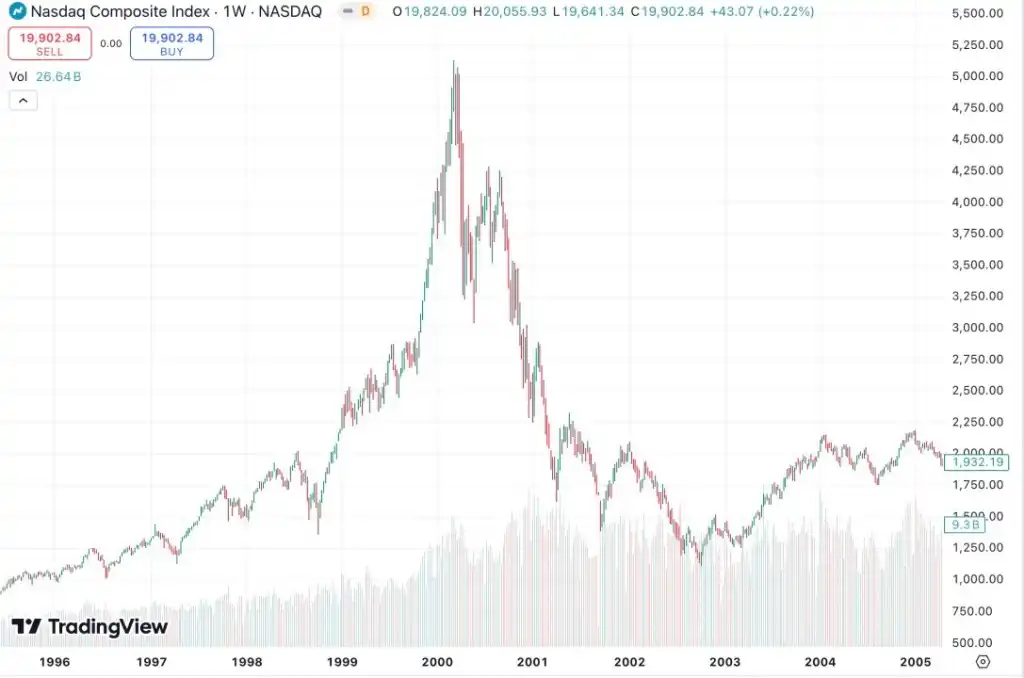
In 2020, MicroStrategy successfully increased the value of the company's stock by purchasing BTC, achieving a significant stock-to-coin linkage effect for the first time. In February 2021, Tesla announced the purchase of Bitcoin, which became a landmark event for the giant to officially enter the market. These historical moments can't help but remind people of the "1995-1996" of the blockchain industry-when the Internet boom began.
Looking to the future, I think the price of Bitcoin may reach a long-term peak at the end of 2025, but it may hit a new low in early 2027. Once the FIT21 bill is passed, it may start a wave of currency issuance by all people, just like the unprecedented grand occasion of the ".com" era.
If the threshold for token financing is reduced to almost zero, and even ordinary people can issue their own tokens like high school students can easily learn to make a website, then the limited capital in the market will be quickly diluted by the various tokens that are flocking in. In such an environment, the last wave of "violent bull market" belonging to token issuers may not last more than three months. Subsequently, due to the imbalance of market supply and demand and the exhaustion of capital, the industry will inevitably usher in a comprehensive collapse.
However, before that, in the next 12 months, we still have BTC's beta potential increase of nearly 2 times, and for ordinary people, because of the global liquidity gathering, countless early currency opportunities of "hundreds and thousands of times" in a very short period of time-why not participate?
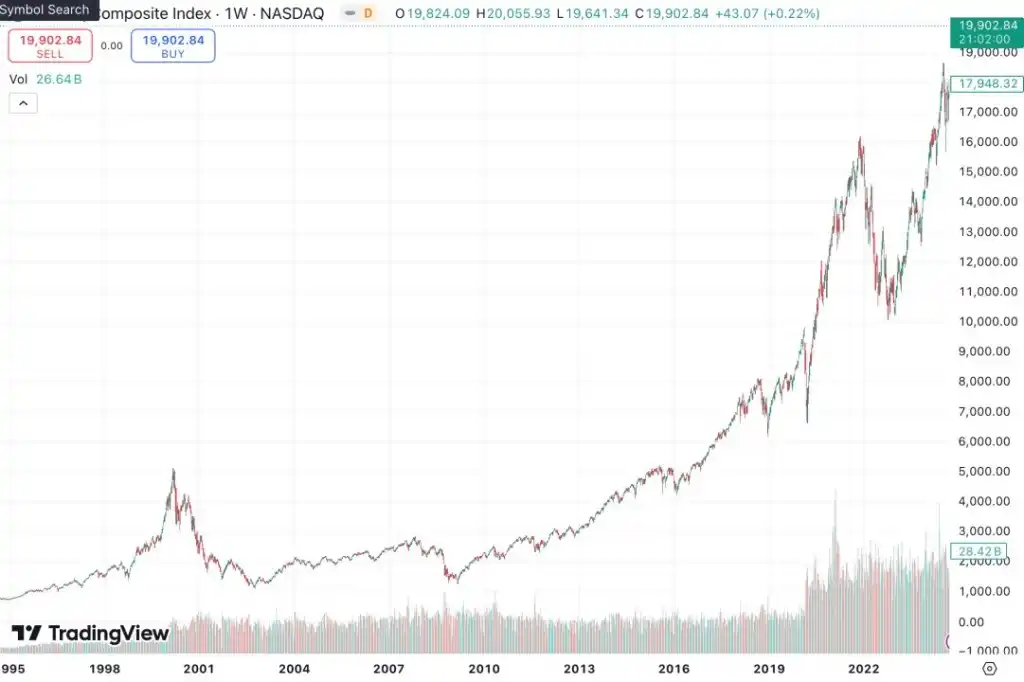
And, looking back at the Internet industry that was surging and criticized by many media as a "bubble". Today, the Nasdaq index broke through the 20,000 mark. Looking back, it looked like a mountain in 2000, but now it is just a small hill. Even if I entered the Internet industry in 2000 and persisted until today, it is still almost the right choice.
What about BTC, one small hill after another.
It has been 3202 days since I bought the first BTC on March 7, 2016.
I still remember the price at the moment I clicked the mouse, which showed 2807RMB, which is less than 400 US dollars.
Many people have asked me, how high do you think BTC can rise?
This question is meaningless. The price of gold has also been setting new highs these days and years.
The meaningful question is, how high can the price of BTC rise before a certain point in time?
Let's wait and see.
The best is yet to come.
You may also like

Token Cannot Compound, Where Is the Real Investment Opportunity?

February 6th Market Key Intelligence, How Much Did You Miss?

China's Central Bank and Eight Other Departments' Latest Regulatory Focus: Key Attention to RWA Tokenized Asset Risk
Foreword: Today, the People's Bank of China's website published the "Notice of the People's Bank of China, National Development and Reform Commission, Ministry of Industry and Information Technology, Ministry of Public Security, State Administration for Market Regulation, China Banking and Insurance Regulatory Commission, China Securities Regulatory Commission, State Administration of Foreign Exchange on Further Preventing and Dealing with Risks Related to Virtual Currency and Others (Yinfa [2026] No. 42)", the latest regulatory requirements from the eight departments including the central bank, which are basically consistent with the regulatory requirements of recent years. The main focus of the regulation is on speculative activities such as virtual currency trading, exchanges, ICOs, overseas platform services, and this time, regulatory oversight of RWA has been added, explicitly prohibiting RWA tokenization, stablecoins (especially those pegged to the RMB). The following is the full text:
To the people's governments of all provinces, autonomous regions, and municipalities directly under the Central Government, the Xinjiang Production and Construction Corps:
Recently, there have been speculative activities related to virtual currency and Real-World Assets (RWA) tokenization, disrupting the economic and financial order and jeopardizing the property security of the people. In order to further prevent and address the risks related to virtual currency and Real-World Assets tokenization, effectively safeguard national security and social stability, in accordance with the "Law of the People's Republic of China on the People's Bank of China," "Law of the People's Republic of China on Commercial Banks," "Securities Law of the People's Republic of China," "Law of the People's Republic of China on Securities Investment Funds," "Law of the People's Republic of China on Futures and Derivatives," "Cybersecurity Law of the People's Republic of China," "Regulations of the People's Republic of China on the Administration of Renminbi," "Regulations on Prevention and Disposal of Illegal Fundraising," "Regulations of the People's Republic of China on Foreign Exchange Administration," "Telecommunications Regulations of the People's Republic of China," and other provisions, after reaching consensus with the Cyberspace Administration of China, the Supreme People's Court, and the Supreme People's Procuratorate, and with the approval of the State Council, the relevant matters are notified as follows:
(I) Virtual currency does not possess the legal status equivalent to fiat currency. Virtual currencies such as Bitcoin, Ether, Tether, etc., have the main characteristics of being issued by non-monetary authorities, using encryption technology and distributed ledger or similar technology, existing in digital form, etc. They do not have legal tender status, should not and cannot be circulated and used as currency in the market.
The business activities related to virtual currency are classified as illegal financial activities. The exchange of fiat currency and virtual currency within the territory, exchange of virtual currencies, acting as a central counterparty in buying and selling virtual currencies, providing information intermediary and pricing services for virtual currency transactions, token issuance financing, and trading of virtual currency-related financial products, etc., fall under illegal financial activities, such as suspected illegal issuance of token vouchers, unauthorized public issuance of securities, illegal operation of securities and futures business, illegal fundraising, etc., are strictly prohibited across the board and resolutely banned in accordance with the law. Overseas entities and individuals are not allowed to provide virtual currency-related services to domestic entities in any form.
A stablecoin pegged to a fiat currency indirectly fulfills some functions of the fiat currency in circulation. Without the consent of relevant authorities in accordance with the law and regulations, any domestic or foreign entity or individual is not allowed to issue a RMB-pegged stablecoin overseas.
(II)Tokenization of Real-World Assets refers to the use of encryption technology and distributed ledger or similar technologies to transform ownership rights, income rights, etc., of assets into tokens (tokens) or other interests or bond certificates with token (token) characteristics, and carry out issuance and trading activities.
Engaging in the tokenization of real-world assets domestically, as well as providing related intermediary, information technology services, etc., which are suspected of illegal issuance of token vouchers, unauthorized public offering of securities, illegal operation of securities and futures business, illegal fundraising, and other illegal financial activities, shall be prohibited; except for relevant business activities carried out with the approval of the competent authorities in accordance with the law and regulations and relying on specific financial infrastructures. Overseas entities and individuals are not allowed to illegally provide services related to the tokenization of real-world assets to domestic entities in any form.
(III) Inter-agency Coordination. The People's Bank of China, together with the National Development and Reform Commission, the Ministry of Industry and Information Technology, the Ministry of Public Security, the State Administration for Market Regulation, the China Banking and Insurance Regulatory Commission, the China Securities Regulatory Commission, the State Administration of Foreign Exchange, and other departments, will improve the work mechanism, strengthen coordination with the Cyberspace Administration of China, the Supreme People's Court, and the Supreme People's Procuratorate, coordinate efforts, and overall guide regions to carry out risk prevention and disposal of virtual currency-related illegal financial activities.
The China Securities Regulatory Commission, together with the National Development and Reform Commission, the Ministry of Industry and Information Technology, the Ministry of Public Security, the People's Bank of China, the State Administration for Market Regulation, the China Banking and Insurance Regulatory Commission, the State Administration of Foreign Exchange, and other departments, will improve the work mechanism, strengthen coordination with the Cyberspace Administration of China, the Supreme People's Court, and the Supreme People's Procuratorate, coordinate efforts, and overall guide regions to carry out risk prevention and disposal of illegal financial activities related to the tokenization of real-world assets.
(IV) Strengthening Local Implementation. The people's governments at the provincial level are overall responsible for the prevention and disposal of risks related to virtual currencies and the tokenization of real-world assets in their respective administrative regions. The specific leading department is the local financial regulatory department, with participation from branches and dispatched institutions of the State Council's financial regulatory department, telecommunications regulators, public security, market supervision, and other departments, in coordination with cyberspace departments, courts, and procuratorates, to improve the normalization of the work mechanism, effectively connect with the relevant work mechanisms of central departments, form a cooperative and coordinated working pattern between central and local governments, effectively prevent and properly handle risks related to virtual currencies and the tokenization of real-world assets, and maintain economic and financial order and social stability.
(5) Enhanced Risk Monitoring. The People's Bank of China, China Securities Regulatory Commission, National Development and Reform Commission, Ministry of Industry and Information Technology, Ministry of Public Security, State Administration of Foreign Exchange, Cyberspace Administration of China, and other departments continue to improve monitoring techniques and system support, enhance cross-departmental data analysis and sharing, establish sound information sharing and cross-validation mechanisms, promptly grasp the risk situation of activities related to virtual currency and real-world asset tokenization. Local governments at all levels give full play to the role of local monitoring and early warning mechanisms. Local financial regulatory authorities, together with branches and agencies of the State Council's financial regulatory authorities, as well as departments of cyberspace and public security, ensure effective connection between online monitoring, offline investigation, and fund tracking, efficiently and accurately identify activities related to virtual currency and real-world asset tokenization, promptly share risk information, improve early warning information dissemination, verification, and rapid response mechanisms.
(6) Strengthened Oversight of Financial Institutions, Intermediaries, and Technology Service Providers. Financial institutions (including non-bank payment institutions) are prohibited from providing account opening, fund transfer, and clearing services for virtual currency-related business activities, issuing and selling financial products related to virtual currency, including virtual currency and related financial products in the scope of collateral, conducting insurance business related to virtual currency, or including virtual currency in the scope of insurance liability. Financial institutions (including non-bank payment institutions) are prohibited from providing custody, clearing, and settlement services for unauthorized real-world asset tokenization-related business and related financial products. Relevant intermediary institutions and information technology service providers are prohibited from providing intermediary, technical, or other services for unauthorized real-world asset tokenization-related businesses and related financial products.
(7) Enhanced Management of Internet Information Content and Access. Internet enterprises are prohibited from providing online business venues, commercial displays, marketing, advertising, or paid traffic diversion services for virtual currency and real-world asset tokenization-related business activities. Upon discovering clues of illegal activities, they should promptly report to relevant departments and provide technical support and assistance for related investigations and inquiries. Based on the clues transferred by the financial regulatory authorities, the cyberspace administration, telecommunications authorities, and public security departments should promptly close and deal with websites, mobile applications (including mini-programs), and public accounts engaged in virtual currency and real-world asset tokenization-related business activities in accordance with the law.
(8) Strengthened Entity Registration and Advertisement Management. Market supervision departments strengthen entity registration and management, and enterprise and individual business registrations must not contain terms such as "virtual currency," "virtual asset," "cryptocurrency," "crypto asset," "stablecoin," "real-world asset tokenization," or "RWA" in their names or business scopes. Market supervision departments, together with financial regulatory authorities, legally enhance the supervision of advertisements related to virtual currency and real-world asset tokenization, promptly investigating and handling relevant illegal advertisements.
(IX) Continued Rectification of Virtual Currency Mining Activities. The National Development and Reform Commission, together with relevant departments, strictly controls virtual currency mining activities, continuously promotes the rectification of virtual currency mining activities. The people's governments of various provinces take overall responsibility for the rectification of "mining" within their respective administrative regions. In accordance with the requirements of the National Development and Reform Commission and other departments in the "Notice on the Rectification of Virtual Currency Mining Activities" (NDRC Energy-saving Building [2021] No. 1283) and the provisions of the "Guidance Catalog for Industrial Structure Adjustment (2024 Edition)," a comprehensive review, investigation, and closure of existing virtual currency mining projects are conducted, new mining projects are strictly prohibited, and mining machine production enterprises are strictly prohibited from providing mining machine sales and other services within the country.
(X) Severe Crackdown on Related Illegal Financial Activities. Upon discovering clues to illegal financial activities related to virtual currency and the tokenization of real-world assets, local financial regulatory authorities, branches of the State Council's financial regulatory authorities, and other relevant departments promptly investigate, determine, and properly handle the issues in accordance with the law, and seriously hold the relevant entities and individuals legally responsible. Those suspected of crimes are transferred to the judicial authorities for processing according to the law.
(XI) Severe Crackdown on Related Illegal and Criminal Activities. The Ministry of Public Security, the People's Bank of China, the State Administration for Market Regulation, the China Banking and Insurance Regulatory Commission, the China Securities Regulatory Commission, as well as judicial and procuratorial organs, in accordance with their respective responsibilities, rigorously crack down on illegal and criminal activities related to virtual currency, the tokenization of real-world assets, such as fraud, money laundering, illegal business operations, pyramid schemes, illegal fundraising, and other illegal and criminal activities carried out under the guise of virtual currency, the tokenization of real-world assets, etc.
(XII) Strengthen Industry Self-discipline. Relevant industry associations should enhance membership management and policy advocacy, based on their own responsibilities, advocate and urge member units to resist illegal financial activities related to virtual currency and the tokenization of real-world assets. Member units that violate regulatory policies and industry self-discipline rules are to be disciplined in accordance with relevant self-regulatory management regulations. By leveraging various industry infrastructure, conduct risk monitoring related to virtual currency, the tokenization of real-world assets, and promptly transfer issue clues to relevant departments.
(XIII) Without the approval of relevant departments in accordance with the law and regulations, domestic entities and foreign entities controlled by them may not issue virtual currency overseas.
(XIV) Domestic entities engaging directly or indirectly in overseas external debt-based tokenization of real-world assets, or conducting asset securitization activities abroad based on domestic ownership rights, income rights, etc. (hereinafter referred to as domestic equity), should be strictly regulated in accordance with the principles of "same business, same risk, same rules." The National Development and Reform Commission, the China Securities Regulatory Commission, the State Administration of Foreign Exchange, and other relevant departments regulate it according to their respective responsibilities. For other forms of overseas real-world asset tokenization activities based on domestic equity by domestic entities, the China Securities Regulatory Commission, together with relevant departments, supervise according to their division of responsibilities. Without the consent and filing of relevant departments, no unit or individual may engage in the above-mentioned business.
(15) Overseas subsidiaries and branches of domestic financial institutions providing Real World Asset Tokenization-related services overseas shall do so legally and prudently. They shall have professional personnel and systems in place to effectively mitigate business risks, strictly implement customer onboarding, suitability management, anti-money laundering requirements, and incorporate them into the domestic financial institutions' compliance and risk management system. Intermediaries and information technology service providers offering Real World Asset Tokenization services abroad based on domestic equity or conducting Real World Asset Tokenization business in the form of overseas debt for domestic entities directly or indirectly venturing abroad must strictly comply with relevant laws and regulations. They should establish and improve relevant compliance and internal control systems in accordance with relevant normative requirements, strengthen business and risk control, and report the business developments to the relevant regulatory authorities for approval or filing.
(16) Strengthen organizational leadership and overall coordination. All departments and regions should attach great importance to the prevention of risks related to virtual currencies and Real World Asset Tokenization, strengthen organizational leadership, clarify work responsibilities, form a long-term effective working mechanism with centralized coordination, local implementation, and shared responsibilities, maintain high pressure, dynamically monitor risks, effectively prevent and mitigate risks in an orderly and efficient manner, legally protect the property security of the people, and make every effort to maintain economic and financial order and social stability.
(17) Widely carry out publicity and education. All departments, regions, and industry associations should make full use of various media and other communication channels to disseminate information through legal and policy interpretation, analysis of typical cases, and education on investment risks, etc. They should promote the illegality and harm of virtual currencies and Real World Asset Tokenization-related businesses and their manifestations, fully alert to potential risks and hidden dangers, and enhance public awareness and identification capabilities for risk prevention.
(18) Engaging in illegal financial activities related to virtual currencies and Real World Asset Tokenization in violation of this notice, as well as providing services for virtual currencies and Real World Asset Tokenization-related businesses, shall be punished in accordance with relevant regulations. If it constitutes a crime, criminal liability shall be pursued according to the law. For domestic entities and individuals who knowingly or should have known that overseas entities illegally provided virtual currency or Real World Asset Tokenization-related services to domestic entities and still assisted them, relevant responsibilities shall be pursued according to the law. If it constitutes a crime, criminal liability shall be pursued according to the law.
(19) If any unit or individual invests in virtual currencies, Real World Asset Tokens, and related financial products against public order and good customs, the relevant civil legal actions shall be invalid, and any resulting losses shall be borne by them. If there are suspicions of disrupting financial order and jeopardizing financial security, the relevant departments shall deal with them according to the law.
This notice shall enter into force upon the date of its issuance. The People's Bank of China and ten other departments' "Notice on Further Preventing and Dealing with the Risks of Virtual Currency Trading Speculation" (Yinfa [2021] No. 237) is hereby repealed.

Former Partner's Perspective on Multicoin: Kyle's Exit, But the Game He Left Behind Just Getting Started
Why Bitcoin Is Falling Now: The Real Reasons Behind BTC's Crash & WEEX's Smart Profit Playbook
Bitcoin's ongoing crash explained: Discover the 5 hidden triggers behind BTC's plunge & how WEEX's Auto Earn and Trade to Earn strategies help traders profit from crypto market volatility.

Wall Street's Hottest Trades See Exodus

Vitalik Discusses Ethereum Scaling Path, Circle Announces Partnership with Polymarket, What's the Overseas Crypto Community Talking About Today?

Believing in the Capital Markets - The Essence and Core Value of Cryptocurrency

Polymarket's 'Weatherman': Predict Temperature, Win Million-Dollar Payout

$15K+ Profits: The 4 AI Trading Secrets WEEX Hackathon Prelim Winners Used to Dominate Volatile Crypto Markets
How WEEX Hackathon's top AI trading strategies made $15K+ in crypto markets: 4 proven rules for ETH/BTC trading, market structure analysis, and risk management in volatile conditions.

A nearly 20% one-day plunge, how long has it been since you last saw a $60,000 Bitcoin?

Raoul Pal: I've seen every single panic, and they are never the end.

Key Market Information Discrepancy on February 6th - A Must-Read! | Alpha Morning Report

2026 Crypto Industry's First Snowfall
The Harsh Reality Behind the $26 Billion Crypto Liquidation: Liquidity Is Killing the Market
Why Is Gold, US Stocks, Bitcoin All Falling?

Key Market Intelligence for February 5th, how much did you miss out on?

Wintermute: By 2026, crypto had gradually become the settlement layer of the Internet economy
Token Cannot Compound, Where Is the Real Investment Opportunity?
February 6th Market Key Intelligence, How Much Did You Miss?
China's Central Bank and Eight Other Departments' Latest Regulatory Focus: Key Attention to RWA Tokenized Asset Risk
Foreword: Today, the People's Bank of China's website published the "Notice of the People's Bank of China, National Development and Reform Commission, Ministry of Industry and Information Technology, Ministry of Public Security, State Administration for Market Regulation, China Banking and Insurance Regulatory Commission, China Securities Regulatory Commission, State Administration of Foreign Exchange on Further Preventing and Dealing with Risks Related to Virtual Currency and Others (Yinfa [2026] No. 42)", the latest regulatory requirements from the eight departments including the central bank, which are basically consistent with the regulatory requirements of recent years. The main focus of the regulation is on speculative activities such as virtual currency trading, exchanges, ICOs, overseas platform services, and this time, regulatory oversight of RWA has been added, explicitly prohibiting RWA tokenization, stablecoins (especially those pegged to the RMB). The following is the full text:
To the people's governments of all provinces, autonomous regions, and municipalities directly under the Central Government, the Xinjiang Production and Construction Corps:
Recently, there have been speculative activities related to virtual currency and Real-World Assets (RWA) tokenization, disrupting the economic and financial order and jeopardizing the property security of the people. In order to further prevent and address the risks related to virtual currency and Real-World Assets tokenization, effectively safeguard national security and social stability, in accordance with the "Law of the People's Republic of China on the People's Bank of China," "Law of the People's Republic of China on Commercial Banks," "Securities Law of the People's Republic of China," "Law of the People's Republic of China on Securities Investment Funds," "Law of the People's Republic of China on Futures and Derivatives," "Cybersecurity Law of the People's Republic of China," "Regulations of the People's Republic of China on the Administration of Renminbi," "Regulations on Prevention and Disposal of Illegal Fundraising," "Regulations of the People's Republic of China on Foreign Exchange Administration," "Telecommunications Regulations of the People's Republic of China," and other provisions, after reaching consensus with the Cyberspace Administration of China, the Supreme People's Court, and the Supreme People's Procuratorate, and with the approval of the State Council, the relevant matters are notified as follows:
(I) Virtual currency does not possess the legal status equivalent to fiat currency. Virtual currencies such as Bitcoin, Ether, Tether, etc., have the main characteristics of being issued by non-monetary authorities, using encryption technology and distributed ledger or similar technology, existing in digital form, etc. They do not have legal tender status, should not and cannot be circulated and used as currency in the market.
The business activities related to virtual currency are classified as illegal financial activities. The exchange of fiat currency and virtual currency within the territory, exchange of virtual currencies, acting as a central counterparty in buying and selling virtual currencies, providing information intermediary and pricing services for virtual currency transactions, token issuance financing, and trading of virtual currency-related financial products, etc., fall under illegal financial activities, such as suspected illegal issuance of token vouchers, unauthorized public issuance of securities, illegal operation of securities and futures business, illegal fundraising, etc., are strictly prohibited across the board and resolutely banned in accordance with the law. Overseas entities and individuals are not allowed to provide virtual currency-related services to domestic entities in any form.
A stablecoin pegged to a fiat currency indirectly fulfills some functions of the fiat currency in circulation. Without the consent of relevant authorities in accordance with the law and regulations, any domestic or foreign entity or individual is not allowed to issue a RMB-pegged stablecoin overseas.
(II)Tokenization of Real-World Assets refers to the use of encryption technology and distributed ledger or similar technologies to transform ownership rights, income rights, etc., of assets into tokens (tokens) or other interests or bond certificates with token (token) characteristics, and carry out issuance and trading activities.
Engaging in the tokenization of real-world assets domestically, as well as providing related intermediary, information technology services, etc., which are suspected of illegal issuance of token vouchers, unauthorized public offering of securities, illegal operation of securities and futures business, illegal fundraising, and other illegal financial activities, shall be prohibited; except for relevant business activities carried out with the approval of the competent authorities in accordance with the law and regulations and relying on specific financial infrastructures. Overseas entities and individuals are not allowed to illegally provide services related to the tokenization of real-world assets to domestic entities in any form.
(III) Inter-agency Coordination. The People's Bank of China, together with the National Development and Reform Commission, the Ministry of Industry and Information Technology, the Ministry of Public Security, the State Administration for Market Regulation, the China Banking and Insurance Regulatory Commission, the China Securities Regulatory Commission, the State Administration of Foreign Exchange, and other departments, will improve the work mechanism, strengthen coordination with the Cyberspace Administration of China, the Supreme People's Court, and the Supreme People's Procuratorate, coordinate efforts, and overall guide regions to carry out risk prevention and disposal of virtual currency-related illegal financial activities.
The China Securities Regulatory Commission, together with the National Development and Reform Commission, the Ministry of Industry and Information Technology, the Ministry of Public Security, the People's Bank of China, the State Administration for Market Regulation, the China Banking and Insurance Regulatory Commission, the State Administration of Foreign Exchange, and other departments, will improve the work mechanism, strengthen coordination with the Cyberspace Administration of China, the Supreme People's Court, and the Supreme People's Procuratorate, coordinate efforts, and overall guide regions to carry out risk prevention and disposal of illegal financial activities related to the tokenization of real-world assets.
(IV) Strengthening Local Implementation. The people's governments at the provincial level are overall responsible for the prevention and disposal of risks related to virtual currencies and the tokenization of real-world assets in their respective administrative regions. The specific leading department is the local financial regulatory department, with participation from branches and dispatched institutions of the State Council's financial regulatory department, telecommunications regulators, public security, market supervision, and other departments, in coordination with cyberspace departments, courts, and procuratorates, to improve the normalization of the work mechanism, effectively connect with the relevant work mechanisms of central departments, form a cooperative and coordinated working pattern between central and local governments, effectively prevent and properly handle risks related to virtual currencies and the tokenization of real-world assets, and maintain economic and financial order and social stability.
(5) Enhanced Risk Monitoring. The People's Bank of China, China Securities Regulatory Commission, National Development and Reform Commission, Ministry of Industry and Information Technology, Ministry of Public Security, State Administration of Foreign Exchange, Cyberspace Administration of China, and other departments continue to improve monitoring techniques and system support, enhance cross-departmental data analysis and sharing, establish sound information sharing and cross-validation mechanisms, promptly grasp the risk situation of activities related to virtual currency and real-world asset tokenization. Local governments at all levels give full play to the role of local monitoring and early warning mechanisms. Local financial regulatory authorities, together with branches and agencies of the State Council's financial regulatory authorities, as well as departments of cyberspace and public security, ensure effective connection between online monitoring, offline investigation, and fund tracking, efficiently and accurately identify activities related to virtual currency and real-world asset tokenization, promptly share risk information, improve early warning information dissemination, verification, and rapid response mechanisms.
(6) Strengthened Oversight of Financial Institutions, Intermediaries, and Technology Service Providers. Financial institutions (including non-bank payment institutions) are prohibited from providing account opening, fund transfer, and clearing services for virtual currency-related business activities, issuing and selling financial products related to virtual currency, including virtual currency and related financial products in the scope of collateral, conducting insurance business related to virtual currency, or including virtual currency in the scope of insurance liability. Financial institutions (including non-bank payment institutions) are prohibited from providing custody, clearing, and settlement services for unauthorized real-world asset tokenization-related business and related financial products. Relevant intermediary institutions and information technology service providers are prohibited from providing intermediary, technical, or other services for unauthorized real-world asset tokenization-related businesses and related financial products.
(7) Enhanced Management of Internet Information Content and Access. Internet enterprises are prohibited from providing online business venues, commercial displays, marketing, advertising, or paid traffic diversion services for virtual currency and real-world asset tokenization-related business activities. Upon discovering clues of illegal activities, they should promptly report to relevant departments and provide technical support and assistance for related investigations and inquiries. Based on the clues transferred by the financial regulatory authorities, the cyberspace administration, telecommunications authorities, and public security departments should promptly close and deal with websites, mobile applications (including mini-programs), and public accounts engaged in virtual currency and real-world asset tokenization-related business activities in accordance with the law.
(8) Strengthened Entity Registration and Advertisement Management. Market supervision departments strengthen entity registration and management, and enterprise and individual business registrations must not contain terms such as "virtual currency," "virtual asset," "cryptocurrency," "crypto asset," "stablecoin," "real-world asset tokenization," or "RWA" in their names or business scopes. Market supervision departments, together with financial regulatory authorities, legally enhance the supervision of advertisements related to virtual currency and real-world asset tokenization, promptly investigating and handling relevant illegal advertisements.
(IX) Continued Rectification of Virtual Currency Mining Activities. The National Development and Reform Commission, together with relevant departments, strictly controls virtual currency mining activities, continuously promotes the rectification of virtual currency mining activities. The people's governments of various provinces take overall responsibility for the rectification of "mining" within their respective administrative regions. In accordance with the requirements of the National Development and Reform Commission and other departments in the "Notice on the Rectification of Virtual Currency Mining Activities" (NDRC Energy-saving Building [2021] No. 1283) and the provisions of the "Guidance Catalog for Industrial Structure Adjustment (2024 Edition)," a comprehensive review, investigation, and closure of existing virtual currency mining projects are conducted, new mining projects are strictly prohibited, and mining machine production enterprises are strictly prohibited from providing mining machine sales and other services within the country.
(X) Severe Crackdown on Related Illegal Financial Activities. Upon discovering clues to illegal financial activities related to virtual currency and the tokenization of real-world assets, local financial regulatory authorities, branches of the State Council's financial regulatory authorities, and other relevant departments promptly investigate, determine, and properly handle the issues in accordance with the law, and seriously hold the relevant entities and individuals legally responsible. Those suspected of crimes are transferred to the judicial authorities for processing according to the law.
(XI) Severe Crackdown on Related Illegal and Criminal Activities. The Ministry of Public Security, the People's Bank of China, the State Administration for Market Regulation, the China Banking and Insurance Regulatory Commission, the China Securities Regulatory Commission, as well as judicial and procuratorial organs, in accordance with their respective responsibilities, rigorously crack down on illegal and criminal activities related to virtual currency, the tokenization of real-world assets, such as fraud, money laundering, illegal business operations, pyramid schemes, illegal fundraising, and other illegal and criminal activities carried out under the guise of virtual currency, the tokenization of real-world assets, etc.
(XII) Strengthen Industry Self-discipline. Relevant industry associations should enhance membership management and policy advocacy, based on their own responsibilities, advocate and urge member units to resist illegal financial activities related to virtual currency and the tokenization of real-world assets. Member units that violate regulatory policies and industry self-discipline rules are to be disciplined in accordance with relevant self-regulatory management regulations. By leveraging various industry infrastructure, conduct risk monitoring related to virtual currency, the tokenization of real-world assets, and promptly transfer issue clues to relevant departments.
(XIII) Without the approval of relevant departments in accordance with the law and regulations, domestic entities and foreign entities controlled by them may not issue virtual currency overseas.
(XIV) Domestic entities engaging directly or indirectly in overseas external debt-based tokenization of real-world assets, or conducting asset securitization activities abroad based on domestic ownership rights, income rights, etc. (hereinafter referred to as domestic equity), should be strictly regulated in accordance with the principles of "same business, same risk, same rules." The National Development and Reform Commission, the China Securities Regulatory Commission, the State Administration of Foreign Exchange, and other relevant departments regulate it according to their respective responsibilities. For other forms of overseas real-world asset tokenization activities based on domestic equity by domestic entities, the China Securities Regulatory Commission, together with relevant departments, supervise according to their division of responsibilities. Without the consent and filing of relevant departments, no unit or individual may engage in the above-mentioned business.
(15) Overseas subsidiaries and branches of domestic financial institutions providing Real World Asset Tokenization-related services overseas shall do so legally and prudently. They shall have professional personnel and systems in place to effectively mitigate business risks, strictly implement customer onboarding, suitability management, anti-money laundering requirements, and incorporate them into the domestic financial institutions' compliance and risk management system. Intermediaries and information technology service providers offering Real World Asset Tokenization services abroad based on domestic equity or conducting Real World Asset Tokenization business in the form of overseas debt for domestic entities directly or indirectly venturing abroad must strictly comply with relevant laws and regulations. They should establish and improve relevant compliance and internal control systems in accordance with relevant normative requirements, strengthen business and risk control, and report the business developments to the relevant regulatory authorities for approval or filing.
(16) Strengthen organizational leadership and overall coordination. All departments and regions should attach great importance to the prevention of risks related to virtual currencies and Real World Asset Tokenization, strengthen organizational leadership, clarify work responsibilities, form a long-term effective working mechanism with centralized coordination, local implementation, and shared responsibilities, maintain high pressure, dynamically monitor risks, effectively prevent and mitigate risks in an orderly and efficient manner, legally protect the property security of the people, and make every effort to maintain economic and financial order and social stability.
(17) Widely carry out publicity and education. All departments, regions, and industry associations should make full use of various media and other communication channels to disseminate information through legal and policy interpretation, analysis of typical cases, and education on investment risks, etc. They should promote the illegality and harm of virtual currencies and Real World Asset Tokenization-related businesses and their manifestations, fully alert to potential risks and hidden dangers, and enhance public awareness and identification capabilities for risk prevention.
(18) Engaging in illegal financial activities related to virtual currencies and Real World Asset Tokenization in violation of this notice, as well as providing services for virtual currencies and Real World Asset Tokenization-related businesses, shall be punished in accordance with relevant regulations. If it constitutes a crime, criminal liability shall be pursued according to the law. For domestic entities and individuals who knowingly or should have known that overseas entities illegally provided virtual currency or Real World Asset Tokenization-related services to domestic entities and still assisted them, relevant responsibilities shall be pursued according to the law. If it constitutes a crime, criminal liability shall be pursued according to the law.
(19) If any unit or individual invests in virtual currencies, Real World Asset Tokens, and related financial products against public order and good customs, the relevant civil legal actions shall be invalid, and any resulting losses shall be borne by them. If there are suspicions of disrupting financial order and jeopardizing financial security, the relevant departments shall deal with them according to the law.
This notice shall enter into force upon the date of its issuance. The People's Bank of China and ten other departments' "Notice on Further Preventing and Dealing with the Risks of Virtual Currency Trading Speculation" (Yinfa [2021] No. 237) is hereby repealed.
Former Partner's Perspective on Multicoin: Kyle's Exit, But the Game He Left Behind Just Getting Started
Why Bitcoin Is Falling Now: The Real Reasons Behind BTC's Crash & WEEX's Smart Profit Playbook
Bitcoin's ongoing crash explained: Discover the 5 hidden triggers behind BTC's plunge & how WEEX's Auto Earn and Trade to Earn strategies help traders profit from crypto market volatility.


 App
App