
 Buy Crypto
- Markets
 Futures
- Spot
- Copy Trade
- Earn
- More
A Decade of Regulation Finally Clarified, Victory for Crypto-Native Logic

BTC, ETH, SOL, XRP, DOGE, SHIB.
These names were written together in an SEC regulatory filing for the first time, with a few words added after them: not securities.
On the evening of March 17, 2026, the SEC and CFTC jointly released a 68-page interpretive document, formally providing a comprehensive qualitative assessment of the securities status of crypto assets. This marked the first time at the U.S. federal level that specific tokens were officially addressed and classified in a regulatory interpretation. The document also superseded the SEC's previous 2019 "Investment Contract Analysis Framework," which had been a primary reference for industry compliance assessments.
This document followed a clear timeline.
In January 2025, SEC Acting Chair Mark T. Uyeda established the Crypto Task Force to clarify the application of securities laws to crypto assets. In July of the same year, the President's Working Group on Digital Assets released a report recommending that the SEC and CFTC use their existing powers to provide regulatory clarity to the industry.
SEC Chair Paul S. Atkins subsequently launched Project Crypto, which was upgraded to a joint SEC-CFTC project in January 2026. During this period, the Crypto Task Force received over 300 public comments from issuers, investors, law firms, audit firms, and other stakeholders.
In other words, this document represents the "unified answer" from the two federal regulatory agencies after more than a year of industry jockeying and policy coordination.
Five Lines Draw the Whole Map
In this document, the SEC categorizes crypto assets into five classes, with the core criterion being the four elements of the Howey Test.
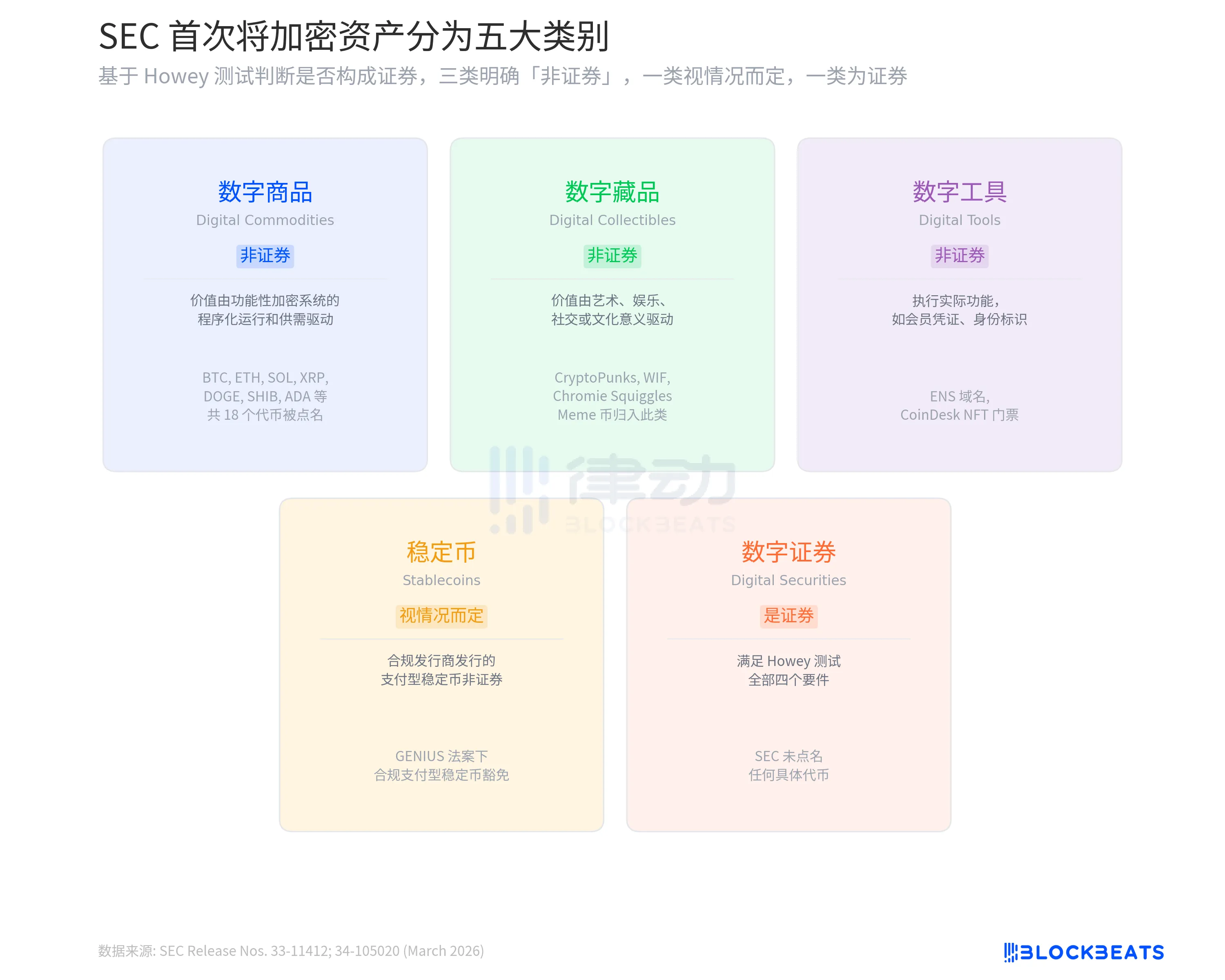
The first category is "Digital Commodities." This is the most highlighted section of the entire document as the SEC provides a specific list of names. BTC, ETH, SOL, XRP, ADA, AVAX, DOGE, SHIB, LINK, DOT, LTC, BCH, HBAR, XLM, XTZ, APT, totaling 16 tokens are explicitly mentioned in the body. The footnote also includes Algorand (ALGO) and LBRY Credits (LBC) in this category.
The logic provided by the SEC is as follows: the value of these tokens is inherently tied to the programmatic operations of the functional encrypted system they reside in, primarily driven by supply and demand, rather than by the expectation of profit from the managerial efforts of others.
The second category is "Digital Collectibles." CryptoPunks, Chromie Squiggles, WIF (dogwifhat), and VCOIN are specifically mentioned. Meme coins find their place here, where the SEC believes their value is primarily driven by "artistic, entertainment, social, or cultural significance," similar to physical collectibles, and thus do not constitute securities.
The third category is "Digital Tools." Examples such as ENS domains and CoinDesk's Microcosms NFT tickets are mentioned. The key feature of these assets is their ability to perform specific functions, such as membership credentials, identity tokens, or ownership certificates, many of which are soul-bound and non-transferrable.
The fourth category is "Stablecoins." According to the previously passed "GENIUS Act," "payment-type stablecoins" issued by compliant issuers are expressly excluded from the definition of securities. However, the SEC retains regulatory authority over stablecoins that do not meet the standards set by this Act.
The fifth category is "Digital Securities." This is the only category definitively classified as securities. However, the SEC does not specifically mention any tokens as belonging to this category in the document.
The boundaries between these five categories are not absolute. The SEC itself acknowledges the existence of hybrid assets that span multiple categories and crypto assets that do not fall into any category. However, the significance of this classification framework lies in bringing the question of "what is a security and what is not" from courtroom debates to the realm of regulatory enforcement for the first time.
Four Categories of On-Chain Activities, Unified Classification
Beyond token classification, another significant contribution of this document is the unified classification of four core on-chain activities: mining, staking, wrapping, and airdrops.
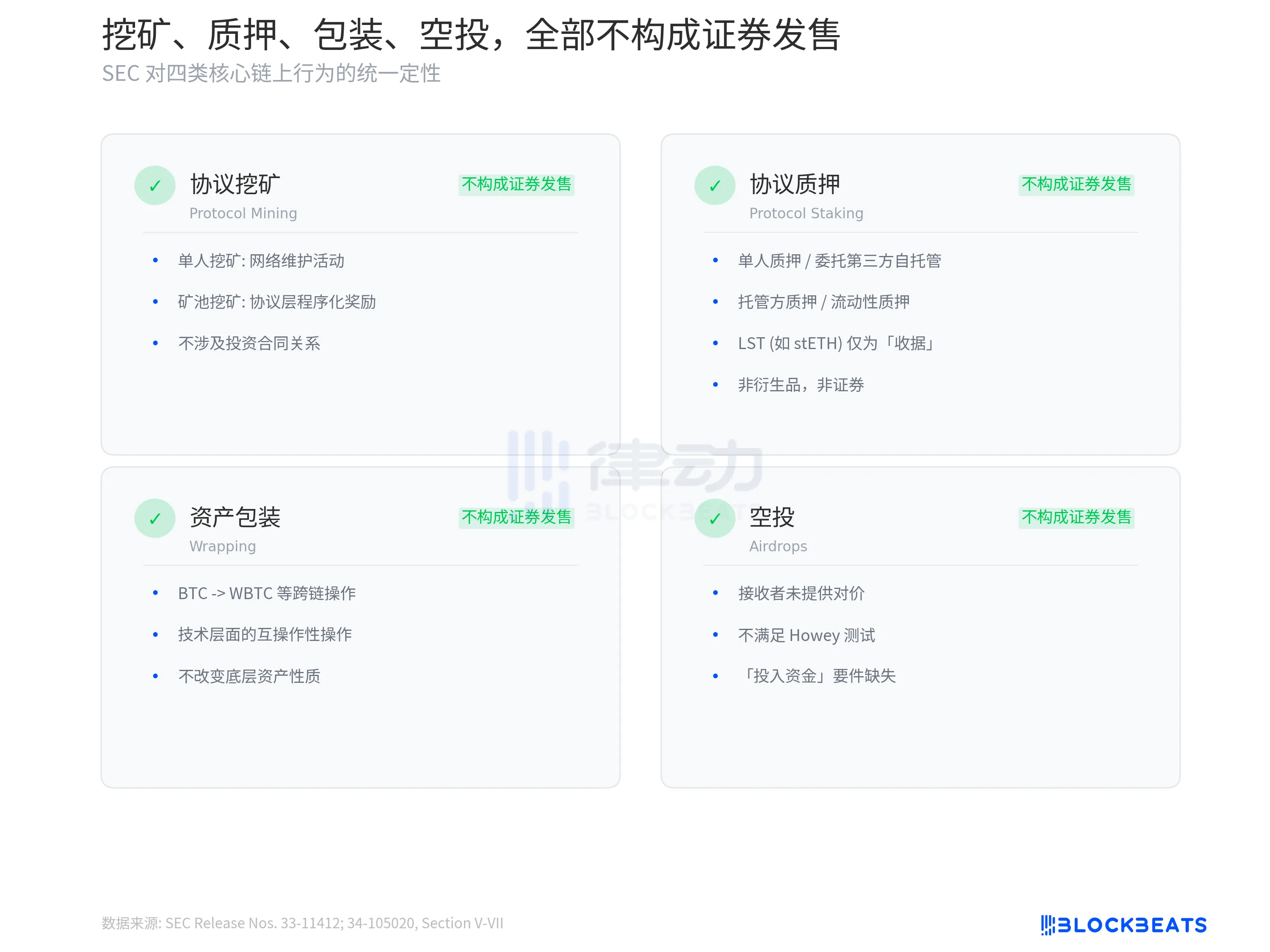
Protocol Mining does not constitute a securities offering. Whether individual mining or joining a mining pool, mining activity itself is considered network maintenance, and the newly minted tokens are a protocol-level programmatic reward, not involving any investment contract relationship.
Protocol Staking does not constitute a securities offering. This determination covers four scenarios: individual staking, self-custody with delegation, delegation to a custodian for staking, and liquidity staking. The SEC expressly states in the document that staking rewards come from the protocol's predetermined programmatic allocation, rather than from the operational efforts of a specific management team. For LST generated from liquidity staking (e.g., stETH), the SEC considers them merely as "receipts" of the underlying staked assets, not classified as derivatives, and not constituting securities.
Asset Wrapping does not constitute a securities offering. Wrapping BTC into WBTC for use on Ethereum is merely a technical interoperability operation and does not alter the nature of the underlying asset.
Airdrops do not constitute a securities offering. As long as recipients do not provide funds, goods, or services as consideration, the free distribution of tokens does not meet the "investment of money" element of the Howey Test.
These determinations have a direct impact on the industry, as core mechanisms of DeFi protocols, such as staking, wrapping, and airdropping, have all been removed from the scope of securities law. Over the past three years, every project offering staking services or distributing airdrops has faced concerns, and now there is a unified answer from federal regulators.
Security Status Is Not a Permanent Label
Perhaps the most worthy section of this document for close reading is the SEC's explanation of the "Separation" mechanism. The document clearly states that a crypto asset that is not itself a security can be subject to securities regulation based on its method of issuance (e.g., through an investment contract). However, when the conditions of the investment contract are no longer met, the asset can be "separated" from its security status.
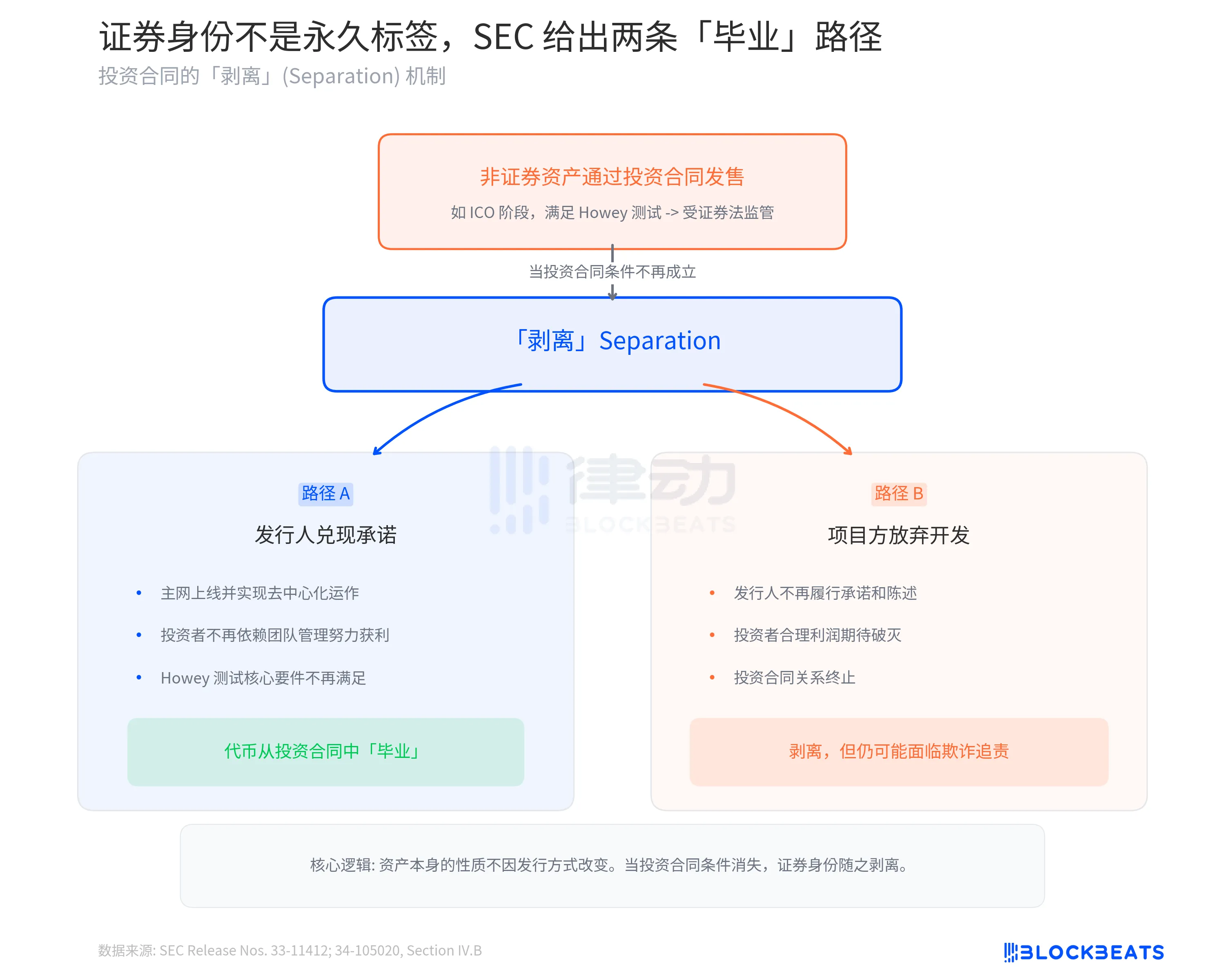
The SEC provides two scenarios for separation. The first is when the issuer fulfills their promises. For example, if a project promised to develop a decentralized network during an ICO and the network later goes live and operates in a decentralized manner, investors no longer rely on the efforts of the issuing team to profit, thus failing to meet the core requirement of the Howey Test, and the token "graduates" from the investment contract.
The second scenario is more interesting, as it involves the project team "abandoning" the project. If the issuer fails to fulfill the promises and statements made in the investment contract, and investors' reasonable expectations of "efforts of others" bringing profits are shattered, the investment contract is likewise terminated. However, the SEC emphasizes that this does not mean the issuer can escape liability, as they may still face fraud charges.
The true significance of this "Separation" mechanism is that it provides a compliant path for crypto projects. From ICO to mainnet launch to full decentralization, it is no longer an adventurous journey through legal gray areas but a regulatory tunnel with a clear endpoint. Once completed, you're out.
68 pages. Nine chapters. 18 tokens singled out, six categorized on-chain behaviors, two "graduation" paths. The SEC spent over a year collecting over 300 comment letters, and ultimately, in collaboration with the CFTC, handed in this response. It is not perfect; the boundaries of stablecoins still have gray areas, no specific examples were given under the "digital securities" category, and the assessment criteria for hybrid assets remain open to interpretation.
But for an agency that has been criticized in the past for its "regulation by enforcement" approach, this document at least does one thing: It puts the rules down on paper instead of in enforcement actions.
You may also like

US AI Startup Goes All In on Chinese Mega-Model | Rewire News Morning Brief

Trump Lies Again: A "Five-Day Pause" Psyop, How Wall Street, Bitcoin, and Polymarket Insiders Synced Uposciogen

When a Token Becomes Labor, People Become the Interface

Ceasefire News Leaked Ahead of Time? Large Polymarket Bets on Outcome Before Trump's Tweet

BlackRock CEO's Annual Shareholder Letter: How is Wall Street Using AI to Keep Profiting from National Pension Funds?

Sun Valley Releases 2025 Financial Report: Bitcoin Mining Revenue Reaches $670 Million, Accelerating Transformation to AI Infrastructure Platform
On March 16, 2026, in Dallas, Texas, USA, CanGu Company (New York Stock Exchange code: CANG, hereinafter referred to as "CanGu" or the "Company") today announced its unaudited financial performance for the fourth quarter and full year ended December 31, 2025. As a bitcoin mining enterprise relying on a globally operated layout and dedicated to building an integrated energy and AI computing power platform, CanGu is actively advancing its business transformation and infrastructure development.
• Financial Performance:
Total revenue for the full year 2025 was $688.1 million, with $179.5 million in the fourth quarter.
Bitcoin mining business revenue for the full year was $675.5 million, with $172.4 million in the fourth quarter.
Full-year adjusted EBITDA was $24.5 million, while the fourth quarter was -$156.3 million.
• Mining Operations and Costs:
A total of 6,594.6 bitcoins were mined throughout the year, averaging 18.07 bitcoins per day; of which 1,718.3 bitcoins were mined in the fourth quarter, averaging 18.68 bitcoins per day.
The average mining cost for the full year (excluding miner depreciation) was $79,707 per bitcoin, and for the fourth quarter, it was $84,552;
The all-in sustaining costs were $97,272 and $106,251 per bitcoin, respectively.
As of the end of December 2025, the company has cumulatively produced 7,528.4 bitcoins since entering the bitcoin mining business.
• Strategic Progress:
The company has completed the termination of the American Depositary Receipt (ADR) program and transitioned to a direct listing on the NYSE to enhance information transparency and align with its strategic direction, with a long-term goal of expanding its investor base.
CEO Paul Yu stated: "2025 marked the company's first full year as a bitcoin mining enterprise, characterized by rapid execution and structural reshaping. We completed a comprehensive adjustment of our asset system and established a globally distributed mining network. Additionally, the company introduced a new management team, further strengthening our capabilities and competitive advantage in the digital asset and energy infrastructure space. The completion of the NYSE direct listing and USD pricing also signifies our transformation into a global AI infrastructure company."
"As we enter 2026, the company will continue to optimize its balance sheet structure and enhance operational efficiency and cost resilience through adjustments to the miner portfolio. At the same time, we are advancing our strategic transformation into an AI infrastructure provider. Leveraging EcoHash, we will utilize our capabilities in scalable computing power and energy networks to provide cost-effective AI inference solutions. The relevant site transformations and product development are progressing simultaneously, and the company is well-positioned to sustain its execution in the new phase."
The company's Chief Financial Officer, Michael Zhang, stated: "By 2025, the company is expected to achieve significant revenue growth through its scaled mining operations. Despite recording a net loss of $452.8 million from ongoing operations, mainly due to one-time transformation costs and market-driven fair value adjustments, the company, from a financial perspective, will reduce its leverage, optimize its Bitcoin reserve strategy and liquidity management, introduce new capital to strengthen its financial position, and seize investment opportunities in high-potential areas such as AI infrastructure while navigating market volatility."
The total revenue for the fourth quarter was $1.795 billion. Of this, the Bitcoin mining business contributed $1.724 billion in revenue, generating 1,718.3 Bitcoins during the quarter. Revenue from the international automobile trading business was $4.8 million.
The total operating costs and expenses for the fourth quarter amounted to $4.56 billion, primarily attributed to expenses related to the Bitcoin mining business, as well as impairment of mining machines and fair value losses on Bitcoin collateral receivables.
This includes:
· Cost of Revenue (excluding depreciation): $1.553 billion
· Cost of Revenue (depreciation): $38.1 million
· Operating Expenses: $9.9 million (including related-party expenses of $1.1 million)
· Mining Machine Impairment Loss: $81.4 million
· Fair Value Loss on Bitcoin Collateral Receivables: $171.4 million
The operating loss for the fourth quarter was $276.6 million, a significant increase from a loss of $0.7 million in the same period of 2024, primarily due to the downward trend in Bitcoin prices.
The net loss from ongoing operations was $285 million, compared to a net profit of $2.4 million in the same period last year.
The adjusted EBITDA was -$156.3 million, compared to $2.4 million in the same period last year.
The total revenue for the full year was $6.881 billion. Of this, the revenue from the Bitcoin mining business was $6.755 billion, with a total output of 6,594.6 Bitcoins for the year. Revenue from the international automobile trading business was $9.8 million.
The total annual operating costs and expenses amount to $1.1 billion.
Specifically, they include:
· Revenue Cost (excluding depreciation): $543.3 million
· Revenue Cost (depreciation): $116.6 million
· Operating Expenses: $28.9 million (including related-party expenses of $1.1 million)
· Miner Impairment Loss: $338.3 million
· Bitcoin Collateral Receivable Fair Value Change Loss: $96.5 million
The full-year operating loss is $437.1 million. The continuing operations net loss is $452.8 million, while in 2024, there was a net profit of $4.8 million.
The 2025 non-GAAP adjusted net profit is $24.5 million (compared to $5.7 million in 2024). This measure does not include share-based compensation expenses; refer to "Use of Non-GAAP Financial Measures" for details.
As of December 31, 2025, the company's key assets and liabilities are as follows:
· Cash and Cash Equivalents: $41.2 million
· Bitcoin Collateral Receivable (Non-current, related party): $663.0 million
· Miner Net Value: $248.7 million
· Long-Term Debt (related party): $557.6 million
In February 2026, the company sold 4,451 bitcoins and repaid a portion of related-party long-term debt to reduce financial leverage and optimize the asset-liability structure.
As per the stock repurchase plan disclosed on March 13, 2025, as of December 31, 2025, the company had repurchased a total of 890,155 shares of Class A common stock for approximately $1.2 million.

The US AI Startup Is Loving China's Open Source Model

Three Weeks of the US-Iran War: Who's Making Money, Who's Paying the Bill?

Interpreting Polymarket's Major Update Last Night: Fee Expansion, Self-Regulation, and New Incentives

From Human Application to Intelligent Collaboration: How GOAT Network Builds the Next Generation Digital Economy

CZ Washington Dialogue: Crypto Entrepreneurs are Accelerating Their Return to the United States

Morning Report | Strategy increased its holdings by 1,031 bitcoins last week; Katana Blockchain acquires IDEX; NYSE completes rule change to eliminate trading limits on crypto ETF options

Electric Capital: Tracking 501 types of yield-generating RWA assets, we discovered these patterns
Those who are cut off by AI will not disappear; they will become the creators of the next round of the economy

Stablecoins reshaping cross-border payments in Asia? Strategic panorama and investment opportunity analysis

Zuckerberg is building an AI agent to help him as CEO

Bloomberg: Swiss Private Bank Old Guard Rifts, Is Bitcoin the Spark?
Zuckerberg is building an AI assistant to help him be CEO
US AI Startup Goes All In on Chinese Mega-Model | Rewire News Morning Brief
Trump Lies Again: A "Five-Day Pause" Psyop, How Wall Street, Bitcoin, and Polymarket Insiders Synced Uposciogen
When a Token Becomes Labor, People Become the Interface
Ceasefire News Leaked Ahead of Time? Large Polymarket Bets on Outcome Before Trump's Tweet
BlackRock CEO's Annual Shareholder Letter: How is Wall Street Using AI to Keep Profiting from National Pension Funds?
Sun Valley Releases 2025 Financial Report: Bitcoin Mining Revenue Reaches $670 Million, Accelerating Transformation to AI Infrastructure Platform
On March 16, 2026, in Dallas, Texas, USA, CanGu Company (New York Stock Exchange code: CANG, hereinafter referred to as "CanGu" or the "Company") today announced its unaudited financial performance for the fourth quarter and full year ended December 31, 2025. As a bitcoin mining enterprise relying on a globally operated layout and dedicated to building an integrated energy and AI computing power platform, CanGu is actively advancing its business transformation and infrastructure development.
• Financial Performance:
Total revenue for the full year 2025 was $688.1 million, with $179.5 million in the fourth quarter.
Bitcoin mining business revenue for the full year was $675.5 million, with $172.4 million in the fourth quarter.
Full-year adjusted EBITDA was $24.5 million, while the fourth quarter was -$156.3 million.
• Mining Operations and Costs:
A total of 6,594.6 bitcoins were mined throughout the year, averaging 18.07 bitcoins per day; of which 1,718.3 bitcoins were mined in the fourth quarter, averaging 18.68 bitcoins per day.
The average mining cost for the full year (excluding miner depreciation) was $79,707 per bitcoin, and for the fourth quarter, it was $84,552;
The all-in sustaining costs were $97,272 and $106,251 per bitcoin, respectively.
As of the end of December 2025, the company has cumulatively produced 7,528.4 bitcoins since entering the bitcoin mining business.
• Strategic Progress:
The company has completed the termination of the American Depositary Receipt (ADR) program and transitioned to a direct listing on the NYSE to enhance information transparency and align with its strategic direction, with a long-term goal of expanding its investor base.
CEO Paul Yu stated: "2025 marked the company's first full year as a bitcoin mining enterprise, characterized by rapid execution and structural reshaping. We completed a comprehensive adjustment of our asset system and established a globally distributed mining network. Additionally, the company introduced a new management team, further strengthening our capabilities and competitive advantage in the digital asset and energy infrastructure space. The completion of the NYSE direct listing and USD pricing also signifies our transformation into a global AI infrastructure company."
"As we enter 2026, the company will continue to optimize its balance sheet structure and enhance operational efficiency and cost resilience through adjustments to the miner portfolio. At the same time, we are advancing our strategic transformation into an AI infrastructure provider. Leveraging EcoHash, we will utilize our capabilities in scalable computing power and energy networks to provide cost-effective AI inference solutions. The relevant site transformations and product development are progressing simultaneously, and the company is well-positioned to sustain its execution in the new phase."
The company's Chief Financial Officer, Michael Zhang, stated: "By 2025, the company is expected to achieve significant revenue growth through its scaled mining operations. Despite recording a net loss of $452.8 million from ongoing operations, mainly due to one-time transformation costs and market-driven fair value adjustments, the company, from a financial perspective, will reduce its leverage, optimize its Bitcoin reserve strategy and liquidity management, introduce new capital to strengthen its financial position, and seize investment opportunities in high-potential areas such as AI infrastructure while navigating market volatility."
The total revenue for the fourth quarter was $1.795 billion. Of this, the Bitcoin mining business contributed $1.724 billion in revenue, generating 1,718.3 Bitcoins during the quarter. Revenue from the international automobile trading business was $4.8 million.
The total operating costs and expenses for the fourth quarter amounted to $4.56 billion, primarily attributed to expenses related to the Bitcoin mining business, as well as impairment of mining machines and fair value losses on Bitcoin collateral receivables.
This includes:
· Cost of Revenue (excluding depreciation): $1.553 billion
· Cost of Revenue (depreciation): $38.1 million
· Operating Expenses: $9.9 million (including related-party expenses of $1.1 million)
· Mining Machine Impairment Loss: $81.4 million
· Fair Value Loss on Bitcoin Collateral Receivables: $171.4 million
The operating loss for the fourth quarter was $276.6 million, a significant increase from a loss of $0.7 million in the same period of 2024, primarily due to the downward trend in Bitcoin prices.
The net loss from ongoing operations was $285 million, compared to a net profit of $2.4 million in the same period last year.
The adjusted EBITDA was -$156.3 million, compared to $2.4 million in the same period last year.
The total revenue for the full year was $6.881 billion. Of this, the revenue from the Bitcoin mining business was $6.755 billion, with a total output of 6,594.6 Bitcoins for the year. Revenue from the international automobile trading business was $9.8 million.
The total annual operating costs and expenses amount to $1.1 billion.
Specifically, they include:
· Revenue Cost (excluding depreciation): $543.3 million
· Revenue Cost (depreciation): $116.6 million
· Operating Expenses: $28.9 million (including related-party expenses of $1.1 million)
· Miner Impairment Loss: $338.3 million
· Bitcoin Collateral Receivable Fair Value Change Loss: $96.5 million
The full-year operating loss is $437.1 million. The continuing operations net loss is $452.8 million, while in 2024, there was a net profit of $4.8 million.
The 2025 non-GAAP adjusted net profit is $24.5 million (compared to $5.7 million in 2024). This measure does not include share-based compensation expenses; refer to "Use of Non-GAAP Financial Measures" for details.
As of December 31, 2025, the company's key assets and liabilities are as follows:
· Cash and Cash Equivalents: $41.2 million
· Bitcoin Collateral Receivable (Non-current, related party): $663.0 million
· Miner Net Value: $248.7 million
· Long-Term Debt (related party): $557.6 million
In February 2026, the company sold 4,451 bitcoins and repaid a portion of related-party long-term debt to reduce financial leverage and optimize the asset-liability structure.
As per the stock repurchase plan disclosed on March 13, 2025, as of December 31, 2025, the company had repurchased a total of 890,155 shares of Class A common stock for approximately $1.2 million.


 App
App