
ACT Flash Crash Night: When Exchange Circuit Breaker Turns into a Short-Selling Bullet

Original Article Title: "Decrypting the Triple Labyrinth Behind ACT's Flash Crash, Has Exchange Risk Control Become a 'Nuclear Button'?"
Original Article Author: Frank, PANews
A routine contract rule adjustment by Binance unexpectedly exposed the most vulnerable sore spot in the crypto market.
On April 1st, a flash crash event that collectively halved the value of low-market-cap tokens like ACT in half an hour brought the exchange risk control mechanisms, market maker algorithm strategies, and the fatal flaws of the MEME coin ecosystem into the spotlight simultaneously.
Despite Binance's emergency response blaming "whale selling," the cliff-like evaporation of 75% of the contract positions, the precise synchronous price fluctuations of multiple currencies, and the mysterious on-chain dump by market maker Wintermute after the crash, all revealed a deeper industry vulnerability in this dilemma. In the current environment of weak liquidity, exchanges attempting to patch up system risks may instead become the final straw that crushes the market.
Half-Hour Flash Crash of Multiple Tokens
On April 1st at 15:32, Binance released an announcement regarding the adjustment of leverage and margin tier of multiple U-based perpetual futures contracts, involving several trading pairs such as 1000SATSUSDT, ACTUSDT, PNUTUSDT, NEOUSDT, NEOUSDC, etc. Based on the content of this adjustment, it mainly focused on adjusting the contract trading position limits and leverage margin ratios of these tokens. Taking ACT as an example, the pre-adjustment position limit was a maximum of $4.5 million, which was reduced to a maximum of $3.5 million after the adjustment. The announcement indicated the adjustment time was 18:30.

At 18:30 on the same day, ACT plummeted from $0.1899 to $0.0836 within 36 minutes, a 55% drop, sparking intense discussions in the market.
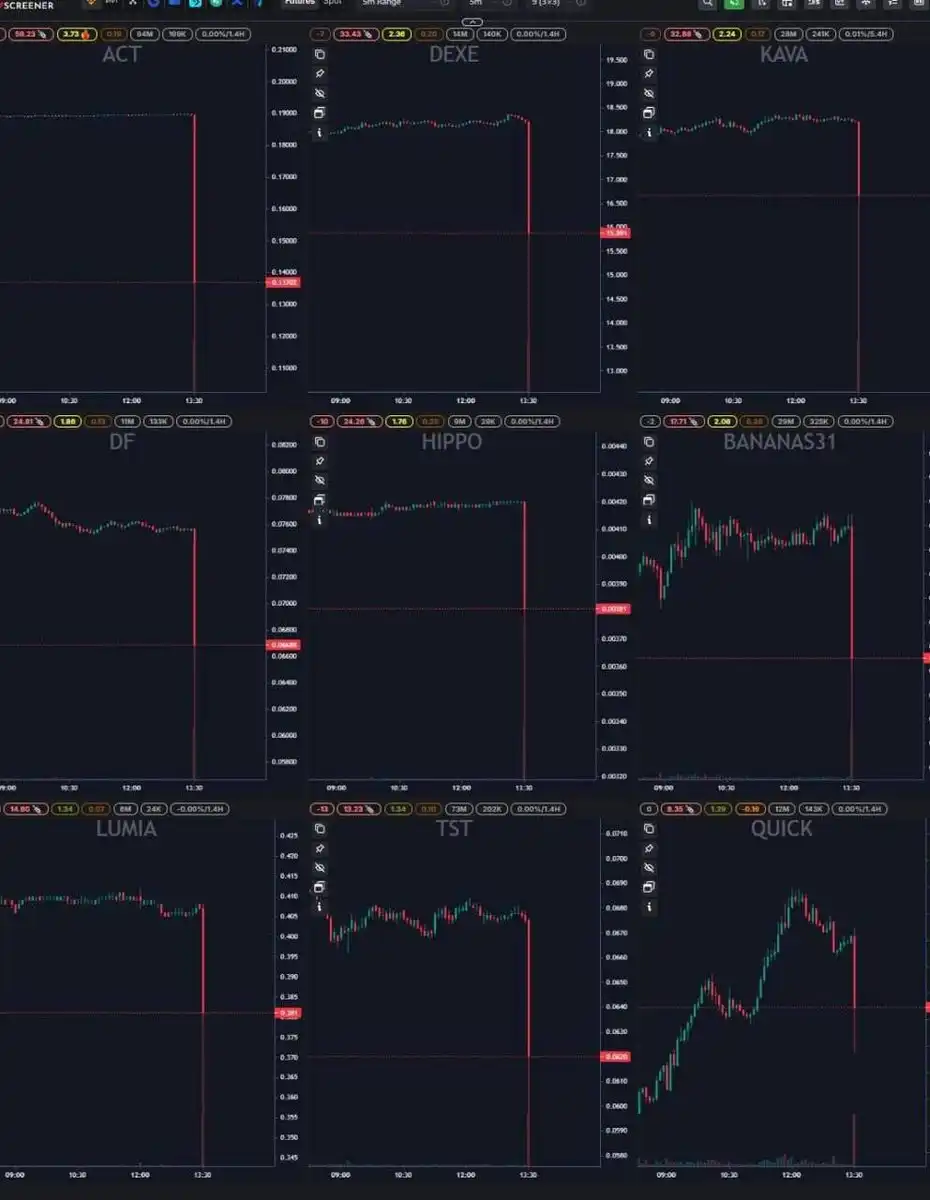
Almost simultaneously with ACT, several low-market-cap tokens on Binance such as TST, HIPPO, DEXE, PNUT experienced flash crash events to varying degrees, with price drops ranging between 20% to 50%. Market data shows that 18:30 became the starting point for a cliff-like drop in prices of multiple tokens, extending far beyond a single project, demonstrating clear synchronicity.
Specifically, this adjustment reduced the maximum position size one could hold with leverage. For example, previously, with a certain leverage, you could hold $1 million worth of a token, but now with the rule change, you may only be able to hold a maximum of $800,000. If users did not voluntarily close their positions, the system would forcibly liquidate the excess positions at market price when the rule took effect. Therefore, a significant drop in contract prices could occur within a short time frame, triggering a cascading event.
In response, a significant amount of discussion was sparked on social media, with @terryroom2014 pointing out, "18:30 Binance contract positions plunged, with the exchange actively liquidating large holders, leading to a price crash"; @yinshanguancha believed that "Market Makers were forcibly liquidated due to insufficient margin, and the rule adjustment was the catalyst." Most users pointed their fingers at Binance's rule adjustment, believing that lowering the position limit triggered forced liquidation, subsequently causing panic selling and a market stampede effect.
Some users also speculated that this was due to ACT's Market Makers actively dumping the price, with @Web3Tinkle noting that ACT's position on Binance decreased by $73 million in just 15 minutes, suggesting that the project team and Market Makers instantly dumped their holdings to harvest the market.
In response, Binance's co-founder He Yi stated during an interaction on Platform X that when asked whether the sharp drop in ACT was due to Binance modifying the contract rules, He Yi responded that the "team is preparing the details for a reply."
Approximately 2 hours later, Binance released a preliminary investigation report on the incident, stating that this ACT's decline was mainly due to three VIP users and one non-VIP user selling about $1.05 million worth of spot tokens in a short period, causing the price drop and affecting the decline of other tokens. In summary, Binance's response believes that the main reason for this short-term plunge was the large holders selling off, rather than Binance's rule adjustments.
Exchange Risk Control: Overcorrection or Market Maker Liquidation for Self-Protection?
This market flash crash event inevitably brings back memories of the recent Hyperliquid lightning attack incident. On March 26, Decentralized Exchange Hyperliquid encountered a trader exploiting a liquidity design flaw to cascade a huge short order onto the platform by withdrawing collateral, nearly causing a loss of over tens of millions of dollars to Hyperliquid's treasury.
Perhaps taking a cue from the Hyperliquid event, Binance attempted to mitigate risks by lowering the parameters for low-cap tokens in contracts, but inadvertently triggered a market minefield beforehand.
In addition to Binance's rule adjustment seemingly serving as the catalyst, Market Maker Wintermute was also suspected as the mastermind behind the scenes. On one hand, the rule adjustment by Binance had the most significant impact on the Market Maker group. @CnmdRain analyzed, "This adjustment particularly affects Market Makers (MM) because they usually rely on high leverage and large positions to maintain market liquidity and earn spread profits."
Prior speculation by Ember indicated that Wintermute may be the market maker for ACT (having received 9.482 million ACT tokens from the ACT community wallet in November 2024) and, following a sharp decline in ACT's price, Wintermute withdrew multiple batches of ACT tokens from the Binance exchange and sold them on-chain.

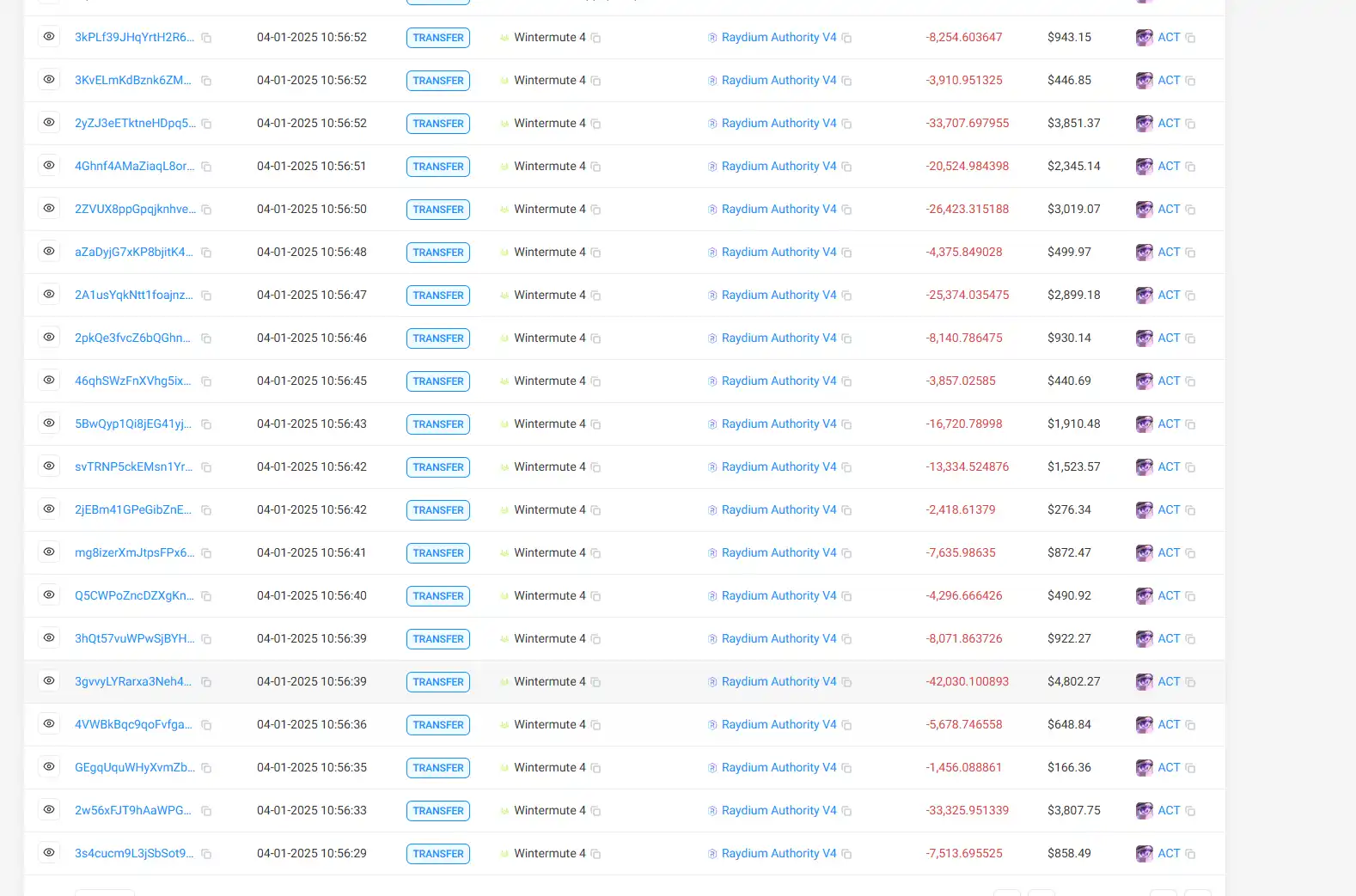
In response to this, Wintermute's founder, Evgeny Gaevoy, stated that the company was not involved in the orchestrated operation behind the meme coin crash of ACT and only arbitrated the AMM liquidity pool after significant price fluctuations. He emphasized that Wintermute was not the party responsible for triggering the market turbulence this time and is currently monitoring the developments post-event.
Faced with this tumultuous event, the ACT team also responded by initiating an investigation, collaborating with relevant parties to address the issue, and working with trusted partners to devise a response plan together.
Can 75% Asset Disappearance be Explained by "Whale Dump"?
So far, all parties involved in this flash crash event seem to have responded promptly and distanced themselves from any responsibility. However, there are still many questions lingering.
Firstly, Binance's initial investigation report appears to lack credibility. Binance's report suggests that the ACT token's decline was linked to three VIP users and one non-VIP user dumping large amounts of ACT tokens. However, this does not mean that every token's decline was driven by similar user sell-offs. For the ACT token, user sell-offs may be the direct cause of ACT's decline, while the underlying reasons for multiple token declines seem to still be somewhat related to this rule adjustment.
CoinGlass data shows that at 18:30, Binance's ACT contract holdings plummeted by 75%, and similar situations were observed in the holdings of several other tokens mentioned in adjustment announcements. This is hard to explain as solely caused by individual whale spot sell-offs.
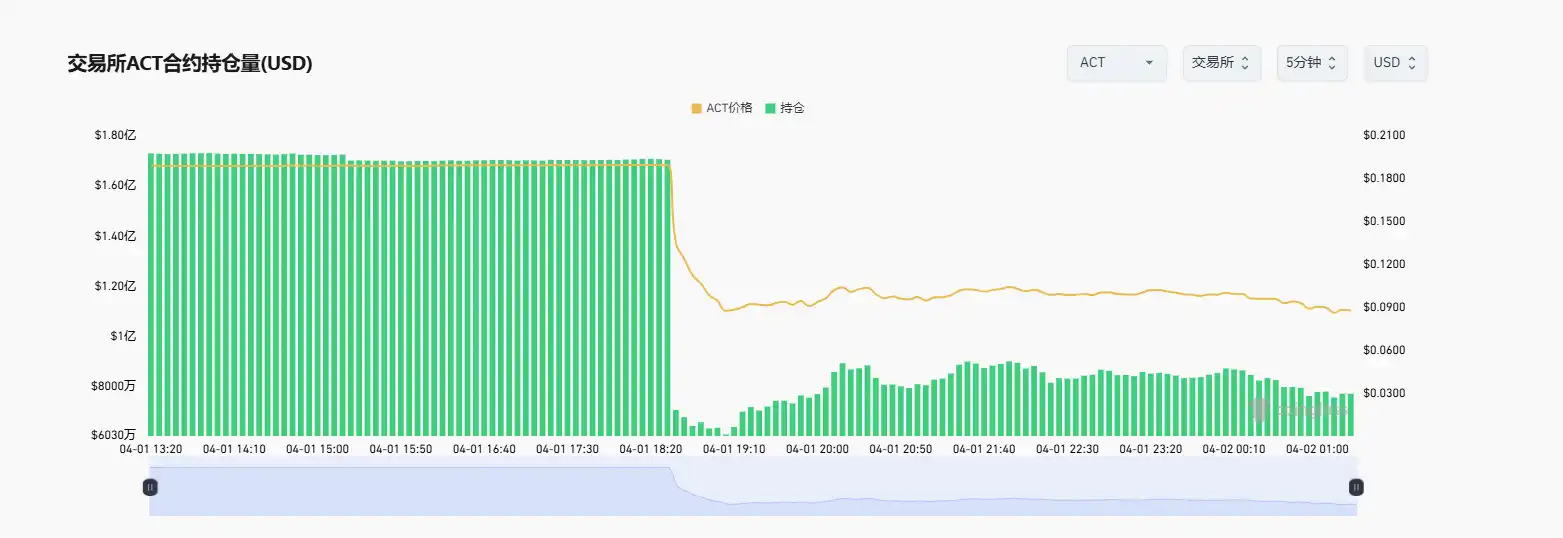
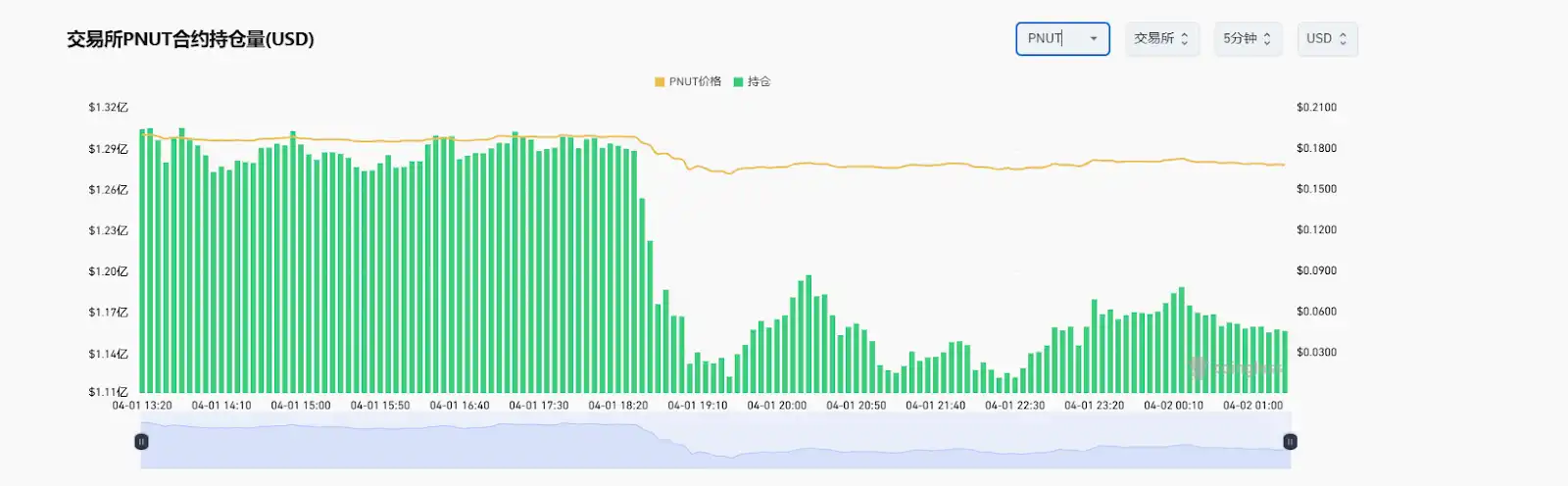
Secondly, however, this decline does not seem to be entirely due to the rule adjustment. From the trends of several tokens, ACT experienced the most significant drop, while other tokens undergoing the same adjustments, such as 1000SATS, also saw declines but not as extreme as ACT's. Additionally, another token, DEXE, that experienced a significant drop is not part of this adjustment. Tokens like MEW, which are listed for adjustment, did not fall as a result but rather began an upward trend.
Third, was Wintermute's exit a coincidence or intentional? During the ACT crash, Wintermute sold off multiple holdings of MEME tokens, causing varying degrees of flash crashes in the prices of these tokens. Some social media users speculated that the main reason for this decline was that Wintermute's algorithmic bots ran into issues due to rule constraints.
Overall, this brief flash crash seems to be more comprehensively explained as a trigger point where Binance adjusted some token contract position rules, leading to algorithmic bots of market makers like Wintermute failing to adjust promptly.
However, regardless of the specific cause of this flash crash, the market/user always ends up holding the bag.
According to Coinglass data, following the ACT flash crash, ACT contracts liquidated $8.71 million, ranking third globally (only behind Bitcoin and Ethereum). Moreover, users holding spot assets also suffered halving of their assets and seemed to have difficulty recovering in a short period.
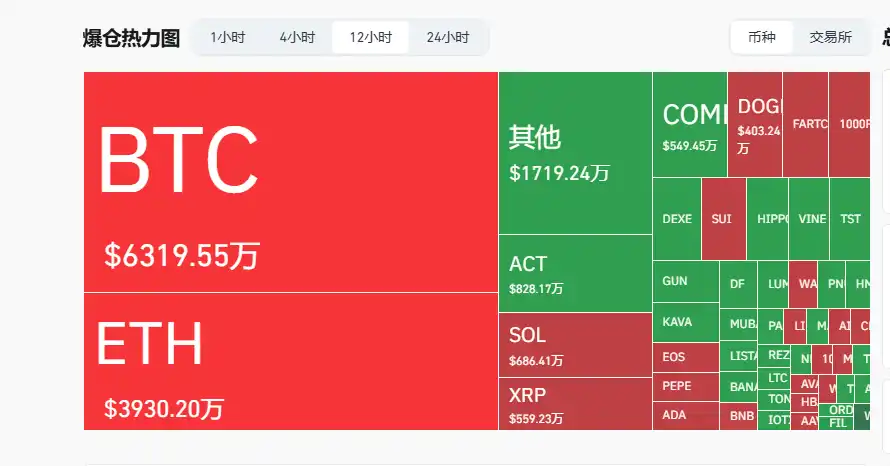
Overall, there are several underlying reasons for this flash crash. First, after the Hyperliquid incident, exchanges began to pay more attention to the risk of whale manipulation in the market and started making adjustments. While this was supposed to be a good move, it inadvertently triggered another stampede. Second, due to the cooling of the MEME market, related tokens became fragile and sensitive in terms of trading depth and sentiment. Hence, once an abnormal trade occurred, it exposed the reality that MEME tokens lack substantial value support.
This multi-million-dollar crypto market "April Fool's Day Nightmare" ultimately concluded with an "responsibility shifting" agreement among exchanges, market makers, and project teams. However, the warning buried within is far more chilling than what meets the eye. While this flash crash may not have a clear "culprit," it exposed the most fundamental rule of survival in the crypto market: within the intricate system built by institutions and whales, retail investors often become passive bearers of systemic fluctuations.
You may also like

What is the connection between Huang Zheng of Pinduoduo and blockchain?

Morning Report | Prediction market platforms like Kalshi and Polymarket jointly sue Kentucky over 14.25% trading tax; Bridgewater founder discusses decision-making in the AI era: principled thinking should run parallel to AI, human insight remains irre...

If the AI bubble has already burst, who will truly remain?

Paul Graham: How to Make a Billion Dollars

After 18 years, blockchain has finally started to head towards the main channel

Claude enforces "facial recognition for household registration," starting in July, no ID card means no access?

On the day of SpaceX's IPO, the first real test of the three perpetual mechanisms

Value Distribution of Stablecoins
Galaxy Deep Dive: Is the Bitcoin Four-Year Cycle Still Valid?

SpaceX IPO, Nvidia, and Bitcoin: Why Traders Are Watching More Than Just Crypto in 2026

The other side of Musk's trillion-dollar fortune: 85% cannot be sold

The U.S. government prohibits foreigners from using Fable 5, Anthropic issues a rebuttal

Citibank releases "2030 Asset Tokenization Market Outlook": 6 major trends may create a $8.2 trillion market

The trillion-dollar valuation test: Are the three major super IPOs a celebration for tech stocks or a nightmare for the crypto market?
Morning Report | Digital Asset completes $355 million financing led by a16z Crypto; Meta completes operational separation from Manus
a16z Crypto Partner: Cash flow is the moat

Cryptocurrency market makers collectively seek change as it becomes increasingly difficult to make money

How TradeXYZ, xStocks, and Alpaca break down the SpaceX IPO into three different strategies
What is the connection between Huang Zheng of Pinduoduo and blockchain?
Morning Report | Prediction market platforms like Kalshi and Polymarket jointly sue Kentucky over 14.25% trading tax; Bridgewater founder discusses decision-making in the AI era: principled thinking should run parallel to AI, human insight remains irre...
If the AI bubble has already burst, who will truly remain?
Paul Graham: How to Make a Billion Dollars
After 18 years, blockchain has finally started to head towards the main channel
Claude enforces "facial recognition for household registration," starting in July, no ID card means no access?

Popular coins
Latest Crypto News


