
Behind the Base FUD Storm: Over $2.5 Billion in Net Inflows in the Past 3 Months, TVL Surpasses Solana


Original Article Title: "Behind the Base Mudslinging: Over $25 Billion in Net Fund Inflows in the Past 3 Months, TVL Exceeds $14.2 Billion Surpassing Solana"
Original Article Author: Frank, PANews
Historically, many public blockchains have liked to label their competitors as Solana, but it seems that no one has been able to truly threaten Solana. However, recently, Solana co-founder Toly seems very willing to engage in a debate with Base's co-founder. At the same time, in recent times, the Base ecosystem has seen explosive growth in various aspects of data, with multiple metrics not only leading in the L2 sector but also surpassing Solana in TVL, fund inflows, and other data.
It seems that Base is actually Solana's biggest potential rival. PANews reviewed Base's recent data and compared it with Solana, exploring whether Base's rise is a real threat or just another false alarm.
Continuous Battle of Wits Between the Two Co-founders
On January 6th, Solana's co-founder Toly commented on social media, suggesting that Base's development has not truly brought growth to the Ethereum ecosystem but that Coinbase is actually draining the Ethereum ecosystem through Base. In response to this statement, Base's founder Jesse retaliated on social media, stating that Base and Ethereum do not have a zero-sum competitive relationship. Base, just like other L2 solutions, is developing within the overall roadmap of Ethereum, and as Base grows, Ethereum also grows and strengthens.
Toly then made an analogy, stating that just as Google and Microsoft's competition has contributed to Linux, the value capture is separate. Therefore, no Fortune 500 company uses a single accounting method to attribute Base's activity to Ethereum but all account for it under the Coinbase company. The $2.15 million in revenue generated by Base is also only paying $59,000 to the Ethereum mainnet.
It may seem like Toly is speaking out for ETH not capturing value from Base, but in reality, the behind-the-scenes of this debate may be unrelated to the competition between Base and Ethereum but rather about the competition between Solana and Base. Although there are many competitors to Solana in the market, such as those positioning themselves as Sui, Aptos, or Hyperliquid, competitors of Solana. From the Solana team's perspective, their biggest competitor may be Base.
As early as December, Pudgy Penguins announced the issuance of a token on Solana, setting a new daily transaction record on the Solana network with 66.9 million transactions on the day of the launch. During this process, Jesse also made a public statement, saying, "Both I and the Base community will warmly welcome Pudgy Penguin and its token PENGU," which was seen by the community as a public move to compete with Solana.
In addition, there have been back-and-forth exchanges between the two in various discussions. For example, Yuga Labs co-founder Garga.eth criticized the Ethereum ecosystem, which received Jesse's dissatisfaction, while Toly added fuel to the fire by commenting below: "Bridging ETH to Solana, I absolutely do not oppose ETH becoming the best currency on Solana." Previously, Jesse has also made several statements comparing Base to Solana.
Base TVL and Inflow Surpass Solana
Behind the verbal battles of the two is the underlying data flow between Base and Solana. PANews compared several key data metrics of Base and Solana over the past year, revealing that while Base's overall data currently lags behind Solana, Base's growth rate is clearly outpacing Solana. If this rate of development continues, Base is likely to surpass Solana in terms of data within 1 to 2 years.
PANews selected several commonly used metrics for public chain comparison, such as daily active addresses, transaction counts, TVL, etc. The data covers changes from a year ago to January 10, 2025.
First, looking at the changes in Base's data, a year ago, Base had a daily transaction count of approximately 338,000, a daily active address count of about 61,200, and a TVL of around $830 million. These figures were equivalent to approximately 1.48%, 11.29%, and 63.85% of Solana at that time, respectively.
As of January 10, 2025, Base's data has changed to a daily transaction count of approximately 11.1 million, a daily active address count of about 811,200, and a TVL of around $14.2 billion. The current ratios of these three metrics to Solana are: 17.59%, 12.88%, and 167.06%.
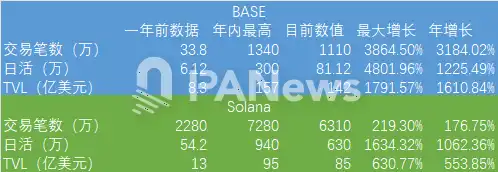
The annual growth rates of these three metrics for Base were 3184.02%, 1225.49%, and 1610.84%, respectively. Whereas, during the same period, Solana saw growth rates of 176.75%, 1062.36%, and 553.85% for these three metrics.
It can be observed that after a year of development, Base still lags behind Solana in terms of transaction volume and daily active users. However, in terms of Total Value Locked (TVL), Base has successfully overtaken Solana. Interestingly, to celebrate this achievement, Jesse and other key team members shaved their heads live on January 9th.

Looking at the growth rates of other metrics, Base's growth momentum is also more aggressive compared to Solana. If both parties maintain their current growth rate, Base may surpass Solana in terms of transaction volume in a year.
Aside from these data points, a more important indicator is quietly undergoing a change. For most of the past year, Solana was the network with the highest inflow of funds. However, data from the last three months shows that Base has become the public chain with the highest net inflow of $25 billion, while Solana ranks second with a net inflow of $9 billion.
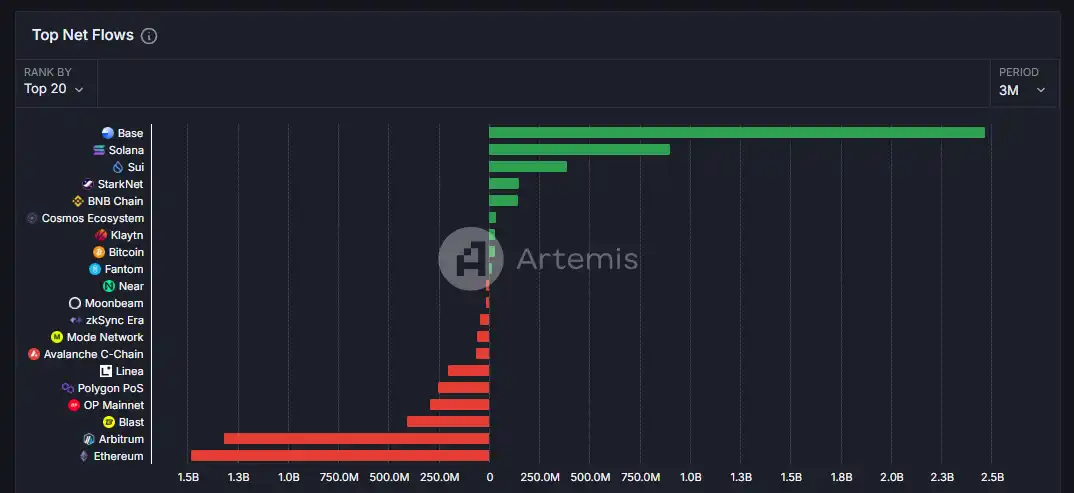
The main shift in this data may have occurred recently, with the net inflow in the past year totaling around $38 billion, of which the net inflow in the last three months ($25 billion) accounts for 65% of the annual total.
From Elections to Virtuals, Base is Closing in with AI
From the perspective of detailed changes, this is indeed the case. Base's TVL volume seems to have experienced significant growth starting from November 3. However, this is not unique to Base, as Arbitrum also saw a wave of rapid development during the same period.
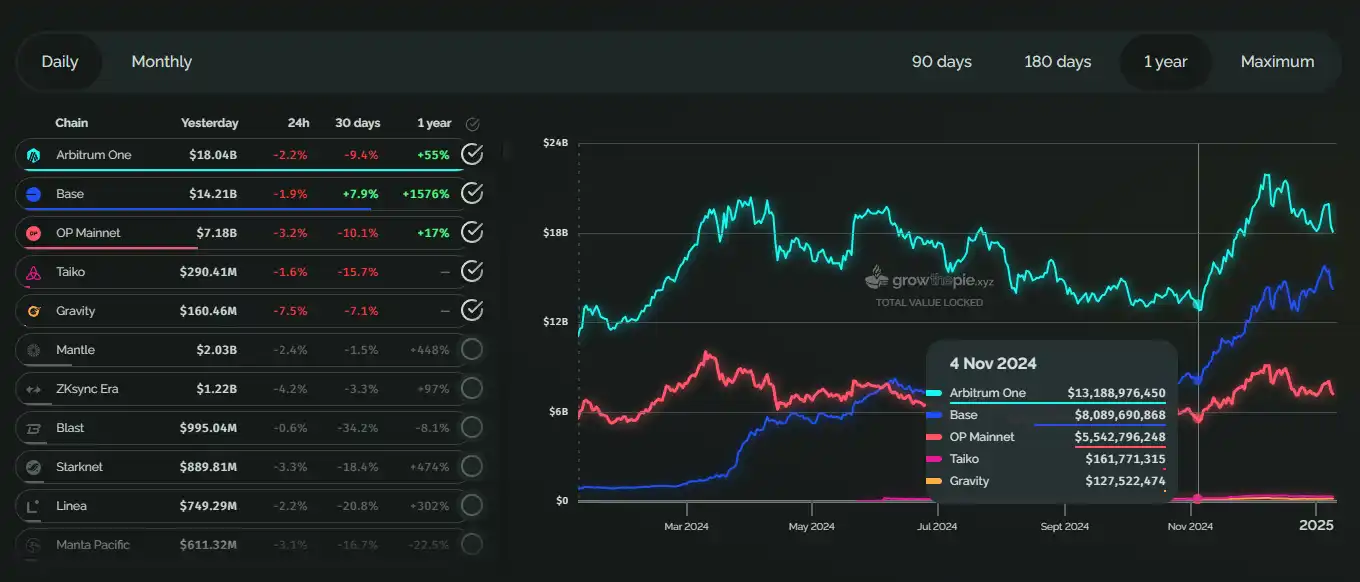
The main reason behind this growth wave may mainly stem from the overall market growth brought about by Trump's re-election after the U.S. election. Over the past month, the main reason Base has attracted attention is that after a long period of competing with Solana in the MEME track, a product finally emerged to rival it — Virtuals Protocol.
Various networks have quietly released their Pump.fun imitations, but most have gone unnoticed. Virtuals Protocol has finally seized the opportunity of the AI Agent trend, becoming the most popular AI Agent one-click launch platform. This has given birth to several AI Agent tokens with market values exceeding billions, such as aixbt and G.A.M.E.
According to Dexscreener data, on January 11th, the DEX trading volume on Solana was $68.8 billion, with 5324 newly created pools in the past 24 hours. The Base trading volume was $21.2 billion, with 2673 new trading pairs added in the last 24 hours. The gap between the two in the MEME field is gradually narrowing, and Base seems to be the only one capable of approaching Solana's popularity in the MEME arena.
However, Sui also had a brief period of explosive growth in the past. Still, after the heat subsided, it inevitably fell silent again. Base's relative advantage lies in the stronger effect of its capital immobilization compared to Sui. Therefore, as long as the TVL volume does not plummet drastically, perhaps this heat can still be maintained.
By comparing the data, it can be seen that Base is becoming Solana's strongest competitor. However, the issue lies in Base always lacking its governance token, making it difficult to be market-priced. The absence of a native token also allows Virtuals protocol to receive more capital overflow effects on the Base public chain. To address this issue, on January 4th, Base developer Jesse Pollak tweeted that Coinbase is considering offering tokenized COIN stocks on its Base network to its U.S. users.
If this goal can be achieved, perhaps the most significant meaning is not that the RWA field has added another important asset, but that the value brought by Base's development can finally be more directly reflected in Coinbase's stock price. For investors who can only participate in cryptocurrency trading, this can be seen as an indirect way to participate in Base's governance and enjoy dividends. Judging by Base's current data performance, the market value of the tokenized version should be above tens of billions of dollars. On January 11th, Coinbase's market cap was approximately $64.7 billion, a value that ranks below BNB and SOL in the cryptocurrency world. It remains to be seen if, once the on-chain capital flows into Base, Coinbase's market cap can surpass BNB and SOL.
You may also like

Morning Report | OpenAI has submitted an S-1 registration statement draft to the U.S. SEC; Morpho completes $175 million financing

Galaxy Deep Research Report: How Hyperliquid's HIP-4 Upgrade Changes the Landscape of Prediction Markets?

Latest research from 13 top universities including Cornell University: The current state, challenges, and misconceptions of the fusion of Crypto and AI

Deconstructing Anthropic: The Best AI Company, Possibly Also a Type of Organizational Invention

Every exchange is a "Universal Exchange."

The counterattack of traditional finance: Alliance chains are quietly reviving
Pantera Capital Partner: How Tokenization is Restructuring the Private Equity and Early Investment Ecosystem?

Mastercard Launches Agent Pay for AI, Plans to Record AI Agent Payment Authorizations on Polygon
Mastercard launched Agent Pay for AI, a new payment protocol designed to help AI agents make small payments such as pay-per-use access to data and APIs. The system plans to record human-granted AI agent permissions on Polygon, focusing on verifiable authorization, identity, and payment controls.

Curve Deploys Llamalend v2 on Optimism With 250,000 OP Incentives
Curve launched Llamalend v2 on Optimism with 250,000 OP incentives from the Optimism Foundation. The upgrade expands Llamalend beyond its earlier crvUSD-focused model, adding broader collateral support, LlamaRisk market reviews, and the ability to use Curve LP tokens as collateral.

Raydium Old Liquidity Pool Reportedly Exploited, With $1.34 Million Moved to Ethereum and Tornado Cash
An old Raydium liquidity pool was reportedly exploited for around $1.34 million in USDC, RAY, and wSOL, with the stolen funds bridged to Ethereum and deposited into Tornado Cash. The incident highlights the tail risks of legacy DeFi pools, old contracts, and cross-chain fund laundering paths.
Kalshi Executive Challenges “SBF Backed AI Unicorns” Narrative, Says Leopold Aschenbrenner Was Key Figure
Kalshi executive John Wang questioned the “SBF backed AI unicorns” narrative, saying Leopold Aschenbrenner was the key figure behind major AI investment decisions.

New York Proposes Stricter Stablecoin Issuer Rules Aligned With Federal GENIUS Act
NYDFS proposed stricter stablecoin issuer rules aligned with the GENIUS Act, covering reserves, custody, redemption timelines, audits, and capital buffers.

CryptoQuant Says Bitcoin Profitable Supply Is Near 45% Pressure Zone as On-Chain Data Points to Market Repricing
CryptoQuant said Bitcoin’s profitable supply is nearing the 45% pressure zone, signaling rising market stress, unrealized losses, and a possible on-chain repricing phase.

Bitcoin Falls Below 200-Week Moving Average as On-Chain Data Shows Over Half of Supply in Loss
Bitcoin dropped below its 200-week moving average as on-chain data showed over 50% of circulating supply is now in loss, signaling rising market stress.

CFTC Reportedly Plans New Prediction Market Rules Focused on Manipulation Risk and Public Interest Review
The CFTC is reportedly preparing new prediction market rules focused on manipulation risk, public interest review, and retail trader protections.

Meet the new WEEX trial fund—your gateway to greater profits

WEEX Labs Lands at Dutch Blockchain Week: A Disruptive Crypto × AI Conversation Sets Sail in Amsterdam
SK Hynix Reportedly Plans U.S. ADR Listing as Early as August, With SEC Approval Possible in Late June
SK Hynix may pursue a U.S. ADR listing as early as August, with SEC approval reportedly possible in late June amid strong AI chip supply chain demand.
Morning Report | OpenAI has submitted an S-1 registration statement draft to the U.S. SEC; Morpho completes $175 million financing
Galaxy Deep Research Report: How Hyperliquid's HIP-4 Upgrade Changes the Landscape of Prediction Markets?
Latest research from 13 top universities including Cornell University: The current state, challenges, and misconceptions of the fusion of Crypto and AI
Deconstructing Anthropic: The Best AI Company, Possibly Also a Type of Organizational Invention
Every exchange is a "Universal Exchange."
The counterattack of traditional finance: Alliance chains are quietly reviving


