
Bitcoin Turns 16: From Zero to $100,000, a Retrospective of BTC's Evolution


Original Article Title: "From Worthless to $2 Trillion Market Cap, the 16-Year Evolution of Bitcoin"
Original Source: Hualihualwai
If we were to choose the best-performing asset of the past decade and a half, undoubtedly, Bitcoin would be at the top of the list. Data shows that over the past 11 years, Bitcoin has been the best-performing asset class for 8 years, as shown in the graph below.
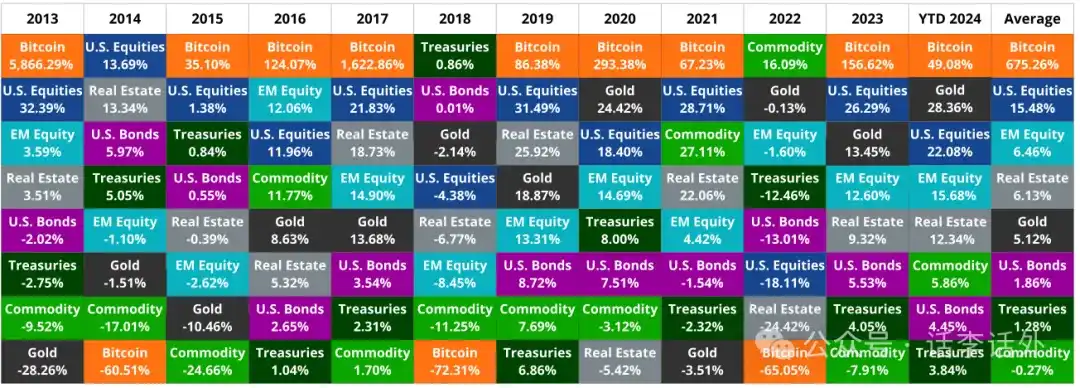
So, how did Bitcoin grow from being virtually worthless to a market cap exceeding $2 trillion? On the occasion of Bitcoin's 16th anniversary, let's take a moment to review the evolution of Bitcoin over the past 16 years:
(1) In 2009, Bitcoin Was Worth $0
On January 3, 2009 (2:15 AM Beijing time on January 4, 2009), Satoshi Nakamoto, on a small server in Helsinki, Finland, personally created the first block, known as the Genesis Block of Bitcoin, and received the system-generated reward of the first 50 bitcoins, thus bringing the first Bitcoin into the world. As shown in the image below.
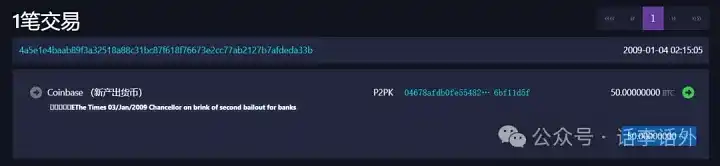
At the same time, Satoshi Nakamoto embedded a message:
「The Times 03/Jan/2009 Chancellor on brink of second bailout for banks」
This deliberate reference to The Times' headline seems to reflect Satoshi's commentary on the economic challenges at the time and the potential need for an alternative financial system.
(2) In 2010, Bitcoin Reached a Peak Value of $0.5
On May 22, 2010, Bitcoin received its first market-value recognition, as on that day, a Bitcoin enthusiast named Laszlo Hanyecz used 10,000 bitcoins in his possession to purchase two pizzas. As shown in the image below.

At that time, the market value of these two pizzas was $30. If we calculate based on this value, then the price of 1 BTC would be equivalent to $0.003. This highly commemorative experimental attempt was also the first time BTC was priced in the real world, and later, people began celebrating May 22nd as "Bitcoin Pizza Day."
Entering the summer of 2010, Bitcoin began to see limited exchange/trading activities within a very niche circle of technical experts and financial enthusiasts, with the BitcoinTalk forum being the main platform for discussion and interaction among these individuals.
In July 2010, Mt. Gox (mentioned later in this text) was launched. Around this time, Bitcoin finally had its own "exchange price." By October of the same year, the price of Bitcoin had risen to $0.1, reaching a peak of $0.5 in November before dropping back to $0.3, a price that was maintained until the year's end.
In January 2010, Bitcoin's price was $0, in December 2011, it was $0.3, and the highest price that year was $0.5.
(3) In 2011, Bitcoin reached its highest value of $31.9
In January 2011, the Bitcoin trading price surpassed $1 for the first time, which was later featured and reported by Forbes magazine, marking a significant milestone. This event catalyzed the price of Bitcoin, which by the end of May 2011 had soared to $8.89.
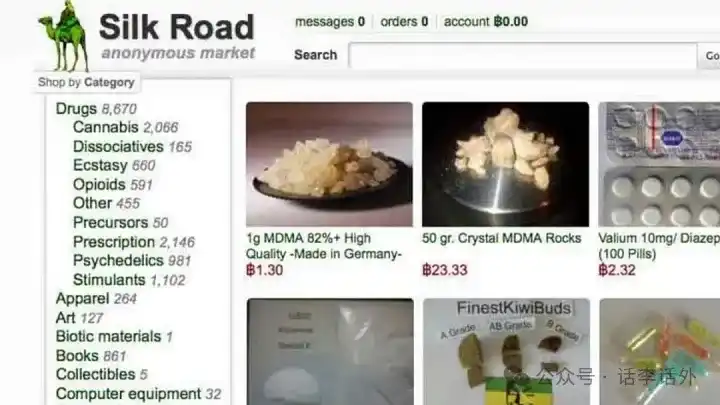
On June 1st of the same year, Gawker, a U.S.-based gossip website (which closed in 2016), published an article stating that Bitcoin was gaining popularity on the Silk Road website. This further fueled Bitcoin's surge to $27, with the total market value of all Bitcoins in circulation reaching $130 million.
Note: The website Silk Road may be sensitive; interested individuals can Google it for more information. The site belonged to the Hei Market exchange website and operated from 2011 to 2013, allowing users to anonymously buy and sell various services or goods using Bitcoin, as shown in the image below. This certainly brought Bitcoin to a wider audience at the time but was also a controversial website. In October 2013, the U.S. FBI arrested the site's operator and shut down its operations, seizing a large amount of Bitcoin in the process.
In January 2011, the opening price of Bitcoin was $0.3, the closing price in December 2011 was $4.7, and the highest price of that year was $31.9.
(4)In 2012, Bitcoin reached its highest value of $15.4
In June 2012, Coinbase was officially established. That year, there were only a few exchanges providing Bitcoin trading, such as Mt. Gox and Bitstamp. On November 28 of the same year, Bitcoin went through its first halving, reducing the block reward from 50 BTC to 25 BTC. This event laid the foundation for Bitcoin's value by driving scarcity.
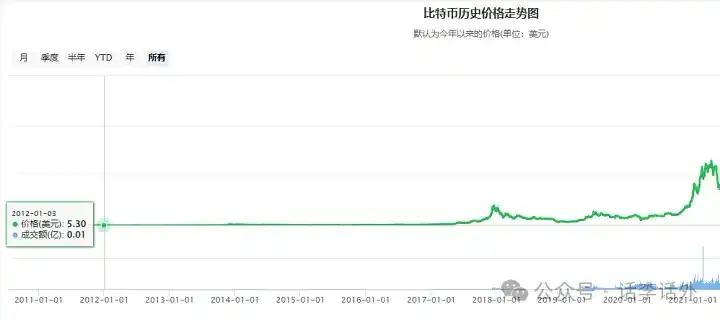
In January 2012, the opening price of Bitcoin was $4.7, the closing price in December 2012 was $13.5, and the highest price of that year was $15.4.
(5)In 2013, Bitcoin reached its highest value of $1156.14
On November 30, 2013, Bitcoin broke $1000 for the first time and reached $1156.14, marking Bitcoin's first major bull run. In the same year, Mt. Gox quickly rose to become the largest exchange at the time. At that time, almost 7 out of every 10 Bitcoin transactions were conducted on Mt. Gox.
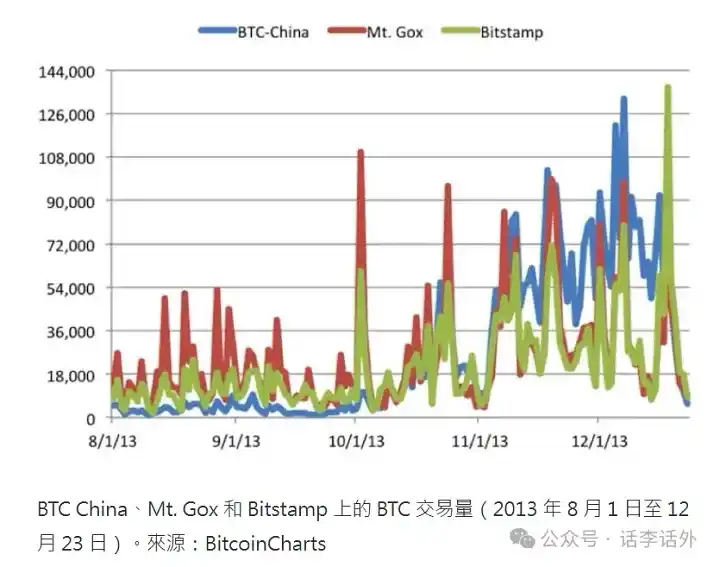
In January 2013, the opening price of Bitcoin was $13.5, the closing price in December 2013 was $754.01, and the highest price of that year was $1156.14.
(6)In 2014, Bitcoin reached its highest value of $1017.12
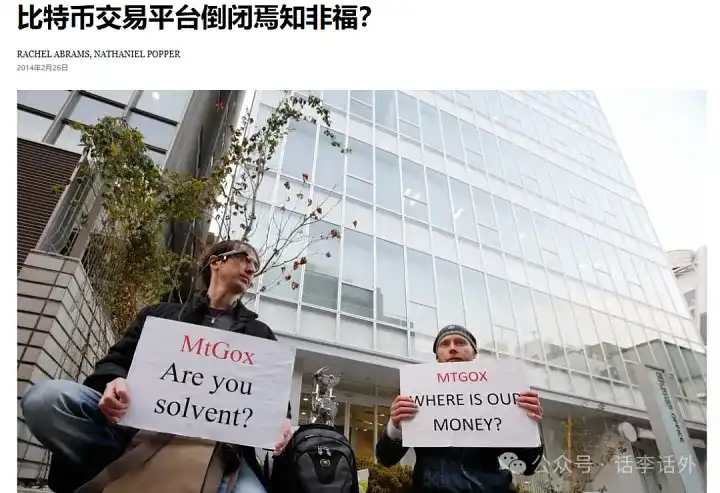
One of the key events of that year was the collapse of Mt. Gox. In February 2014, Mt. Gox announced bankruptcy due to a hack that led to the theft of 850,000 Bitcoins. This event had a significant impact on Bitcoin at the time, resulting in a prolonged price decline and widespread concerns about cryptocurrency security. It also sparked protests from some Bitcoin holders at that time, as shown in the image below.
It was also in the same year that innovations such as multi-signature wallets began to go mainstream. In early 2014, only 0.02% of Bitcoin utilized this encryption technology for security. By the end of the year, this number had increased to 5%. Within a year, the daily Bitcoin transaction volume using multi-signature also increased by 79 times.
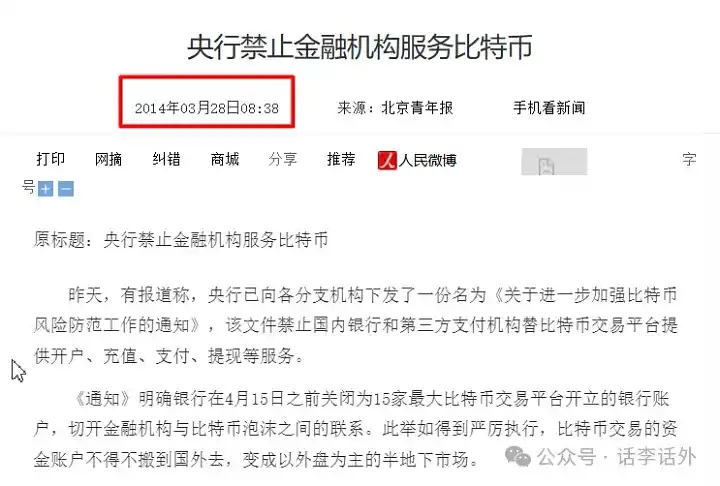
It was in March of the same year that the People's Bank of China issued the "Notice on Further Strengthening the Prevention of Bitcoin Risks," requiring banks and third-party payment institutions to close the accounts of domestic Bitcoin trading platforms. As shown in the image below.
The opening price of Bitcoin in January 2014 was $754.97, the closing price in December 2014 was $320.19, and the highest price of the year was $1017.12.
(7) The highest price of Bitcoin in 2015 was $495.56
This year was also the first true bear market for Bitcoin, but the price of Bitcoin continued to rise, indicating that Bitcoin was attracting more and more attention. Some individuals and institutions were starting to prepare for the next wave of encryption. As shown in the image below.
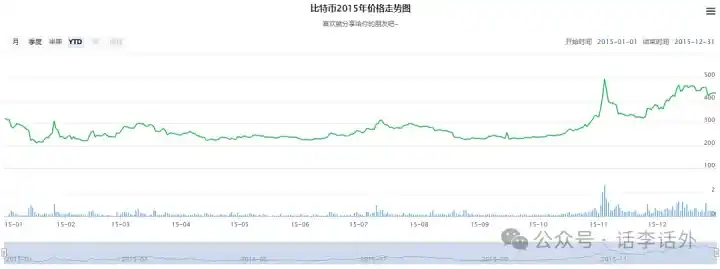
The opening price of Bitcoin in January 2015 was $320.43, the closing price in December 2015 was $430.57, and the highest price of the year was $495.56.
(8) The highest price of Bitcoin in 2016 was $979.40
On July 9, 2016, Bitcoin underwent its second halving, reducing the block reward from 25 BTC to 12.5 BTC. On April 28 of the same year, the popular gaming platform Steam announced it would accept Bitcoin as payment.
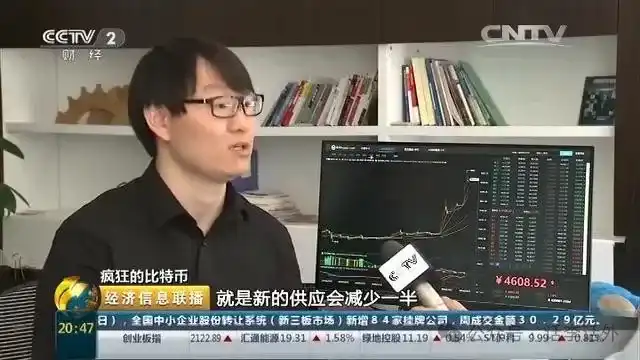
During this year, Bitcoin even made an appearance on CCTV, with Li Lin from Huobi being interviewed by CCTV, as shown in the image below.
Furthermore, it was also in this year that as the community focused on SegWit and the Lightning Network, the scalability debate of Bitcoin continued to escalate, laying the foundation for Bitcoin's future development.
The opening price of Bitcoin in January 2016 was $430.72, the closing price in December 2016 was $963.74, and the highest price of the same year was $979.40.
(9)The highest value of Bitcoin in 2017 was $20,089
In this year, Bitcoin ushered in its second bull market since its inception, also the largest crypto bull market people had experienced at that time. The price of Bitcoin successfully broke through $20,000 this year, with a full-year increase of 1984.66%. It was during this bull market that Big Whale officially entered this circle and got in touch with Bitcoin. I remember that the first transaction was just a tentative purchase of 2,000 RMB worth of pastries.
Additionally, many significant events took place this year, such as:
On August 1, 2017, Segregated Witness was successfully activated, and Bitcoin's first fork coin (Bitcoin Cash) emerged.
On September 4, 2017, the People's Bank of China and six other departments jointly issued the "Announcement on Preventing the Risks of Token Issuance Financing," classifying ICOs as illegal financial activities and suspending all related transactions in China. Later, this day was also referred to as the "94" event in the crypto world.
On September 14, 2017, six ministries once again issued a joint announcement to shut down all domestic cryptocurrency exchanges and prohibit them from providing channels for RMB-to-cryptocurrency exchanges. Subsequently, exchanges went offshore one after another, ushering in a new era of coin-to-coin and OTC trading.
On December 11, 2017, CBOE (Chicago Board Options Exchange) conducted futures trading with XBT as Bitcoin's code, marking the world's first Bitcoin futures listing.
On December 17, 2017, Bitcoin broke through its then all-time high, reaching $20,089.
During this bull market, due to Bitcoin's skyrocketing price and the ICO wealth generation movement, many stories of sudden wealth emerged, bringing global attention to Bitcoin.
Additionally, in this year, there were significant changes in the exchange ranking battle. In addition to Huobi and OKCoin originating from the 2013 bull market, exchanges represented by Binance were also established, presenting an era of flourishing exchanges.
In January 2017, the opening price of Bitcoin was $963.66, the closing price in December 2017 was $14,156.40, and the highest price of that year was $20,089.
(10)In 2018, Bitcoin reached its highest value of $17,712.40
With the collapse of the ICO craze, which signaled the end of the first round of speculative frenzy, and the price decline or extinction of thousands of altcoins, the crypto market ushered in a new bear market cycle. This year was also referred to by many as the "crypto winter." However, despite this, the price of Bitcoin remained relatively stable. As shown in the chart below.
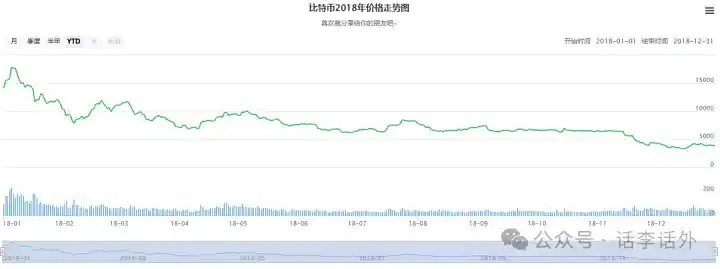
In January 2018, the opening price of Bitcoin was $14,112.20, the closing price in December 2018 was $3,742.70, and the highest price of that year was $17,712.40.
From Satoshi Nakamoto's release of the Bitcoin whitepaper in 2008 to this year, Bitcoin has exactly gone through 10 years. Despite many twists and turns during this period, it seems that the world can no longer stop Bitcoin.
(11)In 2019, Bitcoin reached its highest value of $13,796.49
With the Lightning Network going live on the Bitcoin mainnet in March 2018, by 2019, some people had started paying attention to the Lightning Network, which could make Bitcoin payments faster and cheaper. However, the Bitcoin market in this year was quite challenging, with prices fluctuating alongside significant industry events, seemingly constantly attempting bull-bear conversions.
2019 was also known to many as the Year of DeFi, with various DeFi products and business models emerging rapidly, including MakerDAO, Compound, dYdX, and more.
Additionally, some significant events took place that year, such as:
In January 2019, Binance initiated a new round of fundraising frenzy, a model also known as 1EO (Initial Exchange Offerings), marking the beginning of a new fundraising model in the crypto space. As shown in the chart below.
In June 2019, following the exposure of the Plus Token wallet (a Chinese project) exit scam, the first Ponzi scheme in the crypto world collapsed. You can Google the story of the Plus Token Ponzi scheme for more information.
In November 2019, Canaan Inc. from Hangzhou (founded in 2013 and then the world's second-largest Bitcoin mining machine manufacturer) went public on Nasdaq, finally taking the first step for cryptocurrency to enter the traditional capital market, also known as the first blockchain stock.
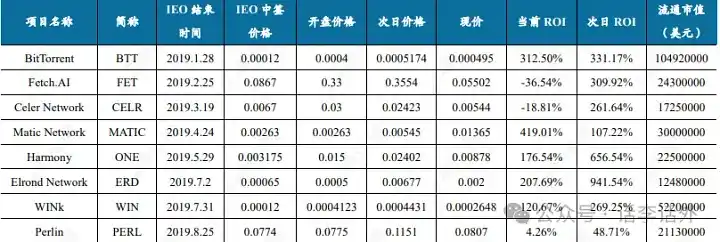
In January 2019, Bitcoin opened at a price of $3,746.71, closed in December 2019 at $7,193.60, with the highest price of the year being $13,796.49.
(12)In 2020, Bitcoin reached a peak value of $29,244.88
Entering 2020, amidst the uncertainty brought to the global economy by the COVID-19 pandemic, the crypto market began to witness another crucial moment. Bitcoin started to shine like digital gold, increasingly being seen as "digital gold." As the Federal Reserve printed trillions of dollars to combat the pandemic, some investors turned to Bitcoin as a new financial force capable of hedging against inflation.
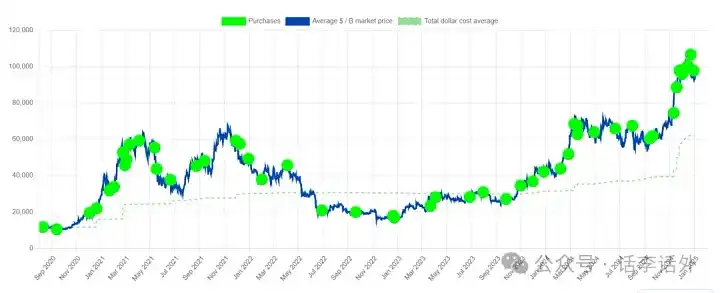
It was also in this year that MicroStrategy started buying Bitcoin, triggering a wave of global corporate adoption of Bitcoin. This year also became the long-awaited year for institutional funds to flow into Bitcoin.
Moreover, the DeFi craze (DeFi Summer) also began in this year, initially led by Maker. Later, with Compound launching its governance token COMP in June, the DeFi landscape changed, triggering a frenzy of "yield farming." In September of the same year, Uniswap also conducted a large-scale airdrop.
Additionally, an event worth mentioning is the OKEx (now OKX) incident in October 2020. It was revealed that OKEx's founder, Star Xu, had been taken away by the domestic police for investigation, leading the OKEx platform to halt user withdrawals. In response to this news, the mainstream cryptocurrencies plummeted, with BTC briefly dropping below $11,200. (I actually used OK quite frequently before. However, after this incident, I stopped using this exchange for a long time. But with Xu Mingxing's subsequent internationalization, the rebranding of OKX, and OK seizing the wallet layout opportunity for 2023, the user base of OK has been growing steadily.)
In January 2020, the opening price of Bitcoin was $7,194.89, the closing price in December 2020 was $29,001.72, and the highest price of the year was $29,244.88.
(13)In 2021, Bitcoin reached its peak value at $68,789.63
2021 was also the third major bull market for Bitcoin. Bitcoin hit (approached) $69,000 in this year, setting a new all-time high.
At the same time, many significant events occurred during this year, such as:
Elon Musk was very active during this bull run. On January 29, 2021, Musk changed his Twitter bio to "#bitcoin," causing the price of Bitcoin to surge by 18% to $38,000 on that day. Under Musk's influence, DOGE also skyrocketed by over 16,000.00% and successfully gained popularity. I remember that even those who had not previously paid attention to the crypto market began discussing DOGE.
On February 8, 2021, Tesla announced that it had purchased $1.5 billion worth of Bitcoin and stated that it would consider accepting Bitcoin as payment for its products (cars). On the day this news broke, the price of Bitcoin reached a high of $56,563.72.
On April 13, 2021, Coinbase went public on the Nasdaq stock exchange, becoming the first publicly traded cryptocurrency company in the United States.
Starting in May 2021, China launched a series of strong regulatory measures against cryptocurrency, including:
On May 18, three industry associations issued a notice on preventing speculation in virtual currency trading, leading to the infamous "5/19" crash, where the price of Bitcoin plummeted by 40% in a single day, reaching a low of $30,000.
On May 21, the Financial Stability and Development Committee of the State Council held its 51st meeting and emphasized the crackdown on Bitcoin mining and trading activities to prevent individual risks from spreading to the broader society.
On May 26, the Development and Reform Commission of Inner Mongolia Autonomous Region published the "Eight Measures to Resolutely Crack Down on and Punish Illegal Virtual Currency Mining Activities" on its official website.
On June 9, the Development and Reform Commission of Changji Hui Autonomous Prefecture in Xinjiang issued a notice to immediately stop production and rectify enterprises engaged in virtual currency mining.
On June 9, the Qinghai Province Department of Industry and Information Technology issued a "Notice on Cleaning up and Rectifying Virtual Currency 'Mining' Projects" and carried out clean-up and rectification of relevant virtual currency mining activities.
On June 18, the Sichuan Provincial Development and Reform Commission and the Sichuan Provincial Energy Bureau issued a "Notice on Cleaning up and Shutting down Virtual Currency 'Mining' Projects."
On June 21, the People's Bank of China issued an announcement, interviewing Industrial and Commercial Bank of China, Agricultural Bank of China, China Construction Bank, Postal Savings Bank of China, Industrial Bank, Alipay, and other banks and payment institutions. Subsequently, major banks and Alipay responded one after another, stating "they will resolutely not engage in or participate in any business activities related to virtual currency."
On June 9, 2021, the South American country of El Salvador passed a law to make Bitcoin legal tender in the country. El Salvador is also the world's first country to grant Bitcoin legal tender status.
On November 10, 2021, the price of Bitcoin reached a historic high of $68,790.
In January 2021, the opening price of Bitcoin was $28,994.01, and in December 2021, the closing price of Bitcoin was $46,306.45, with the highest price of the year reaching $68,789.63.
(14)The highest value of Bitcoin in 2022 was $48,086.84
During this year, the price of Bitcoin continued to decline, and the cryptocurrency market once again entered a bear market. Due to the collapse of Luna/UST and FTX, people's confidence was greatly shaken, creating a sense of a prolonged bear market. However, it was also during this year that I decided to do something publicly, eventually choosing the path of self-media and founding the self-media IP, "Talk Outside of the Box."
A few things that left a deep impression on me this year:
Many people around me left this circle, and various communities began to feel lifeless. During this year, I chose to exit and block all circle and group messages, spending most of my time quietly writing and publishing articles.
On February 24, 2022, the Russia-Ukraine war broke out.
From May 7 to May 13, 2022, the algorithmic stablecoin leader UST experienced two separate uncouplings, ultimately entering a death spiral, leading to the collapse of LUNA and UST.
On July 14, 2022, the well-known crypto lending platform Celsius fell into a vicious cycle of insolvency and ultimately filed for bankruptcy protection.
On July 2, 2022, Three Arrows Capital filed for bankruptcy protection.
On November 9, 2022, FTX Exchange experienced a complete collapse and filed for bankruptcy on November 11. At that time, I was also using this exchange, but had already withdrawn most of my assets prior to this event, so I did not incur significant losses.
In a comprehensive review, 2022 can be considered one of the most turbulent years in the history of the crypto market. However, opportunities often arise from despair. It was from May 2022 that we started a new round of Bitcoin's "20th Month" dollar-cost averaging plan, which we had a specific review and recap of in our previous article on January 1.
Bitcoin opened the year 2022 at a price of $46,311.74, closed the year at $16,547.50, and reached its highest price of $48,086.84 during the year.
(15)Bitcoin's highest value in 2023 is $44,705.52
For the crypto market, this year can be considered quite challenging, but for external observers, 2023 is also a year of rapid growth. Our articles, starting from obscurity with no readers, gradually turned into a circle where many like-minded partners gathered to pay attention together. In this year, we also launched the first e-book "Advanced Blockchain Thinking."
Although the market continued to experience a bear market this year, Bitcoin's fundamentals remained solid. Many people (including myself) are looking forward to the great bull market opportunities in 2024–2025, and many are also eagerly anticipating the possible approval of ETFs at that time.
In 2023, many significant events also took place, such as:
In January, the Bitcoin Ordinals protocol emerged, shortly followed by the BRC-20 concept becoming one of the year's most important new narratives.
In February, with the launch of the Blur token, the NFT market saw a small resurgence, allowing many to earn significant returns through Blur airdrops.
In March, many people received an airdrop from ARB, and Glyph gained some traction. However, most people seemed to be focused on the banking situation in the US, as the US banking industry was facing a severe run on the banks, causing bank stocks to plummet, and even leading to individual bank failures (such as the collapse of Silvergate Bank, Silicon Valley Bank, and Signature Bank).
In April, it seemed to be Hong Kong's month, as the global blockchain conference was held in Hong Kong, and Hong Kong took the opportunity to announce several favorable cryptocurrency policies. Other significant events included Ethereum's upgrades (Shanghai Upgrade and Capella Upgrade).
In May, there was a MemeCoin craze, led by Pepe the Frog (PEPE token launched on April 14, 2023), with various MemeCoins featuring different images almost dominating the attention of the entire crypto community. With PEPE successfully listing on Binance on May 6, the coin's market cap also reached an all-time high at that time.
In June, the SEC stirred things up again, but everyone seemed more concerned about whether CZ would go to jail, and some were following BlackRock's application for a spot Bitcoin ETF.
In July, Ripple won a milestone victory in its lawsuit with the SEC, and XRP's price surged from $0.47 to $0.82, hitting a new high since January 2018. As a result of this event, several tokens (such as SOL, MATIC, ADA, XLM) previously deemed securities by the SEC in the Coinbase lawsuit also saw significant gains.
In August, Grayscale also won a lawsuit against the SEC, which seemed to pave the way for BlackRock's Bitcoin spot ETF application approval, as Grayscale's victory was seen as accelerating the SEC approval trend.
In November, CZ decided to have boxed lunch again, signing a plea agreement and Binance paying a hefty $4.3 billion fine to the US Treasury Department.
December was a highlight for Glyph, as due to a large number of Ordinals trades, the Bitcoin network's daily transaction fees even exceeded Ethereum's at one point. Then, the Solana ecosystem's Meme craze began, and the MemeCoin hype triggered another get-rich-quick movement.
In January 2023, Bitcoin opened at a price of $16,547.91, closed at $42,265.19 in December 2023, and reached a high of $44,705.52 in the same year.
(16)In 2024, Bitcoin's highest value reached $108,268.45
This year, we finally welcomed the long-awaited bull market once again. The BTC ETF was officially approved in January, and Bitcoin's price also successfully surpassed $100,000 in December, marking new milestones for Bitcoin.
In the future, Bitcoin will be unstoppable. As mentioned in our previous article (January 1), the crypto field may usher in or begin to enter a new era, and each of us will be participants and witnesses.
You may also like

SpaceX vs Tesla vs xAI: Which Elon Musk Trade Has the Biggest Upside in 2026?

OpenAI Reveals It Has Confidentially Submitted an S-1 to the SEC, Keeping the Door Open for a Future IPO
On June 9, according to an OpenAI announcement, the company recently confidentially submitted a draft S-1 registration statement to the U.S. Securities and Exchange Commission (SEC), beginning the preliminary compliance process for a potential initial public offering. OpenAI said it chose to disclose this proactively because it expected the news might leak; however, the company has not yet set a specific listing timeline, and related arrangements may still take some time.

Latest research from 13 top universities including Cornell University: The current state, challenges, and misconceptions of the fusion of Crypto and AI
Deconstructing Anthropic: The Best AI Company, Possibly Also a Type of Organizational Invention
Apollo and Blackstone Reportedly Back $35 Billion Anthropic Chip Financing as Deal Details Remain Unclear
On June 9, according to currently available news alerts, Apollo and Blackstone Group participated in a $35 billion financing for an Anthropic “chip project.” Based on the original wording of the report, the funding has already been raised, but public information remains limited. The financing structure, use of proceeds, project entity, and whether Apollo and Blackstone participated through equity, debt, or project financing have not yet been disclosed.

Humanity Protocol Security Incident Escalates: More Than $31 Million Stolen From Related Addresses as Attacker Continues Selling H for ETH
On June 9, according to monitoring by Onchain Lens, more than $31 million has been stolen from addresses linked to Humanity Protocol, and the attack is still ongoing, with the hacker continuously swapping H tokens for ETH. Project founder Terence Kwok later confirmed the security incident on X, saying the issue involved a private key leak.

Bloomberg: As Bitcoin Weakens, Stablecoins and RWA Continue to Drive Expansion in Crypto Businesses
In June, Bloomberg reported that despite Bitcoin falling below $60,000 last week, wiping out about $235 billion in market value within seven days, and dropping close to 50% from last year’s peak, some core businesses in the crypto industry are still expanding, mainly in stablecoins, real-world asset tokenization (RWA), payments, and infrastructure. The report also noted that overall altcoin activity has contracted significantly: altcoin market capitalization has fallen from a peak of about $431 billion in November 2021 to around $170 billion, and among the tens of millions of tokens issued in recent years, fewer than 1,700 still maintain meaningful trading activity.

Galaxy Deep Research Report: How Hyperliquid's HIP-4 Upgrade Changes the Landscape of Prediction Markets?
Binance Research: RWA Market Expected to Expand Nearly 6x from Early 2025, with Public Equities and Onchain Payments Heating Up Together
In June, Binance Research said in its monthly market report that the real-world asset (RWA) market is expected to grow by about 589% from the beginning of 2025. Bond- and money market fund-related RWA expanded by about $6.5 billion, up 83% year over year, while publicly traded equity RWAs grew by about 422%. The report also noted that monthly crypto debit card transaction volume exceeded $747 million in May, up 48.6% year to date.

Japan to Assess a Framework for Yen Stablecoins and Crypto ETFs as Asia’s Compliant Payments Narrative Heats Up
Recently, according to the original report, Japan is considering the launch of yen stablecoins and cryptocurrency ETFs. Public information remains limited at this stage, and there is still no complete policy text, regulatory draft, or clear implementation timeline, so this is better characterized as a “policy discussion” rather than formal implementation. The original wording also noted that advancing stablecoin regulation in Asia is driving XRP usage and supporting growth in the XRPL ecosystem. However, based on currently available public information, there is not enough evidence to directly establish a clear causal relationship between this round of discussion in Japan and XRP or XRPL.

ZachXBT: Humanity private key leak and abnormal surge in H token should be viewed separately
On June 9, according to related disclosures, on-chain investigator ZachXBT posted an update on Humanity’s roughly $31 million security incident, saying that after further analyzing fund flows, he currently tends to believe the project team was not involved in an “inside job” or a self-staged attack. According to him, the official explanation about the private key leak was broadly accurate, but before the token unlock, the price of H had been artificially pushed higher, and the hacker later took advantage of that market environment; therefore, the private key leak and the earlier abnormal price pumping should be regarded as two separate and independent events. This reframing has shifted the market’s understanding of the nature of the incident. Earlier discussion around Humanity had focused on whether the team directly participated in the attack or used the security incident to cover up internal operations. ZachXBT’s latest remarks shift the focus from “whether it was self-theft” to “whether there were pre-unlock market structure issues.” He also questioned whether the team may have.

Morning Report | OpenAI has submitted an S-1 registration statement draft to the U.S. SEC; Morpho completes $175 million financing

Morning Report | BitMine increased its holdings by 126,971 ETH last week; trader Eugene announced his exit from the crypto market

Wang Chuan: How can one not feel anxious after the neighbor Old Wang made thirty times profit by investing in storage stocks? (Seven) - A quarter-century cycle
Cryptocurrency CEXs are flocking to sell US stocks, and traditional brokerages are facing an "uninvited guest."
$75 billion in foreign capital has fled, and South Korean retail investors have absorbed it all using leverage

Japan’s Three Megabanks Plan Joint Stablecoin Issuance in Fiscal 2026
MUFG, SMBC, and Mizuho reportedly plan to jointly issue fiat-pegged stablecoins in fiscal 2026, signaling Japan’s growing push into bank-led digital payment infrastructure.

Humanity Discloses H Token Dual-Chain Attack Details, With Losses on Ethereum and BSC Exceeding $36 Million
Humanity said the H token attack across Ethereum and BSC caused more than $36 million in losses after leaked ProxyAdmin keys enabled malicious contract upgrades and token minting.
SpaceX vs Tesla vs xAI: Which Elon Musk Trade Has the Biggest Upside in 2026?
OpenAI Reveals It Has Confidentially Submitted an S-1 to the SEC, Keeping the Door Open for a Future IPO
On June 9, according to an OpenAI announcement, the company recently confidentially submitted a draft S-1 registration statement to the U.S. Securities and Exchange Commission (SEC), beginning the preliminary compliance process for a potential initial public offering. OpenAI said it chose to disclose this proactively because it expected the news might leak; however, the company has not yet set a specific listing timeline, and related arrangements may still take some time.
Latest research from 13 top universities including Cornell University: The current state, challenges, and misconceptions of the fusion of Crypto and AI
Deconstructing Anthropic: The Best AI Company, Possibly Also a Type of Organizational Invention
Apollo and Blackstone Reportedly Back $35 Billion Anthropic Chip Financing as Deal Details Remain Unclear
On June 9, according to currently available news alerts, Apollo and Blackstone Group participated in a $35 billion financing for an Anthropic “chip project.” Based on the original wording of the report, the funding has already been raised, but public information remains limited. The financing structure, use of proceeds, project entity, and whether Apollo and Blackstone participated through equity, debt, or project financing have not yet been disclosed.
Humanity Protocol Security Incident Escalates: More Than $31 Million Stolen From Related Addresses as Attacker Continues Selling H for ETH
On June 9, according to monitoring by Onchain Lens, more than $31 million has been stolen from addresses linked to Humanity Protocol, and the attack is still ongoing, with the hacker continuously swapping H tokens for ETH. Project founder Terence Kwok later confirmed the security incident on X, saying the issue involved a private key leak.


