
Forbes: 2025 Shiba Inu Season Gold Rush Guide


Original Article Title: Altcoin Season 2025: A Crypto Bull Run Guide
Original Source: Forbes
Original Translation: Bitpush News
Bitcoin halving, new all-time high, and the arrival of altcoin season — is this the classic recipe for a bull market? Or perhaps not?
First, BTC halving reduces its issuance rate, leading to a supply shortage. Subsequently, BTC surges to a new all-time high, followed by the altcoin hype as investors seek higher returns, ushering in the altcoin season. Shortly after Bitcoin's most recent halving, it broke the $100,000 mark — a historic milestone. However, the altcoin market has not seen a surge yet.
Where is the usual rebound? Has the classic storyline been disrupted? The surge in institutional capital and liquidity tightening due to high interest rates, coupled with Trump's positive and bold view on cryptocurrency, have already established one thing: this cycle will be unlike any we have seen before.
What Makes This Cycle Different?
Every cycle has four stages: accumulation, uptrend, distribution, and downtrend. Although the mechanisms behind these stages are well-known, timing the market is one of the most recognized skills. You attempt to predict when we are entering a specific stage to formulate a trading strategy. However, despite cycles following predictable patterns, we also cannot forget the broader market context — cryptocurrency has undergone significant changes in the past year.
Institutional Capital
The increasing presence of institutional investors in the Bitcoin market has reshaped the dynamics of the Bitcoin market. With the emergence and growth of cryptocurrency ETFs, Bitcoin has become the world's seventh-largest asset, becoming a new choice for institutional investors. Increased participation of institutional investors usually brings greater price stability. However, for altcoins, this may not be good news. After all, volatility and major corrections can redirect capital flows back into altcoins. Reduced volatility means reduced potential returns flowing back into the altcoin market.
This year is a special one. The launch of a Bitcoin spot ETF has brought a significant influx of traditional financial capital into the cryptocurrency market. Institutional inflows into these ETFs have triggered a supply shock for Bitcoin, enhancing its dominance. The demand for Bitcoin triggered by the ETFs has a direct impact on Bitcoin's dominance, which currently stands at around 56%, an important metric often overlooked by novice traders. It measures BTC's market share relative to altcoins, providing insight into whether we are in a Bitcoin season (BTC performing well) or an altcoin season (altcoins performing well). Strong BTC dominance coupled with a stable Bitcoin price means what? Altcoin sell-off. And in this cycle, the Bitcoin spot ETF has extended Bitcoin's dominance. This new variable, absent in previous bull markets, will undoubtedly make the 2025 altcoin season unique.
Macro: Liquidity and Regulation
If you ask any CFO what the most important financial metric is, they will tell you it's liquidity.
In 2023 and 2024, U.S. rates rose to one of the highest levels in years. While it has dropped from 5.25% a year ago to 4.19% now, it's still a relatively attractive yield for risk-free assets. On the flip side, rate cuts often fuel a cryptocurrency bull market for one simple reason — they create a favorable environment for higher-risk assets to thrive. After all, a risk-free government bond with a yield of 0.11% in 2021 is as appealing as losing capital to inflation. Lower rates equal cheaper borrowing and higher liquidity, which in turn prompts investors to park funds where they can get a higher return. Where? Yes, you guessed it. Cryptocurrency.
Trump's reelection undoubtedly sent shockwaves through the crypto world. The "Bitcoin Bill" sparked intense debate in both crypto and non-crypto circles. If passed, the Senate legislation would require the Treasury and the Fed to purchase 200,000 bitcoins annually for five years, accumulating 1 million bitcoins. In other words, about 5% of the global supply. Undoubtedly, crypto-supportive regulation is a meaningful step towards widespread adoption of crypto assets, and Trump's stance has proven to be able to spark positive sentiment, as BTC hit an all-time high shortly after the future president confirmed the creation of the BTC Federal Reserve Plan.
With BTC maintaining its dominance, high rates, and U.S. support for crypto regulations, should we expect a full-blown altcoin supercycle by 2025? That's a billion-dollar question.
When Will the Season of Altcoins Come
If history has taught us anything, it's that the surge of altcoins usually follows a significant move in Bitcoin. However, estimating how significant these price fluctuations will be — or how soon altcoins will surge after Bitcoin hits an all-time high — is impossible.
David Siemer, CEO of Wave Digital Assets, said, "I don't think we're going to see a dramatic altcoin season like in 2021 anytime soon, meaning BTC's dominance will drop below 40%. But as BTC continues to rise, we will see significant gains in altcoin value."
Siemer then added, "To have an altcoin season relative to BTC like in 2021, the adoption and revenue capture of altcoins need to increase by several orders of magnitude," emphasizing that this could take at least 3 years. But once it starts, the altcoin season itself is easy to identify, as there are some quite bullish signals:
· Altcoin prices are experiencing rapid growth, outperforming Bitcoin, especially large-cap altcoins. This means that not only are altcoins as a whole on the rise, but their gains are larger than those of Bitcoin.
· Altcoin dominance is soaring, reminiscent of the altcoin season of May 2021. These tokens have claimed a dominant position in the market, with the total market capitalization of the top 100 altcoins reaching 1.3 times that of Bitcoin.
· FOMO-driven sentiment, high trading volumes, and risk-taking investors are intensifying buying pressure and price momentum.
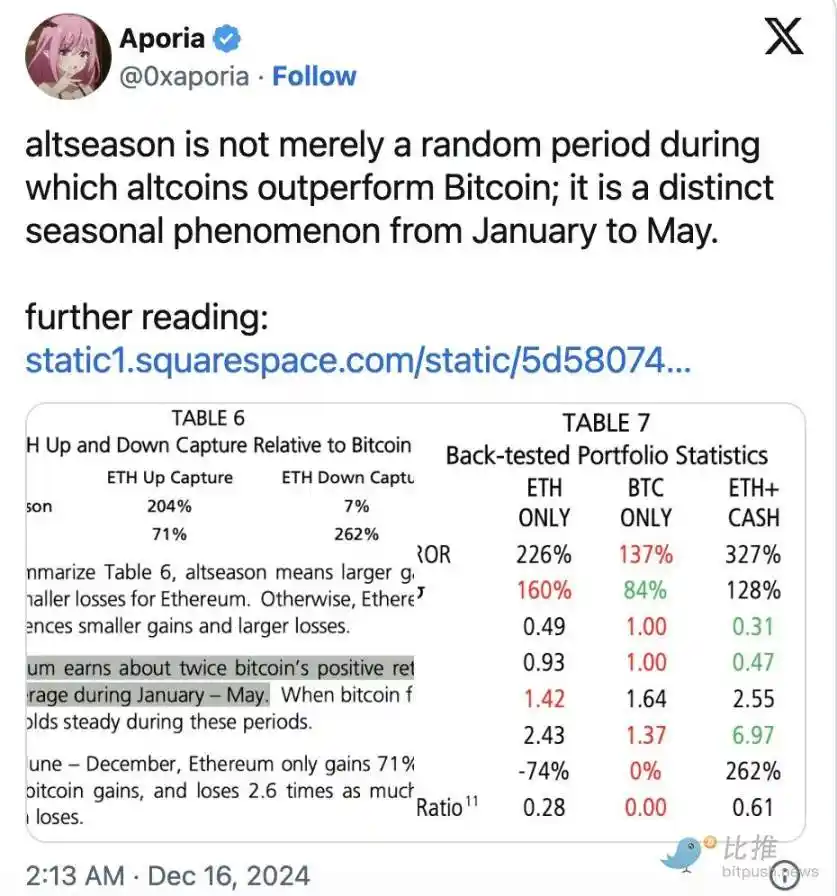
Cane Island Digital Research shared insights in its "Altcoin Seasonality Proof" regarding the seasonal rebounds of altcoins, indicating that ETH is a representative of altcoins going through a bull market. Additionally, it mentioned the repeating pattern of altcoin seasonality from January to May.
Narrative Dominance
While the upcoming altcoin season may be vastly different from the traditional seasons we are accustomed to, certain sub-narratives have already carved out a space in the cryptocurrency realm. Following a staggering 24,908.4% surge in value of the VIRTUAL token (equivalent to a 249x increase), it is safe to say that we have reached a new level of narrative dominance.
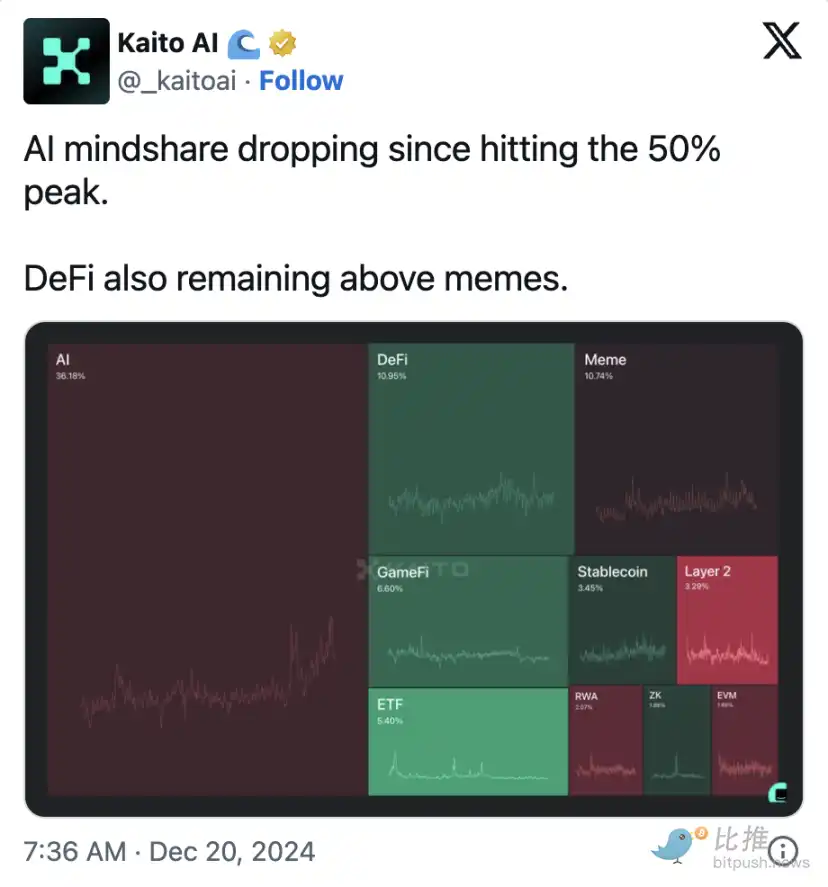
Although memecoins may surpass real-world assets or fields like AI, the AI agent stands out and is often seen as a driver of the next supercycle. Artificial intelligence remains at the forefront, with the advancement of AI agents, the on-chain AI economy has captured a significant market share, projecting to peak at 50% in 2024 according to Kaito AI's data. Fueled by unprecedented demand for AI services, this trend is likely to continue into 2025.
The institutional adoption sparked by major firms like BlackRock has also influenced real-world assets and other fields, making tokenization a fundamental part of the crypto world. While much attention is focused on AI and AI agents, traditional finance is exploring tokenization as a viable business option, with major banks such as JPMorgan and Goldman Sachs attempting to disrupt the financial market.
How to Prepare for the Altcoin Season?
As we enter 2025, ahead of the altcoin season, here are a few key points to keep in mind.
Bitcoin dominance is a classic reference indicator, so make sure to use it wisely to time your trades. Websites like BlockchainCenter.net can help assess whether the market is currently in altcoin season or Bitcoin season. Some key points to note:
The cryptocurrency market is largely driven by emotion, so pay attention to regulatory measures, macroeconomic trends, or crypto-native narratives (DeFi, AI agents, meme coins).
Not all altcoins will follow Bitcoin's price dynamics. Historically, projects with strong fundamentals or alignment with emerging narratives (such as AI projects) have performed better. However, prioritize quality over quantity, focusing on projects with strong fundamentals, an active team, and ideally a product-market fit that can engage a large community.
Pullbacks are a healthy phenomenon. They indicate the market is consolidating, allowing investors to enter positions before the next uptrend. Altcoin seasons typically occur in the later stages of a bull market. Stay patient.
Conclusion
The cryptocurrency market is maturing. Each cycle is a stepping stone and should be seen as a learning experience. While meme coins are still reaping rewards, new narratives are becoming increasingly influential. But what's most interesting is that the current popular narratives, such as AI agents, are not just passing trends. Most importantly, compared to any previous bull market, we are now facing greater influence from macro factors and institutional adoption. Does this mean we should expect a different dynamic in altcoin season this time? To some extent, yes. We should not blindly follow the patterns of the past few years. The question is not whether altcoin season will occur, but when it will happen and how it will differ from the past few years.
You may also like

SpaceX vs Tesla vs xAI: Which Elon Musk Trade Has the Biggest Upside in 2026?

OpenAI Reveals It Has Confidentially Submitted an S-1 to the SEC, Keeping the Door Open for a Future IPO
On June 9, according to an OpenAI announcement, the company recently confidentially submitted a draft S-1 registration statement to the U.S. Securities and Exchange Commission (SEC), beginning the preliminary compliance process for a potential initial public offering. OpenAI said it chose to disclose this proactively because it expected the news might leak; however, the company has not yet set a specific listing timeline, and related arrangements may still take some time.

Latest research from 13 top universities including Cornell University: The current state, challenges, and misconceptions of the fusion of Crypto and AI
Deconstructing Anthropic: The Best AI Company, Possibly Also a Type of Organizational Invention
Apollo and Blackstone Reportedly Back $35 Billion Anthropic Chip Financing as Deal Details Remain Unclear
On June 9, according to currently available news alerts, Apollo and Blackstone Group participated in a $35 billion financing for an Anthropic “chip project.” Based on the original wording of the report, the funding has already been raised, but public information remains limited. The financing structure, use of proceeds, project entity, and whether Apollo and Blackstone participated through equity, debt, or project financing have not yet been disclosed.

Humanity Protocol Security Incident Escalates: More Than $31 Million Stolen From Related Addresses as Attacker Continues Selling H for ETH
On June 9, according to monitoring by Onchain Lens, more than $31 million has been stolen from addresses linked to Humanity Protocol, and the attack is still ongoing, with the hacker continuously swapping H tokens for ETH. Project founder Terence Kwok later confirmed the security incident on X, saying the issue involved a private key leak.

Bloomberg: As Bitcoin Weakens, Stablecoins and RWA Continue to Drive Expansion in Crypto Businesses
In June, Bloomberg reported that despite Bitcoin falling below $60,000 last week, wiping out about $235 billion in market value within seven days, and dropping close to 50% from last year’s peak, some core businesses in the crypto industry are still expanding, mainly in stablecoins, real-world asset tokenization (RWA), payments, and infrastructure. The report also noted that overall altcoin activity has contracted significantly: altcoin market capitalization has fallen from a peak of about $431 billion in November 2021 to around $170 billion, and among the tens of millions of tokens issued in recent years, fewer than 1,700 still maintain meaningful trading activity.

Galaxy Deep Research Report: How Hyperliquid's HIP-4 Upgrade Changes the Landscape of Prediction Markets?
Binance Research: RWA Market Expected to Expand Nearly 6x from Early 2025, with Public Equities and Onchain Payments Heating Up Together
In June, Binance Research said in its monthly market report that the real-world asset (RWA) market is expected to grow by about 589% from the beginning of 2025. Bond- and money market fund-related RWA expanded by about $6.5 billion, up 83% year over year, while publicly traded equity RWAs grew by about 422%. The report also noted that monthly crypto debit card transaction volume exceeded $747 million in May, up 48.6% year to date.

Japan to Assess a Framework for Yen Stablecoins and Crypto ETFs as Asia’s Compliant Payments Narrative Heats Up
Recently, according to the original report, Japan is considering the launch of yen stablecoins and cryptocurrency ETFs. Public information remains limited at this stage, and there is still no complete policy text, regulatory draft, or clear implementation timeline, so this is better characterized as a “policy discussion” rather than formal implementation. The original wording also noted that advancing stablecoin regulation in Asia is driving XRP usage and supporting growth in the XRPL ecosystem. However, based on currently available public information, there is not enough evidence to directly establish a clear causal relationship between this round of discussion in Japan and XRP or XRPL.

ZachXBT: Humanity private key leak and abnormal surge in H token should be viewed separately
On June 9, according to related disclosures, on-chain investigator ZachXBT posted an update on Humanity’s roughly $31 million security incident, saying that after further analyzing fund flows, he currently tends to believe the project team was not involved in an “inside job” or a self-staged attack. According to him, the official explanation about the private key leak was broadly accurate, but before the token unlock, the price of H had been artificially pushed higher, and the hacker later took advantage of that market environment; therefore, the private key leak and the earlier abnormal price pumping should be regarded as two separate and independent events. This reframing has shifted the market’s understanding of the nature of the incident. Earlier discussion around Humanity had focused on whether the team directly participated in the attack or used the security incident to cover up internal operations. ZachXBT’s latest remarks shift the focus from “whether it was self-theft” to “whether there were pre-unlock market structure issues.” He also questioned whether the team may have.

Morning Report | OpenAI has submitted an S-1 registration statement draft to the U.S. SEC; Morpho completes $175 million financing

Morning Report | BitMine increased its holdings by 126,971 ETH last week; trader Eugene announced his exit from the crypto market

Wang Chuan: How can one not feel anxious after the neighbor Old Wang made thirty times profit by investing in storage stocks? (Seven) - A quarter-century cycle
Cryptocurrency CEXs are flocking to sell US stocks, and traditional brokerages are facing an "uninvited guest."
$75 billion in foreign capital has fled, and South Korean retail investors have absorbed it all using leverage

Japan’s Three Megabanks Plan Joint Stablecoin Issuance in Fiscal 2026
MUFG, SMBC, and Mizuho reportedly plan to jointly issue fiat-pegged stablecoins in fiscal 2026, signaling Japan’s growing push into bank-led digital payment infrastructure.

Humanity Discloses H Token Dual-Chain Attack Details, With Losses on Ethereum and BSC Exceeding $36 Million
Humanity said the H token attack across Ethereum and BSC caused more than $36 million in losses after leaked ProxyAdmin keys enabled malicious contract upgrades and token minting.
SpaceX vs Tesla vs xAI: Which Elon Musk Trade Has the Biggest Upside in 2026?
OpenAI Reveals It Has Confidentially Submitted an S-1 to the SEC, Keeping the Door Open for a Future IPO
On June 9, according to an OpenAI announcement, the company recently confidentially submitted a draft S-1 registration statement to the U.S. Securities and Exchange Commission (SEC), beginning the preliminary compliance process for a potential initial public offering. OpenAI said it chose to disclose this proactively because it expected the news might leak; however, the company has not yet set a specific listing timeline, and related arrangements may still take some time.
Latest research from 13 top universities including Cornell University: The current state, challenges, and misconceptions of the fusion of Crypto and AI
Deconstructing Anthropic: The Best AI Company, Possibly Also a Type of Organizational Invention
Apollo and Blackstone Reportedly Back $35 Billion Anthropic Chip Financing as Deal Details Remain Unclear
On June 9, according to currently available news alerts, Apollo and Blackstone Group participated in a $35 billion financing for an Anthropic “chip project.” Based on the original wording of the report, the funding has already been raised, but public information remains limited. The financing structure, use of proceeds, project entity, and whether Apollo and Blackstone participated through equity, debt, or project financing have not yet been disclosed.
Humanity Protocol Security Incident Escalates: More Than $31 Million Stolen From Related Addresses as Attacker Continues Selling H for ETH
On June 9, according to monitoring by Onchain Lens, more than $31 million has been stolen from addresses linked to Humanity Protocol, and the attack is still ongoing, with the hacker continuously swapping H tokens for ETH. Project founder Terence Kwok later confirmed the security incident on X, saying the issue involved a private key leak.


