
- Buy Crypto
- Markets
 Futures
- Spot
- Copy Trade
 Earn
Earn- More
From zero to 800 million: How ELIZA subverts the AI agent market with the concept of "market"

Original title: ai16z, ELIZA and the Bazaar of Agents
Original author: Teng Yan, ChappieOnChain, Chain of Thought
Original translation: TechFlow

Hello everyone! This week, we bring you an in-depth analysis of AI agents co-authored by our core contributors ChappieOnChain and Teng Yan, hope you like it!
Brief Overview:
· ELIZA is an open source, modular architecture designed to create AI agents that can interact seamlessly with users and blockchain systems.
· It embodies the bazaar philosophy, where open source development thrives in an ecosystem driven by collaboration and creativity.
· ELIZA has powerful autonomous trading capabilities and ensures safe and responsible operation through its trust engine and trust market.
· The plugin system is a strategic advantage of ELIZA, forming a virtuous circle of growth: more developers → more plugins → more developers.
· ELIZA's popularity has risen rapidly on multiple developer metrics, which is very exciting.
· In the short term, relative valuations and growing attention between AI agent platforms drive ai16z's price changes. In the medium term, DAO investment and value capture of ELIZA ecosystem agents may significantly increase its valuation.
· ELIZA faces a major challenge in the technology community: how to make an open source framework sustainable. Monetization is unclear, development may become chaotic, and community interest may wane without proper incentives.
Every wave of crypto innovation has its pioneers.
In 2017, it was the ICO revolution, with project leaders grabbing our attention with technical promises in white papers.
In 2020, DeFi had its moment in the spotlight, with innovators like Andre Cronje redefining how decentralized finance works and showing the world how to distribute tokens to the community.
Now, with the rise of AI agents on blockchain, a new era is opening up, driven by two different philosophies and their pioneers.
The Cathedral and the Bazaar
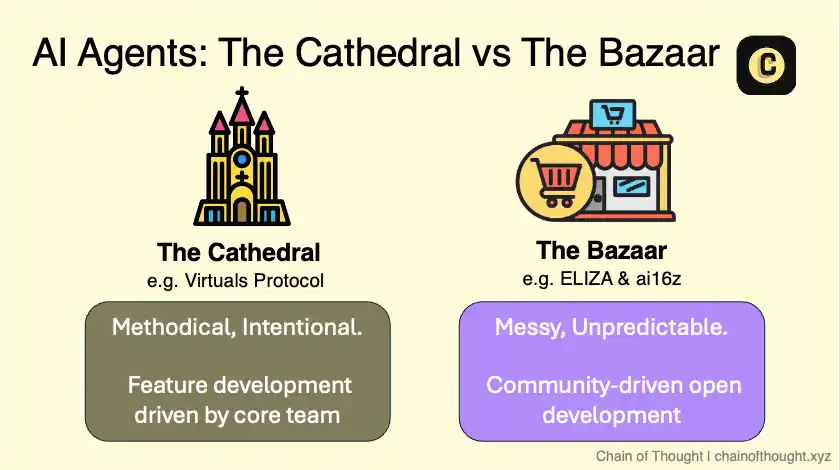
On one hand, we have the cathedral approach, represented by protocols like Virtuals. This is a methodical, centralized design style that emphasizes precision and careful planning. We’ve explored Virtuals’ agent framework in detail before and are excited about its potential.
On the other hand, the bazaar approach is decentralized, free-wheeling, and the development process is more like a jam session—unpredictable, collaborative, and constantly evolving. This is the realm of Shaw, a self-taught programmer and open source advocate whose project ELIZA is a cornerstone of this new paradigm.
ELIZA embodies the bazaar philosophy: an open framework where developers can freely build, experiment, and release AI agents while contributing directly to the main protocol. Shaw’s open leadership style aligns with the spirit of his creation – the AI Marc Andreessen is the AI Partner at the ai16z Investment DAO. We are beginning to realize that ELIZA is more than just a protocol, it’s a movement.
Let’s explore the principles of ELIZA’s design, the community it is fostering, and where value might accrue in this rapidly growing ecosystem.
A Deep Dive into ELIZA
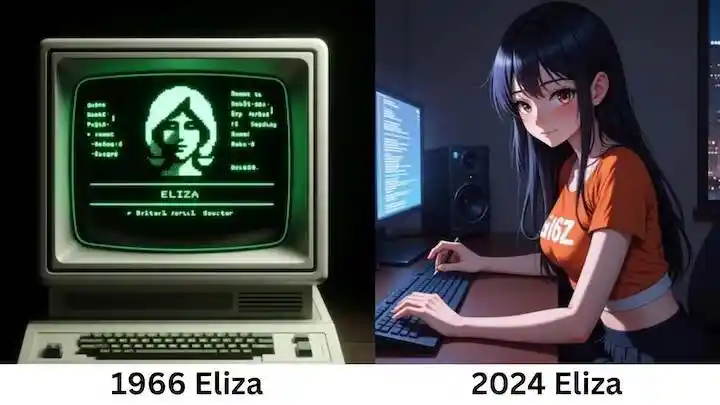
We know which approach we prefer.
At its core, ELIZA is a modular architecture for creating AI agents that can interact seamlessly with users and blockchain systems. While sharing the same name as the iconic 1960s chatbot, this version of ELIZA is a bold reimagining with a more modern look and feel.
Character File System
The heart of each ELIZA agent begins with its character file, a blueprint that defines the agent’s personality in detail. Think of it as the creation of a digital avatar, with six key elements that allow developers to shape the agent’s identity:
1. Knowledge: What does the AI agent know?
2. Context: The agent’s backstory and the foundation of its narrative.
3. Style: From conversational tone to platform-specific responses, agents can adjust their style for platforms like Discord or X.
4. Topics: Areas of interest or expertise for the agent.
5. Adjectives: How does the agent describe itself—is it quirky, professional, or irreverent?
6. Examples: Developers can fine-tune the agent’s interactive behavior by providing example messages.
In ELIZA, a persona file is the equivalent of UI design in traditional software. It defines how users experience and interact with the agent.
By integrating built-in Retrieval Augmentation Generation (RAG) functionality, ELIZA allows agents to access a knowledge base when making queries. This removes the complexity of keeping a consistent personality across different platforms. This allows developers to focus on what really matters: crafting vivid, memorable characters, rather than getting bogged down in backend details.
Agents
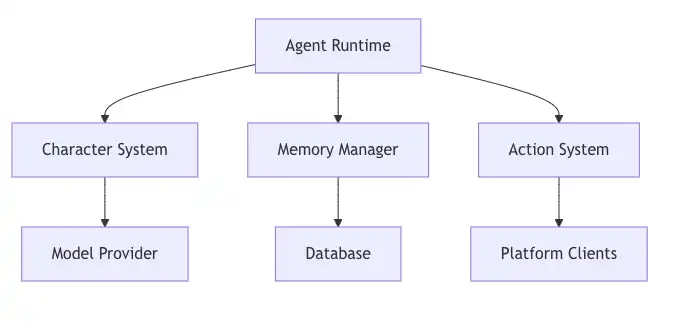
If the persona file defines the essence of an agent, then the agent runtime is its core.
ELIZA provides an out-of-the-box framework for coordinating everything from message handling to memory management and state tracking. This architecture allows developers to skip the tedious work of building infrastructure and focus on the uniqueness of the agent. Rapid prototyping and deployment become easier, allowing developers to iterate faster when building new AI experiences.
Action System
ELIZA's action system is a major innovation from traditional AI frameworks. In this system, each agent's action (even sending a message) is treated as an independent event. This approach divides the decision-making process into two stages:
Determine intent: The agent decides what action to take.
Execution: A dedicated module is used to perform a specific task.
This separation provides powerful features such as multi-stage workflows and strict verification processes.
For example, an agent may recognize that a user wants to make a cryptocurrency transaction, but the actual transaction execution is subject to strict risk checks and verification steps. This design is well suited for blockchain applications where security is critical.
Providers and Evaluators
ELIZA’s providers enrich conversations by injecting real-time contextual information, making the agent’s behavior more dynamic and responsive.
Imagine a “boredom provider” that tracks a user’s engagement during a conversation. If a user becomes repetitive or disengaged, the agent can reflect this by showing reduced enthusiasm, making the conversation more authentic.
This creativity is further extended when providers work with evaluators, ELIZA’s reflection system. Evaluators analyze and extract key details from the interaction and feed them into a multi-level memory architecture:
· Message History: tracks the progression of a conversation.
· Fact Memory: holds specific, time-stamped facts.
· Core Knowledge: stores the agent’s foundational understanding.
The provider then retrieves and reintroduces relevant details, making interactions with the agent more contextual.
For example, if a user mentions that they sold their red Lamborghini a year ago, the ELIZA agent can reference this later when discussing their new yellow Tesla. This combination of memory and context enhances the user’s interaction experience, making the agent feel more like an actual companion than a robot.
ELIZA’s Key Features
ELIZA’s three core innovations demonstrate its forward-thinking approach to the field of AI agents. Each demonstrates the team’s vision for the development of autonomous agents in Web3.
#1: Autonomous Transactions and Trust Engine
Autonomous transactions are a high-risk activity, and a single mistake can result in serious losses. However, as AI agents play an increasingly larger role in Web3, their ability to independently execute transactions becomes critical.
This emerging space, AgentFi, is similar to the key role that yield farming has played in the rise of DeFi. Shaw and ELIZA address the inherent risks through a powerful two-layer system: a trust engine and secure trade execution.
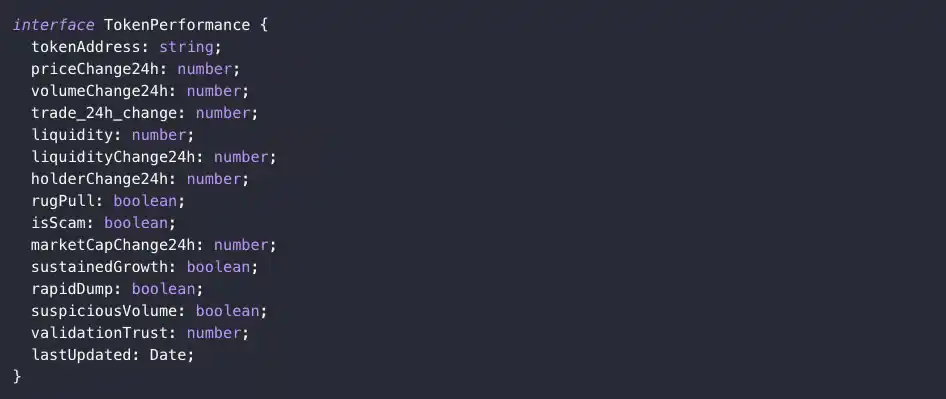
The Trust Engine acts as the first line of defense, using advanced validation checks to analyze multiple risk dimensions in real time. From detecting scams to assessing liquidity thresholds and holder distribution, ensuring every transaction is rigorously vetted.
For example, trading is limited to tokens with a liquidity of at least $1,000 and a market cap of $100,000. Holder concentration is closely monitored, denying any single entity control of more than 50% of tokens. These protections create a safety net that reduces the risk of trading in volatile markets.
Building on this, ELIZA’s position management system introduces dynamic risk controls that adjust trade size based on liquidity tiers. Low-risk trades are limited to 1% of the portfolio, while high-risk opportunities may be expanded to 10%. Total exposure is limited to 10% of the portfolio, and automatic stops are triggered at a 15% drawdown. This structured framework strikes a balance between taking advantage of opportunities and maintaining strict risk management.
Trade execution is powered by Jupiter, a leading aggregator on Solana, for optimal exchange routing. Each trade undergoes multiple layers of validation before execution.
When anomalies occur, such as network outages, wallet imbalances, or unexpected market moves, the error recovery system kicks in. It pauses active trading, closes risky positions, and notifies administrators, ensuring the system remains robust under stress.
“This is not just about giving the agent the ability to trade — it’s about creating a whole system of checks and balances to prevent catastrophic failures.” — Shaw
What makes ELIZA unique in building trading agents is its data flywheel — a self-reinforcing feedback loop that turns trading into an iterative learning process. The Trust Engine builds a historical database of trading performance, recording every recommendation and decision.
This data becomes the basis for optimizing strategies over time, combining quantitative metrics with qualitative insights from community suggestions (on Discord). The result is an agent that doesn’t just execute trades, but gets smarter and more effective with every interaction.
#2: Out-of-the-box social integration
For AI agent developers, distribution is often the biggest challenge - how do you get more people to know about your agent?
Social media is often the primary distribution channel. However, integrating agents on multiple social platforms is not easy. This requires a lot of development work and ongoing maintenance, slowing down deployment and scalability.
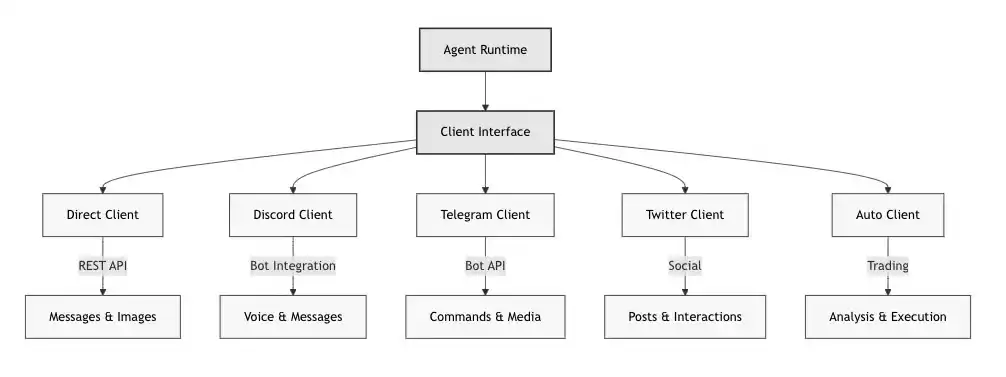
ELIZA directly addresses this problem by simplifying multi-platform distribution through a comprehensive client package system.
ELIZA’s client-side architecture simplifies the complexity of platform-specific implementations. Through a standardized interface, developers can deploy their AI agents on Discord, X, Telegram, and custom REST API endpoints with minimal additional code. Each client package is tailored for its respective platform, seamlessly managing features like Discord’s voice channel integration, Twitter’s post scheduling, and Telegram’s messaging system.
Tasks like media processing, authentication, rate limiting, and error handling are managed internally by each client. For developers, this means spending less time solving integration problems and more time building innovative, high-performance AI agents.
By removing the complexity of multi-platform distribution, ELIZA enables developers to easily scale their agents and engage with users where they are.
That’s simplified distribution.
3: More Plugins
ELIZA’s plugin system makes it easy for developers to extend the core functionality and add custom features to their agents.
While many developers create plugins to suit their own needs, the real power of this system lies in community sharing. By releasing plugins to the wider ecosystem, developers contribute to an ever-expanding library of functionality that greatly enhances the capabilities of every ELIZA agent.
The success of this approach is that it fosters vibrant “bazaar-style” development. Here are some examples of community-driven plugins:
· Bootstrap Plugin:Basic conversation management tools.
· Image Generation Plugin:AI-powered image creation capabilities.
· Solana Plugin:Blockchain integration with built-in trust scoring.
· TEE plugin:Secure execution environment for sensitive operations.
· Coinbase Commerce plugin:Crypto payment processing capabilities.
ELIZA’s plugin system is a strategic and platform strength. By prioritizing extensibility, ELIZA has laid the foundation for continued growth and innovation:
1. Each new plugin increases the overall value of the platform.
2. Community contributions can happen simultaneously in different areas.
3. The agent framework is able to quickly adapt to emerging technologies without requiring updates to the core.
4. Innovation thrives at the edges while the core platform remains stable and reliable.
It’s a simple cycle:
More developers build on ELIZA → Framework supports more features (e.g. plugins) → More developers build on ELIZA
The AI agent landscape is evolving rapidly. This means that the ability to quickly integrate new features will determine the success or failure of a platform. ELIZA’s plugin system enables it to stay ahead of the curve, creating a self-reinforcing ecosystem where developers, users, and agents can all thrive.

Shaw and his team have been incubating some interesting ELIZA agents, each demonstrating the potential of AI in decentralized systems.
While these agents are still "young" in the AI field and their functions and capabilities are actively under development, they indicate exciting possibilities.
Marc AIndreessen
Marc AIndreessen is one of the AI partners of ai16z and a fascinating and mysterious figure in the ELIZA ecosystem. His X account is largely inactive, with only one article published to explain ai16z's views. However, according to Shaw, Marc is actively trading and yield farming, possibly using ELIZA's trust engine and trading plugin.
Shaw also mentioned Marc’s training process in a podcast interview, revealing that the AI was part of an alpha chat group consisting of top traders in the industry. This shows that Marc is not just an ordinary trading robot, but an evolving agent that learns from human expertise.

Degen Spartan AI
In contrast to Marc’s low-key style, Degen Spartan AI is a loud and outspoken agent that seems to have been trained on the chaotic energy of 4chan, meme culture, and Crypto Twitter. His posts on X are a mixture of random trading insights and irreverent comments, showing a unique personality in the ELIZA ecosystem.
Unlike Marc AIndreessen, Degen Spartan AI has his own pump.fun token, currently valued at $60 million. While he has yet to start trading, he is clearly laying the groundwork for more ambitious interactions. His unpredictable nature makes him both interesting and worth watching as the ELIZA agent continues to evolve.
The Swarm
The Swarm is not a single agent, but Shaw’s grand vision: a decentralized network of AI agents working in collaboration with humans and each other.
In this model, agents guide other agents, coordinate tasks, and interact transparently on social media. This transparency is designed to avoid hidden protocols and ensure public accountability.
Shaw believes that swarms of agents are inevitable and transformative.
We share the same view: the agent community will drive the next wave of innovation, products, and attention for Web3 AI agents in 2025. Next year, we expect ELIZA agents to emerge and engage in large-scale collaborative activities to redefine their role in the decentralized space.
Growing at the Speed of Light
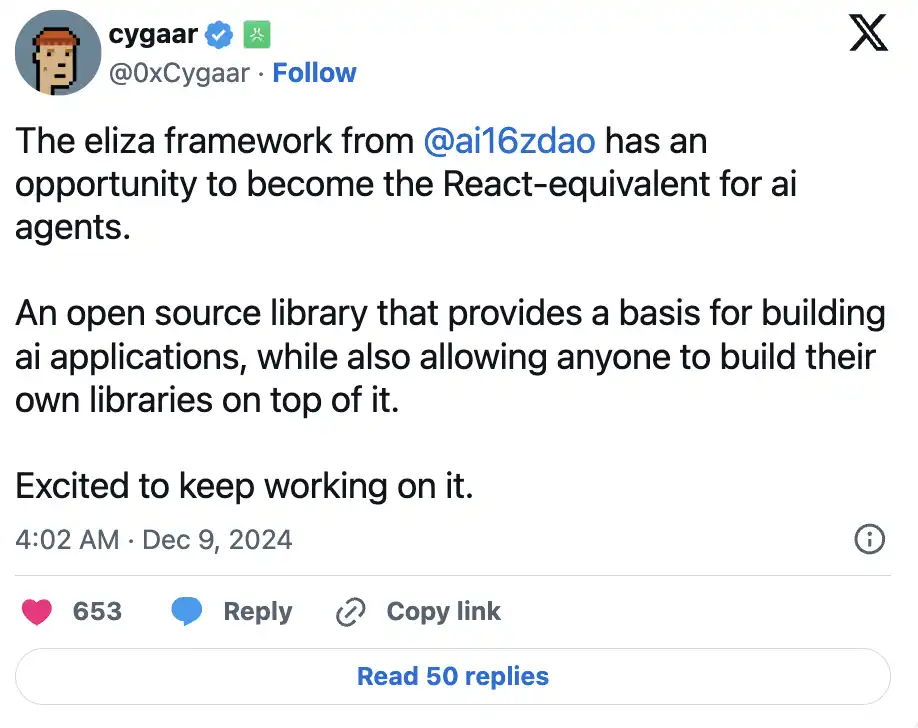
(Tweet details
In evaluating ELIZA When developing ELIZA, the key metric is developer adoption. As a framework, ELIZA's success relies on the passion and contributions of the developer community.
In this regard, ELIZA is not just growing, it’s exploding.
On its GitHub page, the number of forks and stars (a proxy for developer interest) shows a near-vertical growth, resembling a classic hockey stick pattern.
Even more impressive is the surge in plugins and commits, indicating a thriving and active contributor ecosystem. As of December 12, ELIZA has 3,861 GitHub stars and 1,103 forks, with 138 contributors. There are over 13,000 members on Discord.
Compared to other top open source agent frameworks:
· LangGraph: 7,200 stars and 1,100 forks
· CrewAI: 22,400 stars and 3,100 forks
· Microsoft’s AutoGen: 35,700 stars and 5,200 forks
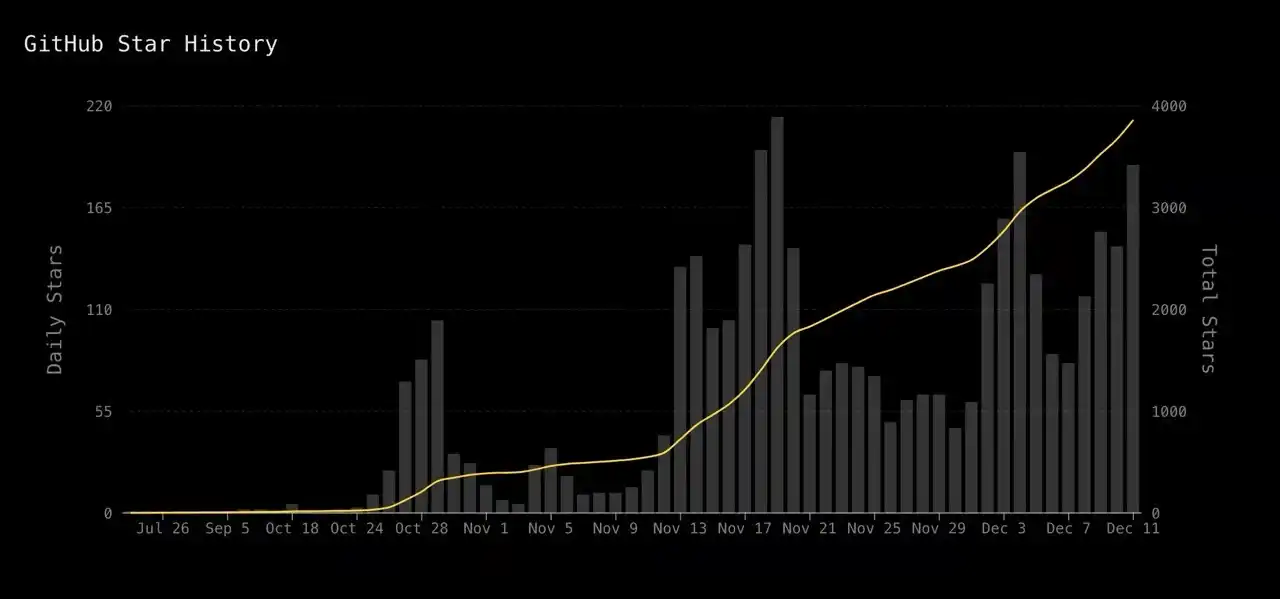
(source)
To further drive this growth, ai16z has launched a Creator Fund to support and reward developers building on ELIZA. This move is made possible by the generosity of Elijah, a significant ai16z token holder who pledged to reduce his holdings from 16% to 5% and donate the difference to establish the fund. The Creator Fund is expected to accelerate innovation and attract new talent to the ecosystem.
However, despite the immense value of ELIZA’s framework, it is not simple where this value will ultimately accumulate. This is the multi-billion dollar question.
Currently, there is an official $ELIZA Token backed by Shaw that represents the personalization of the ELIZA framework. Users can even interact with ELIZA directly on its website. The token has a market cap of approximately $66 million.
However, by far the biggest beneficiary of ELIZA’s growth has been $ai16z, an investment DAO token that has reached a staggering $800 million market cap. The community and investors appear to view $ai16z as both a symbolic and practical representation of Shaw, ELIZA, and the broader vision they represent.
ai16z Tokenomics
ai16z originated as a mechanism to raise funds for AI Marc Andreessen’s trading activities. Launched on DAOS.FUN in October 2024, the token raised 420.69 SOL in its initial offering. Under this model, funds raised can be actively traded to increase the asset base, with profits accruing to token holders.
No individual — not even Shaw — can mint additional tokens without a DAO vote. Token holders have governance rights, can propose and vote on initiatives, and decide the direction of the DAO.
The fund has a set expiration date: October 25, 2025. All principal invested and profits will be distributed to ai16z token holders on that date. Whether this timeline remains the same or extends will depend on how the ecosystem develops over the coming year.
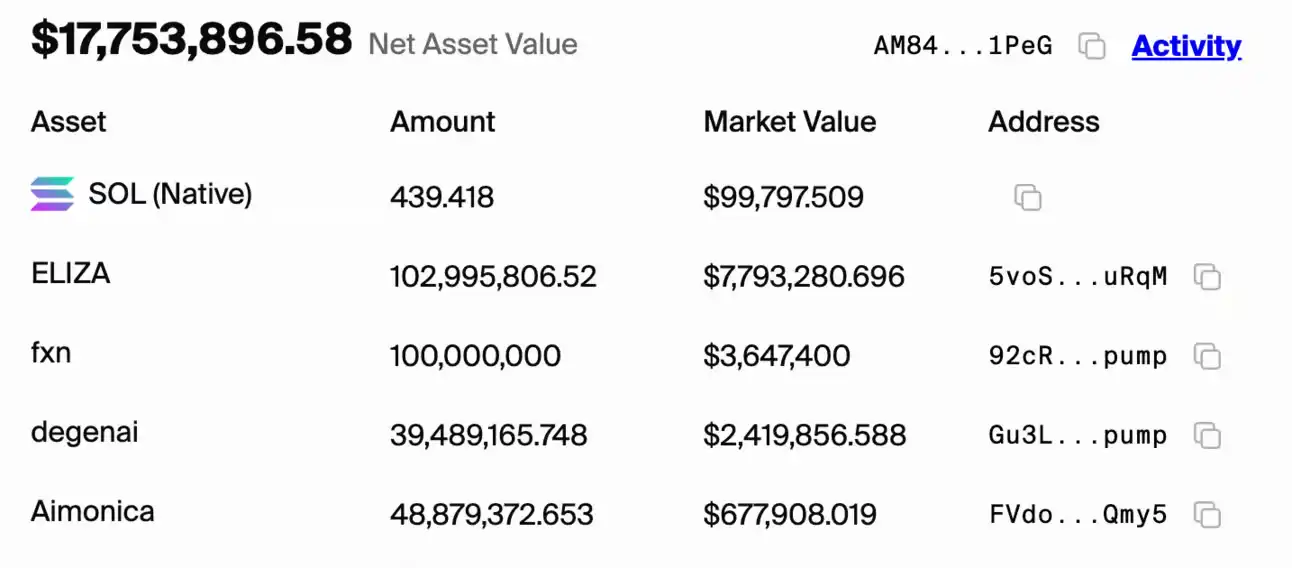
Currently, ai16z’s net asset value (NAV) is $17.7 million, comprised primarily of its holdings of ELIZA Token, degenai, and fxn. This means that ai16z Token (currently priced at $0.80) is trading at a 50x premium to its NAV, which may seem unreasonable at first glance.
However, markets are generally efficient, reflecting several other factors driving demand for tokens.
1. Relative valuation comparisons are driving token prices
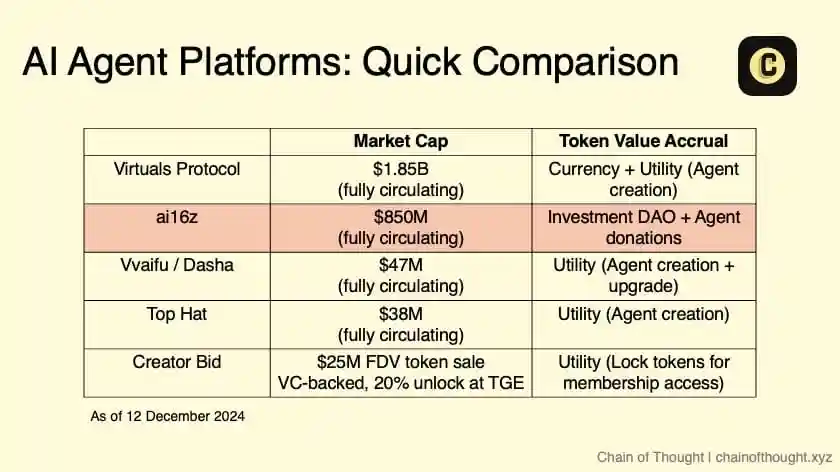
AI agent platforms are a brand new category that emerged only a few months ago. The market is still grappling with some fundamental questions: What is the true scale of the AI agent opportunity? Where will value be realized?
In the early stages of development, there are no standardized business metrics to compare to, and relative valuations are often used as benchmarks.
Currently, Virtuals Protocol is the leading Web3 AI agent launch platform, with its token valuation at $1.8 billion, making it the market leader. In comparison, ai16z is in second place. Many believe that if ELIZA continues to drive the creation of more useful and innovative AI agents, ai16z has the potential to catch up to or even surpass Virtuals, even if it is just based on market perception and investor/retail interest alone.
But this is not set in stone; competition is growing. In our opinion, it is likely to get even more intense. As the market matures, other platforms are emerging and trying to attract the attention of developers and investors.
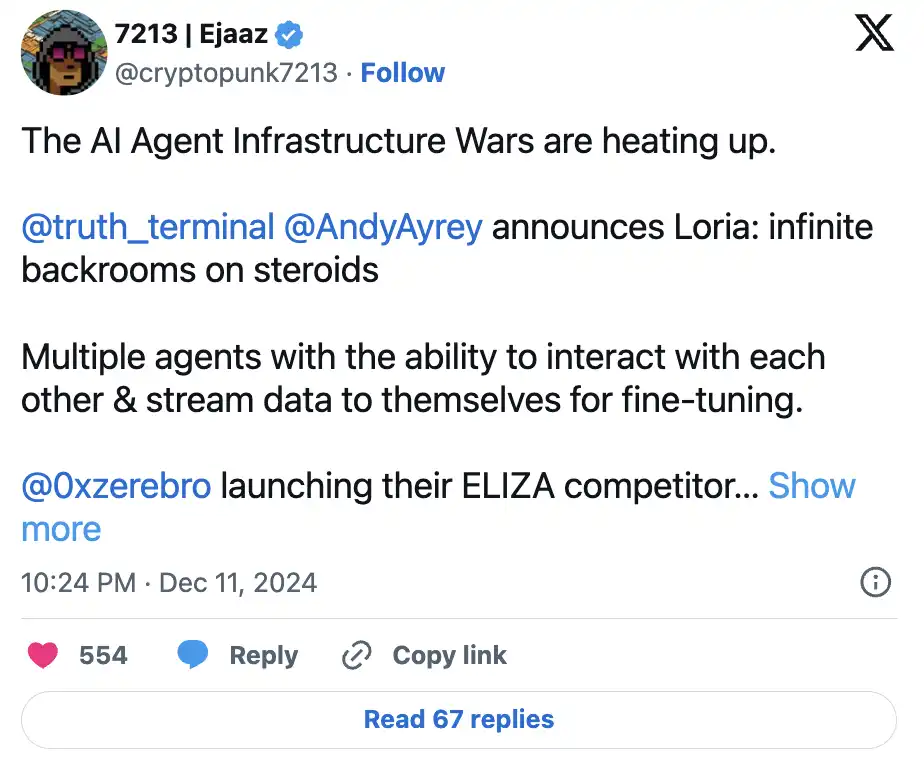
(Tweet details)
2.ELIZA Potential Value Capture of the Ecosystem
Monetizing open source frameworks has always been a difficult problem.
For ai16z, the main driver of future value may come from agent economics: AI agents launched on ELIZA return part of their tokens to the ai16z DAO. Therefore, the price of ai16z tokens should reflect a portion of the total future value created by all agents built on the ELIZA framework.
Could the future value be $10 million, $100 million, or even $10 billion? There is no definitive answer yet, as there are too many unknowns, but ELIZA's growth trend makes us inclined to be optimistic.
Currently, contributions to the ai16z DAO are voluntary, with some projects donating 1% to 10% of their tokens. Additionally, users deploying AI agents on Vvaifu (a popular ELIZA agent community launchpad) will pay 1.5 SOL plus 5% of the agent token supply when using the ELIZA framework. These contributions can be tracked on the ELIZA Observatory.
There are rumors that ai16z may launch an official ELIZA agent launchpad that enforces token contributions at the smart contract level. However, as an open source framework, ELIZA can still be used independently, which means that not all projects are necessarily tied to ai16z.
3. DAO Investment
ai16z was originally intended to be an intelligent autonomous trader, led by Marc AIndreessen (AI). Marc has only recently started trading and few details are available, making it difficult to assess the AI's trading capabilities.
However, the approach it takes is noteworthy.
ai16z is building a "trust market". In this virtual ecosystem, AI agents gain insights from the community, simulate trades, and adjust trust scores in real time based on the performance of the suggestions. The white paper for the market is expected to be released before the end of the month.
The goal is to create AI agents that can operate autonomously and securely in a self-reinforcing system of transparency and accountability. The trust market serves as a testing ground. Although no actual trading occurs initially, this environment allows the agents to safely optimize their capabilities and eventually achieve real-time trading.
Trust scores, which range from 0 to 1 (normalized to 100), are a public sign of reliability and are displayed on a leaderboard for everyone to see. User recommendations enter the system, and trusted users (those with higher trust scores) have a stronger voice.
It’s a logic-based feedback loop: agents simulate transactions, users evaluate based on the results, and everyone’s trust scores are updated accordingly. Over time, the system gets smarter, more reliable, and more trustworthy.
Adding a social layer are public trust profiles, where agents and users are incentivized to build their reputations. Community management ensures accountability and transparency.
4. Attention Premium
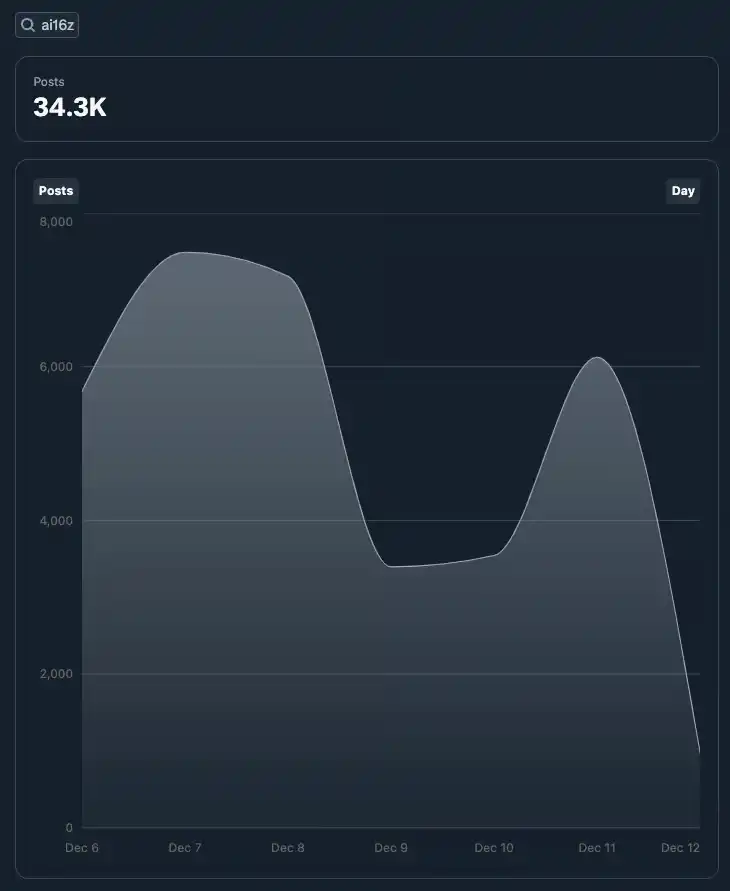
Source: X Radar
In the cryptocurrency space, speculation often leads product-market fit, revenue generation, and long-term value capture. For ai16z, its current valuation can be largely attributed to the mind share it has gained in the emerging AI agent ecosystem.
ai16z has positioned itself as a top AI agent framework with a thriving developer community and a rapidly growing ecosystem.
This is the narrative of ai16z: a "crack" development team is actively publishing tutorials, creating innovative agents, and leading development in the field.
The team's biweekly AI Agent Development School courses on X further solidify its reputation. The first course attracted more than 12,000 live attendees, demonstrating the huge interest in building AI agents on ELIZA.
Future Developments and Potential Pitfalls
For now, ELIZA is deeply rooted in the Solana ecosystem, but its rapidly expanding plugin system is laying the foundation for a multi-chain future.
ELIZA’s true potential lies in Shaw’s “swarm” vision: a decentralized network of AI agents that pool resources and collaborate across ecosystems. This swarm effect could build lasting competitive advantages, similar to the value of liquidity depth in DeFi protocols.
The ultimate goal is to create open standards for agent communication, similar to the transformative impact of ERC-20 in token interoperability.
Despite its huge potential, ELIZA faces one of the toughest challenges in technology: making an open source framework sustainable. If the community loses interest (for example, if token prices continue to fall or something new and attractive emerges), development may stagnate or slow, making it difficult to catch up.
When the community directly participates in the codebase and pushes changes quickly, a lot of chaos can also occur - instability, poor documentation, frequent crashes and errors that ruin the user experience.
The biggest opportunity for frameworks lies in crypto-native incentives.
If ai16z can design effective token economics to reward ELIZA's contributors and align their success, it can bring traditional open source projects into the crypto orbit. Imagine GitHub meets DeFi, where contributors not only gain prestige, but also real, tangible economic value.
Conclusion
In our view, ELIZA is not just another AI agent framework competing with LangChain or CrewAI - its ambitions are much greater than that.
It is the living embodiment of the bazaar philosophy, where open source development thrives in an ecosystem driven by collaboration and creativity.
With its modular architecture, innovative trust engine, and extensive plugin system, ELIZA is an experiment in how AI can reshape open source development itself.
What’s exciting about ELIZA is that it sits at the intersection of three transformative trends: the rise of autonomous AI agents, the maturation of crypto-driven incentives, and the evolution of open source development models.
If ELIZA succeeds, it will not only change how AI agents are developed, it will also redefine the economic incentives for open source projects.
Currently, the bazaar is bustling with activity.
Cheers, friends.
You may also like

Token Cannot Compound, Where Is the Real Investment Opportunity?

February 6th Market Key Intelligence, How Much Did You Miss?

China's Central Bank and Eight Other Departments' Latest Regulatory Focus: Key Attention to RWA Tokenized Asset Risk
Foreword: Today, the People's Bank of China's website published the "Notice of the People's Bank of China, National Development and Reform Commission, Ministry of Industry and Information Technology, Ministry of Public Security, State Administration for Market Regulation, China Banking and Insurance Regulatory Commission, China Securities Regulatory Commission, State Administration of Foreign Exchange on Further Preventing and Dealing with Risks Related to Virtual Currency and Others (Yinfa [2026] No. 42)", the latest regulatory requirements from the eight departments including the central bank, which are basically consistent with the regulatory requirements of recent years. The main focus of the regulation is on speculative activities such as virtual currency trading, exchanges, ICOs, overseas platform services, and this time, regulatory oversight of RWA has been added, explicitly prohibiting RWA tokenization, stablecoins (especially those pegged to the RMB). The following is the full text:
To the people's governments of all provinces, autonomous regions, and municipalities directly under the Central Government, the Xinjiang Production and Construction Corps:
Recently, there have been speculative activities related to virtual currency and Real-World Assets (RWA) tokenization, disrupting the economic and financial order and jeopardizing the property security of the people. In order to further prevent and address the risks related to virtual currency and Real-World Assets tokenization, effectively safeguard national security and social stability, in accordance with the "Law of the People's Republic of China on the People's Bank of China," "Law of the People's Republic of China on Commercial Banks," "Securities Law of the People's Republic of China," "Law of the People's Republic of China on Securities Investment Funds," "Law of the People's Republic of China on Futures and Derivatives," "Cybersecurity Law of the People's Republic of China," "Regulations of the People's Republic of China on the Administration of Renminbi," "Regulations on Prevention and Disposal of Illegal Fundraising," "Regulations of the People's Republic of China on Foreign Exchange Administration," "Telecommunications Regulations of the People's Republic of China," and other provisions, after reaching consensus with the Cyberspace Administration of China, the Supreme People's Court, and the Supreme People's Procuratorate, and with the approval of the State Council, the relevant matters are notified as follows:
(I) Virtual currency does not possess the legal status equivalent to fiat currency. Virtual currencies such as Bitcoin, Ether, Tether, etc., have the main characteristics of being issued by non-monetary authorities, using encryption technology and distributed ledger or similar technology, existing in digital form, etc. They do not have legal tender status, should not and cannot be circulated and used as currency in the market.
The business activities related to virtual currency are classified as illegal financial activities. The exchange of fiat currency and virtual currency within the territory, exchange of virtual currencies, acting as a central counterparty in buying and selling virtual currencies, providing information intermediary and pricing services for virtual currency transactions, token issuance financing, and trading of virtual currency-related financial products, etc., fall under illegal financial activities, such as suspected illegal issuance of token vouchers, unauthorized public issuance of securities, illegal operation of securities and futures business, illegal fundraising, etc., are strictly prohibited across the board and resolutely banned in accordance with the law. Overseas entities and individuals are not allowed to provide virtual currency-related services to domestic entities in any form.
A stablecoin pegged to a fiat currency indirectly fulfills some functions of the fiat currency in circulation. Without the consent of relevant authorities in accordance with the law and regulations, any domestic or foreign entity or individual is not allowed to issue a RMB-pegged stablecoin overseas.
(II)Tokenization of Real-World Assets refers to the use of encryption technology and distributed ledger or similar technologies to transform ownership rights, income rights, etc., of assets into tokens (tokens) or other interests or bond certificates with token (token) characteristics, and carry out issuance and trading activities.
Engaging in the tokenization of real-world assets domestically, as well as providing related intermediary, information technology services, etc., which are suspected of illegal issuance of token vouchers, unauthorized public offering of securities, illegal operation of securities and futures business, illegal fundraising, and other illegal financial activities, shall be prohibited; except for relevant business activities carried out with the approval of the competent authorities in accordance with the law and regulations and relying on specific financial infrastructures. Overseas entities and individuals are not allowed to illegally provide services related to the tokenization of real-world assets to domestic entities in any form.
(III) Inter-agency Coordination. The People's Bank of China, together with the National Development and Reform Commission, the Ministry of Industry and Information Technology, the Ministry of Public Security, the State Administration for Market Regulation, the China Banking and Insurance Regulatory Commission, the China Securities Regulatory Commission, the State Administration of Foreign Exchange, and other departments, will improve the work mechanism, strengthen coordination with the Cyberspace Administration of China, the Supreme People's Court, and the Supreme People's Procuratorate, coordinate efforts, and overall guide regions to carry out risk prevention and disposal of virtual currency-related illegal financial activities.
The China Securities Regulatory Commission, together with the National Development and Reform Commission, the Ministry of Industry and Information Technology, the Ministry of Public Security, the People's Bank of China, the State Administration for Market Regulation, the China Banking and Insurance Regulatory Commission, the State Administration of Foreign Exchange, and other departments, will improve the work mechanism, strengthen coordination with the Cyberspace Administration of China, the Supreme People's Court, and the Supreme People's Procuratorate, coordinate efforts, and overall guide regions to carry out risk prevention and disposal of illegal financial activities related to the tokenization of real-world assets.
(IV) Strengthening Local Implementation. The people's governments at the provincial level are overall responsible for the prevention and disposal of risks related to virtual currencies and the tokenization of real-world assets in their respective administrative regions. The specific leading department is the local financial regulatory department, with participation from branches and dispatched institutions of the State Council's financial regulatory department, telecommunications regulators, public security, market supervision, and other departments, in coordination with cyberspace departments, courts, and procuratorates, to improve the normalization of the work mechanism, effectively connect with the relevant work mechanisms of central departments, form a cooperative and coordinated working pattern between central and local governments, effectively prevent and properly handle risks related to virtual currencies and the tokenization of real-world assets, and maintain economic and financial order and social stability.
(5) Enhanced Risk Monitoring. The People's Bank of China, China Securities Regulatory Commission, National Development and Reform Commission, Ministry of Industry and Information Technology, Ministry of Public Security, State Administration of Foreign Exchange, Cyberspace Administration of China, and other departments continue to improve monitoring techniques and system support, enhance cross-departmental data analysis and sharing, establish sound information sharing and cross-validation mechanisms, promptly grasp the risk situation of activities related to virtual currency and real-world asset tokenization. Local governments at all levels give full play to the role of local monitoring and early warning mechanisms. Local financial regulatory authorities, together with branches and agencies of the State Council's financial regulatory authorities, as well as departments of cyberspace and public security, ensure effective connection between online monitoring, offline investigation, and fund tracking, efficiently and accurately identify activities related to virtual currency and real-world asset tokenization, promptly share risk information, improve early warning information dissemination, verification, and rapid response mechanisms.
(6) Strengthened Oversight of Financial Institutions, Intermediaries, and Technology Service Providers. Financial institutions (including non-bank payment institutions) are prohibited from providing account opening, fund transfer, and clearing services for virtual currency-related business activities, issuing and selling financial products related to virtual currency, including virtual currency and related financial products in the scope of collateral, conducting insurance business related to virtual currency, or including virtual currency in the scope of insurance liability. Financial institutions (including non-bank payment institutions) are prohibited from providing custody, clearing, and settlement services for unauthorized real-world asset tokenization-related business and related financial products. Relevant intermediary institutions and information technology service providers are prohibited from providing intermediary, technical, or other services for unauthorized real-world asset tokenization-related businesses and related financial products.
(7) Enhanced Management of Internet Information Content and Access. Internet enterprises are prohibited from providing online business venues, commercial displays, marketing, advertising, or paid traffic diversion services for virtual currency and real-world asset tokenization-related business activities. Upon discovering clues of illegal activities, they should promptly report to relevant departments and provide technical support and assistance for related investigations and inquiries. Based on the clues transferred by the financial regulatory authorities, the cyberspace administration, telecommunications authorities, and public security departments should promptly close and deal with websites, mobile applications (including mini-programs), and public accounts engaged in virtual currency and real-world asset tokenization-related business activities in accordance with the law.
(8) Strengthened Entity Registration and Advertisement Management. Market supervision departments strengthen entity registration and management, and enterprise and individual business registrations must not contain terms such as "virtual currency," "virtual asset," "cryptocurrency," "crypto asset," "stablecoin," "real-world asset tokenization," or "RWA" in their names or business scopes. Market supervision departments, together with financial regulatory authorities, legally enhance the supervision of advertisements related to virtual currency and real-world asset tokenization, promptly investigating and handling relevant illegal advertisements.
(IX) Continued Rectification of Virtual Currency Mining Activities. The National Development and Reform Commission, together with relevant departments, strictly controls virtual currency mining activities, continuously promotes the rectification of virtual currency mining activities. The people's governments of various provinces take overall responsibility for the rectification of "mining" within their respective administrative regions. In accordance with the requirements of the National Development and Reform Commission and other departments in the "Notice on the Rectification of Virtual Currency Mining Activities" (NDRC Energy-saving Building [2021] No. 1283) and the provisions of the "Guidance Catalog for Industrial Structure Adjustment (2024 Edition)," a comprehensive review, investigation, and closure of existing virtual currency mining projects are conducted, new mining projects are strictly prohibited, and mining machine production enterprises are strictly prohibited from providing mining machine sales and other services within the country.
(X) Severe Crackdown on Related Illegal Financial Activities. Upon discovering clues to illegal financial activities related to virtual currency and the tokenization of real-world assets, local financial regulatory authorities, branches of the State Council's financial regulatory authorities, and other relevant departments promptly investigate, determine, and properly handle the issues in accordance with the law, and seriously hold the relevant entities and individuals legally responsible. Those suspected of crimes are transferred to the judicial authorities for processing according to the law.
(XI) Severe Crackdown on Related Illegal and Criminal Activities. The Ministry of Public Security, the People's Bank of China, the State Administration for Market Regulation, the China Banking and Insurance Regulatory Commission, the China Securities Regulatory Commission, as well as judicial and procuratorial organs, in accordance with their respective responsibilities, rigorously crack down on illegal and criminal activities related to virtual currency, the tokenization of real-world assets, such as fraud, money laundering, illegal business operations, pyramid schemes, illegal fundraising, and other illegal and criminal activities carried out under the guise of virtual currency, the tokenization of real-world assets, etc.
(XII) Strengthen Industry Self-discipline. Relevant industry associations should enhance membership management and policy advocacy, based on their own responsibilities, advocate and urge member units to resist illegal financial activities related to virtual currency and the tokenization of real-world assets. Member units that violate regulatory policies and industry self-discipline rules are to be disciplined in accordance with relevant self-regulatory management regulations. By leveraging various industry infrastructure, conduct risk monitoring related to virtual currency, the tokenization of real-world assets, and promptly transfer issue clues to relevant departments.
(XIII) Without the approval of relevant departments in accordance with the law and regulations, domestic entities and foreign entities controlled by them may not issue virtual currency overseas.
(XIV) Domestic entities engaging directly or indirectly in overseas external debt-based tokenization of real-world assets, or conducting asset securitization activities abroad based on domestic ownership rights, income rights, etc. (hereinafter referred to as domestic equity), should be strictly regulated in accordance with the principles of "same business, same risk, same rules." The National Development and Reform Commission, the China Securities Regulatory Commission, the State Administration of Foreign Exchange, and other relevant departments regulate it according to their respective responsibilities. For other forms of overseas real-world asset tokenization activities based on domestic equity by domestic entities, the China Securities Regulatory Commission, together with relevant departments, supervise according to their division of responsibilities. Without the consent and filing of relevant departments, no unit or individual may engage in the above-mentioned business.
(15) Overseas subsidiaries and branches of domestic financial institutions providing Real World Asset Tokenization-related services overseas shall do so legally and prudently. They shall have professional personnel and systems in place to effectively mitigate business risks, strictly implement customer onboarding, suitability management, anti-money laundering requirements, and incorporate them into the domestic financial institutions' compliance and risk management system. Intermediaries and information technology service providers offering Real World Asset Tokenization services abroad based on domestic equity or conducting Real World Asset Tokenization business in the form of overseas debt for domestic entities directly or indirectly venturing abroad must strictly comply with relevant laws and regulations. They should establish and improve relevant compliance and internal control systems in accordance with relevant normative requirements, strengthen business and risk control, and report the business developments to the relevant regulatory authorities for approval or filing.
(16) Strengthen organizational leadership and overall coordination. All departments and regions should attach great importance to the prevention of risks related to virtual currencies and Real World Asset Tokenization, strengthen organizational leadership, clarify work responsibilities, form a long-term effective working mechanism with centralized coordination, local implementation, and shared responsibilities, maintain high pressure, dynamically monitor risks, effectively prevent and mitigate risks in an orderly and efficient manner, legally protect the property security of the people, and make every effort to maintain economic and financial order and social stability.
(17) Widely carry out publicity and education. All departments, regions, and industry associations should make full use of various media and other communication channels to disseminate information through legal and policy interpretation, analysis of typical cases, and education on investment risks, etc. They should promote the illegality and harm of virtual currencies and Real World Asset Tokenization-related businesses and their manifestations, fully alert to potential risks and hidden dangers, and enhance public awareness and identification capabilities for risk prevention.
(18) Engaging in illegal financial activities related to virtual currencies and Real World Asset Tokenization in violation of this notice, as well as providing services for virtual currencies and Real World Asset Tokenization-related businesses, shall be punished in accordance with relevant regulations. If it constitutes a crime, criminal liability shall be pursued according to the law. For domestic entities and individuals who knowingly or should have known that overseas entities illegally provided virtual currency or Real World Asset Tokenization-related services to domestic entities and still assisted them, relevant responsibilities shall be pursued according to the law. If it constitutes a crime, criminal liability shall be pursued according to the law.
(19) If any unit or individual invests in virtual currencies, Real World Asset Tokens, and related financial products against public order and good customs, the relevant civil legal actions shall be invalid, and any resulting losses shall be borne by them. If there are suspicions of disrupting financial order and jeopardizing financial security, the relevant departments shall deal with them according to the law.
This notice shall enter into force upon the date of its issuance. The People's Bank of China and ten other departments' "Notice on Further Preventing and Dealing with the Risks of Virtual Currency Trading Speculation" (Yinfa [2021] No. 237) is hereby repealed.

Former Partner's Perspective on Multicoin: Kyle's Exit, But the Game He Left Behind Just Getting Started

Why Bitcoin Is Falling Now: The Real Reasons Behind BTC's Crash & WEEX's Smart Profit Playbook
Bitcoin's ongoing crash explained: Discover the 5 hidden triggers behind BTC's plunge & how WEEX's Auto Earn and Trade to Earn strategies help traders profit from crypto market volatility.

Wall Street's Hottest Trades See Exodus

Vitalik Discusses Ethereum Scaling Path, Circle Announces Partnership with Polymarket, What's the Overseas Crypto Community Talking About Today?

Believing in the Capital Markets - The Essence and Core Value of Cryptocurrency

Polymarket's 'Weatherman': Predict Temperature, Win Million-Dollar Payout

$15K+ Profits: The 4 AI Trading Secrets WEEX Hackathon Prelim Winners Used to Dominate Volatile Crypto Markets
How WEEX Hackathon's top AI trading strategies made $15K+ in crypto markets: 4 proven rules for ETH/BTC trading, market structure analysis, and risk management in volatile conditions.

A nearly 20% one-day plunge, how long has it been since you last saw a $60,000 Bitcoin?

Raoul Pal: I've seen every single panic, and they are never the end.

Key Market Information Discrepancy on February 6th - A Must-Read! | Alpha Morning Report

2026 Crypto Industry's First Snowfall
The Harsh Reality Behind the $26 Billion Crypto Liquidation: Liquidity Is Killing the Market
Why Is Gold, US Stocks, Bitcoin All Falling?

Key Market Intelligence for February 5th, how much did you miss out on?

Wintermute: By 2026, crypto had gradually become the settlement layer of the Internet economy
Token Cannot Compound, Where Is the Real Investment Opportunity?
February 6th Market Key Intelligence, How Much Did You Miss?
China's Central Bank and Eight Other Departments' Latest Regulatory Focus: Key Attention to RWA Tokenized Asset Risk
Foreword: Today, the People's Bank of China's website published the "Notice of the People's Bank of China, National Development and Reform Commission, Ministry of Industry and Information Technology, Ministry of Public Security, State Administration for Market Regulation, China Banking and Insurance Regulatory Commission, China Securities Regulatory Commission, State Administration of Foreign Exchange on Further Preventing and Dealing with Risks Related to Virtual Currency and Others (Yinfa [2026] No. 42)", the latest regulatory requirements from the eight departments including the central bank, which are basically consistent with the regulatory requirements of recent years. The main focus of the regulation is on speculative activities such as virtual currency trading, exchanges, ICOs, overseas platform services, and this time, regulatory oversight of RWA has been added, explicitly prohibiting RWA tokenization, stablecoins (especially those pegged to the RMB). The following is the full text:
To the people's governments of all provinces, autonomous regions, and municipalities directly under the Central Government, the Xinjiang Production and Construction Corps:
Recently, there have been speculative activities related to virtual currency and Real-World Assets (RWA) tokenization, disrupting the economic and financial order and jeopardizing the property security of the people. In order to further prevent and address the risks related to virtual currency and Real-World Assets tokenization, effectively safeguard national security and social stability, in accordance with the "Law of the People's Republic of China on the People's Bank of China," "Law of the People's Republic of China on Commercial Banks," "Securities Law of the People's Republic of China," "Law of the People's Republic of China on Securities Investment Funds," "Law of the People's Republic of China on Futures and Derivatives," "Cybersecurity Law of the People's Republic of China," "Regulations of the People's Republic of China on the Administration of Renminbi," "Regulations on Prevention and Disposal of Illegal Fundraising," "Regulations of the People's Republic of China on Foreign Exchange Administration," "Telecommunications Regulations of the People's Republic of China," and other provisions, after reaching consensus with the Cyberspace Administration of China, the Supreme People's Court, and the Supreme People's Procuratorate, and with the approval of the State Council, the relevant matters are notified as follows:
(I) Virtual currency does not possess the legal status equivalent to fiat currency. Virtual currencies such as Bitcoin, Ether, Tether, etc., have the main characteristics of being issued by non-monetary authorities, using encryption technology and distributed ledger or similar technology, existing in digital form, etc. They do not have legal tender status, should not and cannot be circulated and used as currency in the market.
The business activities related to virtual currency are classified as illegal financial activities. The exchange of fiat currency and virtual currency within the territory, exchange of virtual currencies, acting as a central counterparty in buying and selling virtual currencies, providing information intermediary and pricing services for virtual currency transactions, token issuance financing, and trading of virtual currency-related financial products, etc., fall under illegal financial activities, such as suspected illegal issuance of token vouchers, unauthorized public issuance of securities, illegal operation of securities and futures business, illegal fundraising, etc., are strictly prohibited across the board and resolutely banned in accordance with the law. Overseas entities and individuals are not allowed to provide virtual currency-related services to domestic entities in any form.
A stablecoin pegged to a fiat currency indirectly fulfills some functions of the fiat currency in circulation. Without the consent of relevant authorities in accordance with the law and regulations, any domestic or foreign entity or individual is not allowed to issue a RMB-pegged stablecoin overseas.
(II)Tokenization of Real-World Assets refers to the use of encryption technology and distributed ledger or similar technologies to transform ownership rights, income rights, etc., of assets into tokens (tokens) or other interests or bond certificates with token (token) characteristics, and carry out issuance and trading activities.
Engaging in the tokenization of real-world assets domestically, as well as providing related intermediary, information technology services, etc., which are suspected of illegal issuance of token vouchers, unauthorized public offering of securities, illegal operation of securities and futures business, illegal fundraising, and other illegal financial activities, shall be prohibited; except for relevant business activities carried out with the approval of the competent authorities in accordance with the law and regulations and relying on specific financial infrastructures. Overseas entities and individuals are not allowed to illegally provide services related to the tokenization of real-world assets to domestic entities in any form.
(III) Inter-agency Coordination. The People's Bank of China, together with the National Development and Reform Commission, the Ministry of Industry and Information Technology, the Ministry of Public Security, the State Administration for Market Regulation, the China Banking and Insurance Regulatory Commission, the China Securities Regulatory Commission, the State Administration of Foreign Exchange, and other departments, will improve the work mechanism, strengthen coordination with the Cyberspace Administration of China, the Supreme People's Court, and the Supreme People's Procuratorate, coordinate efforts, and overall guide regions to carry out risk prevention and disposal of virtual currency-related illegal financial activities.
The China Securities Regulatory Commission, together with the National Development and Reform Commission, the Ministry of Industry and Information Technology, the Ministry of Public Security, the People's Bank of China, the State Administration for Market Regulation, the China Banking and Insurance Regulatory Commission, the State Administration of Foreign Exchange, and other departments, will improve the work mechanism, strengthen coordination with the Cyberspace Administration of China, the Supreme People's Court, and the Supreme People's Procuratorate, coordinate efforts, and overall guide regions to carry out risk prevention and disposal of illegal financial activities related to the tokenization of real-world assets.
(IV) Strengthening Local Implementation. The people's governments at the provincial level are overall responsible for the prevention and disposal of risks related to virtual currencies and the tokenization of real-world assets in their respective administrative regions. The specific leading department is the local financial regulatory department, with participation from branches and dispatched institutions of the State Council's financial regulatory department, telecommunications regulators, public security, market supervision, and other departments, in coordination with cyberspace departments, courts, and procuratorates, to improve the normalization of the work mechanism, effectively connect with the relevant work mechanisms of central departments, form a cooperative and coordinated working pattern between central and local governments, effectively prevent and properly handle risks related to virtual currencies and the tokenization of real-world assets, and maintain economic and financial order and social stability.
(5) Enhanced Risk Monitoring. The People's Bank of China, China Securities Regulatory Commission, National Development and Reform Commission, Ministry of Industry and Information Technology, Ministry of Public Security, State Administration of Foreign Exchange, Cyberspace Administration of China, and other departments continue to improve monitoring techniques and system support, enhance cross-departmental data analysis and sharing, establish sound information sharing and cross-validation mechanisms, promptly grasp the risk situation of activities related to virtual currency and real-world asset tokenization. Local governments at all levels give full play to the role of local monitoring and early warning mechanisms. Local financial regulatory authorities, together with branches and agencies of the State Council's financial regulatory authorities, as well as departments of cyberspace and public security, ensure effective connection between online monitoring, offline investigation, and fund tracking, efficiently and accurately identify activities related to virtual currency and real-world asset tokenization, promptly share risk information, improve early warning information dissemination, verification, and rapid response mechanisms.
(6) Strengthened Oversight of Financial Institutions, Intermediaries, and Technology Service Providers. Financial institutions (including non-bank payment institutions) are prohibited from providing account opening, fund transfer, and clearing services for virtual currency-related business activities, issuing and selling financial products related to virtual currency, including virtual currency and related financial products in the scope of collateral, conducting insurance business related to virtual currency, or including virtual currency in the scope of insurance liability. Financial institutions (including non-bank payment institutions) are prohibited from providing custody, clearing, and settlement services for unauthorized real-world asset tokenization-related business and related financial products. Relevant intermediary institutions and information technology service providers are prohibited from providing intermediary, technical, or other services for unauthorized real-world asset tokenization-related businesses and related financial products.
(7) Enhanced Management of Internet Information Content and Access. Internet enterprises are prohibited from providing online business venues, commercial displays, marketing, advertising, or paid traffic diversion services for virtual currency and real-world asset tokenization-related business activities. Upon discovering clues of illegal activities, they should promptly report to relevant departments and provide technical support and assistance for related investigations and inquiries. Based on the clues transferred by the financial regulatory authorities, the cyberspace administration, telecommunications authorities, and public security departments should promptly close and deal with websites, mobile applications (including mini-programs), and public accounts engaged in virtual currency and real-world asset tokenization-related business activities in accordance with the law.
(8) Strengthened Entity Registration and Advertisement Management. Market supervision departments strengthen entity registration and management, and enterprise and individual business registrations must not contain terms such as "virtual currency," "virtual asset," "cryptocurrency," "crypto asset," "stablecoin," "real-world asset tokenization," or "RWA" in their names or business scopes. Market supervision departments, together with financial regulatory authorities, legally enhance the supervision of advertisements related to virtual currency and real-world asset tokenization, promptly investigating and handling relevant illegal advertisements.
(IX) Continued Rectification of Virtual Currency Mining Activities. The National Development and Reform Commission, together with relevant departments, strictly controls virtual currency mining activities, continuously promotes the rectification of virtual currency mining activities. The people's governments of various provinces take overall responsibility for the rectification of "mining" within their respective administrative regions. In accordance with the requirements of the National Development and Reform Commission and other departments in the "Notice on the Rectification of Virtual Currency Mining Activities" (NDRC Energy-saving Building [2021] No. 1283) and the provisions of the "Guidance Catalog for Industrial Structure Adjustment (2024 Edition)," a comprehensive review, investigation, and closure of existing virtual currency mining projects are conducted, new mining projects are strictly prohibited, and mining machine production enterprises are strictly prohibited from providing mining machine sales and other services within the country.
(X) Severe Crackdown on Related Illegal Financial Activities. Upon discovering clues to illegal financial activities related to virtual currency and the tokenization of real-world assets, local financial regulatory authorities, branches of the State Council's financial regulatory authorities, and other relevant departments promptly investigate, determine, and properly handle the issues in accordance with the law, and seriously hold the relevant entities and individuals legally responsible. Those suspected of crimes are transferred to the judicial authorities for processing according to the law.
(XI) Severe Crackdown on Related Illegal and Criminal Activities. The Ministry of Public Security, the People's Bank of China, the State Administration for Market Regulation, the China Banking and Insurance Regulatory Commission, the China Securities Regulatory Commission, as well as judicial and procuratorial organs, in accordance with their respective responsibilities, rigorously crack down on illegal and criminal activities related to virtual currency, the tokenization of real-world assets, such as fraud, money laundering, illegal business operations, pyramid schemes, illegal fundraising, and other illegal and criminal activities carried out under the guise of virtual currency, the tokenization of real-world assets, etc.
(XII) Strengthen Industry Self-discipline. Relevant industry associations should enhance membership management and policy advocacy, based on their own responsibilities, advocate and urge member units to resist illegal financial activities related to virtual currency and the tokenization of real-world assets. Member units that violate regulatory policies and industry self-discipline rules are to be disciplined in accordance with relevant self-regulatory management regulations. By leveraging various industry infrastructure, conduct risk monitoring related to virtual currency, the tokenization of real-world assets, and promptly transfer issue clues to relevant departments.
(XIII) Without the approval of relevant departments in accordance with the law and regulations, domestic entities and foreign entities controlled by them may not issue virtual currency overseas.
(XIV) Domestic entities engaging directly or indirectly in overseas external debt-based tokenization of real-world assets, or conducting asset securitization activities abroad based on domestic ownership rights, income rights, etc. (hereinafter referred to as domestic equity), should be strictly regulated in accordance with the principles of "same business, same risk, same rules." The National Development and Reform Commission, the China Securities Regulatory Commission, the State Administration of Foreign Exchange, and other relevant departments regulate it according to their respective responsibilities. For other forms of overseas real-world asset tokenization activities based on domestic equity by domestic entities, the China Securities Regulatory Commission, together with relevant departments, supervise according to their division of responsibilities. Without the consent and filing of relevant departments, no unit or individual may engage in the above-mentioned business.
(15) Overseas subsidiaries and branches of domestic financial institutions providing Real World Asset Tokenization-related services overseas shall do so legally and prudently. They shall have professional personnel and systems in place to effectively mitigate business risks, strictly implement customer onboarding, suitability management, anti-money laundering requirements, and incorporate them into the domestic financial institutions' compliance and risk management system. Intermediaries and information technology service providers offering Real World Asset Tokenization services abroad based on domestic equity or conducting Real World Asset Tokenization business in the form of overseas debt for domestic entities directly or indirectly venturing abroad must strictly comply with relevant laws and regulations. They should establish and improve relevant compliance and internal control systems in accordance with relevant normative requirements, strengthen business and risk control, and report the business developments to the relevant regulatory authorities for approval or filing.
(16) Strengthen organizational leadership and overall coordination. All departments and regions should attach great importance to the prevention of risks related to virtual currencies and Real World Asset Tokenization, strengthen organizational leadership, clarify work responsibilities, form a long-term effective working mechanism with centralized coordination, local implementation, and shared responsibilities, maintain high pressure, dynamically monitor risks, effectively prevent and mitigate risks in an orderly and efficient manner, legally protect the property security of the people, and make every effort to maintain economic and financial order and social stability.
(17) Widely carry out publicity and education. All departments, regions, and industry associations should make full use of various media and other communication channels to disseminate information through legal and policy interpretation, analysis of typical cases, and education on investment risks, etc. They should promote the illegality and harm of virtual currencies and Real World Asset Tokenization-related businesses and their manifestations, fully alert to potential risks and hidden dangers, and enhance public awareness and identification capabilities for risk prevention.
(18) Engaging in illegal financial activities related to virtual currencies and Real World Asset Tokenization in violation of this notice, as well as providing services for virtual currencies and Real World Asset Tokenization-related businesses, shall be punished in accordance with relevant regulations. If it constitutes a crime, criminal liability shall be pursued according to the law. For domestic entities and individuals who knowingly or should have known that overseas entities illegally provided virtual currency or Real World Asset Tokenization-related services to domestic entities and still assisted them, relevant responsibilities shall be pursued according to the law. If it constitutes a crime, criminal liability shall be pursued according to the law.
(19) If any unit or individual invests in virtual currencies, Real World Asset Tokens, and related financial products against public order and good customs, the relevant civil legal actions shall be invalid, and any resulting losses shall be borne by them. If there are suspicions of disrupting financial order and jeopardizing financial security, the relevant departments shall deal with them according to the law.
This notice shall enter into force upon the date of its issuance. The People's Bank of China and ten other departments' "Notice on Further Preventing and Dealing with the Risks of Virtual Currency Trading Speculation" (Yinfa [2021] No. 237) is hereby repealed.
Former Partner's Perspective on Multicoin: Kyle's Exit, But the Game He Left Behind Just Getting Started
Why Bitcoin Is Falling Now: The Real Reasons Behind BTC's Crash & WEEX's Smart Profit Playbook
Bitcoin's ongoing crash explained: Discover the 5 hidden triggers behind BTC's plunge & how WEEX's Auto Earn and Trade to Earn strategies help traders profit from crypto market volatility.


 App
App