
In-Depth Article Exposing the BTCFi TVL Scam, Nubit's "Proof of TVL" Report Explained

By: blockbeats|2025/01/05 19:30:04
0
Share
copy
Original Authors: Nubit and Nebra

In the Bitcoin ecosystem, Total Value Locked (TVL) is a key metric that measures the scale and security of BTCFi (Bitcoin Finance) projects. However, as BTCFi expands, the controversy surrounding the authenticity of TVL data continues to escalate. False statistics, double counting, fake locking, and other phenomena are eroding user trust, challenging the transparency and credibility of the Bitcoin ecosystem.

In response to this phenomenon, leading Bitcoin ecosystem projects such as Nubit, Nebra, Bitcoin Layers, and Alpen Labs released the "Proof of TVL" report on January 5, 2025, addressing the opaque nature of the BTCFi field. They called for the establishment of a higher standard asset transparency verification mechanism and proposed an open-source TVL verification tool to provide strong support for the transparency of the Bitcoin ecosystem.
In-Depth Article Exposing the BTCFi TVL Scam, Nubit's


The following is the original text of the report:

Special thanks to Bitcoin Layers and Alpen Labs for their review and valuable feedback on this article.

The Evolution of BTCFi and Liquid Staking Tokens (LSTs)

Bitcoin has long been the cornerstone of the digital asset ecosystem.

However, over the years, its utility has been primarily limited to serving as a store of value and a medium of exchange. It wasn't until 2023 when protocols like Babylon introduced the concept of Bitcoin staking, allowing users to lock up their BTC in a self-custodial manner and participate in a Proof-of-Stake consensus mechanism to earn rewards.

This innovation ushered in a new era for Bitcoin, now commonly referred to as BTCFi. This movement has empowered Bitcoin with unprecedented capabilities. Since then, Bitcoin is no longer just a passive holding asset but is able to actively participate in the decentralized finance (DeFi) ecosystem.

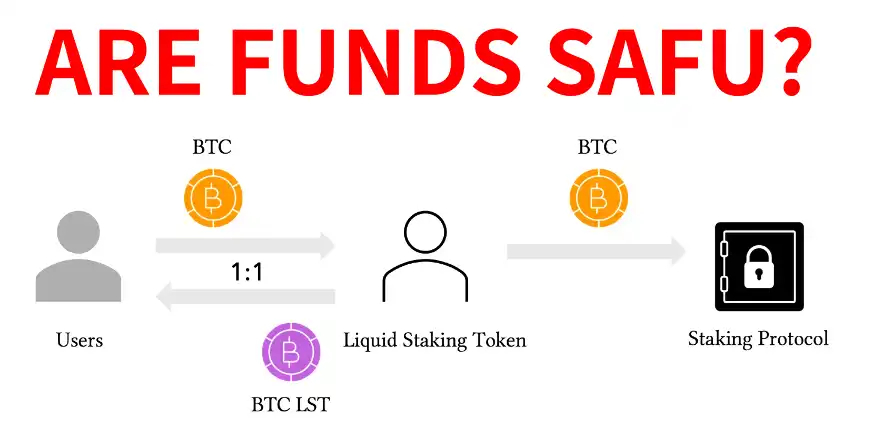
To enhance the usability and liquidity of staked Bitcoin, a wave of Bitcoin Liquid Staking Tokens (LSTs) emerged. These protocols act as custodians, allowing users to stake their BTC and receive tokenized credentials in return. These LSTs can be freely used in DeFi applications, including lending, trading, yield farming, and more. This model allows Bitcoin stakers to have the best of both worlds: earning staking rewards while engaging in a wide range of DeFi opportunities.

These LST protocols have rapidly gained user acceptance, with the total value locked (TVL) of related protocols reaching billions of dollars. TVL is typically seen as a key metric to measure user activity and protocol success.
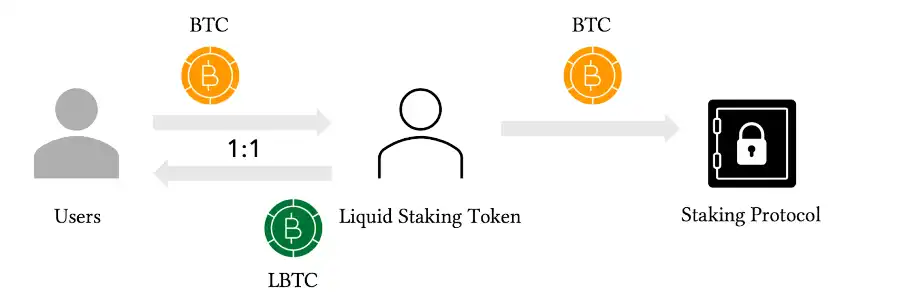
However, we want to pose a critical question for the industry: How reliable is the TVL data reported for Bitcoin LST protocols?

Specifically, for BTC that the protocol cannot effectively custody or slash, should these assets be counted in TVL?

If the TVL data is inflated, it could potentially provide users and investors with a false sense of security. Inflated TVL data may mask the protocol's true liquidity and risk exposure, leading all parties involved to make incorrect decisions and potentially suffer losses.

Why is Tracking TVL for Bitcoin Liquid Staking Protocols Challenging?

In the context of Bitcoin staking, Bitcoin's unique UTXO model adds complexity that makes interpreting Total Value Locked (TVL) data challenging. This complexity erodes trust in Bitcoin Liquid Staking protocols (LST) and raises concerns about the sustainability of the entire BTCFi ecosystem.

Let's examine the reasons in detail.

Bitcoin adopts the UTXO model (Unspent Transaction Output), where each transaction creates a unique "Bitcoin unit" with specific spending conditions. For example:

Some UTXOs may require a private key signature to be spent.

More complex UTXOs may include multi-signature (multisig) requirements or timelocks.

Unlike Ethereum's account-based model, Bitcoin's UTXO model does not aggregate balances, making tracking and locking funds more complex—though not entirely infeasible. Therefore, TVL data for LST protocols is usually self-reported by the protocols. To validate this reported data, we need to start with a simple question:

How should the TVL of Bitcoin Liquid Staking protocols be calculated?

The goal of Bitcoin staking protocols is to provide economic security for layer 2 protocols (such as Rollups, Data Availability Layers (DAs), etc.). From this perspective, economic security is effective only when the staked Bitcoin is under the custody of the staking protocol and is slashable. Therefore, one thing is clear:

Unstaked or non-slashable BTC held in protocol custody should not be counted towards TVL.

How is Bitcoin Double-Staked TVL Faked?

Many Bitcoin yield farming protocols, in their pursuit of a high TVL (Total Value Locked), spare no effort to strike agreements with large holders (whales) to artificially inflate their TVL through "data washing."

Here is how they operate:

1. Whale Staking: A large BTC holder (whale) is incentivized to move their BTC to an address controlled jointly by the whale and the protocol, under the guise of "staking."

2. Whale Retains Control: After staking, the whale still retains ultimate control over the Unspent Transaction Outputs (UTXOs). The protocol cannot force redemption or enforce penalties (including slashing penalties), meaning that this capital was never truly at risk.

3. False TVL Inclusion: The protocol includes these UTXOs in its TVL, even though these funds are not meaningfully locked, and the whale can withdraw or reuse these funds at any time.

The reality is:

Users (whales) maintain full control over the funds: Whales can spend these BTC at any time or stake them in another protocol.

Non-slashable Pseudo-Staking: This "staking" process has no mandatory slashing conditions, making it essentially meaningless.

The essence of staking lies in safeguarding network security by incentivizing benign behavior and penalizing malicious behavior. Slashing ensures that participants face real financial loss risk when not complying with protocol rules or engaging in dishonest behavior. Without this mechanism, staking devolves into a farce of "staking for the sake of staking," serving no practical purpose.

Ask yourself: What is the true purpose of staking? It is not to inflate TVL data or make symbolic gestures but to safeguard the protocol's security through slashing mechanisms.

This brings to mind FTX's painful lesson. In the FTX collapse, the disconnect between reported figures (IOUs) and actual reserves (redeemable assets) ultimately led to a complete breakdown of user trust. If a protocol inflates its TVL data, can you truly believe it won't misuse your reserves behind the scenes? A protocol that distorts facts even on fundamental issues like reserves likely has strayed from the trustless principles that Bitcoin embodies.

This inflated TVL data has raised a larger question: Is the reported "staked" Bitcoin truly locked up? Or is this merely a ploy to attract attention and inflate the digital false metric?

The Risk of False TVL

In theory, Liquidity Staking Tokens (LSTs) are designed to represent Bitcoin staked in protocols like Babylon, allowing holders to earn staking rewards while maintaining asset liquidity. The premise of this mechanism is that each LST is fully backed by real Bitcoin reserves at a 1:1 ratio.

However, some staking arrangements that seek high TVL numbers may undermine these commitments. If some of the staked BTC remains under the control of the original owner while the protocol reports it as fully locked up, this directly threatens the fundamental assumption on which LSTs rely. The results could be:

The actual locked collateral is less than the reported amount.

The staking model fails to provide the expected security guarantees.

There is a significant gap between the reported TVL and the actual amount of BTC participating in staking.

Ultimately, these actions cast doubt on whether LSTs are truly backed by verifiable reserves and raise concerns about the economic security these tokens can provide, such as:

1. Lack of 1:1 Support Guarantee

Because the protocol counts untruly locked or staked Bitcoin as "staked," it cannot guarantee that the assets supporting LSTs actually exist or are under the protocol's control. Users holding these tokens can only rely on the protocol's unilateral statement. Additionally, if these assets do not exist, users face real financial loss risks when redeeming the underlying assets.

2. Unverifiable Staking Rewards

Staking rewards should come from real contributions to network security or Proof of Stake (PoS) consensus. However, when the underlying Bitcoin is not truly engaged in staking, where do these rewards come from? Are they sustainable?

This poses a systemic risk to the entire BTCFi ecosystem. As trust weakens, liquidity may rapidly dissipate, not only undermining a specific protocol but also potentially affecting the stability of the entire BTCFi ecosystem based on Bitcoin staking.

What Happens When a Bitcoin Staking Protocol Becomes No Different from a Centralized Entity? In such a scenario, users are unable to audit the reserve, having to rely solely on the operator's statement. This situation severely threatens the credibility of BTCFi.

The current state of affairs poses a survival threat to BTCFi's credibility. To avoid falling into the same trap of centralized systems and false TVL, we must address the root cause of the issue: the lack of a trustless and verifiable mechanism to prove the reserve and staking activities.

This is where Proof of TVL (PoTVL) comes into play. Only by establishing a scientific, transparent, and cryptographically based reserve verification standard can we rebuild trust in Bitcoin LSTs and ensure the long-term sustainability of the ecosystem.

Core Solution: Transparent TVL Computation

In the context of Bitcoin staking, Taproot addresses play a crucial role in implementing staking locking scripts (e.g., Babylon). These locking scripts define explicit rules for staking, tracking, and eventual withdrawal of BTC. Babylon is a prime example as it directly links staking behavior to verifiable protocol-level rules on the Bitcoin UTXO model.

When stakers engage in the staking protocol, they construct specific transactions to send BTC to the protocol's designated Taproot address. These transactions typically include:

1. Staking Output: A UTXO used to send BTC to the Taproot address for staking.

2. Ownership Proof Output: A second UTXO containing the staker's and protocol's public keys. These public keys prove ownership of the staked BTC.

Using the Babylon staking protocol specification as an example:

The specification requires stakers (or the LST protocol) to construct transactions as follows:

· The first UTXO sends BTC to the Taproot address bound to Babylon's staking locking script.

· The second UTXO contains the staker and Babylon's public key to ensure ownership verification.

This design ensures that the staking behavior can be fully traced on-chain, with clear ownership proof and transparent rules.

Case Study: Lombard Finance

To demonstrate the application of this approach in practice, we used the open-source Proof of TVL tool to validate Lombard Finance.

Here is the complete verification process:

1. Identify User Deposit Wallet

The process starts from user depositing BTC into Lombard's wallet. These wallets represent the initial fund flow into the system.

2. Trace Transactions to Staking Wallet

Track BTC from the deposit wallets to the staking wallet controlled by Lombard. Based on Babylon's staking specification, identify all staking transactions.

3. Verify Ownership

Use Babylon's protocol rules to confirm if the staking transactions include the required public key for ownership verification. Ensure that the transactions comply with the staking locking script.

4. Calculate True TVL

Aggregate the BTC output amounts in the validated staking transactions to calculate on-chain collateral. Compare the collateral to the total LBTC supply, and calculate the collateralization ratio.

Through the above steps, we calculated Lombard's LST TVL as follows:

· BTC On-chain Collateral: 16,580.9220 (15,028.3565 BTC / 90.64% staked)

· Total LBTC Supply: 16,386.4157 (101.19% overcollateralized)

· Latest Validation Timestamp: January 4, 2025, 7:30 PM PST

· Status: Secure (101.19% overcollateralized)
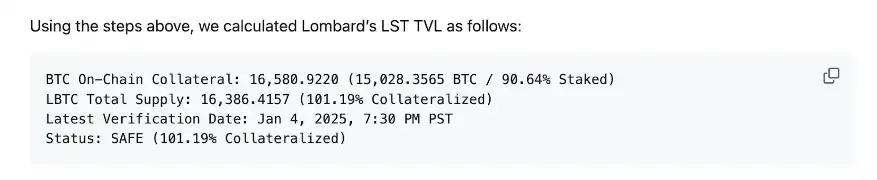
Validation Details:

· 90.64% Staked

Out of a total on-chain collateral of 16,580.9220 BTC, 15,028.3565 BTC is actively staked according to the Babylon standard.

· 101.19% Overcollateralized

The total supply of LBTC is 16,386.41, while the on-chain collateral is 16,599 BTC.

· Full On-chain Transparency

Each staking transaction can be directly traced back to the deposit address of the Lombard protocol, and ownership verification complies with the staking rules.

The validation process was completed on January 4, 2025, at 7:30 PM Pacific Time (at the time of writing), and this data is fully reproducible without any manual intervention. Through our open-source tool Proof of TVL, anyone can independently verify LBTC's TVL data in real-time.

This is true transparency.

While this solution provides a high level of transparency, it has a key drawback: it relies on a trust protocol to accurately calculate and report TVL.

So, is there a way to eliminate this reliance and allow anyone to confidently independently verify the results? Zero-knowledge proofs (ZKPs) offer a potential solution path.

Using Zero-Knowledge Proofs for TVL Verification

One major advantage of Zero-Knowledge Proofs (ZKPs) is their encrypted trust mechanism, with extremely low validation costs, allowing users to directly verify ZKPs on client-side devices such as smartphones or browsers. This significantly reduces the friction and trust assumptions in TVL verification. Now, users don't even need to trust a third party running the TVL verification protocol.

The Zero-Knowledge Proof specifically designed for validating LST TVL is expressed as follows:

Reserve Proof from BTC + LST Wallet on Babylon above LST Total Supply

Reserve Proof from BTC on Babylon above LST

· According to Babylon's transaction specification: To have a transaction considered a valid staking transaction, the following conditions must be met:

· The transaction must have a Taproot output with key path spend disabled and committed to a script tree consisting of three scripts: a timelock script, an unbonding script, and a slashing script. This output is referred to as a staking_output, and its value is referred to as the staking_amount.

· The transaction must include an OP_RETURN output containing the following: global_parameters.tag, version, staker_pk (staking provider's public key), finality_provider_pk (finality provider's public key), staking_time (staking time).

To verify the LST on Babylon above BTC, we first need to validate the staking transaction. For example, verifying if the Taproot output and OP_RETURN contain the same public key.

Reserve Proof of LST Wallet

We can adopt a standard reserve proof protocol, such as the one proposed by Vitalik Buterin: Proof of Solvency Protocol.

In addition, Shumo et al. have proposed a slightly improved version.

Further reading: SNARKed Merkle Sum Tree: A Practical Proof of Solvency Protocol Based on Vitalik's Proposal.

The only technical detail is that we need to replace the signature algorithm used by Ethereum with the one used by Bitcoin. For example, while both Bitcoin and Ethereum use ECDSA, Bitcoin chose SHA instead of Keccak as the secure hash algorithm.

LST Total Supply

This is a user-provided public input.

By using zero-knowledge proofs for TVL verification, the counterpart risk can be effectively minimized, while reducing the barrier to entry for any user verification results.

The Future Roadmap of BTCFi

Bitcoin has always represented trust, decentralization, and transparency. However, with the proliferation of fake TVL data in the Bitcoin staking field, these core principles are at risk of erosion.

The solution is very clear: TVL verification through zero-knowledge proofs provides a clear path to achieving true accountability.

By eliminating reliance on trust and enabling reserves to be verified by anyone, we can rebuild user confidence in Bitcoin LST and ensure that BTCFi thrives on a "real" basis.

Ongoing Engagement

We believe in the power of collective progress. Here are ways you can help drive this process:

· Provide more TVL verification analyses: Help expand the tool's applicability, and contribute transparent analyses to other BTCFi protocols. Transparency is a collective effort across the entire ecosystem.

· Contribute PR: Improve the tool or propose new feature suggestions (e.g., implementation of zk-proofs).

· Develop industry standards: Collaborate with us to create open, verifiable BTCFi transparency standards.

· Spread the word: Share this article to raise awareness of the need for trustless TVL verification.

Attachment: Full report and verification tool open-source link

Proof of TVL GitHub Link

ReportOriginal Article Link

You may also like

Token Cannot Compound, Where Is the Real Investment Opportunity?

The next chapter in the crypto industry will undoubtedly be written by Crypto-empowered Stocks.

February 6th Market Key Intelligence, How Much Did You Miss?

1. On-chain Flows: $508.2M USD inflow to Ethereum today; $390.8M USD outflow from Arbitrum 2. Biggest Gainers/Losers: $HBTC, $AIO 3. Top News: Current Bitcoin weekly RSI oversold signal comparable to June 2022

China's Central Bank and Eight Other Departments' Latest Regulatory Focus: Key Attention to RWA Tokenized Asset Risk


Foreword: Today, the People's Bank of China's website published the "Notice of the People's Bank of China, National Development and Reform Commission, Ministry of Industry and Information Technology, Ministry of Public Security, State Administration for Market Regulation, China Banking and Insurance Regulatory Commission, China Securities Regulatory Commission, State Administration of Foreign Exchange on Further Preventing and Dealing with Risks Related to Virtual Currency and Others (Yinfa [2026] No. 42)", the latest regulatory requirements from the eight departments including the central bank, which are basically consistent with the regulatory requirements of recent years. The main focus of the regulation is on speculative activities such as virtual currency trading, exchanges, ICOs, overseas platform services, and this time, regulatory oversight of RWA has been added, explicitly prohibiting RWA tokenization, stablecoins (especially those pegged to the RMB). The following is the full text:


To the people's governments of all provinces, autonomous regions, and municipalities directly under the Central Government, the Xinjiang Production and Construction Corps:


  Recently, there have been speculative activities related to virtual currency and Real-World Assets (RWA) tokenization, disrupting the economic and financial order and jeopardizing the property security of the people. In order to further prevent and address the risks related to virtual currency and Real-World Assets tokenization, effectively safeguard national security and social stability, in accordance with the "Law of the People's Republic of China on the People's Bank of China," "Law of the People's Republic of China on Commercial Banks," "Securities Law of the People's Republic of China," "Law of the People's Republic of China on Securities Investment Funds," "Law of the People's Republic of China on Futures and Derivatives," "Cybersecurity Law of the People's Republic of China," "Regulations of the People's Republic of China on the Administration of Renminbi," "Regulations on Prevention and Disposal of Illegal Fundraising," "Regulations of the People's Republic of China on Foreign Exchange Administration," "Telecommunications Regulations of the People's Republic of China," and other provisions, after reaching consensus with the Cyberspace Administration of China, the Supreme People's Court, and the Supreme People's Procuratorate, and with the approval of the State Council, the relevant matters are notified as follows:


  I. Clarify the essential attributes of virtual currency, Real-World Assets tokenization, and related business activities


  (I) Virtual currency does not possess the legal status equivalent to fiat currency. Virtual currencies such as Bitcoin, Ether, Tether, etc., have the main characteristics of being issued by non-monetary authorities, using encryption technology and distributed ledger or similar technology, existing in digital form, etc. They do not have legal tender status, should not and cannot be circulated and used as currency in the market.


  The business activities related to virtual currency are classified as illegal financial activities. The exchange of fiat currency and virtual currency within the territory, exchange of virtual currencies, acting as a central counterparty in buying and selling virtual currencies, providing information intermediary and pricing services for virtual currency transactions, token issuance financing, and trading of virtual currency-related financial products, etc., fall under illegal financial activities, such as suspected illegal issuance of token vouchers, unauthorized public issuance of securities, illegal operation of securities and futures business, illegal fundraising, etc., are strictly prohibited across the board and resolutely banned in accordance with the law. Overseas entities and individuals are not allowed to provide virtual currency-related services to domestic entities in any form.


  A stablecoin pegged to a fiat currency indirectly fulfills some functions of the fiat currency in circulation. Without the consent of relevant authorities in accordance with the law and regulations, any domestic or foreign entity or individual is not allowed to issue a RMB-pegged stablecoin overseas.


(II)Tokenization of Real-World Assets refers to the use of encryption technology and distributed ledger or similar technologies to transform ownership rights, income rights, etc., of assets into tokens (tokens) or other interests or bond certificates with token (token) characteristics, and carry out issuance and trading activities.


  Engaging in the tokenization of real-world assets domestically, as well as providing related intermediary, information technology services, etc., which are suspected of illegal issuance of token vouchers, unauthorized public offering of securities, illegal operation of securities and futures business, illegal fundraising, and other illegal financial activities, shall be prohibited; except for relevant business activities carried out with the approval of the competent authorities in accordance with the law and regulations and relying on specific financial infrastructures. Overseas entities and individuals are not allowed to illegally provide services related to the tokenization of real-world assets to domestic entities in any form.


  II. Sound Work Mechanism


  (III) Inter-agency Coordination. The People's Bank of China, together with the National Development and Reform Commission, the Ministry of Industry and Information Technology, the Ministry of Public Security, the State Administration for Market Regulation, the China Banking and Insurance Regulatory Commission, the China Securities Regulatory Commission, the State Administration of Foreign Exchange, and other departments, will improve the work mechanism, strengthen coordination with the Cyberspace Administration of China, the Supreme People's Court, and the Supreme People's Procuratorate, coordinate efforts, and overall guide regions to carry out risk prevention and disposal of virtual currency-related illegal financial activities.


  The China Securities Regulatory Commission, together with the National Development and Reform Commission, the Ministry of Industry and Information Technology, the Ministry of Public Security, the People's Bank of China, the State Administration for Market Regulation, the China Banking and Insurance Regulatory Commission, the State Administration of Foreign Exchange, and other departments, will improve the work mechanism, strengthen coordination with the Cyberspace Administration of China, the Supreme People's Court, and the Supreme People's Procuratorate, coordinate efforts, and overall guide regions to carry out risk prevention and disposal of illegal financial activities related to the tokenization of real-world assets.


  (IV) Strengthening Local Implementation. The people's governments at the provincial level are overall responsible for the prevention and disposal of risks related to virtual currencies and the tokenization of real-world assets in their respective administrative regions. The specific leading department is the local financial regulatory department, with participation from branches and dispatched institutions of the State Council's financial regulatory department, telecommunications regulators, public security, market supervision, and other departments, in coordination with cyberspace departments, courts, and procuratorates, to improve the normalization of the work mechanism, effectively connect with the relevant work mechanisms of central departments, form a cooperative and coordinated working pattern between central and local governments, effectively prevent and properly handle risks related to virtual currencies and the tokenization of real-world assets, and maintain economic and financial order and social stability.


  III. Strengthened Risk Monitoring, Prevention, and Disposal


  (5) Enhanced Risk Monitoring. The People's Bank of China, China Securities Regulatory Commission, National Development and Reform Commission, Ministry of Industry and Information Technology, Ministry of Public Security, State Administration of Foreign Exchange, Cyberspace Administration of China, and other departments continue to improve monitoring techniques and system support, enhance cross-departmental data analysis and sharing, establish sound information sharing and cross-validation mechanisms, promptly grasp the risk situation of activities related to virtual currency and real-world asset tokenization. Local governments at all levels give full play to the role of local monitoring and early warning mechanisms. Local financial regulatory authorities, together with branches and agencies of the State Council's financial regulatory authorities, as well as departments of cyberspace and public security, ensure effective connection between online monitoring, offline investigation, and fund tracking, efficiently and accurately identify activities related to virtual currency and real-world asset tokenization, promptly share risk information, improve early warning information dissemination, verification, and rapid response mechanisms.


  (6) Strengthened Oversight of Financial Institutions, Intermediaries, and Technology Service Providers. Financial institutions (including non-bank payment institutions) are prohibited from providing account opening, fund transfer, and clearing services for virtual currency-related business activities, issuing and selling financial products related to virtual currency, including virtual currency and related financial products in the scope of collateral, conducting insurance business related to virtual currency, or including virtual currency in the scope of insurance liability. Financial institutions (including non-bank payment institutions) are prohibited from providing custody, clearing, and settlement services for unauthorized real-world asset tokenization-related business and related financial products. Relevant intermediary institutions and information technology service providers are prohibited from providing intermediary, technical, or other services for unauthorized real-world asset tokenization-related businesses and related financial products.


  (7) Enhanced Management of Internet Information Content and Access. Internet enterprises are prohibited from providing online business venues, commercial displays, marketing, advertising, or paid traffic diversion services for virtual currency and real-world asset tokenization-related business activities. Upon discovering clues of illegal activities, they should promptly report to relevant departments and provide technical support and assistance for related investigations and inquiries. Based on the clues transferred by the financial regulatory authorities, the cyberspace administration, telecommunications authorities, and public security departments should promptly close and deal with websites, mobile applications (including mini-programs), and public accounts engaged in virtual currency and real-world asset tokenization-related business activities in accordance with the law.


  (8) Strengthened Entity Registration and Advertisement Management. Market supervision departments strengthen entity registration and management, and enterprise and individual business registrations must not contain terms such as "virtual currency," "virtual asset," "cryptocurrency," "crypto asset," "stablecoin," "real-world asset tokenization," or "RWA" in their names or business scopes. Market supervision departments, together with financial regulatory authorities, legally enhance the supervision of advertisements related to virtual currency and real-world asset tokenization, promptly investigating and handling relevant illegal advertisements.


  (IX) Continued Rectification of Virtual Currency Mining Activities. The National Development and Reform Commission, together with relevant departments, strictly controls virtual currency mining activities, continuously promotes the rectification of virtual currency mining activities. The people's governments of various provinces take overall responsibility for the rectification of "mining" within their respective administrative regions. In accordance with the requirements of the National Development and Reform Commission and other departments in the "Notice on the Rectification of Virtual Currency Mining Activities" (NDRC Energy-saving Building [2021] No. 1283) and the provisions of the "Guidance Catalog for Industrial Structure Adjustment (2024 Edition)," a comprehensive review, investigation, and closure of existing virtual currency mining projects are conducted, new mining projects are strictly prohibited, and mining machine production enterprises are strictly prohibited from providing mining machine sales and other services within the country.


  (X) Severe Crackdown on Related Illegal Financial Activities. Upon discovering clues to illegal financial activities related to virtual currency and the tokenization of real-world assets, local financial regulatory authorities, branches of the State Council's financial regulatory authorities, and other relevant departments promptly investigate, determine, and properly handle the issues in accordance with the law, and seriously hold the relevant entities and individuals legally responsible. Those suspected of crimes are transferred to the judicial authorities for processing according to the law.


 (XI) Severe Crackdown on Related Illegal and Criminal Activities. The Ministry of Public Security, the People's Bank of China, the State Administration for Market Regulation, the China Banking and Insurance Regulatory Commission, the China Securities Regulatory Commission, as well as judicial and procuratorial organs, in accordance with their respective responsibilities, rigorously crack down on illegal and criminal activities related to virtual currency, the tokenization of real-world assets, such as fraud, money laundering, illegal business operations, pyramid schemes, illegal fundraising, and other illegal and criminal activities carried out under the guise of virtual currency, the tokenization of real-world assets, etc.


  (XII) Strengthen Industry Self-discipline. Relevant industry associations should enhance membership management and policy advocacy, based on their own responsibilities, advocate and urge member units to resist illegal financial activities related to virtual currency and the tokenization of real-world assets. Member units that violate regulatory policies and industry self-discipline rules are to be disciplined in accordance with relevant self-regulatory management regulations. By leveraging various industry infrastructure, conduct risk monitoring related to virtual currency, the tokenization of real-world assets, and promptly transfer issue clues to relevant departments.


  IV. Strict Supervision of Domestic Entities Engaging in Overseas Business Activities


(XIII) Without the approval of relevant departments in accordance with the law and regulations, domestic entities and foreign entities controlled by them may not issue virtual currency overseas.


  (XIV) Domestic entities engaging directly or indirectly in overseas external debt-based tokenization of real-world assets, or conducting asset securitization activities abroad based on domestic ownership rights, income rights, etc. (hereinafter referred to as domestic equity), should be strictly regulated in accordance with the principles of "same business, same risk, same rules." The National Development and Reform Commission, the China Securities Regulatory Commission, the State Administration of Foreign Exchange, and other relevant departments regulate it according to their respective responsibilities. For other forms of overseas real-world asset tokenization activities based on domestic equity by domestic entities, the China Securities Regulatory Commission, together with relevant departments, supervise according to their division of responsibilities. Without the consent and filing of relevant departments, no unit or individual may engage in the above-mentioned business.


  (15) Overseas subsidiaries and branches of domestic financial institutions providing Real World Asset Tokenization-related services overseas shall do so legally and prudently. They shall have professional personnel and systems in place to effectively mitigate business risks, strictly implement customer onboarding, suitability management, anti-money laundering requirements, and incorporate them into the domestic financial institutions' compliance and risk management system. Intermediaries and information technology service providers offering Real World Asset Tokenization services abroad based on domestic equity or conducting Real World Asset Tokenization business in the form of overseas debt for domestic entities directly or indirectly venturing abroad must strictly comply with relevant laws and regulations. They should establish and improve relevant compliance and internal control systems in accordance with relevant normative requirements, strengthen business and risk control, and report the business developments to the relevant regulatory authorities for approval or filing.


  V. Strengthen Organizational Implementation


  (16) Strengthen organizational leadership and overall coordination. All departments and regions should attach great importance to the prevention of risks related to virtual currencies and Real World Asset Tokenization, strengthen organizational leadership, clarify work responsibilities, form a long-term effective working mechanism with centralized coordination, local implementation, and shared responsibilities, maintain high pressure, dynamically monitor risks, effectively prevent and mitigate risks in an orderly and efficient manner, legally protect the property security of the people, and make every effort to maintain economic and financial order and social stability.


  (17) Widely carry out publicity and education. All departments, regions, and industry associations should make full use of various media and other communication channels to disseminate information through legal and policy interpretation, analysis of typical cases, and education on investment risks, etc. They should promote the illegality and harm of virtual currencies and Real World Asset Tokenization-related businesses and their manifestations, fully alert to potential risks and hidden dangers, and enhance public awareness and identification capabilities for risk prevention.


  VI. Legal Responsibility


  (18) Engaging in illegal financial activities related to virtual currencies and Real World Asset Tokenization in violation of this notice, as well as providing services for virtual currencies and Real World Asset Tokenization-related businesses, shall be punished in accordance with relevant regulations. If it constitutes a crime, criminal liability shall be pursued according to the law. For domestic entities and individuals who knowingly or should have known that overseas entities illegally provided virtual currency or Real World Asset Tokenization-related services to domestic entities and still assisted them, relevant responsibilities shall be pursued according to the law. If it constitutes a crime, criminal liability shall be pursued according to the law.


  (19) If any unit or individual invests in virtual currencies, Real World Asset Tokens, and related financial products against public order and good customs, the relevant civil legal actions shall be invalid, and any resulting losses shall be borne by them. If there are suspicions of disrupting financial order and jeopardizing financial security, the relevant departments shall deal with them according to the law.


  This notice shall enter into force upon the date of its issuance. The People's Bank of China and ten other departments' "Notice on Further Preventing and Dealing with the Risks of Virtual Currency Trading Speculation" (Yinfa [2021] No. 237) is hereby repealed.


Former Partner's Perspective on Multicoin: Kyle's Exit, But the Game He Left Behind Just Getting Started

Kyle knew his game, so he decided to focus on playing the game he was good at and interested in.

Why Bitcoin Is Falling Now: The Real Reasons Behind BTC's Crash & WEEX's Smart Profit Playbook

Bitcoin's ongoing crash explained: Discover the 5 hidden triggers behind BTC's plunge & how WEEX's Auto Earn and Trade to Earn strategies help traders profit from crypto market volatility.

Wall Street's Hottest Trades See Exodus

This time there is no single triggering factor, but rather market anxiety about asset valuation, with many already skeptical of these valuations being too high, leading to investors choosing to retreat almost simultaneously.