
Market Liquidity Gradually Recovering, Defi Q1 Performance Generally Optimistic
Original Article Title: "AI Track Ignition 2025 | Frontier Lab Crypto Market Weekly Report"
Original Source: Frontier Lab
Market Overview
Overall Market Summary
The market sentiment index has risen from 10% last week to 19%, still within the fear zone but showing signs of recovery. Despite still being in the New Year holiday period and with market liquidity not fully restored, funds have started to gradually flow back into the cryptocurrency market. Altcoins have performed stronger than the benchmark index this week, but it is expected that they will follow a synchronous trend with the benchmark index in the short term.
DeFi Ecosystem Development
The Total Value Locked (TVL) of DeFi projects has increased from $527 billion last week to $532 billion, a 0.95% increase, ending two weeks of negative growth. Yield farming projects and Prep DEX projects have performed well, mainly benefiting from the increase in market base interest rates leading to yield enhancements, as well as increased demand for contract transactions due to reduced liquidity during the holiday period.
AI Agent Development
The AI Agent track continues to maintain its hot spot status in the market, with a market size of $12.2 billion, a nearly 12% weekly increase. Market attention is gradually shifting from AI Memes to AI infrastructure projects, with AI Agent autonomous coin issuance becoming the most focused area, and related infrastructure projects such as Phala Network performing well.
Meme Coin Trends
This week, the Meme coin market has mainly focused on AI-related projects, benefiting from the wealth effect brought by AI Agent autonomous coin issuance, with AI Meme projects seeing significant gains. This trend reflects that market funds are chasing AI-related concepts, but it also shows an increased speculative nature.
Public Blockchain Performance Analysis
Public blockchain projects have performed well in this week's market rebound, mainly benefiting from the increase in on-chain DeFi project APY and the development demand of AI projects. Public chains supporting AI development such as Solana, zkSync Era, etc., have performed well, indicating that public blockchains are moving towards AI infrastructure development.
Future Market Outlook
Next week, the market will welcome the release of US employment data, which may impact the Fed's interest rate decision and is expected to bring market volatility. As the holiday season comes to an end, institutional investors will return, and market liquidity is expected to improve. It is recommended that investors maintain a defensive posture, increase the allocation of top assets such as BTC and ETH, and consider participating moderately in high-yield yield farming pools and Prep DEX projects. However, strict position control and risk management are essential.
Market Sentiment Index Analysis
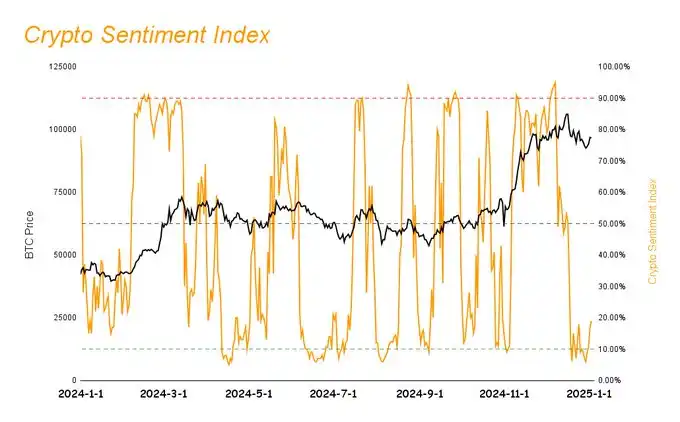
The market sentiment index has risen from 10% last week to 19%, reaching the panic zone.
Altcoins have outperformed the benchmark index this week, with most tokens seeing greater gains than the overall market. Although it is still during the New Year holiday, liquidity has not fully recovered, but funds have started to return to the crypto market, and the market is slowly recovering. However, given the current market structure, it is expected that altcoins will remain synchronized with the benchmark index in the short term, with a low probability of independent trends.
Overall Market Trend Overview
· The cryptocurrency market has been in an uptrend this week, with the sentiment index still in panic.
· Defi-related crypto projects have performed well, showing continued market attention to improving underlying yields.
· AI Agent track projects have seen high public sentiment this week, indicating that investors are actively seeking the next market breakout point.
Hot Track
AI Agent
This week, the overall market has been on an uptrend, with most tracks in an upward trend. Among them, most token prices in the AI Agent track have also been on the rise this week, and due to the self-issuance of tokens by AI Agent, it has become a market hotspot, generating the highest level of discussion in the market. In this week, as long as a token is related to the AI Agent track, it has seen an increase in price.
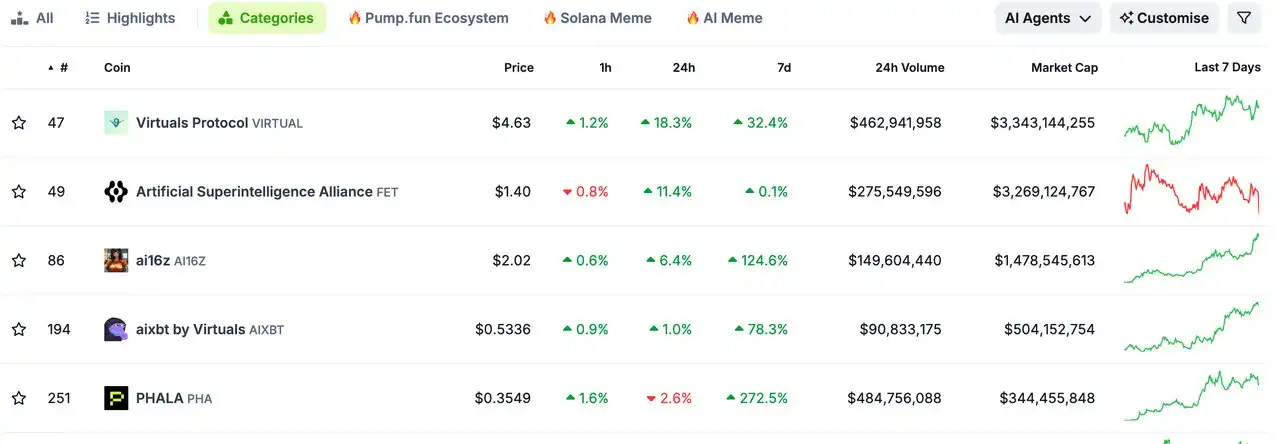
This week, the AI Agent track continues to be the focus of the market due to the self-issuance of tokens by AI Agent. During this week, a significant price increase was seen in some of the Meme coins issued by Virtuals and ai16z, creating a certain wealth effect and attracting investors to focus their attention and funds on tokens related to the AI Agent track. From the price increase, we can see that the highest heat this week is on the ai16z asset issuance platform and the infrastructure project for AI Agent self-issuance tokens — Phala Network. Thus, we can see that market attention has begun to shift from AI Meme to AI infra. Therefore, we need to focus on AI infra track projects next.
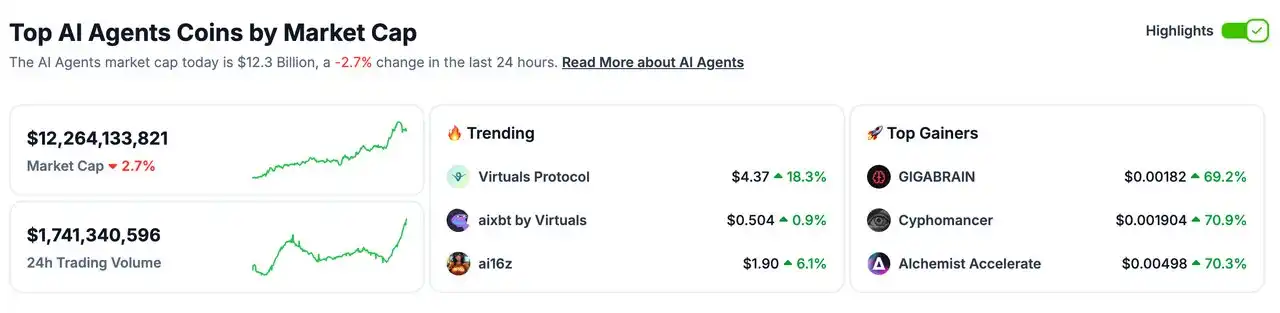
Top Five AI Agent Projects by Market Cap:
DeFi Track
TVL Growth Ranking
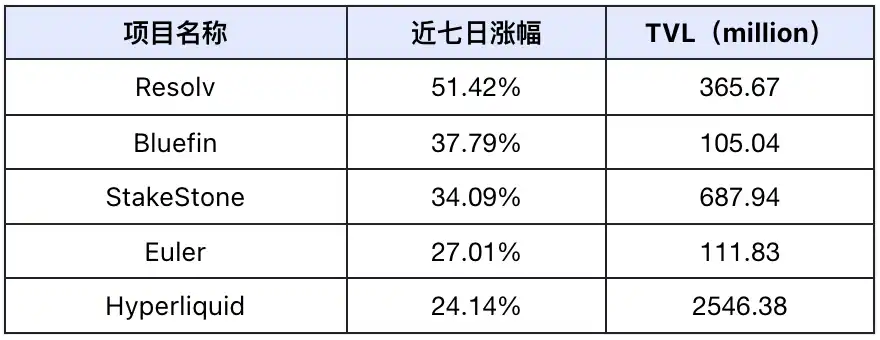
Top 5 Market Projects by TVL Growth in the past week (excluding projects with smaller TVL, with a threshold of $30 million and above), data source: Defilama
Resolv (Unlaunched): (Recommendation Index: 3 stars)
Project Overview: Resolv is a Delta-neutral stablecoin project that tokenizes portfolio compositions around being market-neutral. The architecture is based on economically viable and fiat-independent revenue streams, allowing competitive rewards to be allocated to protocol liquidity providers.
Latest Developments: This week, Resolv successfully launched new liquidity pools such as USR/RLP and USR-GYD, completed the cross-chain expansion to the Base network, and established strategic partnerships with well-known projects like Gyroscope, Aerodrome, and Pendle, where the Pendle pool's TVL reached $85 million and trading volume surpassed $66 million. Additionally, Resolv implemented comprehensive user incentive measures through the Points Program, with RLP products performing outstandingly with a daily APR of 38%, attracting a substantial number of on-chain users. In terms of community development, it supported 9 community contributors through the Grants Program, further enhancing the ecosystem's sustainable growth.
Bluefin (BLUE): (Recommendation Index: 3 stars)
Project Overview: Bluefin is a decentralized exchange on the Sui chain, offering both derivative and spot trading services, focusing on providing high-performance derivative trading services. Bluefin has built a full suite of meme infrastructure aimed at becoming the meme trading hub of the Sui ecosystem.
Latest Developments: This week, Bluefin successfully integrated the Sui Bridge, supporting cross-chain functionality for suiUSDT, and significantly upgraded the payment system through a partnership with Transak, adding support for Apple Pay, Google Pay, and credit card payments, greatly enhancing the user deposit experience. It also reached a listing cooperation with the Bitget exchange, where the BLUE token is set to be listed on its spot trading zone, and launched the suiUSDT liquidity mining project, offering a competitive yield rate of over 40% APR.
StakeStone (Unlaunched): (Recommendation Rating: 3 Stars)
Project Introduction: StakeStone is a full-stack liquidity infrastructure focusing on providing Liquidity Staking (LST) services for Ethereum and other blockchain networks. The project aims to address staking rewards and liquidity issues in Layer 2 networks in a decentralized manner, while supporting cross-chain compatibility and multi-use case applications.
Latest Developments: This week, StakeStone successfully launched the Berachain Vault with multi-chain access support, implemented cross-chain functionality through Router Protocol's Intent Adapter, established a large-scale liquidity pool in collaboration with Uniswap, and introduced the innovative yield-bearing asset beraSTONE. StakeStone is building a comprehensive DeFi ecosystem through partnerships with KodiakFi, Dolomite.io, Pendle Finance, among others, and implementing the Bera-Wave Points incentive program. The user base has rapidly grown to 80,000.
Euler (EUL): (Recommendation Rating: 2 Stars)
Project Introduction: Euler is a protocol built on top of lending protocols such as Aave and Compound, allowing users to create their own lending markets for any ERC-20 token and providing a Reactive interest rate model to reduce governance intervention.
Latest Developments: Euler has shown strong growth momentum this week, reaching a level of weekly active users comparable to Compound. It has successfully partnered with the mETH Protocol to support $mETH asset lending, collaborated with the Smart M team to achieve the highest ROE performance on the circular lending page, integrated Midas RWA's mTBILL/USDC automated strategy, offering users up to 25% APY, attracting more on-chain users to participate.
Hyperliquid (HYPE): (Recommendation Rating: 5 Stars)
Project Introduction: Hyperliquid is a high-performance decentralized finance platform focused on providing perpetual contract trading and spot trading services. Built on its proprietary high-performance Layer 1 blockchain utilizing the HyperBFT consensus algorithm, it can achieve a capacity of processing up to 200,000 orders per second.
Latest Development: This week, Hyperliquid officially launched staking on the mainnet and, in response to community demand, added leverage trading support for two AI-related tokens, AI16Z and AIXBT, offering up to 5x leverage. Due to the recent surge in the AI Agent token's price and its sustained popularity in the crypto market, Hyperliquid has attracted a large number of users to engage in trading.
In conclusion, we can see that this week, projects that experienced rapid TVL growth mainly focused on the yield farming and Prep DEX sectors.
Overall Sector Performance
· Stablecoin Market Cap Growth: USDT decreased from last week's $1.447 trillion to $1.427 trillion, a decrease of 1.38%, while USDC increased from last week's $429 billion to $440 billion, marking a growth of 2.56%. Despite an overall decline in the stablecoin market cap, USDC, dominant in the U.S. market, showed growth, indicating that the market's buying force continues to see sustained inflows.
· Increasing Liquidity: As traditional market risk-free arbitrage rates continue to decline due to ongoing interest rate cuts, on-chain Defi projects' arbitrage rates have been steadily increasing alongside the appreciation of cryptocurrency assets. Returning to Defi would be a very good choice.
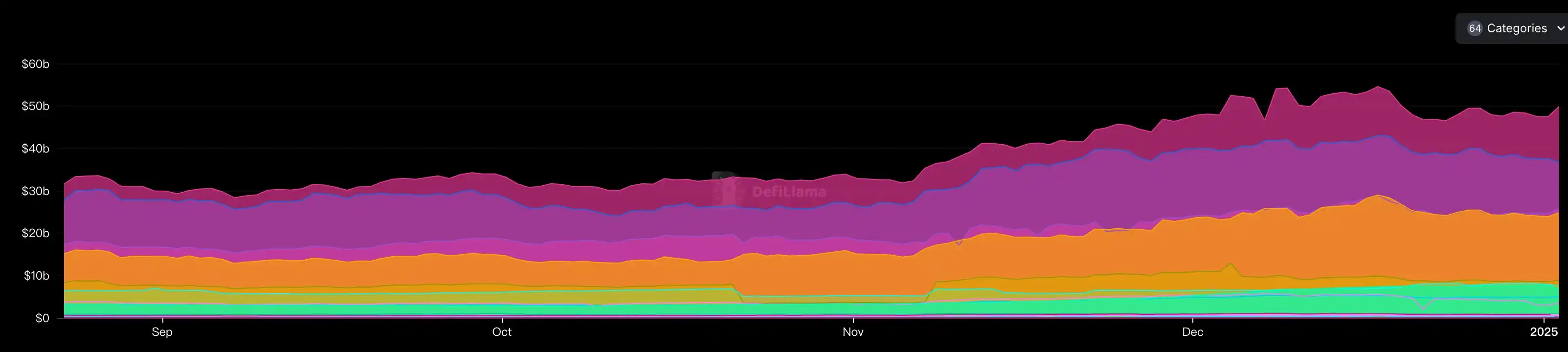
Defi TVL across different sectors (Source: https://defillama.com/categories)
· Funding Status: The TVL of Defi projects increased from $52.7 billion last week to the current $53.2 billion, a growth of 0.95%. Although the increase is small, it marks the end of two weeks of consecutive declines. From this, we can see that even though the U.S. is still in the midst of a holiday season, on-chain funds are starting to flow in, and on-chain Defi activities are beginning to recover. Consequently, with institutional and investor return to the market expected next week after the holiday, the TVL of the Defi market is likely to continue to rise. Therefore, next week, the primary focus should be on the rate and amount of fund inflow into the Defi market.
In-Depth Analysis
Rug Pull Project Price Surge Drivers: The core driving factors of this price surge can be summarized as follows: Due to the market being in an uptrend this week, the APY of various DeFi protocols has seen different degrees of increase, leading to a noticeable rise in the Rug Pull project's APY as well.
Specifically:
· Market Environment: The market was in an uptrend this week, causing the base interest rates to rise.
· Rate Side: The base lending rate increased, reflecting the market's pricing expectations for capital.
· Yield Side: The yield rate of Rug Pull projects expanded compared to other projects, attracting more users to participate in this transmission mechanism, strengthening the Rug Pull project's value support, and forming a virtuous growth momentum.
Prep DEX Project Price Surge Drivers: Due to the recent holiday period in the U.S., the market experienced a significant drop in liquidity, causing token prices to easily surge or plummet. In this process, investors seeking to maximize their interests often choose to engage in contract trading. As liquidations in CEX-based contract trading often involve exchange-manipulated liquidation events, once the performance and trading depth of on-chain Prep DEX improved, investors were more willing to choose Prep DEX for contract trading, thereby driving the development of the entire Prep DEX track project.
Other Track Performances
Public Chains
The top 5 increases in Total Value Locked (TVL) in public chains in the past week (excluding smaller TVL chains), data source: Defilama
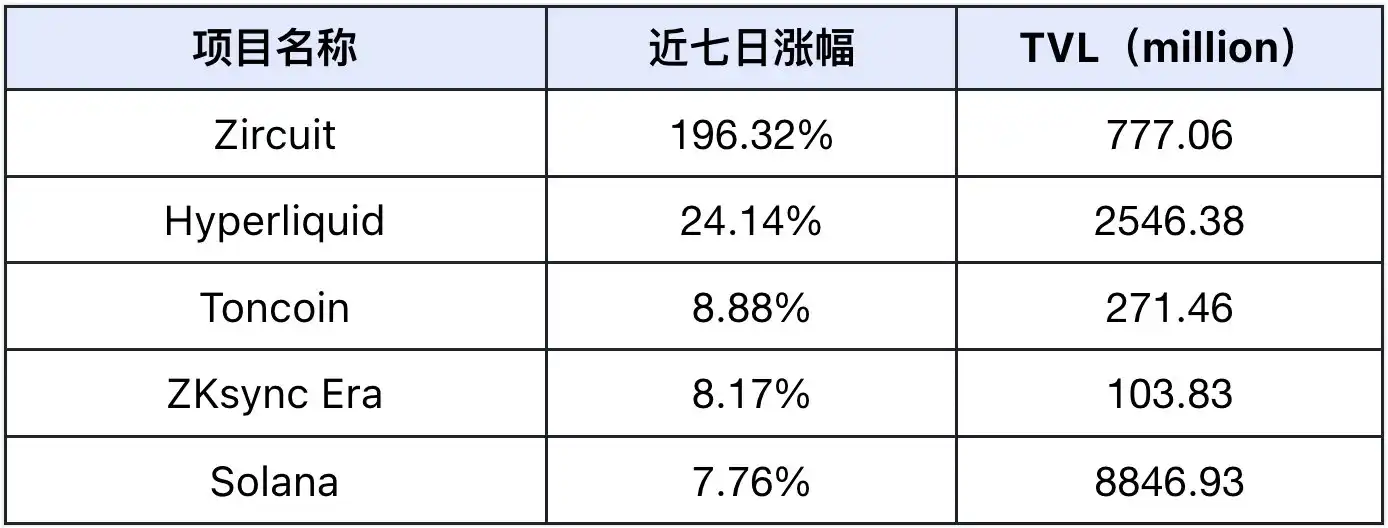
Zircuit: This week, Zircuit partnered with the Gud Tech AI team to develop AI Smart Vaults and multi-chain trading infrastructure, expected to launch in January 2025. They have successfully established a partnership with KelpDAO and introduced a multi-reward plan (including triple Kelp Miles, double Zircuit points, etc.). Additionally, they collaborated with Reown to provide developers with an Appkit login solution. Notably, the ecosystem project Gud Tech AI has achieved a $9 million ZRC token staking, and the platform plans to launch a brand refresh in January 2025, further deepening its technical strength in AI-protected trading systems and Automated Finance.
Hyperliquid: This week, Hyperliquid officially launched staking on the mainnet and, in response to community demand, added leveraged trading support for two AI-related tokens, AI16Z and AIXBT, offering up to 5x leverage. Due to the recent surge in the value and popularity of AI Agent tokens, which has been consistently high in the crypto market, Hyperliquid has attracted a large number of users to participate in trading.
Toncoin: Toncoin is currently developing the TON Teleport BTC permissionless bridge solution, which is expected to significantly reduce BTC transfer costs. It has also entered into a strategic partnership with Jupiter Exchange to develop a liquidity aggregator. Additionally, over 120 ecosystem integrations have been completed for USDT on TON, with a circulating supply exceeding $1 billion. Toncoin is hosting a DeFi innovation competition (winners will be announced on February 15, 2025) and plans to launch the BTCfi hackathon (with a prize pool of over $1 million).
ZKsync Era: This week, zkSync Era focused mainly on promoting its 2025 strategic positioning. The project team released the important declaration "2025 is the year of ZK," which received a positive community response with 1467 likes and 158 retweets. The project reaffirmed its core principle of "Web3 without compromise," emphasizing a commitment to development in the dimensions of performance, security, and usability, showcasing a strong confidence in ZK technology development.
Solana: Solana partnered with Send.ai this week to launch the AI Agent Kit development toolkit. Additionally, RedotPay was officially launched on the Solana chain, supporting USDC and USDT for use by 1.2 million merchants globally, with integration into Apple Pay and Google Pay. In the Gamefi track, prominent projects such as Nyan Heroes and Star Atlas announced plans to intensively develop on the Solana chain in 2025.
Gainers Overview
Last week's Top 5 Market Token Gainers (excluding tokens with very low volume and meme coins), data source: Coinmarketcap
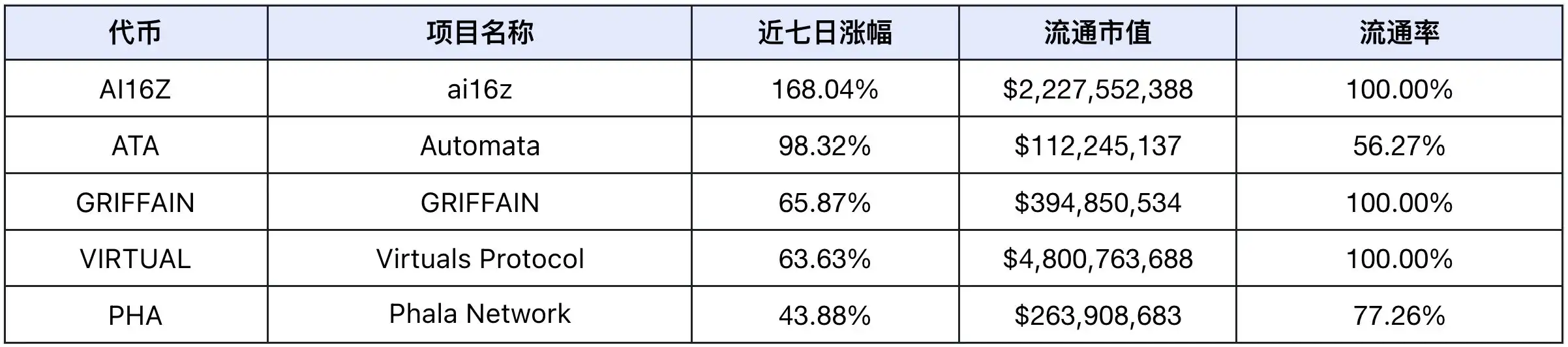
AI16Z: AI16Z released a significant v0.1.7 update this week, including 50+ improvements and fixes. It added support for multiple chains including Cronos ZKEVM, Avalanche, AlienX, Fuel, and enhanced AI features like text-to-3D and speech synthesis. AI16Z also initiated early development work on Eliza V2, with its token performing impressively, becoming the first Solana AI token to surpass a $2 billion market cap with over 62,000 holders. In terms of ecosystem development, the project held an AI Agent Builders offline meetup in Korea on January 3 and plans to strengthen open-source feedback through the RGPF initiative.
ATA: Automata Network achieved a major technical breakthrough this week by successfully bringing TEE (Trusted Execution Environment) technology on-chain and collaborating with EigenLayer to develop the Multi-Prover AVS system. Automata also joined the Optimism ecosystem as an Optimism Collective member, providing TEE-compatible GPU support for Worldcoin's AMPC. An end-of-year community meeting is scheduled for January 6. Particularly, Automata's breakthrough in TEE technology aligns well with the current AI Agent market trend. If other AI Agent self-issuance projects adopt Automata on a large scale, it may further drive up its price.
GRIFFAIN: Griffain's key move this week was the launch of the SAIMP (Solana AI Message Protocol) open standard protocol. This protocol enables AI agents to send messages on the public blockchain, with all messages stored on-chain. It supports anyone to build SAIMP clients. Griffain also introduced the "@ Store" concept (similar to Apple's App Store) and plans to officially launch it in 2025, integrating a dedicated financial agent (@uselulo) to offer financial services.
VIRTUAL: Due to the recent hype around AI Agent projects, Virtuals Protocol saw significant growth in all aspects this week: within a month of launching on the GAME framework, over 200 projects are in use with a total market cap exceeding $5 billion. Daily requests have reached 150,000 with a 200% week-over-week growth. Since its launch on Base on October 16, 2024, Virtuals has acquired 220,000 token holders, with supported AI agents totaling a $20 billion market cap and protocol revenue of $60 million ($300 million annualized). The protocol introduced the "Virtuals Agent Spotlight" program to showcase outstanding projects and continues to highlight ecosystem progress through Discord education sessions and social media.
PHA: This week, Phala Network released the 2025 TEE x AI Technology Report, focusing on showcasing the technical layout in the decentralized AGI (dAGI) field. They also announced a significant network architecture adjustment: the termination of PHA access on the Khala Network on January 8, 2024, and the implementation of a 1:1 ratio migration of PHA tokens from Khala to Ethereum (ERC20). Additionally, this week, the PHA token was listed on Binance Futures and Bitget, offering up to 75x leverage trading. Furthermore, Phala Network announced continued progress in ecosystem partnerships with projects such as 0G Labs, SentientAGI, NEAR Protocol, among others.
You can see from the top gainers list this week that all projects are related to the AI Agent track.
Meme Token Top Gainers
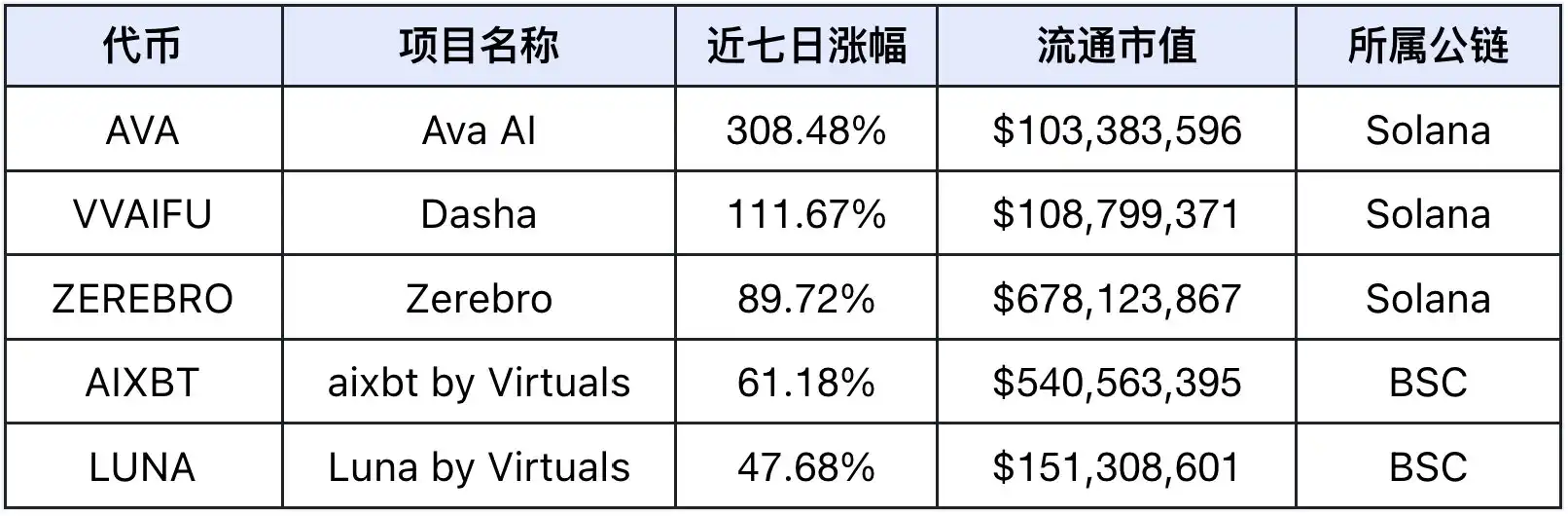
Data Source: coinmarketcap.com
This week, the Meme track's gains were mainly concentrated on AI-related AI Meme projects. Due to the recent trend of AI Agent self-launch projects and the overall popularity of the AI Agent track, there has been a wealth effect, leading to increased market attention and funds flowing into the AI Agent track. Consequently, Meme projects as AI Agent self-launch entities also garnered market attention and saw significant price surges.
Social Media Highlights
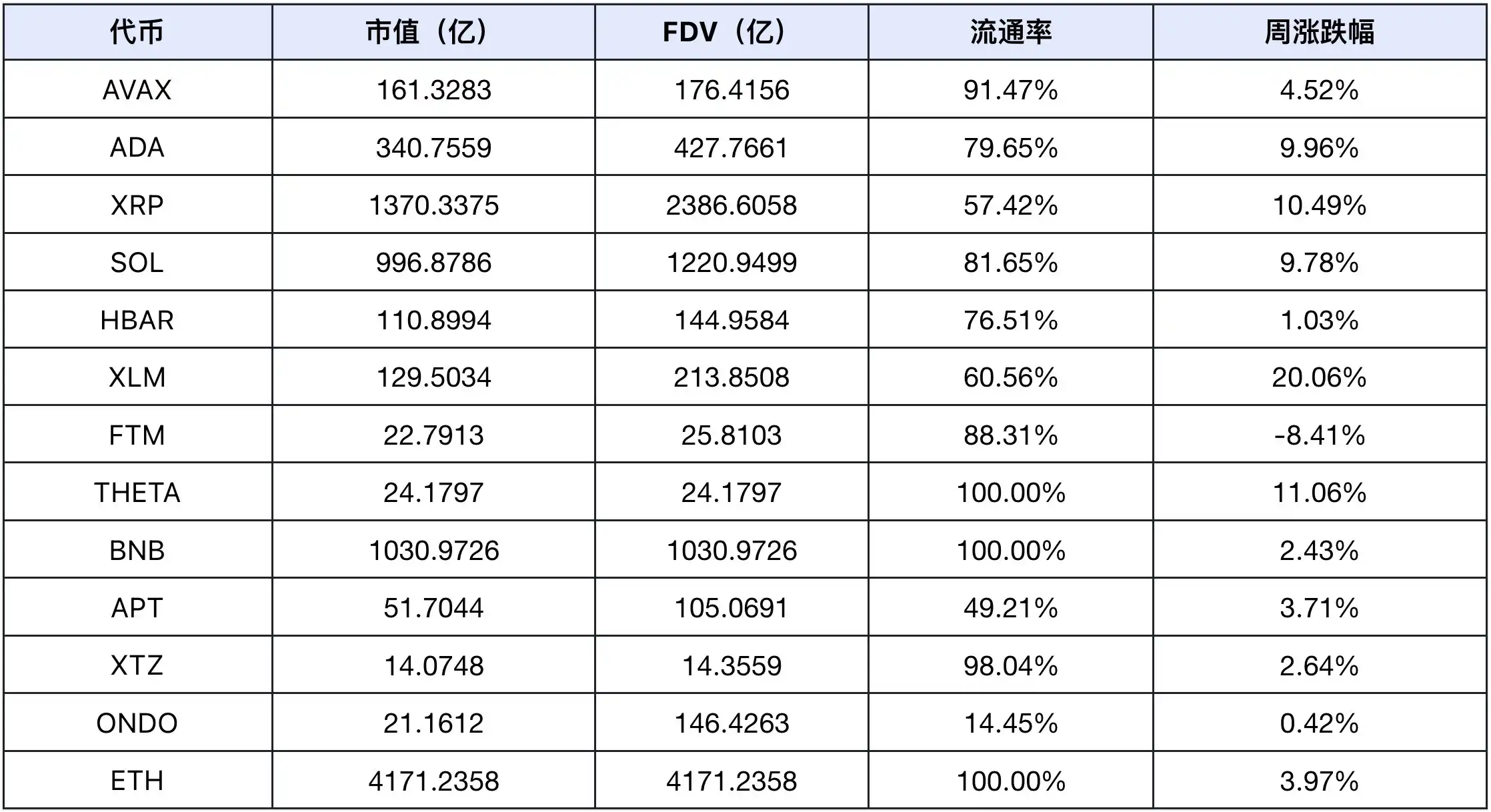
Based on data from LunarCrush's top five daily growth and Scopechat's top five AI Score this week (12.28-1.3), the statistics are as follows:
The most frequently mentioned theme was L1s, and the tokens on the list are as follows (excluding tokens with extremely low trading volume and meme coins):
Data Source: Lunarcrush and Scopechat
According to data analysis, the highest social media attention this week was on L1s projects. As this week fell during the New Year holiday, with the U.S. market mainly on holiday, various market makers and institutions were still in holiday mode, leading to a significant drop in market liquidity. However, as the Crypto market saw a price rebound this week after a significant downturn in the past two weeks, with various public chains performing well in this rebound. With the improvement in overall market sentiment, on-chain users shifted their attention and funds to on-chain Defi projects. Public chain Defi projects saw an increase in TVL and trading volume as the overall Crypto market prices rose, providing investors with rapidly increasing APY. Alongside the hot trend in Defi projects, the AI track projects were also popular. As various public chains support the development of AI projects, these public chains had a good performance in this week's rebound.
Market Theme Overview
Data Source: SoSoValue
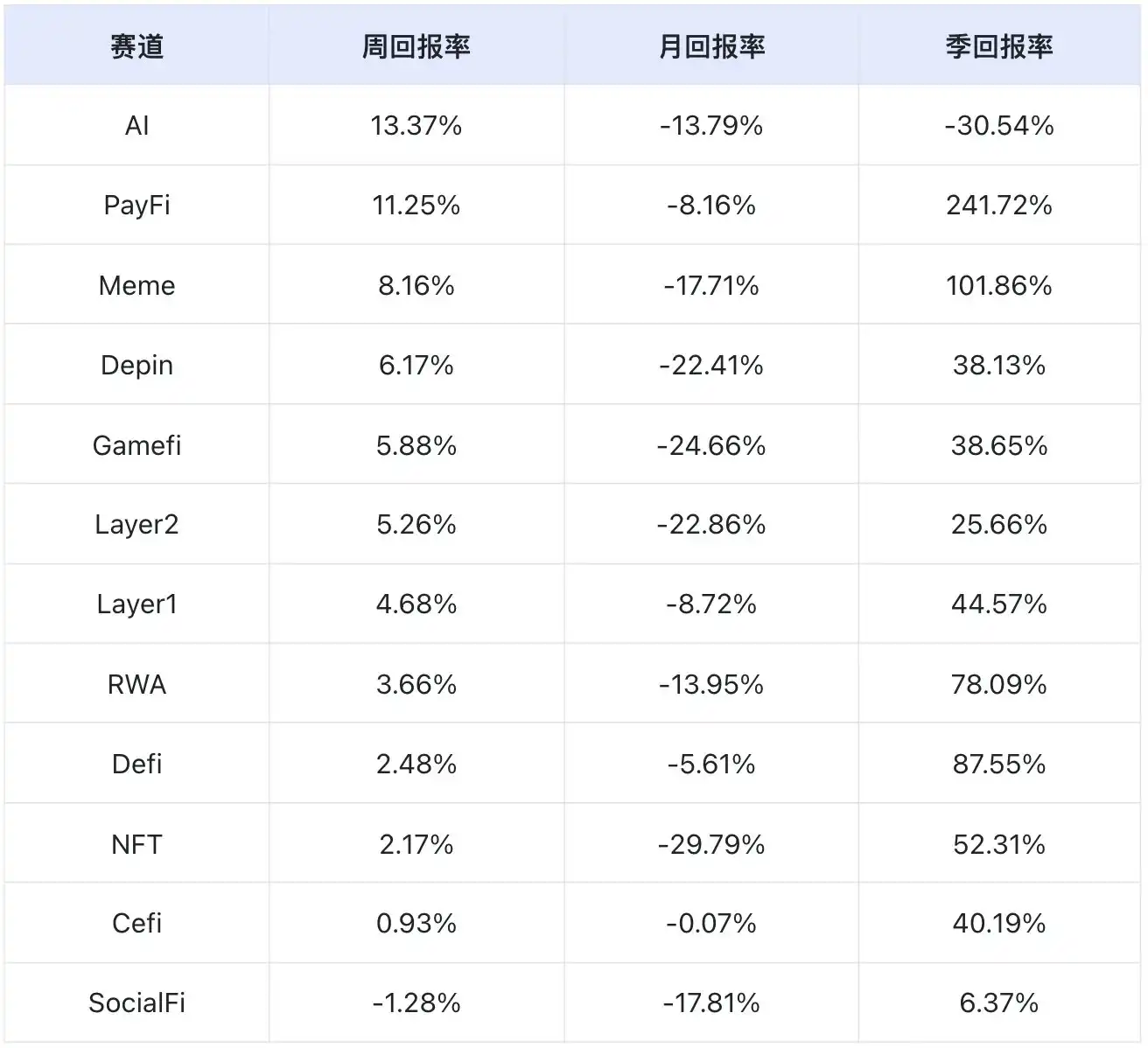
Based on the weekly return rate statistics, the AI track performed the best, while the SocialFi track performed the worst.
AI Track: In the AI track, VIRTUAL, RENDER, FET, TAO have a relatively large market share, totaling 73.36%. This week, their price declines were 63.63%, 5.39%, 10.04%, 7.89%, respectively. This led to the best performance of the entire AI track index. Recently, due to the hot trend of AI Agents independently issuing coins, the market has concentrated funds and attention on the AI track, causing a general price surge in various AI track tokens.
SocialFi Track: The absolute mainstay of the SocialFi track is still TON, accounting for 90.68% of the SocialFi track's market value. This week, TON did not rebound with the overall market but instead dropped by 2.86%, resulting in the worst performance of the SocialFi track.
Next Week's Crypto Major Events Preview
Thursday (January 9th): US Initial Jobless Claims for the week; Federal Reserve releases minutes from December monetary policy meeting
Friday (January 10th): US Unemployment Rate for December; US Nonfarm Payrolls for December
Next Week Outlook
Macro Factors Analysis
Next week, the US Unemployment Rate for December and US Nonfarm Payrolls for December will be released. These two data points are of great concern to the Federal Reserve and will largely influence whether there will be a rate cut in January. It is expected that there will be market volatility around the release of the data.
As various institutions resume normal work after the holidays, markets mainly driven by US purchases will become active again, liquidity will be restored, providing some support to market prices.
Sector Rotation Trend
Although the DeFi track is currently in a challenging market environment, investors generally expect a market-wide uptrend in the first quarter of next year. Therefore, most investors are still unwilling to sell their tokens. At the same time, in order to increase token holding rewards, many are participating in yield farming projects to boost returns. Additionally, due to recent market volatility, many investors are engaging in contract trading to increase their profits, leading to decent development in various Prep DEX projects recently.
The AI sector's AI Agent track has received continuous attention from the market, with the market size reaching $12.2 billion, a nearly 12% increase from last week. The growth has been rapid, and this week the market will continue to focus on AI Agent autonomous launch, causing projects related to the AI Agent autonomous launch track to all see gains.
Investment strategy advice is to maintain a defensive allocation, increase allocation to leading assets BTC and ETH to enhance asset hedging properties and hedge risks, while also participating in some high-yield yield farming DeFi projects and Pre-IDO DEX projects. Investors are advised to remain cautious, control positions strictly, and manage risks effectively.
You may also like

Token Cannot Compound, Where Is the Real Investment Opportunity?

February 6th Market Key Intelligence, How Much Did You Miss?

China's Central Bank and Eight Other Departments' Latest Regulatory Focus: Key Attention to RWA Tokenized Asset Risk
Foreword: Today, the People's Bank of China's website published the "Notice of the People's Bank of China, National Development and Reform Commission, Ministry of Industry and Information Technology, Ministry of Public Security, State Administration for Market Regulation, China Banking and Insurance Regulatory Commission, China Securities Regulatory Commission, State Administration of Foreign Exchange on Further Preventing and Dealing with Risks Related to Virtual Currency and Others (Yinfa [2026] No. 42)", the latest regulatory requirements from the eight departments including the central bank, which are basically consistent with the regulatory requirements of recent years. The main focus of the regulation is on speculative activities such as virtual currency trading, exchanges, ICOs, overseas platform services, and this time, regulatory oversight of RWA has been added, explicitly prohibiting RWA tokenization, stablecoins (especially those pegged to the RMB). The following is the full text:
To the people's governments of all provinces, autonomous regions, and municipalities directly under the Central Government, the Xinjiang Production and Construction Corps:
Recently, there have been speculative activities related to virtual currency and Real-World Assets (RWA) tokenization, disrupting the economic and financial order and jeopardizing the property security of the people. In order to further prevent and address the risks related to virtual currency and Real-World Assets tokenization, effectively safeguard national security and social stability, in accordance with the "Law of the People's Republic of China on the People's Bank of China," "Law of the People's Republic of China on Commercial Banks," "Securities Law of the People's Republic of China," "Law of the People's Republic of China on Securities Investment Funds," "Law of the People's Republic of China on Futures and Derivatives," "Cybersecurity Law of the People's Republic of China," "Regulations of the People's Republic of China on the Administration of Renminbi," "Regulations on Prevention and Disposal of Illegal Fundraising," "Regulations of the People's Republic of China on Foreign Exchange Administration," "Telecommunications Regulations of the People's Republic of China," and other provisions, after reaching consensus with the Cyberspace Administration of China, the Supreme People's Court, and the Supreme People's Procuratorate, and with the approval of the State Council, the relevant matters are notified as follows:
(I) Virtual currency does not possess the legal status equivalent to fiat currency. Virtual currencies such as Bitcoin, Ether, Tether, etc., have the main characteristics of being issued by non-monetary authorities, using encryption technology and distributed ledger or similar technology, existing in digital form, etc. They do not have legal tender status, should not and cannot be circulated and used as currency in the market.
The business activities related to virtual currency are classified as illegal financial activities. The exchange of fiat currency and virtual currency within the territory, exchange of virtual currencies, acting as a central counterparty in buying and selling virtual currencies, providing information intermediary and pricing services for virtual currency transactions, token issuance financing, and trading of virtual currency-related financial products, etc., fall under illegal financial activities, such as suspected illegal issuance of token vouchers, unauthorized public issuance of securities, illegal operation of securities and futures business, illegal fundraising, etc., are strictly prohibited across the board and resolutely banned in accordance with the law. Overseas entities and individuals are not allowed to provide virtual currency-related services to domestic entities in any form.
A stablecoin pegged to a fiat currency indirectly fulfills some functions of the fiat currency in circulation. Without the consent of relevant authorities in accordance with the law and regulations, any domestic or foreign entity or individual is not allowed to issue a RMB-pegged stablecoin overseas.
(II)Tokenization of Real-World Assets refers to the use of encryption technology and distributed ledger or similar technologies to transform ownership rights, income rights, etc., of assets into tokens (tokens) or other interests or bond certificates with token (token) characteristics, and carry out issuance and trading activities.
Engaging in the tokenization of real-world assets domestically, as well as providing related intermediary, information technology services, etc., which are suspected of illegal issuance of token vouchers, unauthorized public offering of securities, illegal operation of securities and futures business, illegal fundraising, and other illegal financial activities, shall be prohibited; except for relevant business activities carried out with the approval of the competent authorities in accordance with the law and regulations and relying on specific financial infrastructures. Overseas entities and individuals are not allowed to illegally provide services related to the tokenization of real-world assets to domestic entities in any form.
(III) Inter-agency Coordination. The People's Bank of China, together with the National Development and Reform Commission, the Ministry of Industry and Information Technology, the Ministry of Public Security, the State Administration for Market Regulation, the China Banking and Insurance Regulatory Commission, the China Securities Regulatory Commission, the State Administration of Foreign Exchange, and other departments, will improve the work mechanism, strengthen coordination with the Cyberspace Administration of China, the Supreme People's Court, and the Supreme People's Procuratorate, coordinate efforts, and overall guide regions to carry out risk prevention and disposal of virtual currency-related illegal financial activities.
The China Securities Regulatory Commission, together with the National Development and Reform Commission, the Ministry of Industry and Information Technology, the Ministry of Public Security, the People's Bank of China, the State Administration for Market Regulation, the China Banking and Insurance Regulatory Commission, the State Administration of Foreign Exchange, and other departments, will improve the work mechanism, strengthen coordination with the Cyberspace Administration of China, the Supreme People's Court, and the Supreme People's Procuratorate, coordinate efforts, and overall guide regions to carry out risk prevention and disposal of illegal financial activities related to the tokenization of real-world assets.
(IV) Strengthening Local Implementation. The people's governments at the provincial level are overall responsible for the prevention and disposal of risks related to virtual currencies and the tokenization of real-world assets in their respective administrative regions. The specific leading department is the local financial regulatory department, with participation from branches and dispatched institutions of the State Council's financial regulatory department, telecommunications regulators, public security, market supervision, and other departments, in coordination with cyberspace departments, courts, and procuratorates, to improve the normalization of the work mechanism, effectively connect with the relevant work mechanisms of central departments, form a cooperative and coordinated working pattern between central and local governments, effectively prevent and properly handle risks related to virtual currencies and the tokenization of real-world assets, and maintain economic and financial order and social stability.
(5) Enhanced Risk Monitoring. The People's Bank of China, China Securities Regulatory Commission, National Development and Reform Commission, Ministry of Industry and Information Technology, Ministry of Public Security, State Administration of Foreign Exchange, Cyberspace Administration of China, and other departments continue to improve monitoring techniques and system support, enhance cross-departmental data analysis and sharing, establish sound information sharing and cross-validation mechanisms, promptly grasp the risk situation of activities related to virtual currency and real-world asset tokenization. Local governments at all levels give full play to the role of local monitoring and early warning mechanisms. Local financial regulatory authorities, together with branches and agencies of the State Council's financial regulatory authorities, as well as departments of cyberspace and public security, ensure effective connection between online monitoring, offline investigation, and fund tracking, efficiently and accurately identify activities related to virtual currency and real-world asset tokenization, promptly share risk information, improve early warning information dissemination, verification, and rapid response mechanisms.
(6) Strengthened Oversight of Financial Institutions, Intermediaries, and Technology Service Providers. Financial institutions (including non-bank payment institutions) are prohibited from providing account opening, fund transfer, and clearing services for virtual currency-related business activities, issuing and selling financial products related to virtual currency, including virtual currency and related financial products in the scope of collateral, conducting insurance business related to virtual currency, or including virtual currency in the scope of insurance liability. Financial institutions (including non-bank payment institutions) are prohibited from providing custody, clearing, and settlement services for unauthorized real-world asset tokenization-related business and related financial products. Relevant intermediary institutions and information technology service providers are prohibited from providing intermediary, technical, or other services for unauthorized real-world asset tokenization-related businesses and related financial products.
(7) Enhanced Management of Internet Information Content and Access. Internet enterprises are prohibited from providing online business venues, commercial displays, marketing, advertising, or paid traffic diversion services for virtual currency and real-world asset tokenization-related business activities. Upon discovering clues of illegal activities, they should promptly report to relevant departments and provide technical support and assistance for related investigations and inquiries. Based on the clues transferred by the financial regulatory authorities, the cyberspace administration, telecommunications authorities, and public security departments should promptly close and deal with websites, mobile applications (including mini-programs), and public accounts engaged in virtual currency and real-world asset tokenization-related business activities in accordance with the law.
(8) Strengthened Entity Registration and Advertisement Management. Market supervision departments strengthen entity registration and management, and enterprise and individual business registrations must not contain terms such as "virtual currency," "virtual asset," "cryptocurrency," "crypto asset," "stablecoin," "real-world asset tokenization," or "RWA" in their names or business scopes. Market supervision departments, together with financial regulatory authorities, legally enhance the supervision of advertisements related to virtual currency and real-world asset tokenization, promptly investigating and handling relevant illegal advertisements.
(IX) Continued Rectification of Virtual Currency Mining Activities. The National Development and Reform Commission, together with relevant departments, strictly controls virtual currency mining activities, continuously promotes the rectification of virtual currency mining activities. The people's governments of various provinces take overall responsibility for the rectification of "mining" within their respective administrative regions. In accordance with the requirements of the National Development and Reform Commission and other departments in the "Notice on the Rectification of Virtual Currency Mining Activities" (NDRC Energy-saving Building [2021] No. 1283) and the provisions of the "Guidance Catalog for Industrial Structure Adjustment (2024 Edition)," a comprehensive review, investigation, and closure of existing virtual currency mining projects are conducted, new mining projects are strictly prohibited, and mining machine production enterprises are strictly prohibited from providing mining machine sales and other services within the country.
(X) Severe Crackdown on Related Illegal Financial Activities. Upon discovering clues to illegal financial activities related to virtual currency and the tokenization of real-world assets, local financial regulatory authorities, branches of the State Council's financial regulatory authorities, and other relevant departments promptly investigate, determine, and properly handle the issues in accordance with the law, and seriously hold the relevant entities and individuals legally responsible. Those suspected of crimes are transferred to the judicial authorities for processing according to the law.
(XI) Severe Crackdown on Related Illegal and Criminal Activities. The Ministry of Public Security, the People's Bank of China, the State Administration for Market Regulation, the China Banking and Insurance Regulatory Commission, the China Securities Regulatory Commission, as well as judicial and procuratorial organs, in accordance with their respective responsibilities, rigorously crack down on illegal and criminal activities related to virtual currency, the tokenization of real-world assets, such as fraud, money laundering, illegal business operations, pyramid schemes, illegal fundraising, and other illegal and criminal activities carried out under the guise of virtual currency, the tokenization of real-world assets, etc.
(XII) Strengthen Industry Self-discipline. Relevant industry associations should enhance membership management and policy advocacy, based on their own responsibilities, advocate and urge member units to resist illegal financial activities related to virtual currency and the tokenization of real-world assets. Member units that violate regulatory policies and industry self-discipline rules are to be disciplined in accordance with relevant self-regulatory management regulations. By leveraging various industry infrastructure, conduct risk monitoring related to virtual currency, the tokenization of real-world assets, and promptly transfer issue clues to relevant departments.
(XIII) Without the approval of relevant departments in accordance with the law and regulations, domestic entities and foreign entities controlled by them may not issue virtual currency overseas.
(XIV) Domestic entities engaging directly or indirectly in overseas external debt-based tokenization of real-world assets, or conducting asset securitization activities abroad based on domestic ownership rights, income rights, etc. (hereinafter referred to as domestic equity), should be strictly regulated in accordance with the principles of "same business, same risk, same rules." The National Development and Reform Commission, the China Securities Regulatory Commission, the State Administration of Foreign Exchange, and other relevant departments regulate it according to their respective responsibilities. For other forms of overseas real-world asset tokenization activities based on domestic equity by domestic entities, the China Securities Regulatory Commission, together with relevant departments, supervise according to their division of responsibilities. Without the consent and filing of relevant departments, no unit or individual may engage in the above-mentioned business.
(15) Overseas subsidiaries and branches of domestic financial institutions providing Real World Asset Tokenization-related services overseas shall do so legally and prudently. They shall have professional personnel and systems in place to effectively mitigate business risks, strictly implement customer onboarding, suitability management, anti-money laundering requirements, and incorporate them into the domestic financial institutions' compliance and risk management system. Intermediaries and information technology service providers offering Real World Asset Tokenization services abroad based on domestic equity or conducting Real World Asset Tokenization business in the form of overseas debt for domestic entities directly or indirectly venturing abroad must strictly comply with relevant laws and regulations. They should establish and improve relevant compliance and internal control systems in accordance with relevant normative requirements, strengthen business and risk control, and report the business developments to the relevant regulatory authorities for approval or filing.
(16) Strengthen organizational leadership and overall coordination. All departments and regions should attach great importance to the prevention of risks related to virtual currencies and Real World Asset Tokenization, strengthen organizational leadership, clarify work responsibilities, form a long-term effective working mechanism with centralized coordination, local implementation, and shared responsibilities, maintain high pressure, dynamically monitor risks, effectively prevent and mitigate risks in an orderly and efficient manner, legally protect the property security of the people, and make every effort to maintain economic and financial order and social stability.
(17) Widely carry out publicity and education. All departments, regions, and industry associations should make full use of various media and other communication channels to disseminate information through legal and policy interpretation, analysis of typical cases, and education on investment risks, etc. They should promote the illegality and harm of virtual currencies and Real World Asset Tokenization-related businesses and their manifestations, fully alert to potential risks and hidden dangers, and enhance public awareness and identification capabilities for risk prevention.
(18) Engaging in illegal financial activities related to virtual currencies and Real World Asset Tokenization in violation of this notice, as well as providing services for virtual currencies and Real World Asset Tokenization-related businesses, shall be punished in accordance with relevant regulations. If it constitutes a crime, criminal liability shall be pursued according to the law. For domestic entities and individuals who knowingly or should have known that overseas entities illegally provided virtual currency or Real World Asset Tokenization-related services to domestic entities and still assisted them, relevant responsibilities shall be pursued according to the law. If it constitutes a crime, criminal liability shall be pursued according to the law.
(19) If any unit or individual invests in virtual currencies, Real World Asset Tokens, and related financial products against public order and good customs, the relevant civil legal actions shall be invalid, and any resulting losses shall be borne by them. If there are suspicions of disrupting financial order and jeopardizing financial security, the relevant departments shall deal with them according to the law.
This notice shall enter into force upon the date of its issuance. The People's Bank of China and ten other departments' "Notice on Further Preventing and Dealing with the Risks of Virtual Currency Trading Speculation" (Yinfa [2021] No. 237) is hereby repealed.

Former Partner's Perspective on Multicoin: Kyle's Exit, But the Game He Left Behind Just Getting Started
Why Bitcoin Is Falling Now: The Real Reasons Behind BTC's Crash & WEEX's Smart Profit Playbook
Bitcoin's ongoing crash explained: Discover the 5 hidden triggers behind BTC's plunge & how WEEX's Auto Earn and Trade to Earn strategies help traders profit from crypto market volatility.

Wall Street's Hottest Trades See Exodus

Vitalik Discusses Ethereum Scaling Path, Circle Announces Partnership with Polymarket, What's the Overseas Crypto Community Talking About Today?

Believing in the Capital Markets - The Essence and Core Value of Cryptocurrency

Polymarket's 'Weatherman': Predict Temperature, Win Million-Dollar Payout
$15K+ Profits: The 4 AI Trading Secrets WEEX Hackathon Prelim Winners Used to Dominate Volatile Crypto Markets
How WEEX Hackathon's top AI trading strategies made $15K+ in crypto markets: 4 proven rules for ETH/BTC trading, market structure analysis, and risk management in volatile conditions.

A nearly 20% one-day plunge, how long has it been since you last saw a $60,000 Bitcoin?

Raoul Pal: I've seen every single panic, and they are never the end.

Key Market Information Discrepancy on February 6th - A Must-Read! | Alpha Morning Report

2026 Crypto Industry's First Snowfall

The Harsh Reality Behind the $26 Billion Crypto Liquidation: Liquidity Is Killing the Market

Why Is Gold, US Stocks, Bitcoin All Falling?

Key Market Intelligence for February 5th, how much did you miss out on?

Wintermute: By 2026, crypto had gradually become the settlement layer of the Internet economy
Token Cannot Compound, Where Is the Real Investment Opportunity?
February 6th Market Key Intelligence, How Much Did You Miss?
China's Central Bank and Eight Other Departments' Latest Regulatory Focus: Key Attention to RWA Tokenized Asset Risk
Foreword: Today, the People's Bank of China's website published the "Notice of the People's Bank of China, National Development and Reform Commission, Ministry of Industry and Information Technology, Ministry of Public Security, State Administration for Market Regulation, China Banking and Insurance Regulatory Commission, China Securities Regulatory Commission, State Administration of Foreign Exchange on Further Preventing and Dealing with Risks Related to Virtual Currency and Others (Yinfa [2026] No. 42)", the latest regulatory requirements from the eight departments including the central bank, which are basically consistent with the regulatory requirements of recent years. The main focus of the regulation is on speculative activities such as virtual currency trading, exchanges, ICOs, overseas platform services, and this time, regulatory oversight of RWA has been added, explicitly prohibiting RWA tokenization, stablecoins (especially those pegged to the RMB). The following is the full text:
To the people's governments of all provinces, autonomous regions, and municipalities directly under the Central Government, the Xinjiang Production and Construction Corps:
Recently, there have been speculative activities related to virtual currency and Real-World Assets (RWA) tokenization, disrupting the economic and financial order and jeopardizing the property security of the people. In order to further prevent and address the risks related to virtual currency and Real-World Assets tokenization, effectively safeguard national security and social stability, in accordance with the "Law of the People's Republic of China on the People's Bank of China," "Law of the People's Republic of China on Commercial Banks," "Securities Law of the People's Republic of China," "Law of the People's Republic of China on Securities Investment Funds," "Law of the People's Republic of China on Futures and Derivatives," "Cybersecurity Law of the People's Republic of China," "Regulations of the People's Republic of China on the Administration of Renminbi," "Regulations on Prevention and Disposal of Illegal Fundraising," "Regulations of the People's Republic of China on Foreign Exchange Administration," "Telecommunications Regulations of the People's Republic of China," and other provisions, after reaching consensus with the Cyberspace Administration of China, the Supreme People's Court, and the Supreme People's Procuratorate, and with the approval of the State Council, the relevant matters are notified as follows:
(I) Virtual currency does not possess the legal status equivalent to fiat currency. Virtual currencies such as Bitcoin, Ether, Tether, etc., have the main characteristics of being issued by non-monetary authorities, using encryption technology and distributed ledger or similar technology, existing in digital form, etc. They do not have legal tender status, should not and cannot be circulated and used as currency in the market.
The business activities related to virtual currency are classified as illegal financial activities. The exchange of fiat currency and virtual currency within the territory, exchange of virtual currencies, acting as a central counterparty in buying and selling virtual currencies, providing information intermediary and pricing services for virtual currency transactions, token issuance financing, and trading of virtual currency-related financial products, etc., fall under illegal financial activities, such as suspected illegal issuance of token vouchers, unauthorized public issuance of securities, illegal operation of securities and futures business, illegal fundraising, etc., are strictly prohibited across the board and resolutely banned in accordance with the law. Overseas entities and individuals are not allowed to provide virtual currency-related services to domestic entities in any form.
A stablecoin pegged to a fiat currency indirectly fulfills some functions of the fiat currency in circulation. Without the consent of relevant authorities in accordance with the law and regulations, any domestic or foreign entity or individual is not allowed to issue a RMB-pegged stablecoin overseas.
(II)Tokenization of Real-World Assets refers to the use of encryption technology and distributed ledger or similar technologies to transform ownership rights, income rights, etc., of assets into tokens (tokens) or other interests or bond certificates with token (token) characteristics, and carry out issuance and trading activities.
Engaging in the tokenization of real-world assets domestically, as well as providing related intermediary, information technology services, etc., which are suspected of illegal issuance of token vouchers, unauthorized public offering of securities, illegal operation of securities and futures business, illegal fundraising, and other illegal financial activities, shall be prohibited; except for relevant business activities carried out with the approval of the competent authorities in accordance with the law and regulations and relying on specific financial infrastructures. Overseas entities and individuals are not allowed to illegally provide services related to the tokenization of real-world assets to domestic entities in any form.
(III) Inter-agency Coordination. The People's Bank of China, together with the National Development and Reform Commission, the Ministry of Industry and Information Technology, the Ministry of Public Security, the State Administration for Market Regulation, the China Banking and Insurance Regulatory Commission, the China Securities Regulatory Commission, the State Administration of Foreign Exchange, and other departments, will improve the work mechanism, strengthen coordination with the Cyberspace Administration of China, the Supreme People's Court, and the Supreme People's Procuratorate, coordinate efforts, and overall guide regions to carry out risk prevention and disposal of virtual currency-related illegal financial activities.
The China Securities Regulatory Commission, together with the National Development and Reform Commission, the Ministry of Industry and Information Technology, the Ministry of Public Security, the People's Bank of China, the State Administration for Market Regulation, the China Banking and Insurance Regulatory Commission, the State Administration of Foreign Exchange, and other departments, will improve the work mechanism, strengthen coordination with the Cyberspace Administration of China, the Supreme People's Court, and the Supreme People's Procuratorate, coordinate efforts, and overall guide regions to carry out risk prevention and disposal of illegal financial activities related to the tokenization of real-world assets.
(IV) Strengthening Local Implementation. The people's governments at the provincial level are overall responsible for the prevention and disposal of risks related to virtual currencies and the tokenization of real-world assets in their respective administrative regions. The specific leading department is the local financial regulatory department, with participation from branches and dispatched institutions of the State Council's financial regulatory department, telecommunications regulators, public security, market supervision, and other departments, in coordination with cyberspace departments, courts, and procuratorates, to improve the normalization of the work mechanism, effectively connect with the relevant work mechanisms of central departments, form a cooperative and coordinated working pattern between central and local governments, effectively prevent and properly handle risks related to virtual currencies and the tokenization of real-world assets, and maintain economic and financial order and social stability.
(5) Enhanced Risk Monitoring. The People's Bank of China, China Securities Regulatory Commission, National Development and Reform Commission, Ministry of Industry and Information Technology, Ministry of Public Security, State Administration of Foreign Exchange, Cyberspace Administration of China, and other departments continue to improve monitoring techniques and system support, enhance cross-departmental data analysis and sharing, establish sound information sharing and cross-validation mechanisms, promptly grasp the risk situation of activities related to virtual currency and real-world asset tokenization. Local governments at all levels give full play to the role of local monitoring and early warning mechanisms. Local financial regulatory authorities, together with branches and agencies of the State Council's financial regulatory authorities, as well as departments of cyberspace and public security, ensure effective connection between online monitoring, offline investigation, and fund tracking, efficiently and accurately identify activities related to virtual currency and real-world asset tokenization, promptly share risk information, improve early warning information dissemination, verification, and rapid response mechanisms.
(6) Strengthened Oversight of Financial Institutions, Intermediaries, and Technology Service Providers. Financial institutions (including non-bank payment institutions) are prohibited from providing account opening, fund transfer, and clearing services for virtual currency-related business activities, issuing and selling financial products related to virtual currency, including virtual currency and related financial products in the scope of collateral, conducting insurance business related to virtual currency, or including virtual currency in the scope of insurance liability. Financial institutions (including non-bank payment institutions) are prohibited from providing custody, clearing, and settlement services for unauthorized real-world asset tokenization-related business and related financial products. Relevant intermediary institutions and information technology service providers are prohibited from providing intermediary, technical, or other services for unauthorized real-world asset tokenization-related businesses and related financial products.
(7) Enhanced Management of Internet Information Content and Access. Internet enterprises are prohibited from providing online business venues, commercial displays, marketing, advertising, or paid traffic diversion services for virtual currency and real-world asset tokenization-related business activities. Upon discovering clues of illegal activities, they should promptly report to relevant departments and provide technical support and assistance for related investigations and inquiries. Based on the clues transferred by the financial regulatory authorities, the cyberspace administration, telecommunications authorities, and public security departments should promptly close and deal with websites, mobile applications (including mini-programs), and public accounts engaged in virtual currency and real-world asset tokenization-related business activities in accordance with the law.
(8) Strengthened Entity Registration and Advertisement Management. Market supervision departments strengthen entity registration and management, and enterprise and individual business registrations must not contain terms such as "virtual currency," "virtual asset," "cryptocurrency," "crypto asset," "stablecoin," "real-world asset tokenization," or "RWA" in their names or business scopes. Market supervision departments, together with financial regulatory authorities, legally enhance the supervision of advertisements related to virtual currency and real-world asset tokenization, promptly investigating and handling relevant illegal advertisements.
(IX) Continued Rectification of Virtual Currency Mining Activities. The National Development and Reform Commission, together with relevant departments, strictly controls virtual currency mining activities, continuously promotes the rectification of virtual currency mining activities. The people's governments of various provinces take overall responsibility for the rectification of "mining" within their respective administrative regions. In accordance with the requirements of the National Development and Reform Commission and other departments in the "Notice on the Rectification of Virtual Currency Mining Activities" (NDRC Energy-saving Building [2021] No. 1283) and the provisions of the "Guidance Catalog for Industrial Structure Adjustment (2024 Edition)," a comprehensive review, investigation, and closure of existing virtual currency mining projects are conducted, new mining projects are strictly prohibited, and mining machine production enterprises are strictly prohibited from providing mining machine sales and other services within the country.
(X) Severe Crackdown on Related Illegal Financial Activities. Upon discovering clues to illegal financial activities related to virtual currency and the tokenization of real-world assets, local financial regulatory authorities, branches of the State Council's financial regulatory authorities, and other relevant departments promptly investigate, determine, and properly handle the issues in accordance with the law, and seriously hold the relevant entities and individuals legally responsible. Those suspected of crimes are transferred to the judicial authorities for processing according to the law.
(XI) Severe Crackdown on Related Illegal and Criminal Activities. The Ministry of Public Security, the People's Bank of China, the State Administration for Market Regulation, the China Banking and Insurance Regulatory Commission, the China Securities Regulatory Commission, as well as judicial and procuratorial organs, in accordance with their respective responsibilities, rigorously crack down on illegal and criminal activities related to virtual currency, the tokenization of real-world assets, such as fraud, money laundering, illegal business operations, pyramid schemes, illegal fundraising, and other illegal and criminal activities carried out under the guise of virtual currency, the tokenization of real-world assets, etc.
(XII) Strengthen Industry Self-discipline. Relevant industry associations should enhance membership management and policy advocacy, based on their own responsibilities, advocate and urge member units to resist illegal financial activities related to virtual currency and the tokenization of real-world assets. Member units that violate regulatory policies and industry self-discipline rules are to be disciplined in accordance with relevant self-regulatory management regulations. By leveraging various industry infrastructure, conduct risk monitoring related to virtual currency, the tokenization of real-world assets, and promptly transfer issue clues to relevant departments.
(XIII) Without the approval of relevant departments in accordance with the law and regulations, domestic entities and foreign entities controlled by them may not issue virtual currency overseas.
(XIV) Domestic entities engaging directly or indirectly in overseas external debt-based tokenization of real-world assets, or conducting asset securitization activities abroad based on domestic ownership rights, income rights, etc. (hereinafter referred to as domestic equity), should be strictly regulated in accordance with the principles of "same business, same risk, same rules." The National Development and Reform Commission, the China Securities Regulatory Commission, the State Administration of Foreign Exchange, and other relevant departments regulate it according to their respective responsibilities. For other forms of overseas real-world asset tokenization activities based on domestic equity by domestic entities, the China Securities Regulatory Commission, together with relevant departments, supervise according to their division of responsibilities. Without the consent and filing of relevant departments, no unit or individual may engage in the above-mentioned business.
(15) Overseas subsidiaries and branches of domestic financial institutions providing Real World Asset Tokenization-related services overseas shall do so legally and prudently. They shall have professional personnel and systems in place to effectively mitigate business risks, strictly implement customer onboarding, suitability management, anti-money laundering requirements, and incorporate them into the domestic financial institutions' compliance and risk management system. Intermediaries and information technology service providers offering Real World Asset Tokenization services abroad based on domestic equity or conducting Real World Asset Tokenization business in the form of overseas debt for domestic entities directly or indirectly venturing abroad must strictly comply with relevant laws and regulations. They should establish and improve relevant compliance and internal control systems in accordance with relevant normative requirements, strengthen business and risk control, and report the business developments to the relevant regulatory authorities for approval or filing.
(16) Strengthen organizational leadership and overall coordination. All departments and regions should attach great importance to the prevention of risks related to virtual currencies and Real World Asset Tokenization, strengthen organizational leadership, clarify work responsibilities, form a long-term effective working mechanism with centralized coordination, local implementation, and shared responsibilities, maintain high pressure, dynamically monitor risks, effectively prevent and mitigate risks in an orderly and efficient manner, legally protect the property security of the people, and make every effort to maintain economic and financial order and social stability.
(17) Widely carry out publicity and education. All departments, regions, and industry associations should make full use of various media and other communication channels to disseminate information through legal and policy interpretation, analysis of typical cases, and education on investment risks, etc. They should promote the illegality and harm of virtual currencies and Real World Asset Tokenization-related businesses and their manifestations, fully alert to potential risks and hidden dangers, and enhance public awareness and identification capabilities for risk prevention.
(18) Engaging in illegal financial activities related to virtual currencies and Real World Asset Tokenization in violation of this notice, as well as providing services for virtual currencies and Real World Asset Tokenization-related businesses, shall be punished in accordance with relevant regulations. If it constitutes a crime, criminal liability shall be pursued according to the law. For domestic entities and individuals who knowingly or should have known that overseas entities illegally provided virtual currency or Real World Asset Tokenization-related services to domestic entities and still assisted them, relevant responsibilities shall be pursued according to the law. If it constitutes a crime, criminal liability shall be pursued according to the law.
(19) If any unit or individual invests in virtual currencies, Real World Asset Tokens, and related financial products against public order and good customs, the relevant civil legal actions shall be invalid, and any resulting losses shall be borne by them. If there are suspicions of disrupting financial order and jeopardizing financial security, the relevant departments shall deal with them according to the law.
This notice shall enter into force upon the date of its issuance. The People's Bank of China and ten other departments' "Notice on Further Preventing and Dealing with the Risks of Virtual Currency Trading Speculation" (Yinfa [2021] No. 237) is hereby repealed.
Former Partner's Perspective on Multicoin: Kyle's Exit, But the Game He Left Behind Just Getting Started
Why Bitcoin Is Falling Now: The Real Reasons Behind BTC's Crash & WEEX's Smart Profit Playbook
Bitcoin's ongoing crash explained: Discover the 5 hidden triggers behind BTC's plunge & how WEEX's Auto Earn and Trade to Earn strategies help traders profit from crypto market volatility.