
- Buy Crypto
- Markets
 Futures
- Spot
- Copy Trade
 Earn
Earn- More
Maybe This Is the Real Reason Why COW Surged 162% in One Month

CowSwap is the recently skyrocketing DeFi coin, and is also one of Vitalik's favorite DEXes, as well as a whale-exclusive on-chain platform. It is even the official DEX used by the Degen King team.
However, what many people don't know is that behind CowSwap lies a highly underestimated top incubator in the Ethereum community—Gnosis. I believe this is the true reason for the $COW's meteoric rise.
Recently, a piece of on-chain activity in the Chinese community related to the DeFi project World Liberty Financial (WLFI) associated with the Trump team has attracted market attention. Although $COW is not included in WLFI's asset list, according to on-chain analyst Ai Yi, WLFI has made several token purchases using CowSwap. This aligns with Ethereum's founder Vitalik Buterin's habit of frequently using CowSwap.
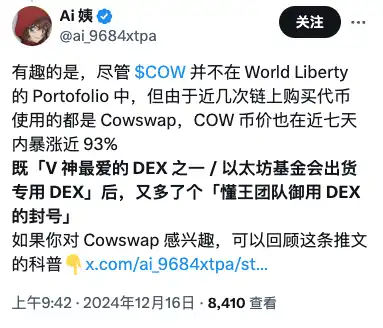
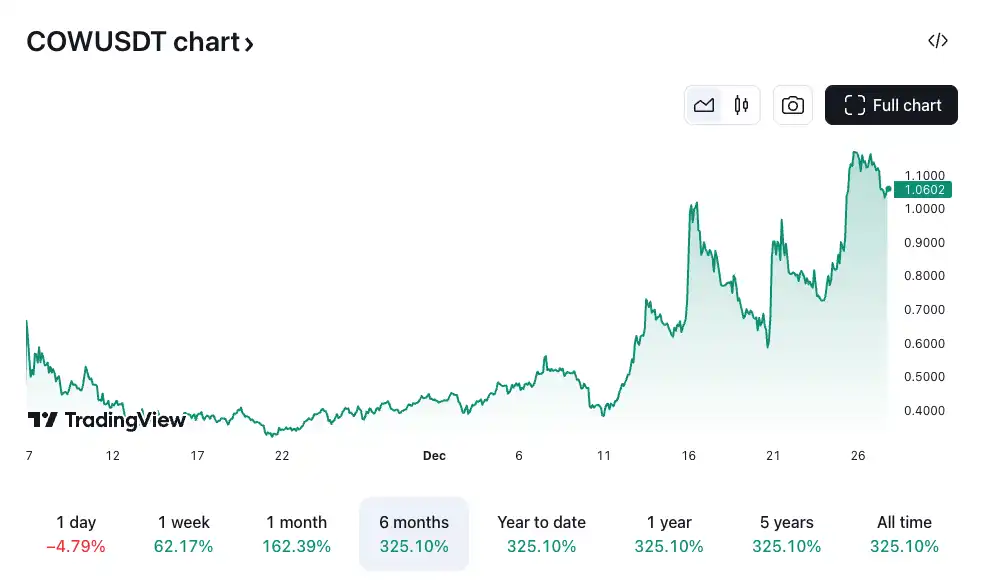
This particular on-chain behavior has directly influenced market sentiment. With the dual anticipation of Trump's imminent inauguration and the frenzy around political concept coins, $COW's price surged by 62% in just one week and spiked by 162% within a month.
The Force Behind CowSwap is Gnosis
Gnosis is the powerful force standing behind CowSwap.
The precursor to CowSwap was the Gnosis Protocol V1 launched in 2020, which was the first decentralized exchange platform to achieve circular trades through a batch auction mechanism. Its unique design enables all orders to share liquidity and settle efficiently.
By 2021, Gnosis Protocol V2 introduced an innovative settlement mechanism (Solvers), significantly enhancing order matching efficiency and effectively addressing the long-standing MEV (Miner Extractable Value) issue that has plagued DeFi traders. In the same year, Gnosis Protocol rebranded as CowSwap, becoming the aggregator we are familiar with today.
It can be said that CowSwap's rise is inseparable from the deep-rooted foundation of the Gnosis ecosystem. In fact, the story of the Gnosis ecosystem can be traced back to 2015.
Compared to the now well-known Polymarket, Gnosis co-founder Martin Koeppelmann started researching decentralized prediction markets much earlier. In 2015, he published his thoughts on the combination of MarketMaker and OrderBook on his forum, one of the earliest decentralized prediction market concepts in the industry.
Martin Koeppelmann is also one of the earliest Ethereum developers, having joined even before TheDAO era. Due to his residence in Berlin, he had close contact with Vitalik, who was working in the Berlin office at that time.
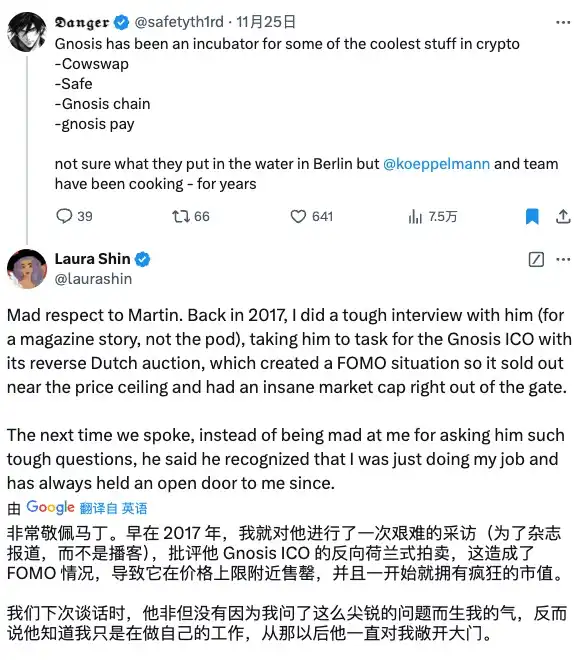
Over the years, he has participated in many discussions in the Ethereum development community, often engaging with Vitalik on topics such as L2, ZK, and the Ethereum roadmap. From Martin's social media presence, it is evident how involved he is in the community.
Based on this technical accumulation, Gnosis has gradually developed a complete ecosystem. Evolving from Gnosis Protocol to CowSwap, Martin and his team further derived products such as Gnosis Chain, Safe, and Gnosis Pay, forming a highly collaborative ecosystem.
Therefore, mutual integration is natural. One of the most representative integrations is between CowSwap and Safe.
The Preferred Wallet of the DeFi King Family
As the star product in the Gnosis suite, Safe is the most popular multisig wallet in the Ethereum ecosystem and is a wallet for whales. During this year's Safe distribution, almost all of the top 100 airdrop addresses were project teams or institutions.
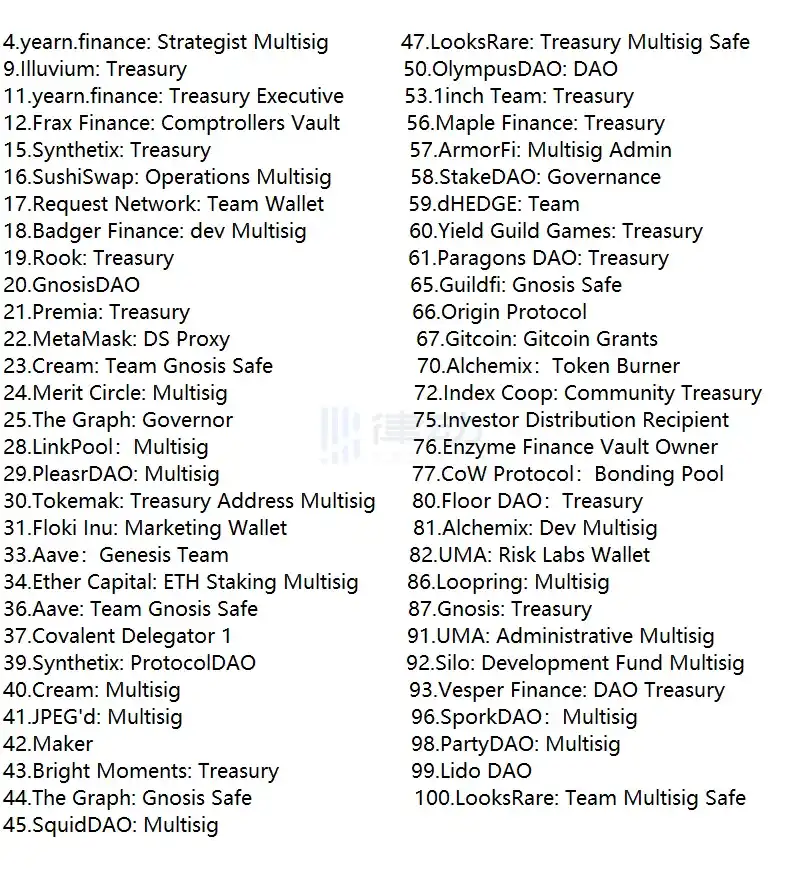
In other words, the early whales of Safe were project teams, not individual users. This includes OP, Polymarket, Drukula, Worldcoin, Lido, and more. Related read: "Safe Trading Soon: Tokenomics and Ecosystem Overview"
Initially, Safe's audience was more focused on DAOs and cryptocurrency projects. However, as the crypto industry entered the next stage, traditional finance, institutional players, family offices, and old money started to enter the space. Due to the high barrier to entry in crypto and the need to protect funds while engaging in on-chain activities, the safest way is through a multi-signature wallet, with Safe being the choice.
Safe's design significantly enhances fund management security. Through a multi-signature mechanism, funds are held in a smart contract address, and a transaction can only be executed once the required number of signatures is met (e.g., 3 out of 10). This mechanism effectively reduces the risk of single points of failure. Even if a signing address's private key is compromised, an attacker would struggle to obtain enough signatures to complete a transaction. Furthermore, during the multi-signature confirmation process, the signers prior to the final confirmation do not need to pay Gas for their signing operation, as the transaction remains in a "pending" state. Only the address that confirms the final signature to execute the operation (such as a transaction or transfer) needs to pay Gas. This optimization not only lowers the usage costs but also makes Safe the optimal choice for institutional users and whales.
According to Safe Guardians who spoke to BlockBeats, the simplest way to determine if an on-chain address is a Safe wallet address is through two methods: first, by seeing the "MultiSig" label on ARKHAM, and second, by the address displaying "MultiSig: Safe" on the debank page.
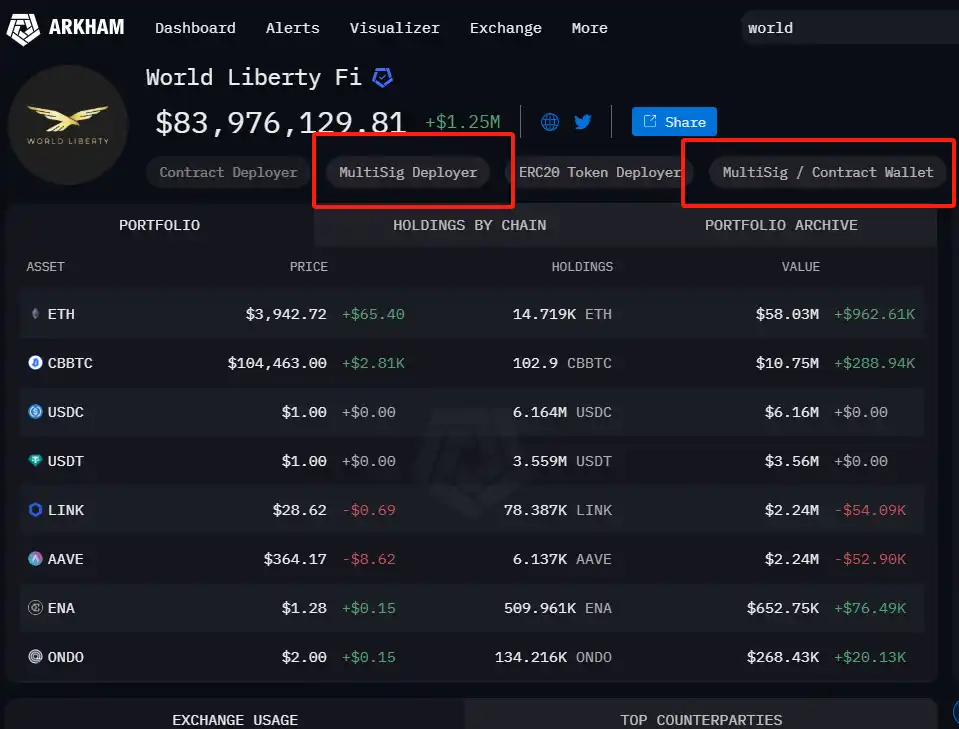
Trump's project address
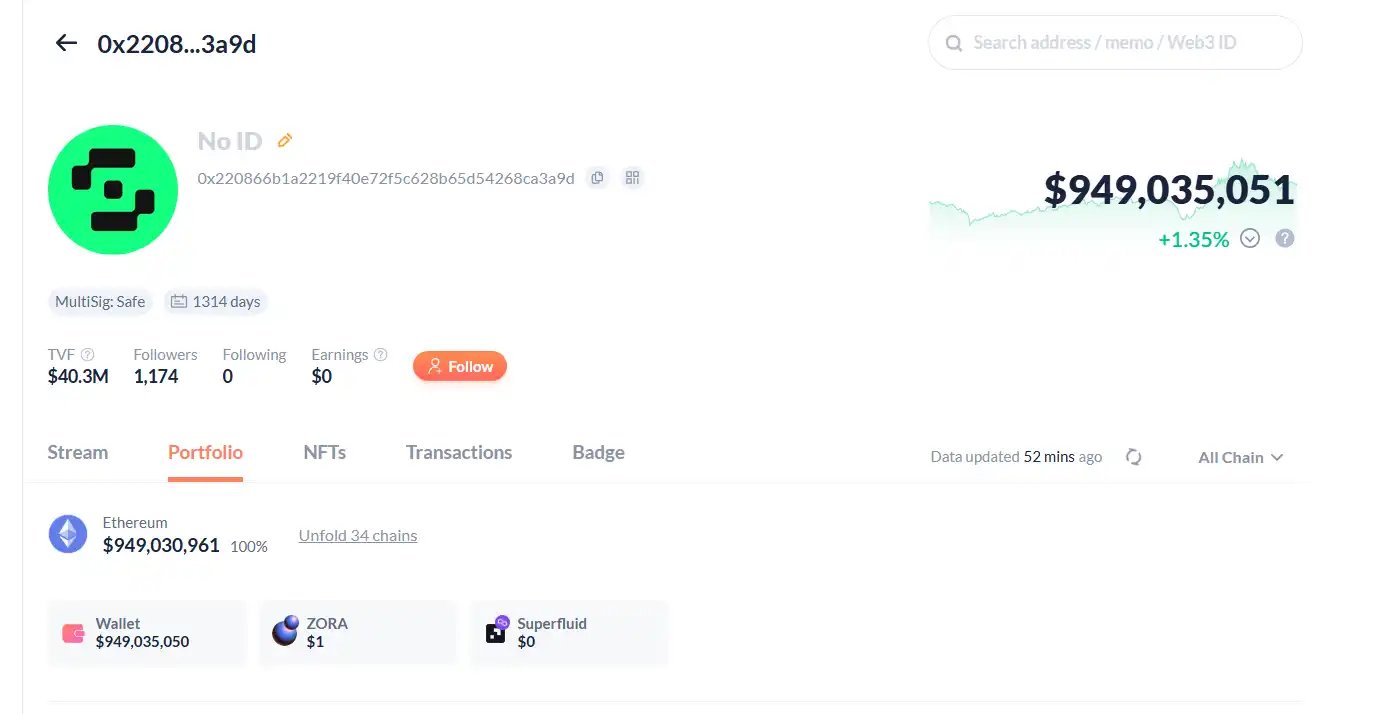
Vitalik's address
Most importantly, as part of the Gnosis ecosystem, the built-in DEX in Safe is CowSwap. This is why whales like Vitalik and the Trump team favor CowSwap.
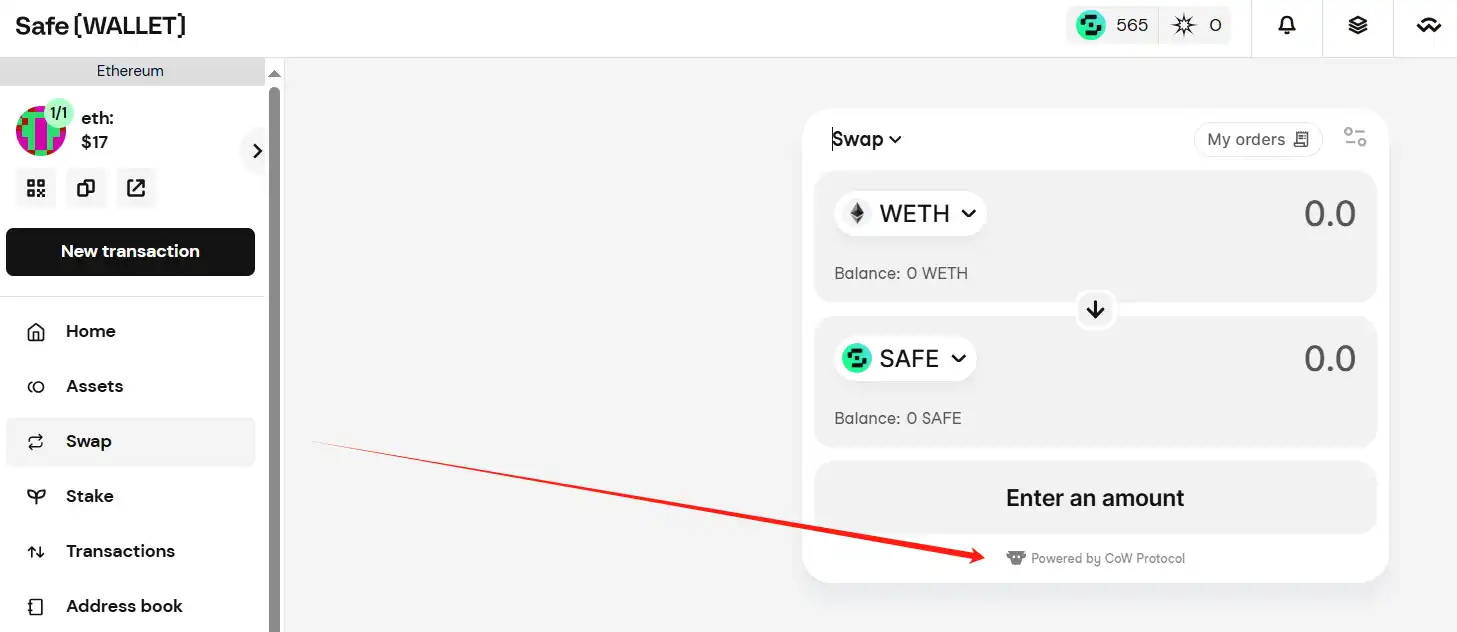
From this perspective, what whales like Trump, Vitalik, and others favor might not just be because CowSwap is an MEV-resistant aggregated DEX, but also due to the synergies within the Gnosis ecosystem, delivering tailored solutions that directly address the real needs of whales.
From Incubator to Investment DAO
As mentioned earlier, the Gnosis ecosystem has been expanding since 2015. Originally a Ethereum-based prediction market platform, it later evolved into the Gnosis ecosystem, giving rise to many projects such as Gnosis Chain, Safe, CowSwap, Gnosis Pay, and more.
Gnosis Chain, a prominent Ethereum sidechain in the previous cycle, focuses on efficient and secure decentralized application development. According to DefiLlama data, as of the time of writing, Gnosis Chain has a total value locked (TVL) of $349.31M, including $71.61M in native assets and $277.7M in cross-chain bridged assets. The stablecoin market value is $119.98M, with DAI accounting for 74.07%, and the trading volume remains stable.
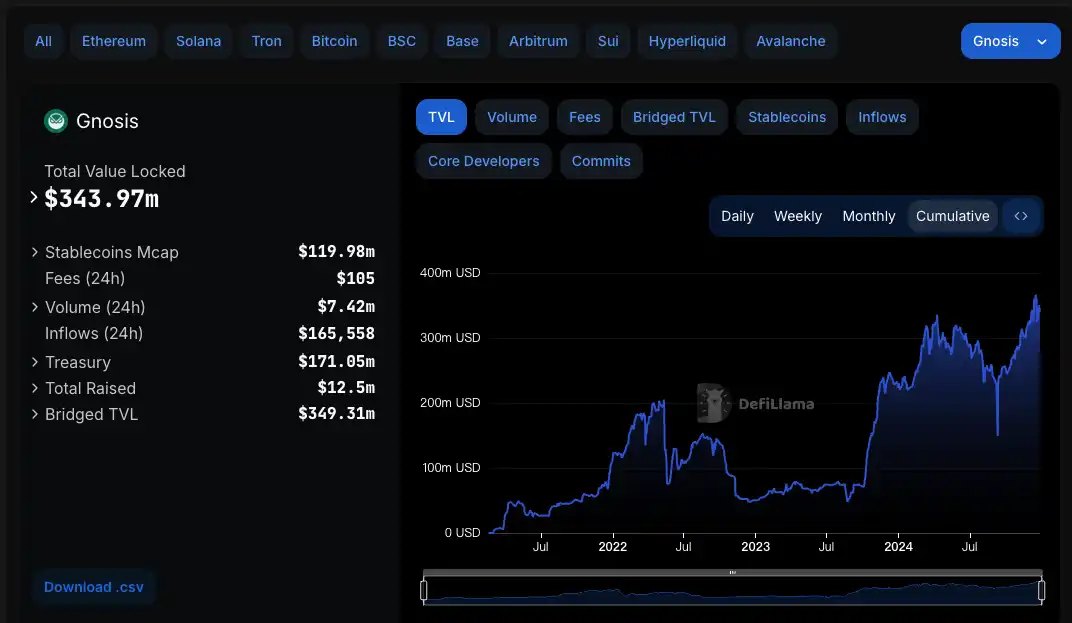
Gnosis Chain Data, Source: DefiLlama
On the other hand, Gnosis Pay is an on-chain payment debit card that seamlessly integrates blockchain technology to provide a convenient payment experience for users and institutions. There is also CowSwap and the multisig wallet Gnosis Safe (now known as Safe). Related read: "Gnosis Card: The First Visa Debit Card Linked to a Wallet Is Coming".
As for GnosisDAO, it is the core governance body of the Gnosis ecosystem, driving the incubation and development of innovative projects through decentralized autonomous governance. As the ecosystem's incubation flourished, GnosisDAO also ventured into investment activities.
In addition to incubating well-known projects like Safe and CowSwap, as early as 2019, GnosisDAO began its blockchain investment journey through its investment arm, GnosisVS, supporting over 60 startups.
Some of the invested projects include: Monerium, on-chain fiat infrastructure for Web3 builders; Naptha AI, a decentralized platform for AI workflows; and Schuman Financial, a MiCA-compliant stablecoin protocol.
This year, the investment arm has further expanded. In October this year, GnosisDAO approved a proposal and launched a new $40 million venture capital fund. GnosisDAO committed $20 million to the fund, while the other half of the funding came from external limited partners (LPs). This dual structure not only increased the fund's size but also created more opportunities for external collaboration.
The fund is named GnosisVC Ecosystem and will prioritize investments in projects involved in Real-World Asset (RWA) tokenization, decentralized infrastructure, and financial payment channels.
The key investment areas are focused on three aspects: 1. Real-World Asset (RWA) Tokenization: Driving the digitization and on-chain representation of traditional financial assets through blockchain technology, providing more liquidity and transparency to the global financial markets; 2. Decentralized Infrastructure: Covering a wide range from node operation to decentralized computing and storage, supporting the efficient operation of next-generation blockchain applications; 3. Payment Channels and Middleware: Around solutions like Gnosis Pay, providing seamless payment capabilities to the DeFi and Web3 ecosystem.
What Makes CowSwap Stand Out?
One could say that CowSwap's rise is more like the best embodiment of the Gnosis ecosystem's collaborative efforts, but that doesn't mean CowSwap itself hasn't created a new paradigm.
More precisely, the CoW Protocol is a decentralized trading protocol, and CowSwap is a DEX built on top of the CoW Protocol, acting as its frontend interface, where users interact with CoW Protocol through CowSwap.
As the frontend application of CoW Protocol, CowSwap further amplifies the protocol's advantages. It is referred to as the "trade assistant" of the CoW Protocol, serving as a Meta DEX aggregator that can switch between multiple AMMs and other aggregators to help users find the best price in the current market. Unlike traditional DEXs where users have to manually compare prices, CowSwap's mission is to streamline users' operations through intelligent matching and ensure transactions are completed in the most favorable manner. From this perspective, CowSwap addresses a long-standing issue for DeFi users: the frontend reliance problem.
What Is the Ultimate Goal Against MEV?
Miner Extractable Value (MEV) has long been a major issue for traders. MEV refers to the additional value extracted by miners or other traders from ordinary user transactions through manipulating transaction order or frontrunning. According to Galaxy Digital's report, on the Ethereum network alone, MEV bots have extracted as much as $3-9 billion in user value.
This is very unfriendly to whales and large traders, even Ethereum founder Vitalik Buterin himself, as he is often "sandwiched," causing significant trouble and headaches. Therefore, the MEV issue is also one of Vitalik's most concerning issues in building Ethereum, and he frequently mentions this problem in various speeches and the Ethereum roadmap.
CowSwap effectively solves this problem.
In traditional DeFi interactions, users' operations (such as asset bridging, swapping, staking, and withdrawing) directly interact with on-chain contracts. This design is not only complex but also exposes users' transaction needs, making them vulnerable to MEV frontrunning attacks. Therefore, the CoW Protocol fundamentally changes this interaction pattern by migrating users' transaction needs off-chain for processing. This solution is called "off-chain preprocessing," which also has a more familiar name known as "intentions transactions."
The intention process is essentially an off-chain preprocessing black box where users' intentions are placed in an "invisible" preprocessing center. After collecting and preprocessing users' transaction needs, CowSwap introduces third-party "Solvers" off-chain to match and process transactions. This mechanism brings multiple benefits, significantly reducing direct on-chain risks for users, optimizing protocol liquidity management, and making user transactions more efficient, secure, and private.
To be more specific, through intention narratives, the CoW Protocol has designed three core protection mechanisms against the MEV issue:
1. Unified Settlement Price Batches
The CoW Protocol introduces the "Unified Settlement Price" mechanism. When the same token pair (such as ETH-USDC) is traded multiple times in a batch, all transactions' assets will be settled at the same market price. This mechanism makes transaction order irrelevant, fundamentally eliminating the possibility of MEV bots profiting from reordering transactions. Importantly, this mechanism also addresses the price inconsistency issue in traditional AMMs (such as Uniswap) based on the constant function market maker (CFMM) model, providing users with a fairer trading environment.
2. Delegated Transaction Execution
User transactions are executed by trusted third-party Solvers, avoiding direct exposure to on-chain MEV risks. Solvers must ensure that transaction prices are not lower than the price signed by the user, while optimizing liquidity through off-chain matching or private market-making. This design not only reduces users' price risks but also significantly improves transaction execution efficiency.
3. Coincidence of Wants Model
Compared to traditional Automated Market Maker (AMM) or Central Limit Order Book (CLOB) models, the CoW Protocol's strength lies in its core auction mechanism. This mechanism allows multiple trades to occur simultaneously, akin to an efficient large-scale market promotion event. In this event, whoever can find the best match stands to gain the most benefit, embodying the concept of "Coincidence of Wants (CoWs)." The name CoW Protocol is derived from this concept, cleverly spelling out the word "cow."
Related Read: "Surging Over 40% in a Single Day, What Makes CowSwap Special?"
Therefore, driven by Gnosis's ecosystem momentum and CowSwap's product innovation, CowSwap has experienced significant transaction volume on the Ethereum chain over the past 30 days.
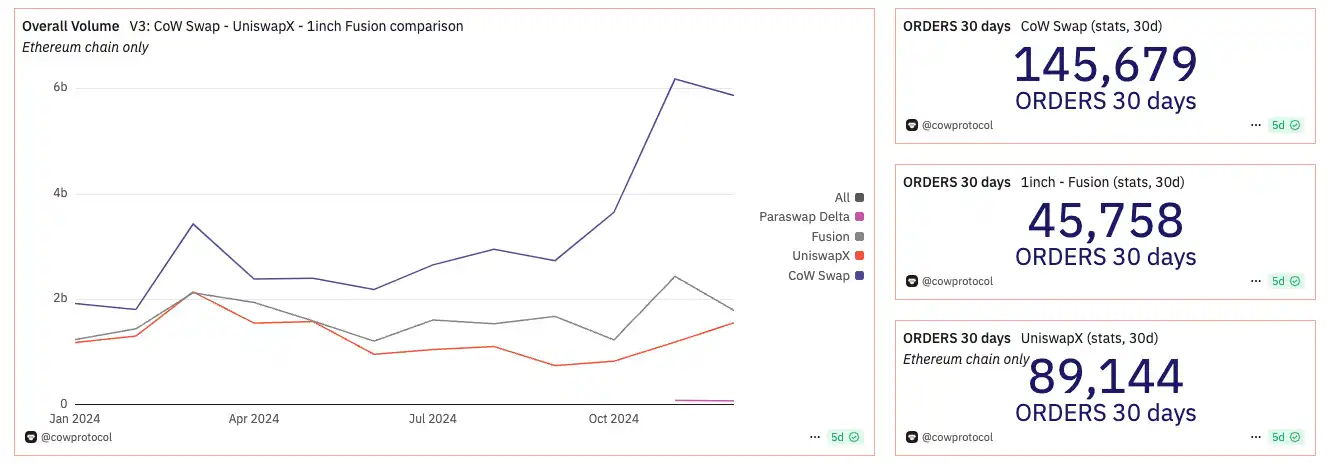
The History Between CowSwap and Uniswap
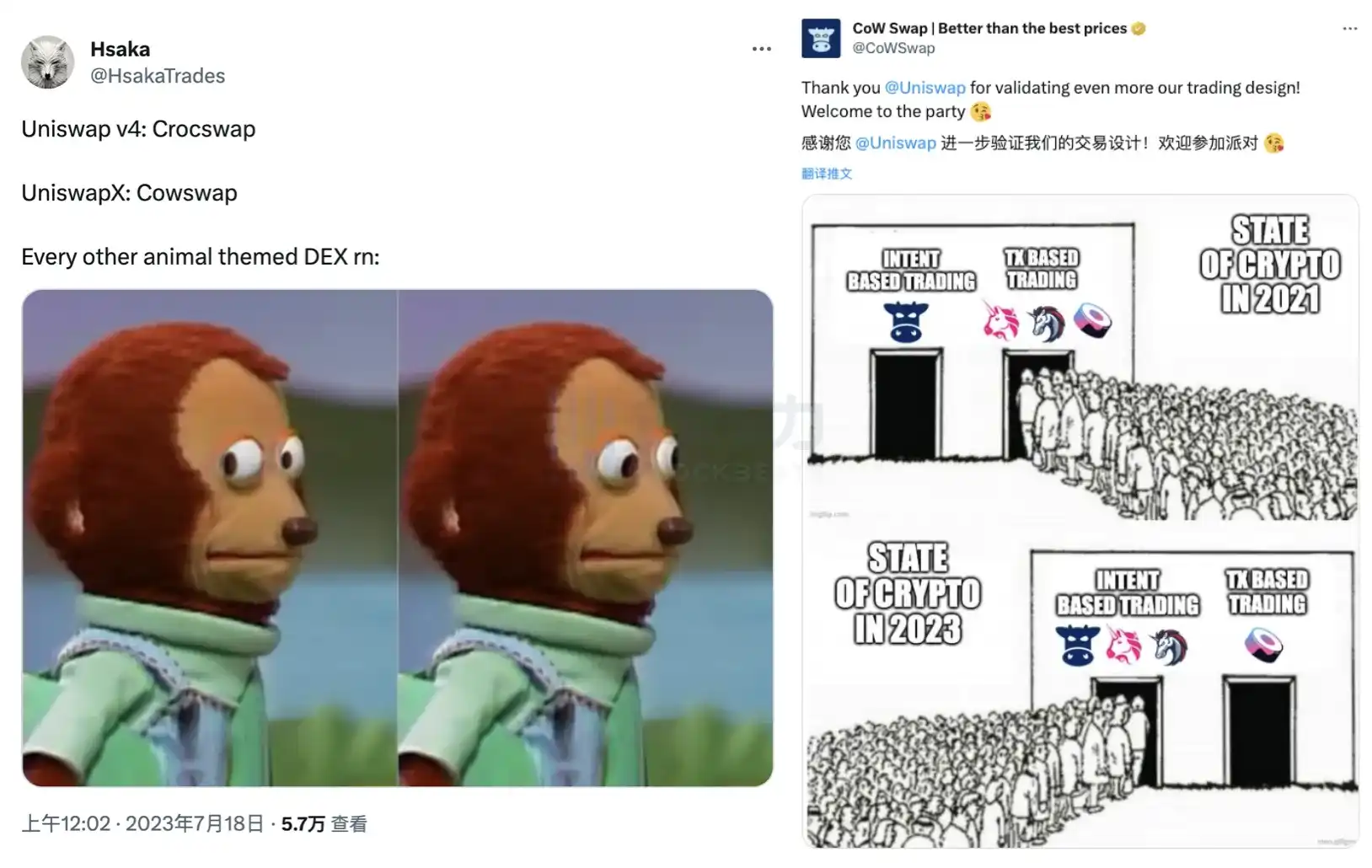
Many are unaware that CowSwap has a history with Uniswap. Last year, the leading DEX Uniswap's release of UniswapX was embroiled in a plagiarism controversy with CowSwap.
Following the announcement of Uniswap V4, Uniswap promptly declared the upcoming release of UniswapX. However, the community was highly dissatisfied with UniswapX, sparking numerous debates. Some directly questioned, "What is the difference between UniswapX and CowSwap?" Some even jokingly remarked, "UniswapX should thank the cryptocurrency industry's open-source spirit."
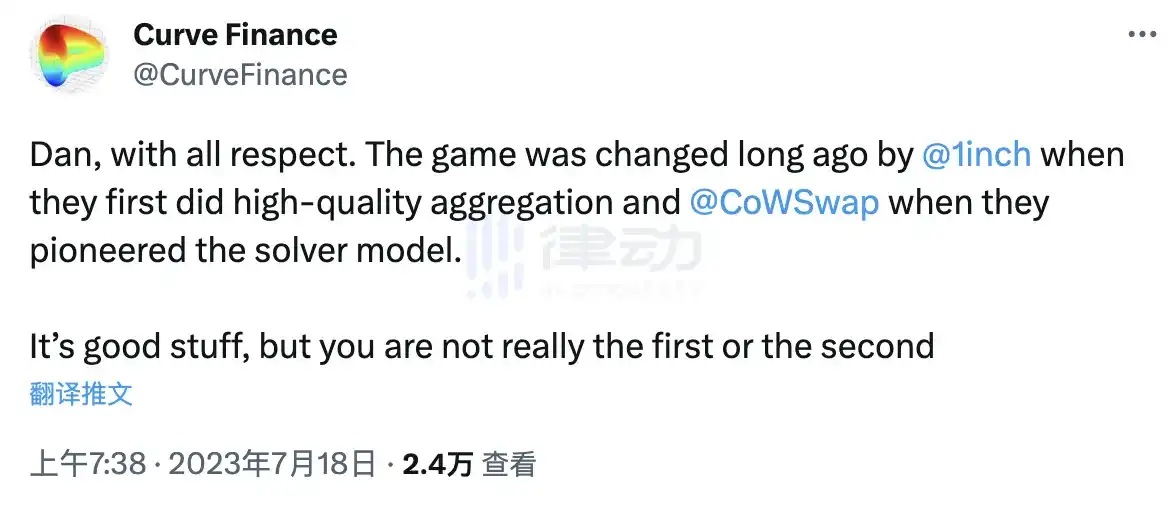
Curve Finance's official account provided a straightforward assessment: "Forgive my bluntness. The rules of the game changed a long time ago: when 1inch first engaged in high-quality aggregation, when CowSwap introduced the Solvers model. UniswapX is good, but it is not a trailblazer, not even the second player." Related Read: "Half Praise, Half Critique: Is Uniswap Truly the "Tencent of the Coin Circle"?"
This public opinion pressure has posed a significant challenge to Uniswap, seemingly aiming to shed the title of "Tencent of the DEX world." Two months ago, Uniswap Labs launched Unichain, an Ethereum Layer 2 network based on the OP Stack, finally turning the tide in a "small" way.
One of the significant innovation points is that Unichain innovated on the MEV revenue distribution mechanism. Through a Trusted Execution Environment (TEE), part of the MEV revenue is directly allocated to users or liquidity providers (LP), achieving a more equitable value sharing.
Furthermore, MEV revenue is proportionally injected into the validator and user reward pools. This mechanism not only reduces LP participation risks but also encourages more users to engage in ecosystem development.
Wintermute "Walking on Rainbow Clouds" Has Arrived
It seems that CowSwap's product is excellent, but there are many ways for good products in the crypto space to "die," and few can make it to a top-tier exchange, and even fewer can achieve a 162% increase in one month.
If we rewind time back by four months, we will find that the commencement of COW's price surge coincided with the collaboration with Wintermute.
Initially, to increase on-chain liquidity, CoW DAO proposed the allocation of 10 million $COW tokens to inject liquidity into the ETH/COW market. This proposal included an innovative strategy: part of the $COW tokens would be converted to ETH and together with the remaining $COW, injected into a brand-new Function Maximizing AMM (FM-AMM) liquidity pool. Unlike traditional AMMs, FM-AMM can effectively eliminate most MEV attacks and arbitrageurs' high profits while reducing risks for liquidity providers (LP).
However, on-chain liquidity alone was insufficient to meet market demand, and deep markets on centralized exchanges were also essential. After all, those markets are larger, and there is more money there. At that time, the only way to acquire $COW was through decentralized channels, with the largest pool being the ETH/COW pair on Balancer on the Ethereum mainnet. In the absence of a CEX trading scenario, many users and institutions were unable to acquire $COW.
At this point, Wintermute "walking on rainbow clouds" arrived.
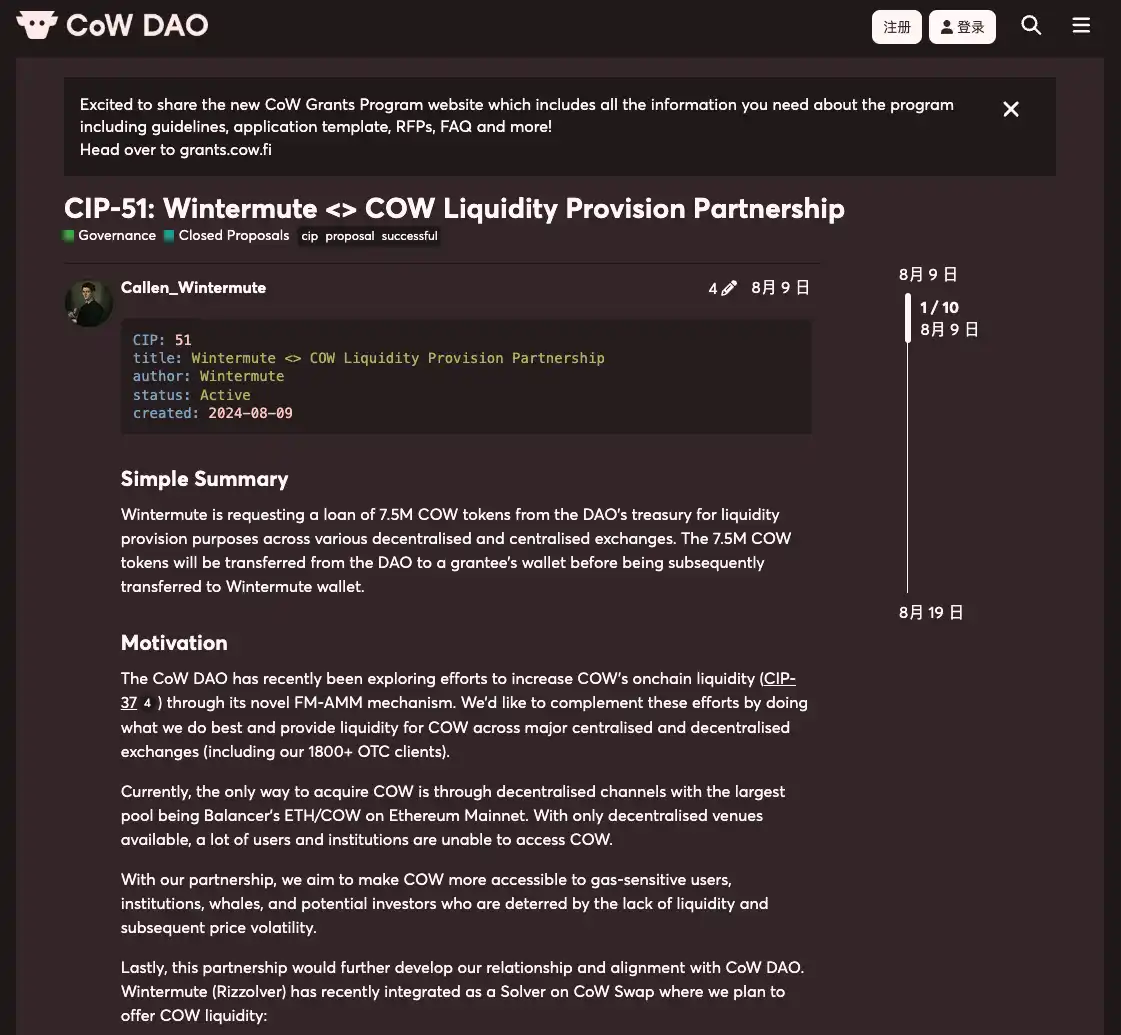
Wintermute has proposed to borrow 7.5 million COW tokens from the CoW DAO treasury to support liquidity on both decentralized and centralized exchanges. This proposal has received strong community support and has officially ushered in a new chapter for $COW liquidity.
As a leading market maker in the crypto industry, Wintermute excels at efficiently bridging markets between centralized and decentralized exchanges. Its founding team has previous experience at the traditional finance giant Optiver, bringing with them a wealth of market depth management expertise.
Over the past few months of collaboration, Wintermute has provided deep market support for COW against ETH and other trading pairs, ensuring liquidity and maintaining a stable trading environment for DeFi aggregators such as CowSwap, UniswapX, and 1inch. Additionally, Wintermute has offered significant OTC trading support to institutions, further expanding the user base of $COW.
This dual-sided market-making effort has directly contributed to the skyrocketing price of $COW.
Even in Wintermute's second month of market-making, Coinbase announced the inclusion of $COW in its listing roadmap, with COW perpetual contracts launching three months later. Subsequently, $COW began listing on major exchanges one after another, with Binance swiftly following suit by listing the COW/USDT spot trading pair.
These are what I believe to be the true reasons behind $COW's staggering 162% surge in a month.
The Flywheel Effect Between the Gnosis Ecosystem and Ethereum
Looking at a broader blockchain perspective, during a bull market, Solana's ecosystem has seen rapid growth while Ethereum has shown signs of fatigue. Yet, in terms of the on-chain dynamics of the Trump team's WLFI project, Solana still has significant room to grow in serving institutional whales, as its performance in multi-sign products cannot match Ethereum's deep-rooted foundation.
While Solana's chain also hosts multi-sign products, the assets being held are not in the same league.
For instance, taking the most asset-managed multi-sign protocol Squads on Solana, its managed funds currently amount to around $170 million. In contrast, the Gnosis ecosystem's Safe holds assets in multi-sign wallets totaling a whopping $89 billion.
More importantly, the Gnosis ecosystem's products are not only impressive in scale, but also, through collaboration and deep integration, have formed a powerful ecosystem that can serve institutions and large holders. The security of Safe, the efficiency of CowSwap, and the convenience of Gnosis Pay together have helped Ethereum "fight tooth and nail" in this round of blockchain competition.
What's even more important is that, under project collaboration, the products in the Gnosis ecosystem have already formed a solid ecosystem to serve institutions and large holders, helping Ethereum "fight tooth and nail" in this round of blockchain race.
It is this synergy that has built the flywheel effect between the Gnosis ecosystem and Ethereum.
You may also like

Token Cannot Compound, Where Is the Real Investment Opportunity?

February 6th Market Key Intelligence, How Much Did You Miss?

China's Central Bank and Eight Other Departments' Latest Regulatory Focus: Key Attention to RWA Tokenized Asset Risk
Foreword: Today, the People's Bank of China's website published the "Notice of the People's Bank of China, National Development and Reform Commission, Ministry of Industry and Information Technology, Ministry of Public Security, State Administration for Market Regulation, China Banking and Insurance Regulatory Commission, China Securities Regulatory Commission, State Administration of Foreign Exchange on Further Preventing and Dealing with Risks Related to Virtual Currency and Others (Yinfa [2026] No. 42)", the latest regulatory requirements from the eight departments including the central bank, which are basically consistent with the regulatory requirements of recent years. The main focus of the regulation is on speculative activities such as virtual currency trading, exchanges, ICOs, overseas platform services, and this time, regulatory oversight of RWA has been added, explicitly prohibiting RWA tokenization, stablecoins (especially those pegged to the RMB). The following is the full text:
To the people's governments of all provinces, autonomous regions, and municipalities directly under the Central Government, the Xinjiang Production and Construction Corps:
Recently, there have been speculative activities related to virtual currency and Real-World Assets (RWA) tokenization, disrupting the economic and financial order and jeopardizing the property security of the people. In order to further prevent and address the risks related to virtual currency and Real-World Assets tokenization, effectively safeguard national security and social stability, in accordance with the "Law of the People's Republic of China on the People's Bank of China," "Law of the People's Republic of China on Commercial Banks," "Securities Law of the People's Republic of China," "Law of the People's Republic of China on Securities Investment Funds," "Law of the People's Republic of China on Futures and Derivatives," "Cybersecurity Law of the People's Republic of China," "Regulations of the People's Republic of China on the Administration of Renminbi," "Regulations on Prevention and Disposal of Illegal Fundraising," "Regulations of the People's Republic of China on Foreign Exchange Administration," "Telecommunications Regulations of the People's Republic of China," and other provisions, after reaching consensus with the Cyberspace Administration of China, the Supreme People's Court, and the Supreme People's Procuratorate, and with the approval of the State Council, the relevant matters are notified as follows:
(I) Virtual currency does not possess the legal status equivalent to fiat currency. Virtual currencies such as Bitcoin, Ether, Tether, etc., have the main characteristics of being issued by non-monetary authorities, using encryption technology and distributed ledger or similar technology, existing in digital form, etc. They do not have legal tender status, should not and cannot be circulated and used as currency in the market.
The business activities related to virtual currency are classified as illegal financial activities. The exchange of fiat currency and virtual currency within the territory, exchange of virtual currencies, acting as a central counterparty in buying and selling virtual currencies, providing information intermediary and pricing services for virtual currency transactions, token issuance financing, and trading of virtual currency-related financial products, etc., fall under illegal financial activities, such as suspected illegal issuance of token vouchers, unauthorized public issuance of securities, illegal operation of securities and futures business, illegal fundraising, etc., are strictly prohibited across the board and resolutely banned in accordance with the law. Overseas entities and individuals are not allowed to provide virtual currency-related services to domestic entities in any form.
A stablecoin pegged to a fiat currency indirectly fulfills some functions of the fiat currency in circulation. Without the consent of relevant authorities in accordance with the law and regulations, any domestic or foreign entity or individual is not allowed to issue a RMB-pegged stablecoin overseas.
(II)Tokenization of Real-World Assets refers to the use of encryption technology and distributed ledger or similar technologies to transform ownership rights, income rights, etc., of assets into tokens (tokens) or other interests or bond certificates with token (token) characteristics, and carry out issuance and trading activities.
Engaging in the tokenization of real-world assets domestically, as well as providing related intermediary, information technology services, etc., which are suspected of illegal issuance of token vouchers, unauthorized public offering of securities, illegal operation of securities and futures business, illegal fundraising, and other illegal financial activities, shall be prohibited; except for relevant business activities carried out with the approval of the competent authorities in accordance with the law and regulations and relying on specific financial infrastructures. Overseas entities and individuals are not allowed to illegally provide services related to the tokenization of real-world assets to domestic entities in any form.
(III) Inter-agency Coordination. The People's Bank of China, together with the National Development and Reform Commission, the Ministry of Industry and Information Technology, the Ministry of Public Security, the State Administration for Market Regulation, the China Banking and Insurance Regulatory Commission, the China Securities Regulatory Commission, the State Administration of Foreign Exchange, and other departments, will improve the work mechanism, strengthen coordination with the Cyberspace Administration of China, the Supreme People's Court, and the Supreme People's Procuratorate, coordinate efforts, and overall guide regions to carry out risk prevention and disposal of virtual currency-related illegal financial activities.
The China Securities Regulatory Commission, together with the National Development and Reform Commission, the Ministry of Industry and Information Technology, the Ministry of Public Security, the People's Bank of China, the State Administration for Market Regulation, the China Banking and Insurance Regulatory Commission, the State Administration of Foreign Exchange, and other departments, will improve the work mechanism, strengthen coordination with the Cyberspace Administration of China, the Supreme People's Court, and the Supreme People's Procuratorate, coordinate efforts, and overall guide regions to carry out risk prevention and disposal of illegal financial activities related to the tokenization of real-world assets.
(IV) Strengthening Local Implementation. The people's governments at the provincial level are overall responsible for the prevention and disposal of risks related to virtual currencies and the tokenization of real-world assets in their respective administrative regions. The specific leading department is the local financial regulatory department, with participation from branches and dispatched institutions of the State Council's financial regulatory department, telecommunications regulators, public security, market supervision, and other departments, in coordination with cyberspace departments, courts, and procuratorates, to improve the normalization of the work mechanism, effectively connect with the relevant work mechanisms of central departments, form a cooperative and coordinated working pattern between central and local governments, effectively prevent and properly handle risks related to virtual currencies and the tokenization of real-world assets, and maintain economic and financial order and social stability.
(5) Enhanced Risk Monitoring. The People's Bank of China, China Securities Regulatory Commission, National Development and Reform Commission, Ministry of Industry and Information Technology, Ministry of Public Security, State Administration of Foreign Exchange, Cyberspace Administration of China, and other departments continue to improve monitoring techniques and system support, enhance cross-departmental data analysis and sharing, establish sound information sharing and cross-validation mechanisms, promptly grasp the risk situation of activities related to virtual currency and real-world asset tokenization. Local governments at all levels give full play to the role of local monitoring and early warning mechanisms. Local financial regulatory authorities, together with branches and agencies of the State Council's financial regulatory authorities, as well as departments of cyberspace and public security, ensure effective connection between online monitoring, offline investigation, and fund tracking, efficiently and accurately identify activities related to virtual currency and real-world asset tokenization, promptly share risk information, improve early warning information dissemination, verification, and rapid response mechanisms.
(6) Strengthened Oversight of Financial Institutions, Intermediaries, and Technology Service Providers. Financial institutions (including non-bank payment institutions) are prohibited from providing account opening, fund transfer, and clearing services for virtual currency-related business activities, issuing and selling financial products related to virtual currency, including virtual currency and related financial products in the scope of collateral, conducting insurance business related to virtual currency, or including virtual currency in the scope of insurance liability. Financial institutions (including non-bank payment institutions) are prohibited from providing custody, clearing, and settlement services for unauthorized real-world asset tokenization-related business and related financial products. Relevant intermediary institutions and information technology service providers are prohibited from providing intermediary, technical, or other services for unauthorized real-world asset tokenization-related businesses and related financial products.
(7) Enhanced Management of Internet Information Content and Access. Internet enterprises are prohibited from providing online business venues, commercial displays, marketing, advertising, or paid traffic diversion services for virtual currency and real-world asset tokenization-related business activities. Upon discovering clues of illegal activities, they should promptly report to relevant departments and provide technical support and assistance for related investigations and inquiries. Based on the clues transferred by the financial regulatory authorities, the cyberspace administration, telecommunications authorities, and public security departments should promptly close and deal with websites, mobile applications (including mini-programs), and public accounts engaged in virtual currency and real-world asset tokenization-related business activities in accordance with the law.
(8) Strengthened Entity Registration and Advertisement Management. Market supervision departments strengthen entity registration and management, and enterprise and individual business registrations must not contain terms such as "virtual currency," "virtual asset," "cryptocurrency," "crypto asset," "stablecoin," "real-world asset tokenization," or "RWA" in their names or business scopes. Market supervision departments, together with financial regulatory authorities, legally enhance the supervision of advertisements related to virtual currency and real-world asset tokenization, promptly investigating and handling relevant illegal advertisements.
(IX) Continued Rectification of Virtual Currency Mining Activities. The National Development and Reform Commission, together with relevant departments, strictly controls virtual currency mining activities, continuously promotes the rectification of virtual currency mining activities. The people's governments of various provinces take overall responsibility for the rectification of "mining" within their respective administrative regions. In accordance with the requirements of the National Development and Reform Commission and other departments in the "Notice on the Rectification of Virtual Currency Mining Activities" (NDRC Energy-saving Building [2021] No. 1283) and the provisions of the "Guidance Catalog for Industrial Structure Adjustment (2024 Edition)," a comprehensive review, investigation, and closure of existing virtual currency mining projects are conducted, new mining projects are strictly prohibited, and mining machine production enterprises are strictly prohibited from providing mining machine sales and other services within the country.
(X) Severe Crackdown on Related Illegal Financial Activities. Upon discovering clues to illegal financial activities related to virtual currency and the tokenization of real-world assets, local financial regulatory authorities, branches of the State Council's financial regulatory authorities, and other relevant departments promptly investigate, determine, and properly handle the issues in accordance with the law, and seriously hold the relevant entities and individuals legally responsible. Those suspected of crimes are transferred to the judicial authorities for processing according to the law.
(XI) Severe Crackdown on Related Illegal and Criminal Activities. The Ministry of Public Security, the People's Bank of China, the State Administration for Market Regulation, the China Banking and Insurance Regulatory Commission, the China Securities Regulatory Commission, as well as judicial and procuratorial organs, in accordance with their respective responsibilities, rigorously crack down on illegal and criminal activities related to virtual currency, the tokenization of real-world assets, such as fraud, money laundering, illegal business operations, pyramid schemes, illegal fundraising, and other illegal and criminal activities carried out under the guise of virtual currency, the tokenization of real-world assets, etc.
(XII) Strengthen Industry Self-discipline. Relevant industry associations should enhance membership management and policy advocacy, based on their own responsibilities, advocate and urge member units to resist illegal financial activities related to virtual currency and the tokenization of real-world assets. Member units that violate regulatory policies and industry self-discipline rules are to be disciplined in accordance with relevant self-regulatory management regulations. By leveraging various industry infrastructure, conduct risk monitoring related to virtual currency, the tokenization of real-world assets, and promptly transfer issue clues to relevant departments.
(XIII) Without the approval of relevant departments in accordance with the law and regulations, domestic entities and foreign entities controlled by them may not issue virtual currency overseas.
(XIV) Domestic entities engaging directly or indirectly in overseas external debt-based tokenization of real-world assets, or conducting asset securitization activities abroad based on domestic ownership rights, income rights, etc. (hereinafter referred to as domestic equity), should be strictly regulated in accordance with the principles of "same business, same risk, same rules." The National Development and Reform Commission, the China Securities Regulatory Commission, the State Administration of Foreign Exchange, and other relevant departments regulate it according to their respective responsibilities. For other forms of overseas real-world asset tokenization activities based on domestic equity by domestic entities, the China Securities Regulatory Commission, together with relevant departments, supervise according to their division of responsibilities. Without the consent and filing of relevant departments, no unit or individual may engage in the above-mentioned business.
(15) Overseas subsidiaries and branches of domestic financial institutions providing Real World Asset Tokenization-related services overseas shall do so legally and prudently. They shall have professional personnel and systems in place to effectively mitigate business risks, strictly implement customer onboarding, suitability management, anti-money laundering requirements, and incorporate them into the domestic financial institutions' compliance and risk management system. Intermediaries and information technology service providers offering Real World Asset Tokenization services abroad based on domestic equity or conducting Real World Asset Tokenization business in the form of overseas debt for domestic entities directly or indirectly venturing abroad must strictly comply with relevant laws and regulations. They should establish and improve relevant compliance and internal control systems in accordance with relevant normative requirements, strengthen business and risk control, and report the business developments to the relevant regulatory authorities for approval or filing.
(16) Strengthen organizational leadership and overall coordination. All departments and regions should attach great importance to the prevention of risks related to virtual currencies and Real World Asset Tokenization, strengthen organizational leadership, clarify work responsibilities, form a long-term effective working mechanism with centralized coordination, local implementation, and shared responsibilities, maintain high pressure, dynamically monitor risks, effectively prevent and mitigate risks in an orderly and efficient manner, legally protect the property security of the people, and make every effort to maintain economic and financial order and social stability.
(17) Widely carry out publicity and education. All departments, regions, and industry associations should make full use of various media and other communication channels to disseminate information through legal and policy interpretation, analysis of typical cases, and education on investment risks, etc. They should promote the illegality and harm of virtual currencies and Real World Asset Tokenization-related businesses and their manifestations, fully alert to potential risks and hidden dangers, and enhance public awareness and identification capabilities for risk prevention.
(18) Engaging in illegal financial activities related to virtual currencies and Real World Asset Tokenization in violation of this notice, as well as providing services for virtual currencies and Real World Asset Tokenization-related businesses, shall be punished in accordance with relevant regulations. If it constitutes a crime, criminal liability shall be pursued according to the law. For domestic entities and individuals who knowingly or should have known that overseas entities illegally provided virtual currency or Real World Asset Tokenization-related services to domestic entities and still assisted them, relevant responsibilities shall be pursued according to the law. If it constitutes a crime, criminal liability shall be pursued according to the law.
(19) If any unit or individual invests in virtual currencies, Real World Asset Tokens, and related financial products against public order and good customs, the relevant civil legal actions shall be invalid, and any resulting losses shall be borne by them. If there are suspicions of disrupting financial order and jeopardizing financial security, the relevant departments shall deal with them according to the law.
This notice shall enter into force upon the date of its issuance. The People's Bank of China and ten other departments' "Notice on Further Preventing and Dealing with the Risks of Virtual Currency Trading Speculation" (Yinfa [2021] No. 237) is hereby repealed.

Former Partner's Perspective on Multicoin: Kyle's Exit, But the Game He Left Behind Just Getting Started
Why Bitcoin Is Falling Now: The Real Reasons Behind BTC's Crash & WEEX's Smart Profit Playbook
Bitcoin's ongoing crash explained: Discover the 5 hidden triggers behind BTC's plunge & how WEEX's Auto Earn and Trade to Earn strategies help traders profit from crypto market volatility.

Wall Street's Hottest Trades See Exodus

Vitalik Discusses Ethereum Scaling Path, Circle Announces Partnership with Polymarket, What's the Overseas Crypto Community Talking About Today?

Believing in the Capital Markets - The Essence and Core Value of Cryptocurrency

Polymarket's 'Weatherman': Predict Temperature, Win Million-Dollar Payout

$15K+ Profits: The 4 AI Trading Secrets WEEX Hackathon Prelim Winners Used to Dominate Volatile Crypto Markets
How WEEX Hackathon's top AI trading strategies made $15K+ in crypto markets: 4 proven rules for ETH/BTC trading, market structure analysis, and risk management in volatile conditions.

A nearly 20% one-day plunge, how long has it been since you last saw a $60,000 Bitcoin?

Raoul Pal: I've seen every single panic, and they are never the end.

Key Market Information Discrepancy on February 6th - A Must-Read! | Alpha Morning Report

2026 Crypto Industry's First Snowfall
The Harsh Reality Behind the $26 Billion Crypto Liquidation: Liquidity Is Killing the Market
Why Is Gold, US Stocks, Bitcoin All Falling?

Key Market Intelligence for February 5th, how much did you miss out on?

Wintermute: By 2026, crypto had gradually become the settlement layer of the Internet economy
Token Cannot Compound, Where Is the Real Investment Opportunity?
February 6th Market Key Intelligence, How Much Did You Miss?
China's Central Bank and Eight Other Departments' Latest Regulatory Focus: Key Attention to RWA Tokenized Asset Risk
Foreword: Today, the People's Bank of China's website published the "Notice of the People's Bank of China, National Development and Reform Commission, Ministry of Industry and Information Technology, Ministry of Public Security, State Administration for Market Regulation, China Banking and Insurance Regulatory Commission, China Securities Regulatory Commission, State Administration of Foreign Exchange on Further Preventing and Dealing with Risks Related to Virtual Currency and Others (Yinfa [2026] No. 42)", the latest regulatory requirements from the eight departments including the central bank, which are basically consistent with the regulatory requirements of recent years. The main focus of the regulation is on speculative activities such as virtual currency trading, exchanges, ICOs, overseas platform services, and this time, regulatory oversight of RWA has been added, explicitly prohibiting RWA tokenization, stablecoins (especially those pegged to the RMB). The following is the full text:
To the people's governments of all provinces, autonomous regions, and municipalities directly under the Central Government, the Xinjiang Production and Construction Corps:
Recently, there have been speculative activities related to virtual currency and Real-World Assets (RWA) tokenization, disrupting the economic and financial order and jeopardizing the property security of the people. In order to further prevent and address the risks related to virtual currency and Real-World Assets tokenization, effectively safeguard national security and social stability, in accordance with the "Law of the People's Republic of China on the People's Bank of China," "Law of the People's Republic of China on Commercial Banks," "Securities Law of the People's Republic of China," "Law of the People's Republic of China on Securities Investment Funds," "Law of the People's Republic of China on Futures and Derivatives," "Cybersecurity Law of the People's Republic of China," "Regulations of the People's Republic of China on the Administration of Renminbi," "Regulations on Prevention and Disposal of Illegal Fundraising," "Regulations of the People's Republic of China on Foreign Exchange Administration," "Telecommunications Regulations of the People's Republic of China," and other provisions, after reaching consensus with the Cyberspace Administration of China, the Supreme People's Court, and the Supreme People's Procuratorate, and with the approval of the State Council, the relevant matters are notified as follows:
(I) Virtual currency does not possess the legal status equivalent to fiat currency. Virtual currencies such as Bitcoin, Ether, Tether, etc., have the main characteristics of being issued by non-monetary authorities, using encryption technology and distributed ledger or similar technology, existing in digital form, etc. They do not have legal tender status, should not and cannot be circulated and used as currency in the market.
The business activities related to virtual currency are classified as illegal financial activities. The exchange of fiat currency and virtual currency within the territory, exchange of virtual currencies, acting as a central counterparty in buying and selling virtual currencies, providing information intermediary and pricing services for virtual currency transactions, token issuance financing, and trading of virtual currency-related financial products, etc., fall under illegal financial activities, such as suspected illegal issuance of token vouchers, unauthorized public issuance of securities, illegal operation of securities and futures business, illegal fundraising, etc., are strictly prohibited across the board and resolutely banned in accordance with the law. Overseas entities and individuals are not allowed to provide virtual currency-related services to domestic entities in any form.
A stablecoin pegged to a fiat currency indirectly fulfills some functions of the fiat currency in circulation. Without the consent of relevant authorities in accordance with the law and regulations, any domestic or foreign entity or individual is not allowed to issue a RMB-pegged stablecoin overseas.
(II)Tokenization of Real-World Assets refers to the use of encryption technology and distributed ledger or similar technologies to transform ownership rights, income rights, etc., of assets into tokens (tokens) or other interests or bond certificates with token (token) characteristics, and carry out issuance and trading activities.
Engaging in the tokenization of real-world assets domestically, as well as providing related intermediary, information technology services, etc., which are suspected of illegal issuance of token vouchers, unauthorized public offering of securities, illegal operation of securities and futures business, illegal fundraising, and other illegal financial activities, shall be prohibited; except for relevant business activities carried out with the approval of the competent authorities in accordance with the law and regulations and relying on specific financial infrastructures. Overseas entities and individuals are not allowed to illegally provide services related to the tokenization of real-world assets to domestic entities in any form.
(III) Inter-agency Coordination. The People's Bank of China, together with the National Development and Reform Commission, the Ministry of Industry and Information Technology, the Ministry of Public Security, the State Administration for Market Regulation, the China Banking and Insurance Regulatory Commission, the China Securities Regulatory Commission, the State Administration of Foreign Exchange, and other departments, will improve the work mechanism, strengthen coordination with the Cyberspace Administration of China, the Supreme People's Court, and the Supreme People's Procuratorate, coordinate efforts, and overall guide regions to carry out risk prevention and disposal of virtual currency-related illegal financial activities.
The China Securities Regulatory Commission, together with the National Development and Reform Commission, the Ministry of Industry and Information Technology, the Ministry of Public Security, the People's Bank of China, the State Administration for Market Regulation, the China Banking and Insurance Regulatory Commission, the State Administration of Foreign Exchange, and other departments, will improve the work mechanism, strengthen coordination with the Cyberspace Administration of China, the Supreme People's Court, and the Supreme People's Procuratorate, coordinate efforts, and overall guide regions to carry out risk prevention and disposal of illegal financial activities related to the tokenization of real-world assets.
(IV) Strengthening Local Implementation. The people's governments at the provincial level are overall responsible for the prevention and disposal of risks related to virtual currencies and the tokenization of real-world assets in their respective administrative regions. The specific leading department is the local financial regulatory department, with participation from branches and dispatched institutions of the State Council's financial regulatory department, telecommunications regulators, public security, market supervision, and other departments, in coordination with cyberspace departments, courts, and procuratorates, to improve the normalization of the work mechanism, effectively connect with the relevant work mechanisms of central departments, form a cooperative and coordinated working pattern between central and local governments, effectively prevent and properly handle risks related to virtual currencies and the tokenization of real-world assets, and maintain economic and financial order and social stability.
(5) Enhanced Risk Monitoring. The People's Bank of China, China Securities Regulatory Commission, National Development and Reform Commission, Ministry of Industry and Information Technology, Ministry of Public Security, State Administration of Foreign Exchange, Cyberspace Administration of China, and other departments continue to improve monitoring techniques and system support, enhance cross-departmental data analysis and sharing, establish sound information sharing and cross-validation mechanisms, promptly grasp the risk situation of activities related to virtual currency and real-world asset tokenization. Local governments at all levels give full play to the role of local monitoring and early warning mechanisms. Local financial regulatory authorities, together with branches and agencies of the State Council's financial regulatory authorities, as well as departments of cyberspace and public security, ensure effective connection between online monitoring, offline investigation, and fund tracking, efficiently and accurately identify activities related to virtual currency and real-world asset tokenization, promptly share risk information, improve early warning information dissemination, verification, and rapid response mechanisms.
(6) Strengthened Oversight of Financial Institutions, Intermediaries, and Technology Service Providers. Financial institutions (including non-bank payment institutions) are prohibited from providing account opening, fund transfer, and clearing services for virtual currency-related business activities, issuing and selling financial products related to virtual currency, including virtual currency and related financial products in the scope of collateral, conducting insurance business related to virtual currency, or including virtual currency in the scope of insurance liability. Financial institutions (including non-bank payment institutions) are prohibited from providing custody, clearing, and settlement services for unauthorized real-world asset tokenization-related business and related financial products. Relevant intermediary institutions and information technology service providers are prohibited from providing intermediary, technical, or other services for unauthorized real-world asset tokenization-related businesses and related financial products.
(7) Enhanced Management of Internet Information Content and Access. Internet enterprises are prohibited from providing online business venues, commercial displays, marketing, advertising, or paid traffic diversion services for virtual currency and real-world asset tokenization-related business activities. Upon discovering clues of illegal activities, they should promptly report to relevant departments and provide technical support and assistance for related investigations and inquiries. Based on the clues transferred by the financial regulatory authorities, the cyberspace administration, telecommunications authorities, and public security departments should promptly close and deal with websites, mobile applications (including mini-programs), and public accounts engaged in virtual currency and real-world asset tokenization-related business activities in accordance with the law.
(8) Strengthened Entity Registration and Advertisement Management. Market supervision departments strengthen entity registration and management, and enterprise and individual business registrations must not contain terms such as "virtual currency," "virtual asset," "cryptocurrency," "crypto asset," "stablecoin," "real-world asset tokenization," or "RWA" in their names or business scopes. Market supervision departments, together with financial regulatory authorities, legally enhance the supervision of advertisements related to virtual currency and real-world asset tokenization, promptly investigating and handling relevant illegal advertisements.
(IX) Continued Rectification of Virtual Currency Mining Activities. The National Development and Reform Commission, together with relevant departments, strictly controls virtual currency mining activities, continuously promotes the rectification of virtual currency mining activities. The people's governments of various provinces take overall responsibility for the rectification of "mining" within their respective administrative regions. In accordance with the requirements of the National Development and Reform Commission and other departments in the "Notice on the Rectification of Virtual Currency Mining Activities" (NDRC Energy-saving Building [2021] No. 1283) and the provisions of the "Guidance Catalog for Industrial Structure Adjustment (2024 Edition)," a comprehensive review, investigation, and closure of existing virtual currency mining projects are conducted, new mining projects are strictly prohibited, and mining machine production enterprises are strictly prohibited from providing mining machine sales and other services within the country.
(X) Severe Crackdown on Related Illegal Financial Activities. Upon discovering clues to illegal financial activities related to virtual currency and the tokenization of real-world assets, local financial regulatory authorities, branches of the State Council's financial regulatory authorities, and other relevant departments promptly investigate, determine, and properly handle the issues in accordance with the law, and seriously hold the relevant entities and individuals legally responsible. Those suspected of crimes are transferred to the judicial authorities for processing according to the law.
(XI) Severe Crackdown on Related Illegal and Criminal Activities. The Ministry of Public Security, the People's Bank of China, the State Administration for Market Regulation, the China Banking and Insurance Regulatory Commission, the China Securities Regulatory Commission, as well as judicial and procuratorial organs, in accordance with their respective responsibilities, rigorously crack down on illegal and criminal activities related to virtual currency, the tokenization of real-world assets, such as fraud, money laundering, illegal business operations, pyramid schemes, illegal fundraising, and other illegal and criminal activities carried out under the guise of virtual currency, the tokenization of real-world assets, etc.
(XII) Strengthen Industry Self-discipline. Relevant industry associations should enhance membership management and policy advocacy, based on their own responsibilities, advocate and urge member units to resist illegal financial activities related to virtual currency and the tokenization of real-world assets. Member units that violate regulatory policies and industry self-discipline rules are to be disciplined in accordance with relevant self-regulatory management regulations. By leveraging various industry infrastructure, conduct risk monitoring related to virtual currency, the tokenization of real-world assets, and promptly transfer issue clues to relevant departments.
(XIII) Without the approval of relevant departments in accordance with the law and regulations, domestic entities and foreign entities controlled by them may not issue virtual currency overseas.
(XIV) Domestic entities engaging directly or indirectly in overseas external debt-based tokenization of real-world assets, or conducting asset securitization activities abroad based on domestic ownership rights, income rights, etc. (hereinafter referred to as domestic equity), should be strictly regulated in accordance with the principles of "same business, same risk, same rules." The National Development and Reform Commission, the China Securities Regulatory Commission, the State Administration of Foreign Exchange, and other relevant departments regulate it according to their respective responsibilities. For other forms of overseas real-world asset tokenization activities based on domestic equity by domestic entities, the China Securities Regulatory Commission, together with relevant departments, supervise according to their division of responsibilities. Without the consent and filing of relevant departments, no unit or individual may engage in the above-mentioned business.
(15) Overseas subsidiaries and branches of domestic financial institutions providing Real World Asset Tokenization-related services overseas shall do so legally and prudently. They shall have professional personnel and systems in place to effectively mitigate business risks, strictly implement customer onboarding, suitability management, anti-money laundering requirements, and incorporate them into the domestic financial institutions' compliance and risk management system. Intermediaries and information technology service providers offering Real World Asset Tokenization services abroad based on domestic equity or conducting Real World Asset Tokenization business in the form of overseas debt for domestic entities directly or indirectly venturing abroad must strictly comply with relevant laws and regulations. They should establish and improve relevant compliance and internal control systems in accordance with relevant normative requirements, strengthen business and risk control, and report the business developments to the relevant regulatory authorities for approval or filing.
(16) Strengthen organizational leadership and overall coordination. All departments and regions should attach great importance to the prevention of risks related to virtual currencies and Real World Asset Tokenization, strengthen organizational leadership, clarify work responsibilities, form a long-term effective working mechanism with centralized coordination, local implementation, and shared responsibilities, maintain high pressure, dynamically monitor risks, effectively prevent and mitigate risks in an orderly and efficient manner, legally protect the property security of the people, and make every effort to maintain economic and financial order and social stability.
(17) Widely carry out publicity and education. All departments, regions, and industry associations should make full use of various media and other communication channels to disseminate information through legal and policy interpretation, analysis of typical cases, and education on investment risks, etc. They should promote the illegality and harm of virtual currencies and Real World Asset Tokenization-related businesses and their manifestations, fully alert to potential risks and hidden dangers, and enhance public awareness and identification capabilities for risk prevention.
(18) Engaging in illegal financial activities related to virtual currencies and Real World Asset Tokenization in violation of this notice, as well as providing services for virtual currencies and Real World Asset Tokenization-related businesses, shall be punished in accordance with relevant regulations. If it constitutes a crime, criminal liability shall be pursued according to the law. For domestic entities and individuals who knowingly or should have known that overseas entities illegally provided virtual currency or Real World Asset Tokenization-related services to domestic entities and still assisted them, relevant responsibilities shall be pursued according to the law. If it constitutes a crime, criminal liability shall be pursued according to the law.
(19) If any unit or individual invests in virtual currencies, Real World Asset Tokens, and related financial products against public order and good customs, the relevant civil legal actions shall be invalid, and any resulting losses shall be borne by them. If there are suspicions of disrupting financial order and jeopardizing financial security, the relevant departments shall deal with them according to the law.
This notice shall enter into force upon the date of its issuance. The People's Bank of China and ten other departments' "Notice on Further Preventing and Dealing with the Risks of Virtual Currency Trading Speculation" (Yinfa [2021] No. 237) is hereby repealed.
Former Partner's Perspective on Multicoin: Kyle's Exit, But the Game He Left Behind Just Getting Started
Why Bitcoin Is Falling Now: The Real Reasons Behind BTC's Crash & WEEX's Smart Profit Playbook
Bitcoin's ongoing crash explained: Discover the 5 hidden triggers behind BTC's plunge & how WEEX's Auto Earn and Trade to Earn strategies help traders profit from crypto market volatility.


 App
App