
On-Chain Data Academy (Part 3): Have the Whales Profiting from Bottom Feeding Cashed Out?


Original Article Title: "On-chain Data School (Part 3): Have the Bottom-Fishing Whales Taken Profit?"
Original Article Author: Mr. Berg, On-chain Data Analyst
This article is the 3rd part of the On-chain Data School series, with a total of 10 parts. It takes you step by step through understanding on-chain data analysis. Interested readers are welcome to follow this series of articles.
Related Reading: "On-chain Data School (Part 2): The Ever-profitable Hodlers, What Is Their BTC Acquisition Cost?"
TLDR
- This article will introduce the on-chain metric Realized Profit
- Realized Profit shows the daily amount of profit-taking in the market
- Massive Realized Profit is usually only caused by low-cost chip holders
- Tops are usually accompanied by massive Realized Profit
Realized Profit & Realized Loss Overview
Realized Profit, translated as "已实现利润" in Chinese, is based on the price of each BTC at the time of its last transfer and the price at the time of the previous transfer, calculating how many BTC are profitably settled each day. By summing up the total profit from these settled BTC, the daily Realized Profit can be obtained.
Of course, if the price at the time of the last transfer is lower than the price at the time of the previous transfer, it will be recorded as Realized Loss.
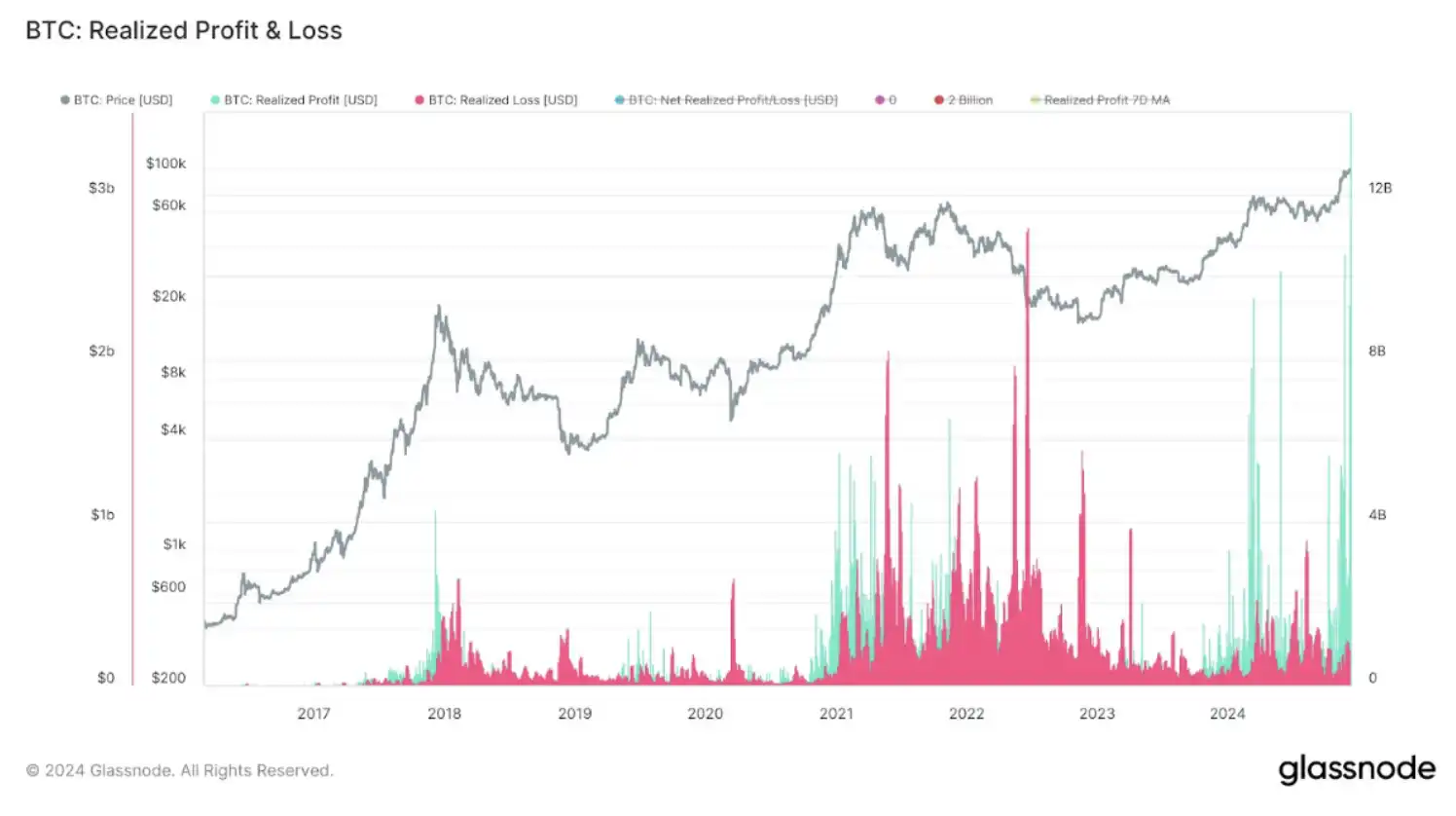
Realized Profit & Realized Loss Chart
Massive Realized Profit is Usually Only Caused by Low-Cost Chip Holders
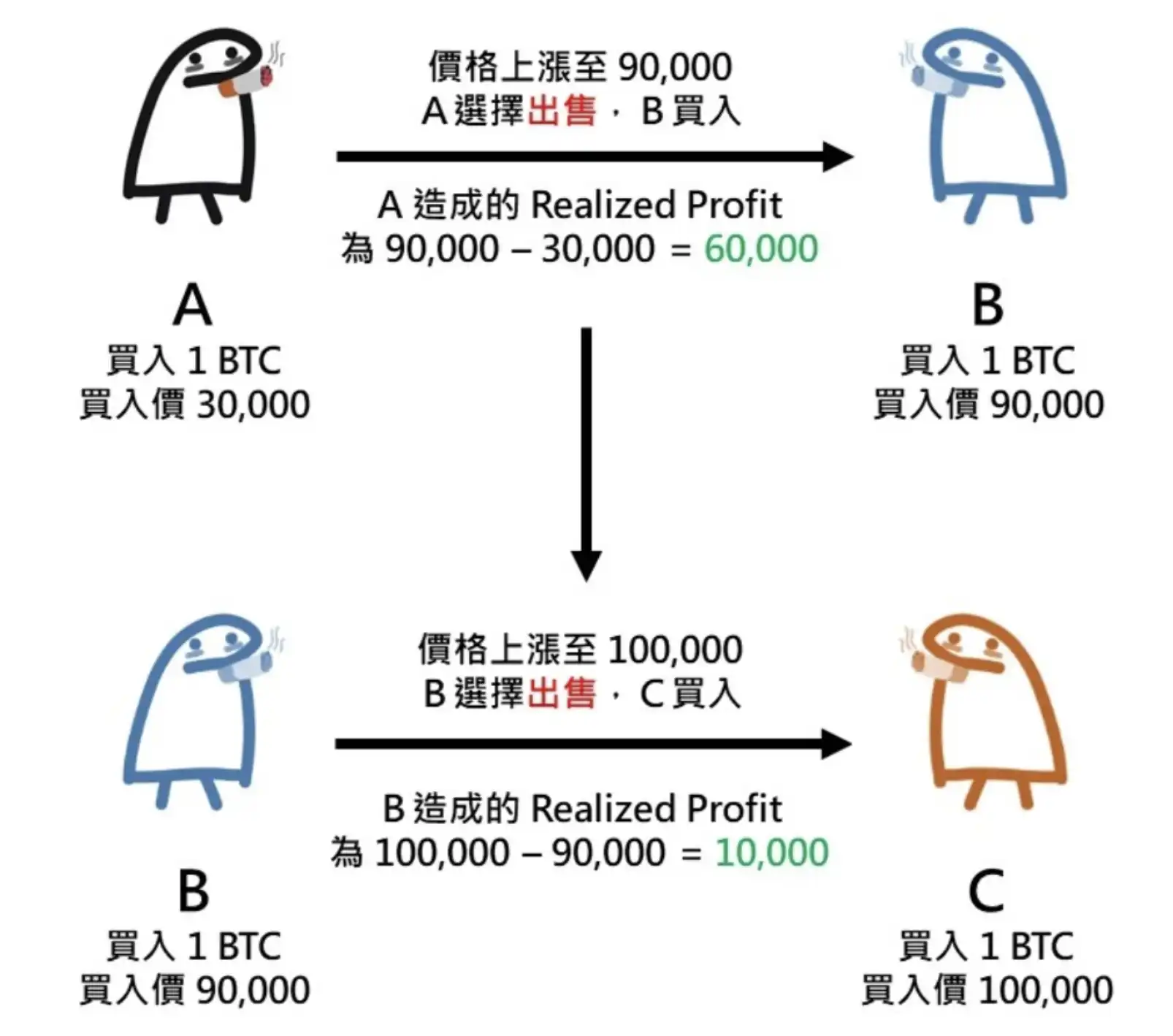
As shown in the diagram below: Due to the high cost basis of holders, their profit margin is not large, so when they sell, the **Realized Profit** they can generate is not high.
Therefore, when we see a significant amount of Realized Profit, it usually means that holders with a low cost basis are selling BTC.
Realized Profit Calculation Diagram
Tops are usually accompanied by significant Realized Profit
When a large number of holders with a low cost basis sell their BTC, we will see clustered high-volume realized profits on the chart.
At this point, since the remaining participants in the market are high cost basis acquirers, and the market price is close to their cost basis, any slight shift in sentiment is more likely to trigger panic selling from them, causing a cascading price drop, forming a top.
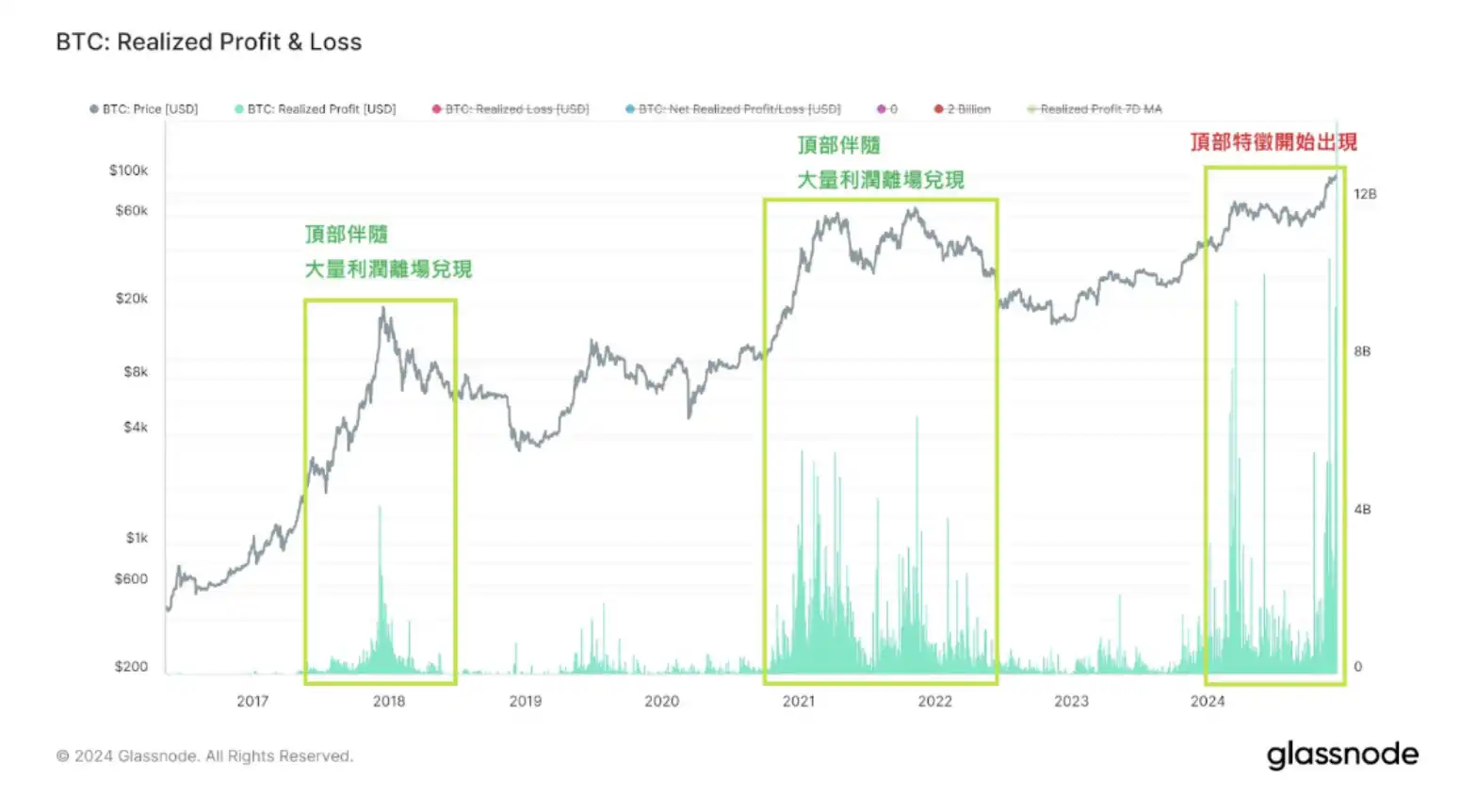
Tops are usually accompanied by significant Realized Profit
Conclusion
The above is all the content of On-Chain Data School (III). For readers interested in delving deeper into on-chain data analysis, remember to keep track of this series of articles!
If you would like to see more analysis and educational content on on-chain data, feel free to follow my Twitter handle (X)!
I hope this article has been helpful to you. Thank you for reading.
You may also like

Can the CLARITY Act Become Law by July 4? Everything You Need to Know About the Final Battle

How to exit after asset tokenization?

The foundation of SpaceX's trillion-dollar valuation: Who is dividing Musk's annual capital expenditure of tens of billions?

France vs Senegal World Cup 2026: Mbappe’s New Era Begins Against a Historic Rival

SharpLink CEO: How to understand that Ethereum developers have just surpassed 1 million?

Morning Report | MiCA grace period expires on July 1; Kalshi's trading volume in the first week of the World Cup breaks $5.1 billion, setting a record

What is the connection between Huang Zheng of Pinduoduo and blockchain?

Morning Report | Prediction market platforms like Kalshi and Polymarket jointly sue Kentucky over 14.25% trading tax; Bridgewater founder discusses decision-making in the AI era: principled thinking should run parallel to AI, human insight remains irre...

If the AI bubble has already burst, who will truly remain?
Paul Graham: How to Make a Billion Dollars

After 18 years, blockchain has finally started to head towards the main channel
Claude enforces "facial recognition for household registration," starting in July, no ID card means no access?

On the day of SpaceX's IPO, the first real test of the three perpetual mechanisms

Value Distribution of Stablecoins
Galaxy Deep Dive: Is the Bitcoin Four-Year Cycle Still Valid?

SpaceX IPO, Nvidia, and Bitcoin: Why Traders Are Watching More Than Just Crypto in 2026

The other side of Musk's trillion-dollar fortune: 85% cannot be sold

The U.S. government prohibits foreigners from using Fable 5, Anthropic issues a rebuttal
Can the CLARITY Act Become Law by July 4? Everything You Need to Know About the Final Battle
How to exit after asset tokenization?
The foundation of SpaceX's trillion-dollar valuation: Who is dividing Musk's annual capital expenditure of tens of billions?
France vs Senegal World Cup 2026: Mbappe’s New Era Begins Against a Historic Rival
SharpLink CEO: How to understand that Ethereum developers have just surpassed 1 million?
Morning Report | MiCA grace period expires on July 1; Kalshi's trading volume in the first week of the World Cup breaks $5.1 billion, setting a record


