
- Buy Crypto
- Markets
 Futures
- Spot
- Copy Trade
 Earn
Earn- More
Presto Annual Report: Increasingly clear market, BTC will reach $210,000 in 2025

Original title: From Chaos To Clarity: 2024 Crypto Market Review & 2025 Forecasts
Original source: Presto Research
Original translation: Yuliya, PANews
In 2024, the cryptocurrency market showed obvious differentiation characteristics. Data shows that Meme coins led the rise, VC-backed tokens were generally under pressure, and RWA tokenization became a new focus of the market, with a significant increase in transaction volume. The market structure continues to evolve, high FDV and low circulation tokens are weak, and institutional demand for Bitcoin allocation is rising. These trends deserve continued attention in the new market cycle.
Looking forward to 2025, with the improvement of infrastructure and clear supervision, the crypto asset market will enter a new stage. Bitcoin's value storage function, competition in the public chain ecosystem, and innovative applications such as DEX and NFT may become new growth drivers for the market.
Against this backdrop, Presto Research has released its first annual report, providing a comprehensive review of key market trends and forward-looking forecasts through 2025.
Key predictions for 2025 include:
· Bitcoin price reaches $210,000
· Total cryptocurrency market capitalization expands to $7.5 trillion
· ETH/BTC ratio rebounds to 0.05 as Ethereum solves user experience issues
· Solana breaks through $1,000
· Stablecoin market capitalization reaches $300 billion
· DEX trading volume exceeds 20% of CEX trading volume
· New EVM Layer1 public chain market capitalization reaches $20 billion and total locked value (TVL) reaches $10 billion
· A sovereign country or S&P 500 company includes Bitcoin in its treasury reserves
· Crypto hedge funds outperform crypto VC
….
2024 Year in Review
Best and Worst Performing Tokens Analysis
In a well-functioning market, asset prices embody the wisdom of the crowd, forming dynamic signals that reflect market narratives, themes, and trends. Therefore, reviewing the best and worst performing projects in a thriving market is an effective way to reflect on the past. The following will expand on this detailed analysis.
Regarding the research methodology, the following points need to be explained:
· First, the analysis is limited to the three major centralized exchanges: Binance, Bybit, and OKX.
· Second, the analysis objects are further subdivided into two categories: "Newly listed projects (listed in 2024)" and "Existing projects (listed in 2023 or earlier)".
· Third, from each of the six subcategories, the five best and worst performing projects are selected.
It is worth noting that this analysis method may not fully reflect the trends of mainstream assets such as Bitcoin or Ethereum, as small-cap assets tend to show more extreme fluctuations. Instead, this analysis aims to discover industry themes or individual projects that may have been overlooked.
Based on the above, the findings point to three key trends:
· VC-backed tokens underperform
· Meme coin craze continues
· Real-world asset (RWA) tokenization attracts attention
· Decentralized exchanges (DEX) rise
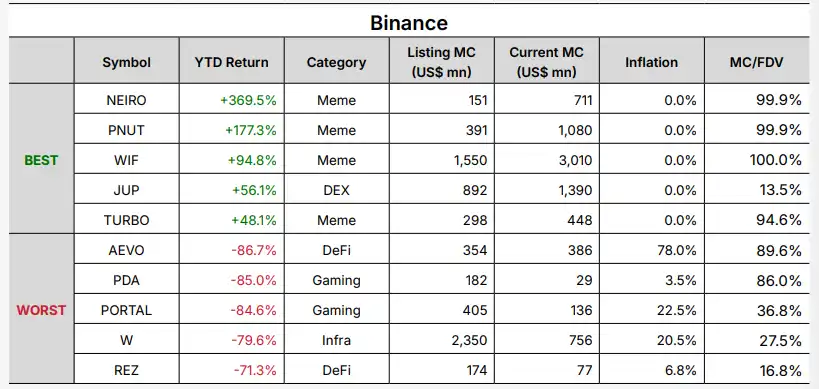
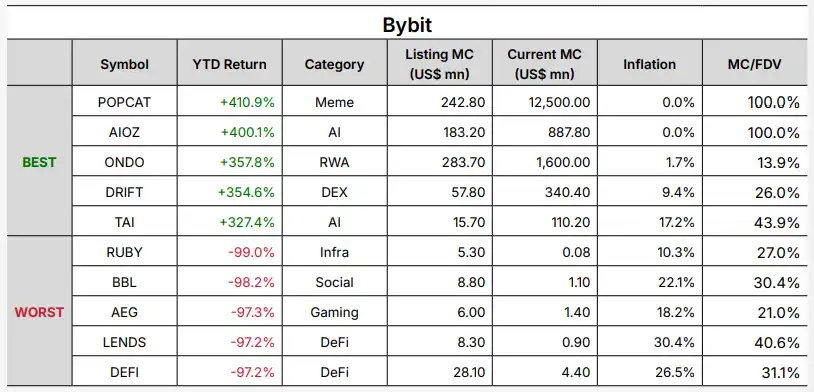
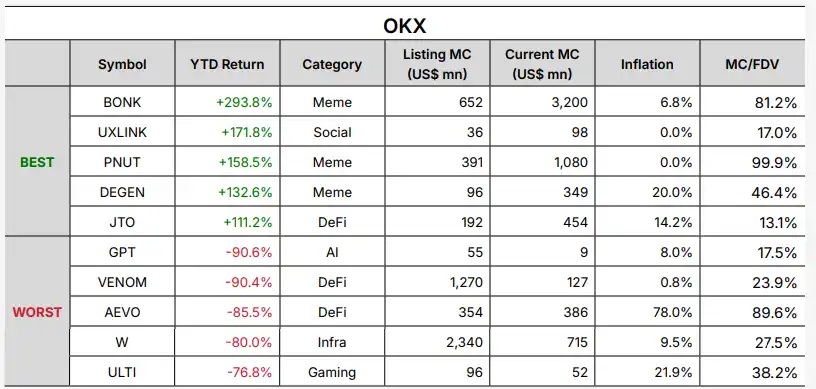
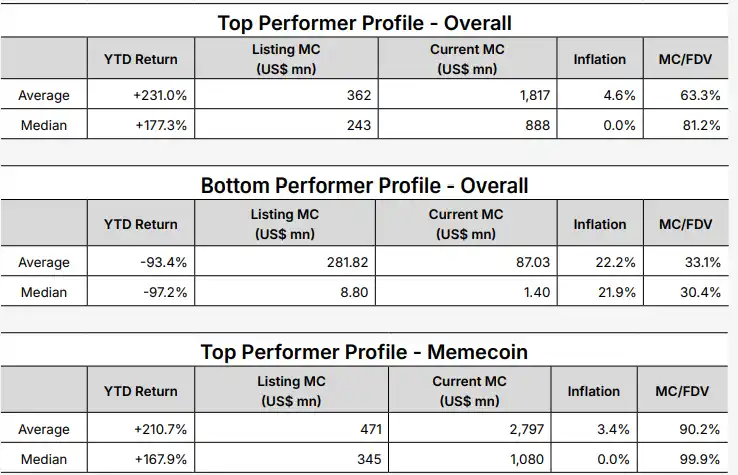
Top 5 new listings in 2024 (as of November 29) )
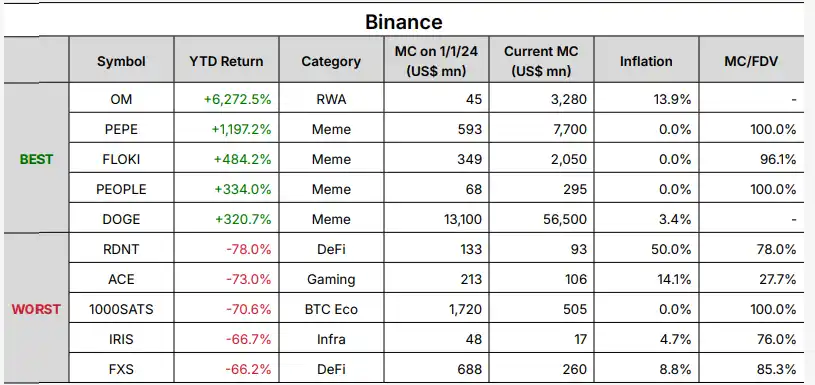
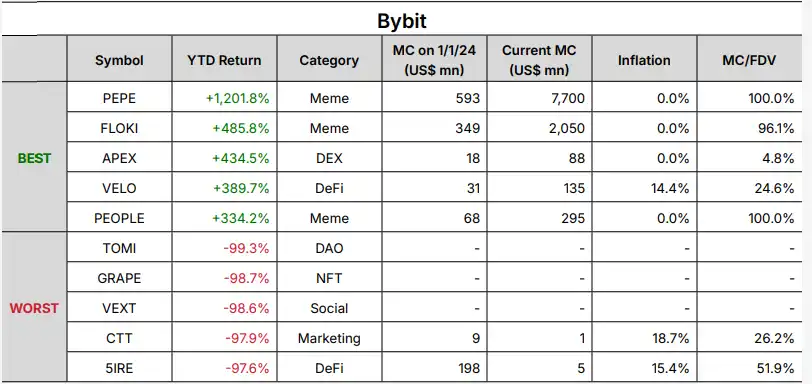
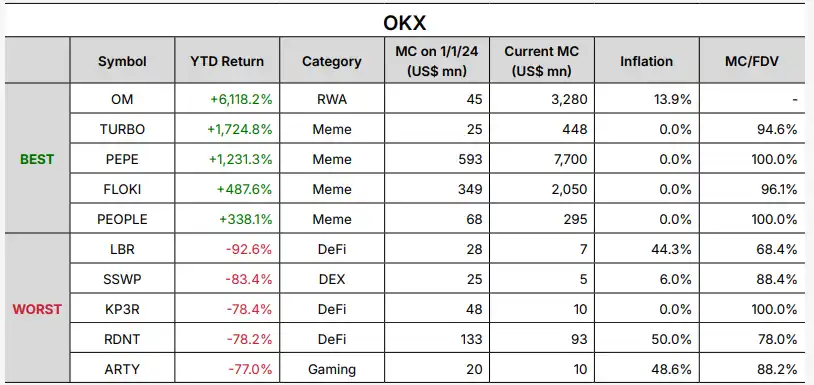
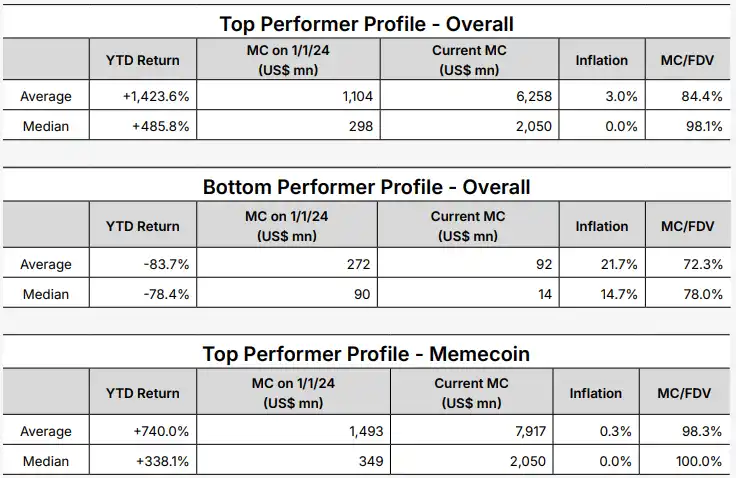
Top 5 Performance of Existing Projects in 2024 (As of November 29)
“VC Coin” (Low Circulation/High FDV) Performed Poorly
Market data shows that poorly performing projects generally have two characteristics:
1. High inflation rate
New projects: median 22%
Existing projects: median 15%
2. Low circulation rate
New projects: the median is only 30%
Existing projects: the median is 78%
This trend has become a unique phenomenon in the cryptocurrency market in 2024. Although the negative impact of large-scale token unlocking has always been seen as a risk factor, this year it has become the dominant narrative, and exchanges, project parties and investors are highly vigilant about it.
From the perspective of market development, this change reflects that the crypto market is gradually maturing:
· New tokens are no longer popular with retail investors just by virtue of their shiny packaging or endorsement by well-known VCs
· The effectiveness of the strategy of using information asymmetry to use retail investors as a CEX exit channel is gradually diminishing
· The short-term arbitrage model used by some VCs is difficult to sustain
Meme coin craze
Retail investors generally believe that VC coins are unfair, so a large amount of funds have begun to turn to the Meme coin market. This trend has directly promoted the significant growth of the Meme coin sector, and the prominent position of Meme coins can be seen in the six best-performing lists.
Meme coins show a clear contrast with VC coins:
· Generally low inflation rates
· High overall circulation rates
The "fairness" narrative of Meme coins has had a significant impact on the crypto market in 2024:
· Successfully attracted a large number of retail investors to participate
· Driving a shift in market sentiment
· Becoming one of the most significant features of the crypto market of the year
RWA project surpasses Meme coins
The most eye-catching project in 2024 is Mantra (OM), which has increased far more than other projects:
· OM: up 6,118%
· PEPE (Best Meme Coin): up 1,231%
Mantra positions itself as a "purpose-built RWA public chain" that can "meet real-world regulatory requirements" by supporting compliant on-chain and off-chain protocols for fiat currencies, stocks, and tokenized RWAs. OM, as the governance token of MANTRA DAO, provides users with a reward program related to key initiatives and ecosystem development.
OM's outstanding performance reflects two key trends:
· The RWA track is gaining market favor
· The appeal of the RWA concept may surpass the Meme narrative
Early returns turn to DEX
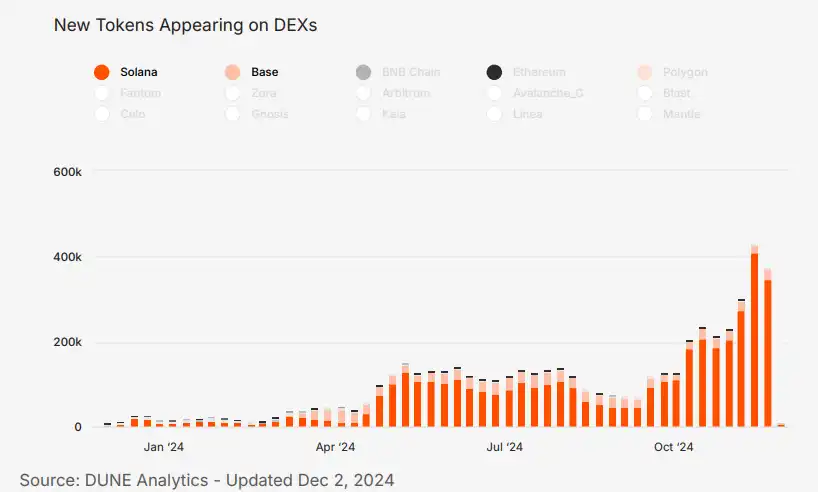
Data shows that the yield of existing tokens is higher than that of newly listed projects, which is in contrast to traditional cognition. Behind this phenomenon is an important change in the crypto market in 2024: DEX has become the main place for early price discovery of tokens.
Thanks to the improvement of DEX functions and user experience, many projects choose to be listed on DEX first. Therefore, the steepest rise often occurs on DEX, and centralized exchanges can only capture the later stages of the rise. In the early days of the crypto market, centralized exchanges were the undisputed liquidity provider. However, with the rise of DEXs such as Hyperliquid and Raydium, and the emergence of applications such as Moonshot and Pump.fun, the market landscape has changed.
2025 Forecast
Institutionalization in full swing
The mainstreaming of cryptocurrency is continuing and is expected to reach new heights in 2025, and the full participation of top institutions will further accelerate this trend. Here are four major developments predicted.
Bitcoin price will reach $210,000 in 2025
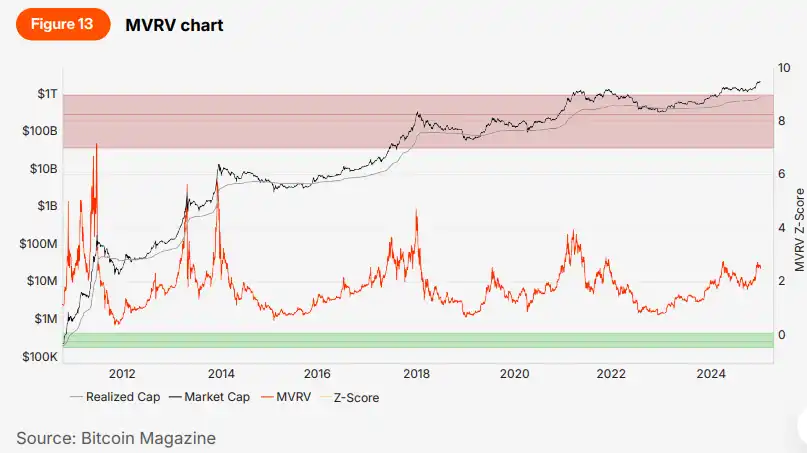
The MVRV ratio (market value/realized value) has become one of the recognized and reliable Bitcoin valuation tools in the digital asset industry. Market value (MV) calculates the total value of all circulating bitcoins at the current market price, while realized value (RV) calculates the value of each bitcoin at the most recent transaction price based on on-chain transaction records, representing the average acquisition cost of all circulating bitcoins.
Historically, Bitcoin's MVRV ratio has fluctuated between 0.4x and 7.7x. If only data since 2017 is considered (excluding early periods of extreme volatility), the range is narrower, between 0.5x and 4.7x. In the past two bull markets (2017 and 2021), Bitcoin's MVRV peaked at 4.7x and 4x, respectively.
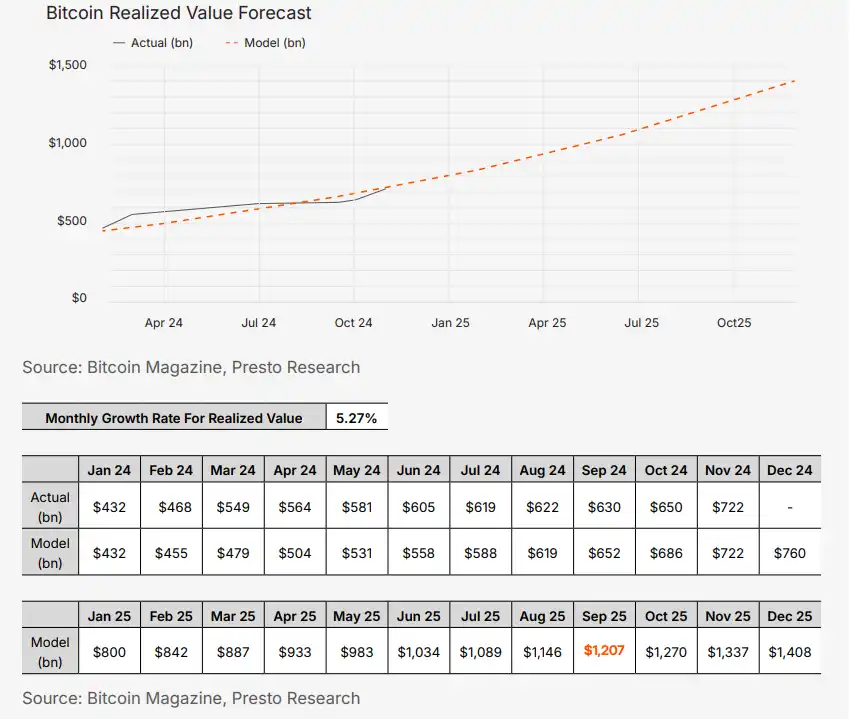
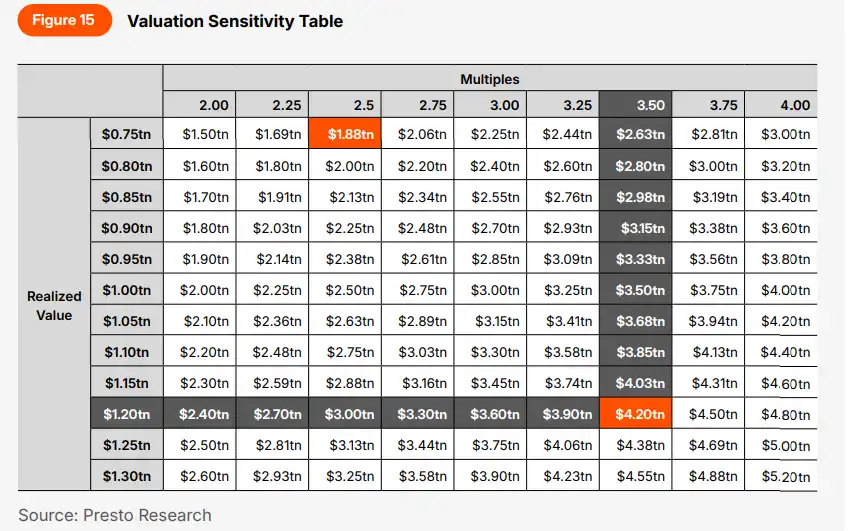
Using a more conservative 3.5x multiplier and assuming that the realized value grows at a compound monthly rate of 5.3% from the current $722 billion to $1.2 trillion in the third quarter of 2025 (this growth rate reflects the impact of institutional access facilitation brought by spot ETFs), the target value of the Bitcoin network in 2025 is $4.2 trillion (currently $1.9 trillion), or $210,000 per Bitcoin.
Bitcoin Land Rover: New Sovereigns or S&P 500 Companies to Adopt Bitcoin as Reserves
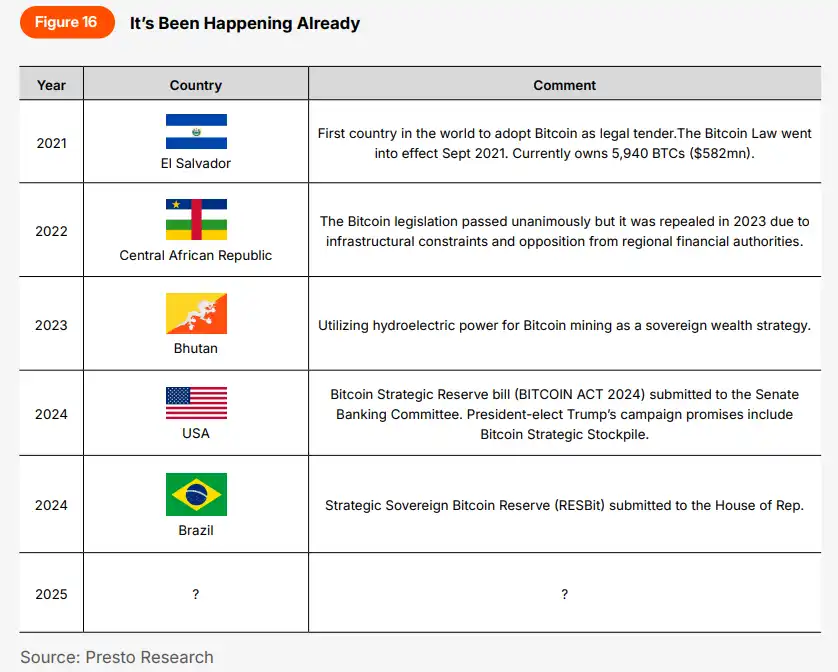
Expected announcements of sovereigns or S&P 500 companies adopting Bitcoin as a reserve strategy. For sovereigns, "adoption" refers to a government agency proposing to include Bitcoin in its treasury reserves. At least one country has taken such action in each of the past three years. Trump's campaign promise to hold Bitcoin reserves after his election may have prompted other countries to study similar strategies for game theory considerations.
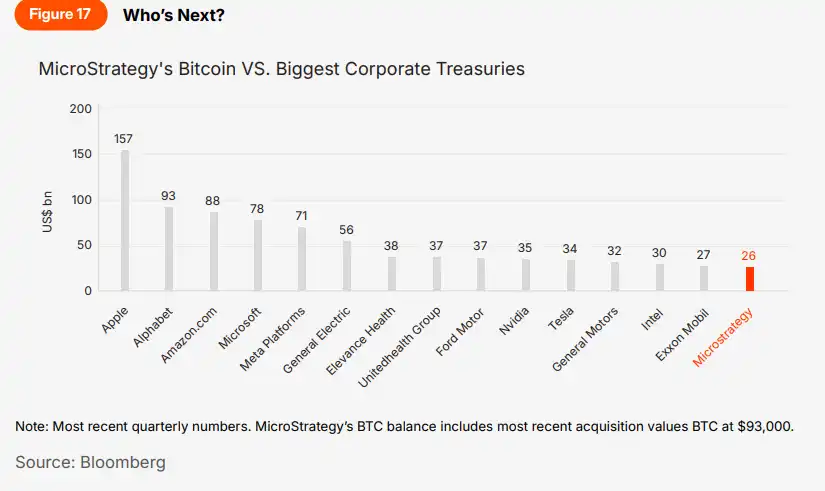
In terms of corporate adoption, MicroStrategy's parabolic stock price rise this year has attracted unprecedented attention from the corporate community. This accounting hurdle will be eased with the FASB’s announcement earlier this year that it will switch from the original lower of cost to fair value accounting. MicroStrategy plans to implement this change by the first quarter of 2025, providing other companies with clearer guidance and a stronger incentive to adopt.
Stablecoin Market Cap to Reach $300 Billion
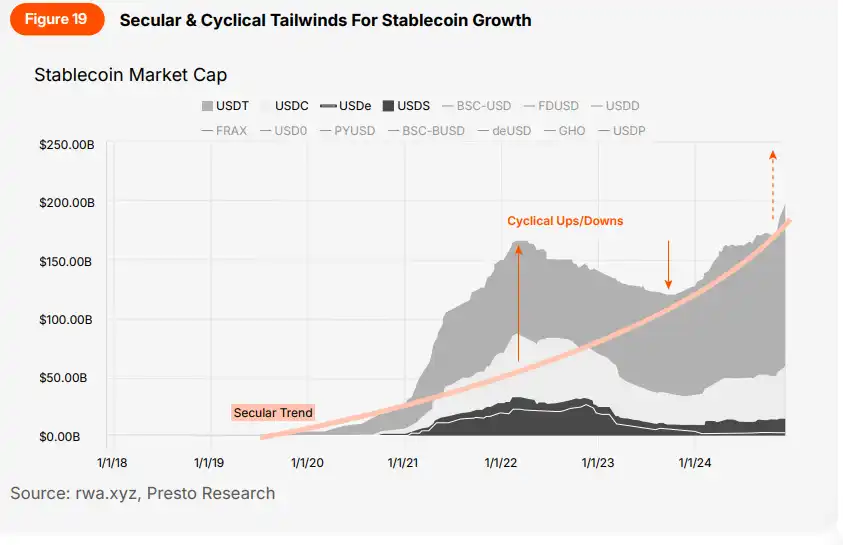
While stablecoins may not be the most talked about topic among cryptocurrency speculators seeking high yields, they are undoubtedly the most successful application of blockchain. After rebounding from the local lows in November 2022, the total stablecoin market capitalization has now reached $200 billion, making it the largest cryptocurrency application category.
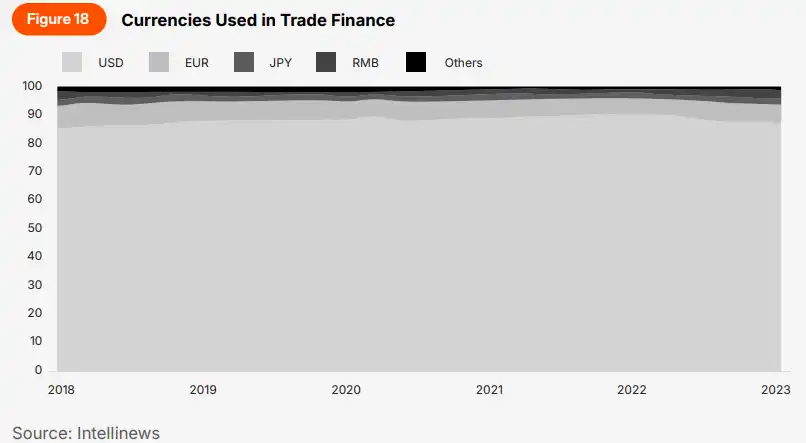
It’s no accident that 99% of stablecoins are pegged to the US dollar. Tokenizing assets does not create demand out of thin air, but the assets that need to be tokenized have global demand themselves. Few currencies other than the US dollar enjoy such universal demand, as evidenced by its dominance as a settlement currency. This is why blockchain and US dollar stablecoins offer the best product-market fit.
Stablecoin market cap is expected to reach $300 billion by 2025, with growth driven by both secular and cyclical factors. Secular drivers include recognition of the superior functionality of a tokenized dollar and progress on stablecoin legislation in the US Congress. Cyclical drivers include the broader cryptocurrency bull cycle. Even at $300 billion, this would only represent 1.4% of the US dollar M2 supply, leaving significant upside.
More Corporate Action: Circle/Ripple/Kraken to IPO
Under the crypto-friendly environment of the Trump administration, opportunities that were previously shelved due to political risks may be unlocked. Traditional companies will see crypto startups as attractive assets to enter the crypto field, driving more M&A activity and higher valuations. There are already signs of this trend, even the struggling Bakkt has found an acquirer, Trump Media.
Companies in the late growth stage will not miss this listing opportunity. Well-known crypto companies such as Circle, Ripple and Kraken have long been seen as potential IPO candidates. For reference, Coinbase went public at the peak of the last bull market (April 2021).
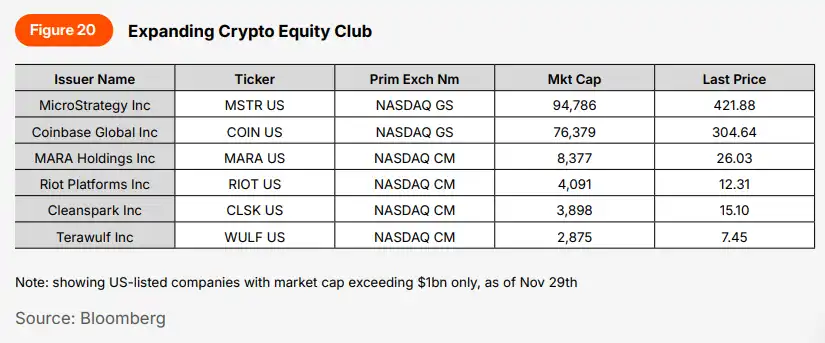
The equitization trend of cryptocurrencies
The United States: The new capital of cryptocurrencies
Trump's "Make America Great Again" (MAGA) and "America First" policy philosophy are likely to extend to the cryptocurrency sector. To ensure that the United States stays ahead of competitors such as China in the global cryptocurrency landscape, the government may adopt a series of supportive policies. There have been rumors of plans to abolish capital gains taxes on cryptocurrencies issued by US-registered companies, indicating the government's intention to attract crypto innovation. This may be just the beginning of a series of policies.
This shift will fundamentally change the crypto industry. Currently, cryptocurrencies are seen as global assets, and the location of the project or founder is not valued. But as the United States differentiates itself through preferential policies, this perception will change. Just as the nationality of a company is important in traditional stock markets, so will the cryptocurrency sector.
· "US cryptocurrencies" will command a notable premium, attracting top talent and projects.
· The US will replicate its successful model in the stock market, where US-listed companies enjoy a valuation premium due to the country's legal and economic stability.
· The knock-on effects of US dominance will extend to trading dynamics.
· Volume and volatility during US trading hours are likely to increase significantly, as macro and project-level news events will be concentrated during US hours.
· In addition, US exchanges (particularly Coinbase) are expected to grow significantly, and a listing on their platform will serve as a signal of global legitimacy, similar to a major IPO on Nasdaq.
· At the project level, Coinbase’s Base ecosystem will be one of the biggest beneficiaries of U.S. dominance.
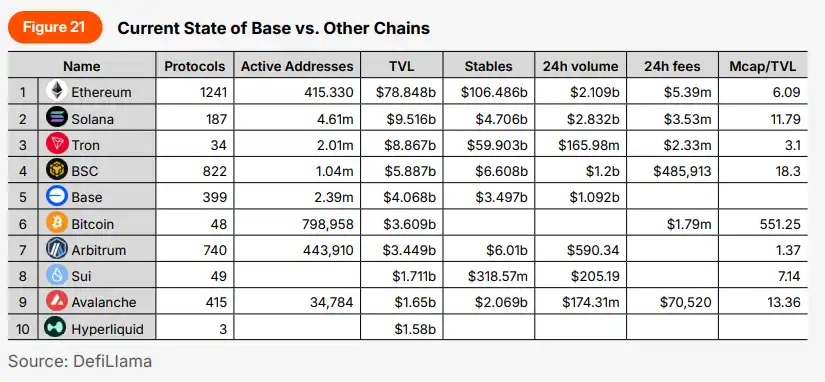
Crypto turns to fundamentals: Liquidity hedge funds will outperform
The crypto industry is moving away from speculative hype and toward fundamentals-driven investing, aided by the rise of standardized valuation frameworks. These frameworks are reshaping how projects are evaluated, financed, and traded, making crypto investing more standardized and closer to traditional finance principles.
As projects generate revenue through staking rewards, token buybacks, and transaction fees, they become systemically valuable. Investors can now calculate actual returns to token holders and assess project sustainability. Metrics such as TVL/Market Cap Ratio and Protocol Revenue Multiple are gaining acceptance.
In 2025, expect liquidity hedge funds to outperform venture capital funds, using their valuation-based strategies to profit in both bull and bear markets. At least five major macro or equity long-short hedge funds are likely to enter the space, while major investment banks are expected to formally cover digital assets.
The Rise of Crypto Indices: Index Trading Volumes to Rank in the Top Five
As cryptocurrencies become a mainstream asset class, the average investor begins to realize the importance of including them in their portfolios, and the market is increasingly demanding a simplified and diversified approach to investing. This shift is similar to the trajectory of traditional stock markets, just as investors have moved from selecting individual stocks to buying the S&P 500, the crypto market is undergoing a similar evolution.
In traditional finance, ETFs currently account for 13% of total U.S. equity assets. Cryptocurrencies are expected to follow a similar trajectory, with index products offering a mix of assets across industries or themes.
Currently, projects are developing unique use cases and behavioral patterns, with performance in different industries driven by unique fundamentals, no longer just following Bitcoin's price movements. It is expected that the index will become a staple product on major exchanges, and crypto equivalents of $SPDR products (such as the Coinbase 50 Index) may emerge and consistently rank in the top five by volume.
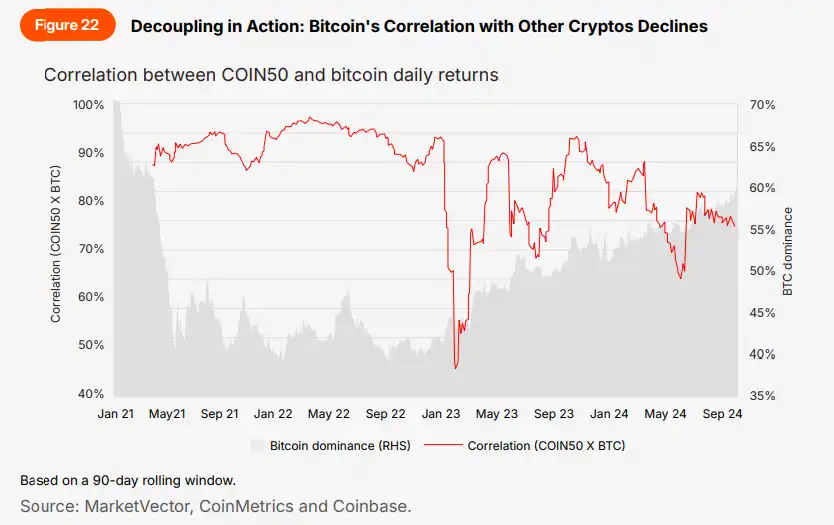
Bull Run Phase 2
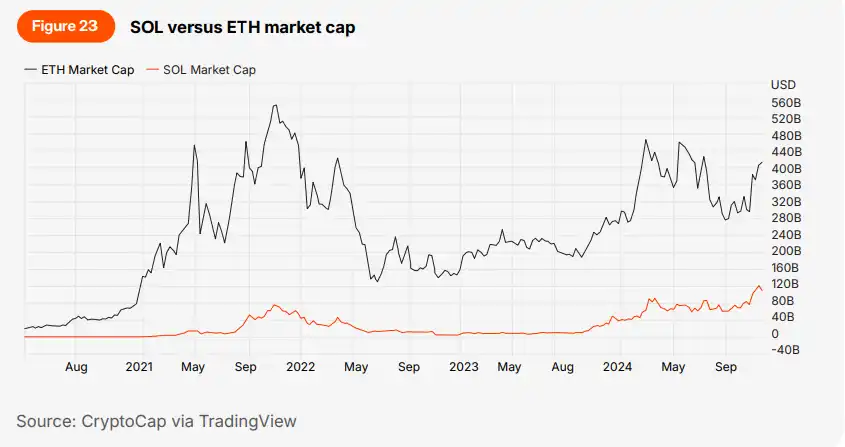
Solana to $1,000
Solana’s path to $1,000 is built on its transformation from a high-performance blockchain to a deeply institutional ecosystem. The surge in institutional adoption, coupled with $173 million in funding raised by projects in Q3 2024, reflects that the platform has achieved the critical intersection of technological excellence and institutional embedding.
Network activity is growing at an unprecedented pace, with Solana accounting for over 50% of all on-chain daily transaction volume and activity up 1,900% year-over-year. This explosive growth reflects a deeper truth about network success — as Placeholder’s Mario Laul explores, network success is not just about technology, but also about the degree of institutionalization achieved through professional infrastructure and developer network effects. Solana’s differentiation stems from its unique cultural philosophy: prioritizing rapid innovation over theoretical perfection, in stark contrast to Ethereum’s research-first approach.
From a technical roadmap perspective, Anatoly advances the vision of a global state machine with 120ms block times, while the network architecture is a natural fit for rollup-based expansion, laying the foundation for unprecedented scalability. The upcoming Firedancer client, which aims to achieve 1 million transactions per second, further reflects this pragmatic progress.
1.93% of tokens will enter the market next year, with a projected market cap of $485.93 billion at $1,000 - within Ethereum's historical precedent. This combination of cultural differentiation, institutional adoption, technological evolution, and favorable token economics creates a compelling case for SOL to rise.
Total Cryptocurrency Market Cap to Reach $7.5 Trillion
The crypto market continued to be dominated by Bitcoin in 2024. Institutional funds continued to flow in through ETFs, Bitcoin's institutionalization process continued to deepen, and the benefits brought by Trump's victory allowed this cryptocurrency veteran to continue to outperform most altcoins.
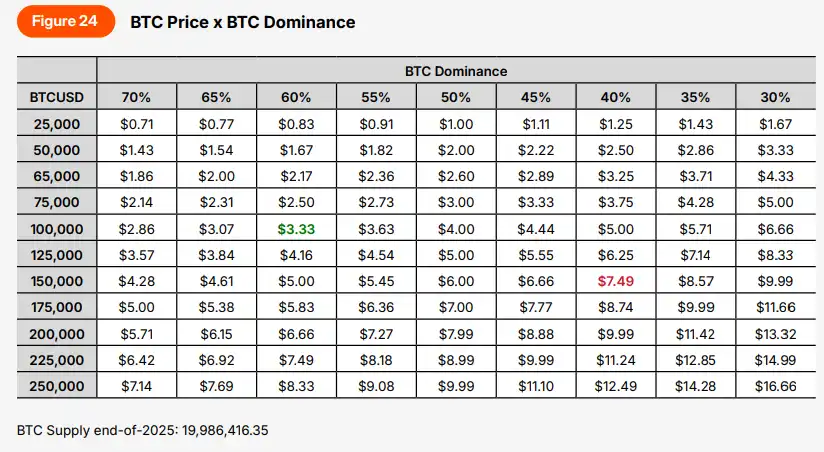
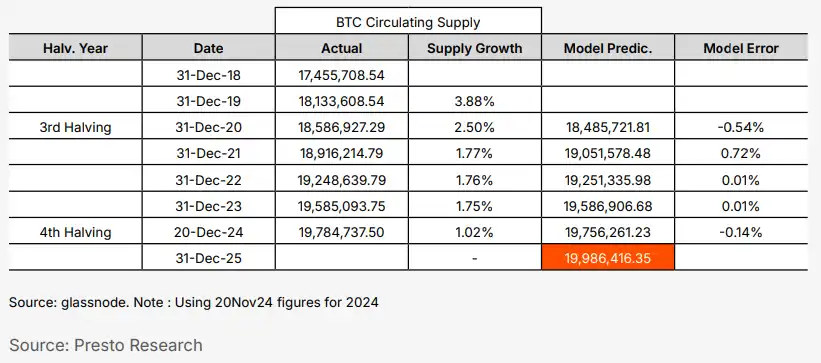
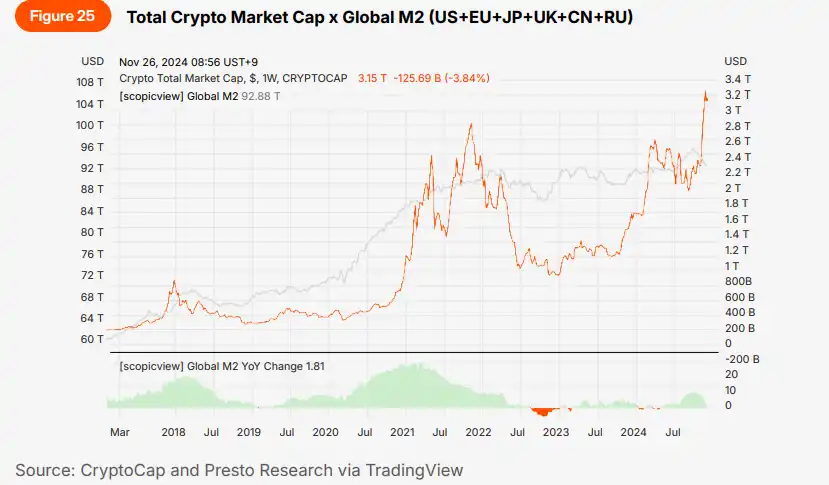
If Bitcoin reaches $150,000 and maintains a 60% market share, the overall crypto market will reach $7.49 trillion, more than 2.5 times the previous high (November 2021, $2.9 trillion).
Trump's presidency will be a key factor in the duration of this bull market. There are two possible development paths for the market:
· Under the optimistic path, Trump will implement policies to promote economic growth, relax regulations, maintain low tariffs and open immigration policies. This situation may lead to higher real interest rates, a stronger dollar, and rising stock markets, but gold prices will be under pressure.
· Under the pessimistic path, a trade war may break out, with a 60% tariff on China and a 10-20% tariff imposed globally, while immigration policies will be tightened. This will lead to the Federal Reserve easing its policies and lowering interest rates, the dollar strengthening first and then weakening, the stock market adjusting, and gold strengthening.
But in either case, there are positive factors for cryptocurrencies:
· In an optimistic environment, Bitcoin may rise in tandem with risky assets
· In a pessimistic environment, Bitcoin may be positively correlated with gold and negatively correlated with the US dollar.
Given Trump's cabinet selections and overall policy orientation, the market environment is more likely to be optimistic, which will provide favorable support for risk-taking crypto assets.
NFT rebound in 2025: monthly trading volume will reach $2 billion
Bitcoin is currently at a record high, but market sentiment seems different than before. The magic moment of the bull market cycle "rising tide lifts all boats" has not yet arrived, which is exactly why we are optimistic about NFTs in 2025. The market is currently entering a mature phase, which history shows is often the most culturally innovative.
Current data supports the potential for this cultural renaissance, with NFT sales reaching $562 million in November 2024, up 57.8% month-over-month. The continued growth of the NFT subculture and its influence on the broader crypto culture, with the emergence of unique art movements from trash art to generative art, reflects a maturing ecosystem.
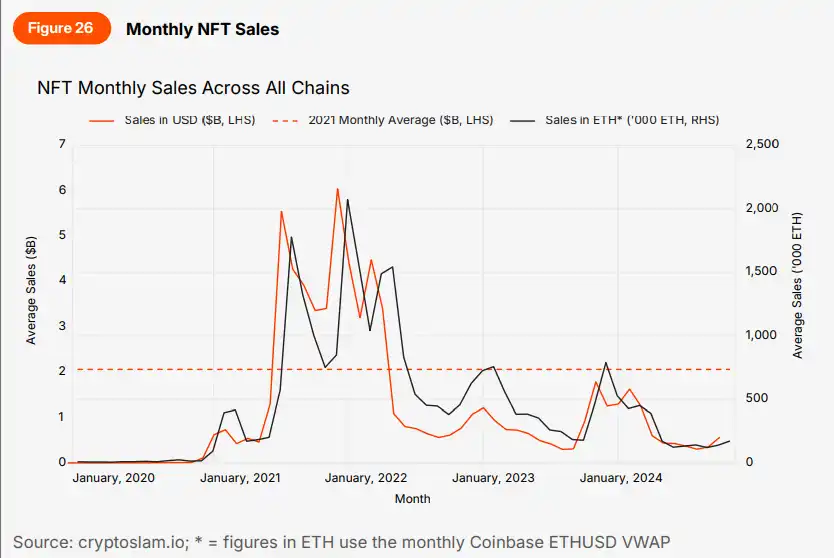
The adoption of NFTs by mainstream brands such as Nike and Sony is not only about corporate adoption, but also about legitimizing these digital subcultures. NFT monthly trading volume is expected to exceed $2 billion sometime in 2025 (up from a monthly average of $2.056 billion in 2021).
Focus on fundamentals
Ethereum rebounds: ETH/BTC ratio will recover to 0.05
In the second half of 2024, Ethereum became one of the most controversial topics in the crypto industry. While single chains such as Solana have achieved significant development with "convenience and speed", Ethereum still faces many challenges:
· Lack of a perfect proof system for the L2 network
· User experience problems caused by asset fragmentation
· Lack of narrative cohesion
These factors have caused the ETH/BTC ratio to hit a new low since 2021.
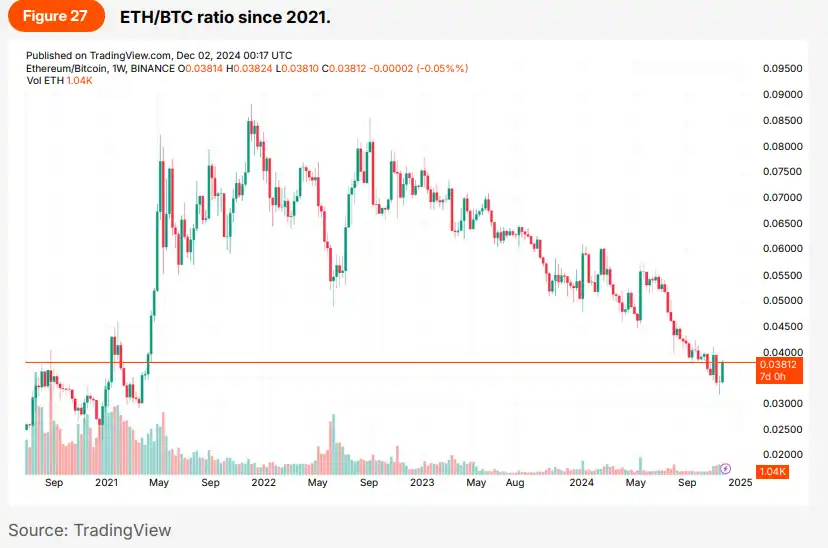
Despite the challenges, Ethereum is still worth keeping an eye on in 2025 and beyond. It is expected that the ETH/BTC ratio may return to 0.05 when Bitcoin reaches $120,000 and Ethereum climbs to $6,000. Two important upgrades are worth paying attention to:
1. L2 network defragmentation (ERC-7683 and EIP-7702)
In the past few years, although Ethereum's L2 solution has solved the expansion problem, it has also brought about ecological fragmentation. Each L2 network has formed an independent ecosystem, and cross-chain operations have become complicated. The new upgrade will be achieved through: · ERC-7683 standardized intents: allow users to declare desired operations without worrying about specific L2 network details · EIP-7702 account abstraction: allow external accounts (EOAs) to be temporarily used as smart contract wallets · Achieve seamless cross-chain operations: users can complete cross-chain token swaps, asset transfers, and governance voting in one go
2. Beam Chain roadmap optimization
The Beam Chain roadmap announced by Justin Drake of the Ethereum Foundation at Devcon 7 proposes a long-term plan until 2029, involving 9 major upgrades in three major categories: block production, staking, and cryptography:
· Reduce the final confirmation time from 15 minutes to 36 seconds (3-slot finality)
· Reduce block time from 12 seconds to 4 seconds
· Reduce minimum staking requirement from 32 ETH to 1 ETH
Based on currently available information, L2 defragmentation related updates are expected to be launched in early 2025, while the Beam Chain roadmap has not yet determined a specific timeline. In particular, the core proposals of the Beam Chain roadmap involve ideas that fundamentally change the key mechanisms of the Ethereum consensus layer, and these updates may take more than 1-2 years to complete.
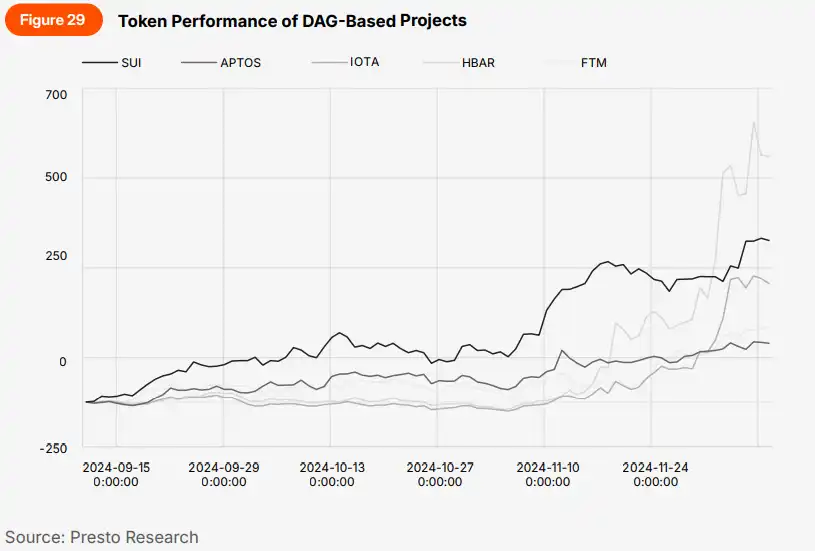
Focus on DAG-based blockchains (SUI, APTOS, HBAR, FTM)
The traditional blockchain is like a one-way street, where all transactions need to queue up and pass through in turn. The DAG (directed acyclic graph) technology is like a complex road network that allows multiple lanes to pass at the same time. This design has made a qualitative leap in transaction processing efficiency and can be regarded as an important evolution of blockchain technology.
Although the early DAG project IOTA pioneered the introduction of this technology into the crypto world, it has many inherent limitations, just like the first generation of iPhone. When the network transaction volume is insufficient, the performance will decrease, and a centralized coordinator is required to "stand guard". These problems ultimately limit its development.
The emergence of Sui has injected new vitality into DAG technology. It does not completely abandon the advantages of traditional blockchain, but cleverly integrates DAG into the consensus mechanism. Through the innovative Mysticeti consensus protocol, validators can freely process blocks in parallel, which not only ensures decentralization and security, but also greatly improves network performance. It's like Tesla's perfect combination of electric motors and traditional automotive technology.
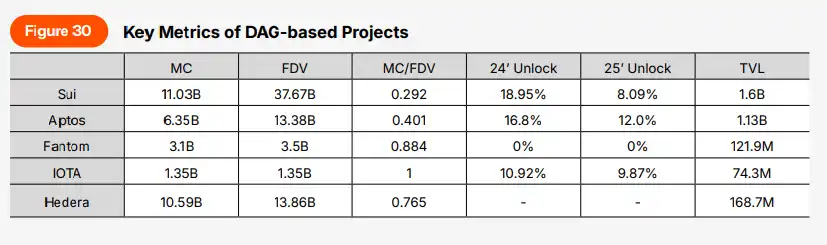
Sui's technological innovation quickly gained market recognition. Since September 2024, Sui's coin price has soared by more than 300%, and it currently ranks third among non-EVM public chains with a TVL of $1.6 billion. Even after experiencing large-scale unlocking at the end of 2024, Sui still showed strong resilience. Looking forward to 2025, as the pressure of unlocking is significantly reduced, Sui's development prospects are brighter.
Not only Sui, but the entire DAG track is showing a booming trend. Aptos, which also uses DAG technology, has jumped to the fourth place in non-EVM public chain TVL, with a locked volume of $1.13 billion. DAG projects such as IOTA, HBAR, and FTM have also achieved at least 100% growth since September 2024.
As technology continues to mature, DAG projects are proving themselves to be the most suitable public chain solution for large-scale applications. It is expected that by 2025, the total TVL of major DAG projects is expected to grow from the current $3.1 billion to $5-6 billion, equivalent to more than half of Solana's current TVL.
The Golden Age of Chain
DEX Gold Rush: Spot DEX to CEX trading volume ratio will exceed 20%, perpetual contract DEX to CEX ratio will exceed 10%
While CEXs such as Binance and Coinbase remain the primary trading platforms for most investors, the volume ratio of DEXs to CEXs has gradually increased as the bull market progresses. This trend is expected to accelerate next year, with the spot volume ratio likely to exceed 20% and the perpetual contract volume ratio likely to exceed 10%.
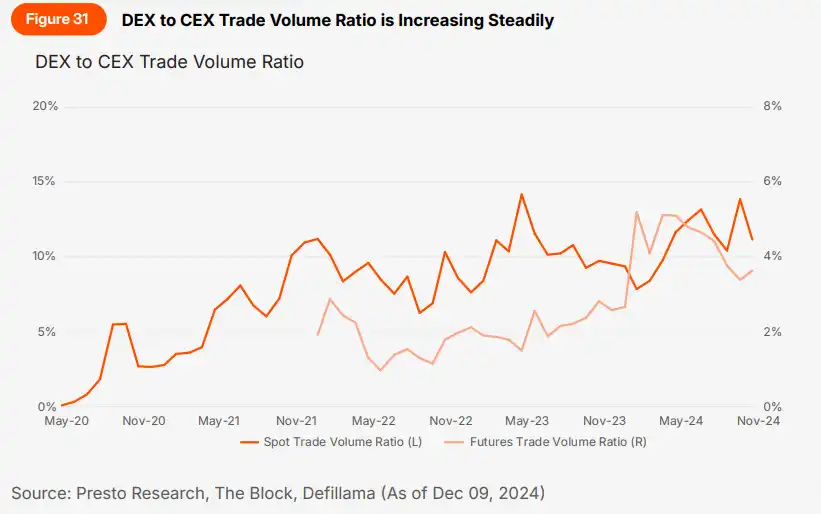
There are three factors driving this shift:
· First, a more DeFi-friendly regulatory environment under the new Trump administration will expand the DeFi scene, encouraging exploration of less censorship and token value accumulation. This will boost the demand for DeFi tokens and create a virtuous cycle for the entire on-chain ecosystem.
· Second, the user experience at multiple levels, including wallets, trading terminals, and trading bots, has improved significantly. After the FTX collapse, traders became more sensitive to counterparty risk, and on-chain activities became more popular as a result. Phantom has been listed among the top applications many times this year, indicating that the user experience and popularity of on-chain have reached an unprecedented level.
· Third, the listing of highly valued tokens on CEX will drive more investors to turn to the chain. As the scale of the crypto industry reaches the trillion-dollar level, it is becoming more and more common for new tokens to be issued with valuations of hundreds of millions or billions of dollars. Investors are increasingly aware that the era of holding tokens on CEX to obtain excess returns is over, and the most profitable opportunities are on the chain.
Although there are still certain thresholds for on-chain operations and self-custody, the bull market FOMO sentiment will surely drive more users to embrace the on-chain economy. This wave of "gold rush" will not only bring about an increase in the number of users, but also promote the entire blockchain industry to move towards an open, trustless economic system.
Digital gold is better than gold: the value of the Bitcoin ecosystem will exceed 1% of the BTC network
After multiple cycles, Bitcoin is increasingly accepted by the public as digital gold and a means of storing value. Since 2023, numerous protocols have emerged to unlock the full potential of Bitcoin as digital gold. Native Bitcoin protocols such as Ordinals and Runes have made Bitcoin the base layer for native DeFi by minting tokens and NFTs directly on its blockchain. In addition, various L2 solutions and re-staking protocols have begun to use Bitcoin to generate returns.
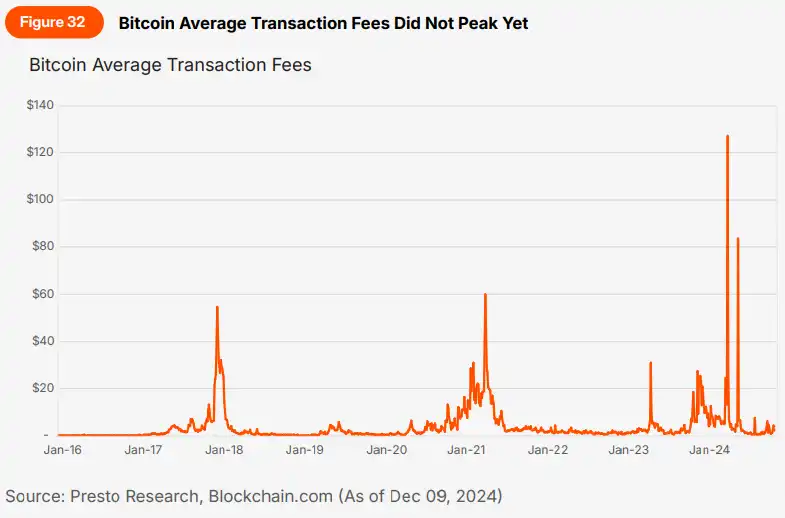
Since the launch of the Ordinals protocol in 2023, transaction fees on the Bitcoin network have climbed to the highs of previous bull markets. However, on the eve of the upcoming new bull market, transaction fees have returned to normal, indicating that Bitcoin's on-chain demand has not yet been fully released. According to market laws, if the bull market ushers in 2025 as expected, Bitcoin's on-chain usage and transaction fees are likely to hit record highs.
While most Bitcoin holders value stability, there is always a demand for Bitcoin to generate income. Current data can illustrate this point:
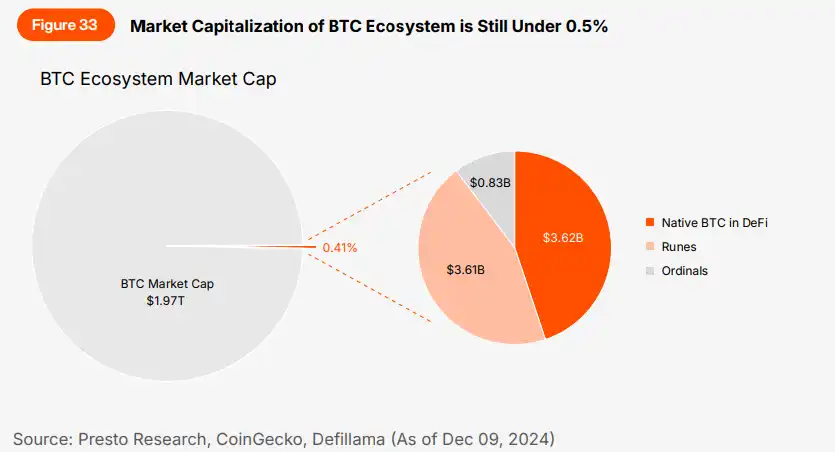
· Bitcoin ranks sixth in total locked value (TVL) among all public chains, with approximately $3.8 billion of Bitcoin being used for income generation
· Combined with the total market value of Ordinals and Runes, the market size of the entire Bitcoin chain ecosystem has reached $7 billion
Considering Bitcoin's status as a $2 trillion asset, 1% of its supply would represent more than $20 billion invested in the ecosystem.
EVM Era Return: New Alternative EVM L1 to Reach $20B+ Market Cap and $10B+ TVL
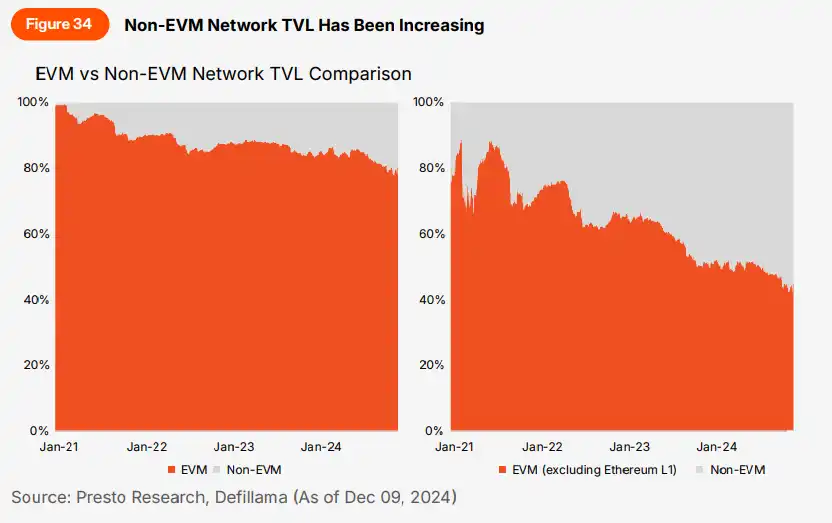
In 2024, on-chain growth is concentrated in the non-EVM ecosystem, especially Solana and Sui:
· Solana’s on-chain transaction volume exceeds the sum of Ethereum and all its L2 networks
· Sui’s momentum exceeds that of most Ethereum L2 solutions
· The EVM ecosystem, excluding the Ethereum mainnet, has seen a significant decline in market share in TVL (total locked value)
This trend is expected to reverse in 2025:
· The new alternative EVM L1 public chain is expected to reach $20B+ market cap and $10B+ TVL $100 billion market cap
· TVL expected to reach $10 billion
· This goal has already been achieved by Avalanche in 2021
Despite the significant growth of networks such as Solana and Sui, the EVM ecosystem still has unparalleled depth. It has the largest user and developer base, unrivaled liquidity, and a TVL of $165 billion, four times the total of other ecosystems. This huge liquidity, mainly in ETH, has been on the sidelines during the Solana meme coin craze in 2024. However, the growth of interest in EVM-based protocols such as Hyperliquid, Ethena, and Virtuals shows that there is underlying demand.
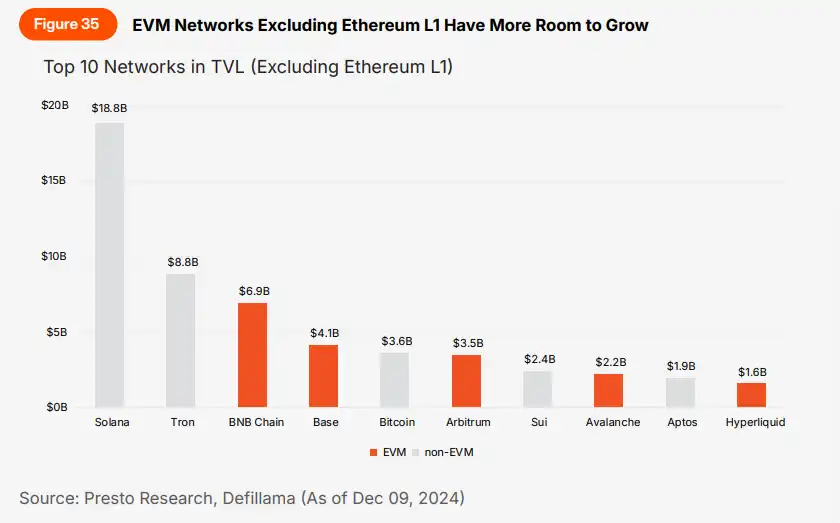
This prediction is not bearish on Solana or Sui, but bullish on the development prospects of the EVM network. The EVM network has the following advantages:
Technical advantages
· Easier cross-chain bridging
· Easier DApp deployment
· Better wallet compatibility
User base
· Solana (especially Phantom wallet) has a remarkable record in attracting new users
· Jupiter has more than 500,000 daily active traders
· Even if only 10% of users turn to on-chain DeFi, it will significantly increase the vitality and liquidity of the ecosystem
Growth is expected to be mainly concentrated in EVM-compatible L1 networks rather than L2 networks:
· Challenges facing L2 networks: Most L2 networks have difficulty gaining effective traction, and user adoption rates are lower than expected
· L1 Advantages of the network: attracting users and liquidity through the wealth effect of native tokens, as evidenced by the success stories of BSC, Avalanche, Fantom, etc. in 2021
Potential alternative EVM L1s in this cycle include: Hyperliquid, Monad, and Berachain.
Conclusion
The crypto world is as complex as the vast starry sky. Even the most comprehensive research report can hardly fully depict this booming new continent. This study focuses on the track with the most practical application potential, trying to reveal how crypto technology can break through the shackles of speculative bubbles and truly serve the real world.
However, innovation in the crypto field never stops. Although experimental fields such as blockchain games (GameFi), decentralized physical infrastructure networks (DePIN), and decentralized social networking (DeSoc) are not yet mature, they contain infinite possibilities for breakthrough innovation. These emerging tracks may not have found a clear path to mainstream adoption, but their revolutionary potential cannot be ignored.
Looking ahead to 2025, the crypto industry will continue to evolve under a clearer regulatory environment. New ideas will continue to emerge and new trends will continue to evolve. In this noisy market, it is critical to maintain a humble and open mind, while also staying agile and focused. Only by tracing through the fog and finding the truth can we seize the opportunity in this digital revolution.
You may also like

Token Cannot Compound, Where Is the Real Investment Opportunity?

February 6th Market Key Intelligence, How Much Did You Miss?

China's Central Bank and Eight Other Departments' Latest Regulatory Focus: Key Attention to RWA Tokenized Asset Risk
Foreword: Today, the People's Bank of China's website published the "Notice of the People's Bank of China, National Development and Reform Commission, Ministry of Industry and Information Technology, Ministry of Public Security, State Administration for Market Regulation, China Banking and Insurance Regulatory Commission, China Securities Regulatory Commission, State Administration of Foreign Exchange on Further Preventing and Dealing with Risks Related to Virtual Currency and Others (Yinfa [2026] No. 42)", the latest regulatory requirements from the eight departments including the central bank, which are basically consistent with the regulatory requirements of recent years. The main focus of the regulation is on speculative activities such as virtual currency trading, exchanges, ICOs, overseas platform services, and this time, regulatory oversight of RWA has been added, explicitly prohibiting RWA tokenization, stablecoins (especially those pegged to the RMB). The following is the full text:
To the people's governments of all provinces, autonomous regions, and municipalities directly under the Central Government, the Xinjiang Production and Construction Corps:
Recently, there have been speculative activities related to virtual currency and Real-World Assets (RWA) tokenization, disrupting the economic and financial order and jeopardizing the property security of the people. In order to further prevent and address the risks related to virtual currency and Real-World Assets tokenization, effectively safeguard national security and social stability, in accordance with the "Law of the People's Republic of China on the People's Bank of China," "Law of the People's Republic of China on Commercial Banks," "Securities Law of the People's Republic of China," "Law of the People's Republic of China on Securities Investment Funds," "Law of the People's Republic of China on Futures and Derivatives," "Cybersecurity Law of the People's Republic of China," "Regulations of the People's Republic of China on the Administration of Renminbi," "Regulations on Prevention and Disposal of Illegal Fundraising," "Regulations of the People's Republic of China on Foreign Exchange Administration," "Telecommunications Regulations of the People's Republic of China," and other provisions, after reaching consensus with the Cyberspace Administration of China, the Supreme People's Court, and the Supreme People's Procuratorate, and with the approval of the State Council, the relevant matters are notified as follows:
(I) Virtual currency does not possess the legal status equivalent to fiat currency. Virtual currencies such as Bitcoin, Ether, Tether, etc., have the main characteristics of being issued by non-monetary authorities, using encryption technology and distributed ledger or similar technology, existing in digital form, etc. They do not have legal tender status, should not and cannot be circulated and used as currency in the market.
The business activities related to virtual currency are classified as illegal financial activities. The exchange of fiat currency and virtual currency within the territory, exchange of virtual currencies, acting as a central counterparty in buying and selling virtual currencies, providing information intermediary and pricing services for virtual currency transactions, token issuance financing, and trading of virtual currency-related financial products, etc., fall under illegal financial activities, such as suspected illegal issuance of token vouchers, unauthorized public issuance of securities, illegal operation of securities and futures business, illegal fundraising, etc., are strictly prohibited across the board and resolutely banned in accordance with the law. Overseas entities and individuals are not allowed to provide virtual currency-related services to domestic entities in any form.
A stablecoin pegged to a fiat currency indirectly fulfills some functions of the fiat currency in circulation. Without the consent of relevant authorities in accordance with the law and regulations, any domestic or foreign entity or individual is not allowed to issue a RMB-pegged stablecoin overseas.
(II)Tokenization of Real-World Assets refers to the use of encryption technology and distributed ledger or similar technologies to transform ownership rights, income rights, etc., of assets into tokens (tokens) or other interests or bond certificates with token (token) characteristics, and carry out issuance and trading activities.
Engaging in the tokenization of real-world assets domestically, as well as providing related intermediary, information technology services, etc., which are suspected of illegal issuance of token vouchers, unauthorized public offering of securities, illegal operation of securities and futures business, illegal fundraising, and other illegal financial activities, shall be prohibited; except for relevant business activities carried out with the approval of the competent authorities in accordance with the law and regulations and relying on specific financial infrastructures. Overseas entities and individuals are not allowed to illegally provide services related to the tokenization of real-world assets to domestic entities in any form.
(III) Inter-agency Coordination. The People's Bank of China, together with the National Development and Reform Commission, the Ministry of Industry and Information Technology, the Ministry of Public Security, the State Administration for Market Regulation, the China Banking and Insurance Regulatory Commission, the China Securities Regulatory Commission, the State Administration of Foreign Exchange, and other departments, will improve the work mechanism, strengthen coordination with the Cyberspace Administration of China, the Supreme People's Court, and the Supreme People's Procuratorate, coordinate efforts, and overall guide regions to carry out risk prevention and disposal of virtual currency-related illegal financial activities.
The China Securities Regulatory Commission, together with the National Development and Reform Commission, the Ministry of Industry and Information Technology, the Ministry of Public Security, the People's Bank of China, the State Administration for Market Regulation, the China Banking and Insurance Regulatory Commission, the State Administration of Foreign Exchange, and other departments, will improve the work mechanism, strengthen coordination with the Cyberspace Administration of China, the Supreme People's Court, and the Supreme People's Procuratorate, coordinate efforts, and overall guide regions to carry out risk prevention and disposal of illegal financial activities related to the tokenization of real-world assets.
(IV) Strengthening Local Implementation. The people's governments at the provincial level are overall responsible for the prevention and disposal of risks related to virtual currencies and the tokenization of real-world assets in their respective administrative regions. The specific leading department is the local financial regulatory department, with participation from branches and dispatched institutions of the State Council's financial regulatory department, telecommunications regulators, public security, market supervision, and other departments, in coordination with cyberspace departments, courts, and procuratorates, to improve the normalization of the work mechanism, effectively connect with the relevant work mechanisms of central departments, form a cooperative and coordinated working pattern between central and local governments, effectively prevent and properly handle risks related to virtual currencies and the tokenization of real-world assets, and maintain economic and financial order and social stability.
(5) Enhanced Risk Monitoring. The People's Bank of China, China Securities Regulatory Commission, National Development and Reform Commission, Ministry of Industry and Information Technology, Ministry of Public Security, State Administration of Foreign Exchange, Cyberspace Administration of China, and other departments continue to improve monitoring techniques and system support, enhance cross-departmental data analysis and sharing, establish sound information sharing and cross-validation mechanisms, promptly grasp the risk situation of activities related to virtual currency and real-world asset tokenization. Local governments at all levels give full play to the role of local monitoring and early warning mechanisms. Local financial regulatory authorities, together with branches and agencies of the State Council's financial regulatory authorities, as well as departments of cyberspace and public security, ensure effective connection between online monitoring, offline investigation, and fund tracking, efficiently and accurately identify activities related to virtual currency and real-world asset tokenization, promptly share risk information, improve early warning information dissemination, verification, and rapid response mechanisms.
(6) Strengthened Oversight of Financial Institutions, Intermediaries, and Technology Service Providers. Financial institutions (including non-bank payment institutions) are prohibited from providing account opening, fund transfer, and clearing services for virtual currency-related business activities, issuing and selling financial products related to virtual currency, including virtual currency and related financial products in the scope of collateral, conducting insurance business related to virtual currency, or including virtual currency in the scope of insurance liability. Financial institutions (including non-bank payment institutions) are prohibited from providing custody, clearing, and settlement services for unauthorized real-world asset tokenization-related business and related financial products. Relevant intermediary institutions and information technology service providers are prohibited from providing intermediary, technical, or other services for unauthorized real-world asset tokenization-related businesses and related financial products.
(7) Enhanced Management of Internet Information Content and Access. Internet enterprises are prohibited from providing online business venues, commercial displays, marketing, advertising, or paid traffic diversion services for virtual currency and real-world asset tokenization-related business activities. Upon discovering clues of illegal activities, they should promptly report to relevant departments and provide technical support and assistance for related investigations and inquiries. Based on the clues transferred by the financial regulatory authorities, the cyberspace administration, telecommunications authorities, and public security departments should promptly close and deal with websites, mobile applications (including mini-programs), and public accounts engaged in virtual currency and real-world asset tokenization-related business activities in accordance with the law.
(8) Strengthened Entity Registration and Advertisement Management. Market supervision departments strengthen entity registration and management, and enterprise and individual business registrations must not contain terms such as "virtual currency," "virtual asset," "cryptocurrency," "crypto asset," "stablecoin," "real-world asset tokenization," or "RWA" in their names or business scopes. Market supervision departments, together with financial regulatory authorities, legally enhance the supervision of advertisements related to virtual currency and real-world asset tokenization, promptly investigating and handling relevant illegal advertisements.
(IX) Continued Rectification of Virtual Currency Mining Activities. The National Development and Reform Commission, together with relevant departments, strictly controls virtual currency mining activities, continuously promotes the rectification of virtual currency mining activities. The people's governments of various provinces take overall responsibility for the rectification of "mining" within their respective administrative regions. In accordance with the requirements of the National Development and Reform Commission and other departments in the "Notice on the Rectification of Virtual Currency Mining Activities" (NDRC Energy-saving Building [2021] No. 1283) and the provisions of the "Guidance Catalog for Industrial Structure Adjustment (2024 Edition)," a comprehensive review, investigation, and closure of existing virtual currency mining projects are conducted, new mining projects are strictly prohibited, and mining machine production enterprises are strictly prohibited from providing mining machine sales and other services within the country.
(X) Severe Crackdown on Related Illegal Financial Activities. Upon discovering clues to illegal financial activities related to virtual currency and the tokenization of real-world assets, local financial regulatory authorities, branches of the State Council's financial regulatory authorities, and other relevant departments promptly investigate, determine, and properly handle the issues in accordance with the law, and seriously hold the relevant entities and individuals legally responsible. Those suspected of crimes are transferred to the judicial authorities for processing according to the law.
(XI) Severe Crackdown on Related Illegal and Criminal Activities. The Ministry of Public Security, the People's Bank of China, the State Administration for Market Regulation, the China Banking and Insurance Regulatory Commission, the China Securities Regulatory Commission, as well as judicial and procuratorial organs, in accordance with their respective responsibilities, rigorously crack down on illegal and criminal activities related to virtual currency, the tokenization of real-world assets, such as fraud, money laundering, illegal business operations, pyramid schemes, illegal fundraising, and other illegal and criminal activities carried out under the guise of virtual currency, the tokenization of real-world assets, etc.
(XII) Strengthen Industry Self-discipline. Relevant industry associations should enhance membership management and policy advocacy, based on their own responsibilities, advocate and urge member units to resist illegal financial activities related to virtual currency and the tokenization of real-world assets. Member units that violate regulatory policies and industry self-discipline rules are to be disciplined in accordance with relevant self-regulatory management regulations. By leveraging various industry infrastructure, conduct risk monitoring related to virtual currency, the tokenization of real-world assets, and promptly transfer issue clues to relevant departments.
(XIII) Without the approval of relevant departments in accordance with the law and regulations, domestic entities and foreign entities controlled by them may not issue virtual currency overseas.
(XIV) Domestic entities engaging directly or indirectly in overseas external debt-based tokenization of real-world assets, or conducting asset securitization activities abroad based on domestic ownership rights, income rights, etc. (hereinafter referred to as domestic equity), should be strictly regulated in accordance with the principles of "same business, same risk, same rules." The National Development and Reform Commission, the China Securities Regulatory Commission, the State Administration of Foreign Exchange, and other relevant departments regulate it according to their respective responsibilities. For other forms of overseas real-world asset tokenization activities based on domestic equity by domestic entities, the China Securities Regulatory Commission, together with relevant departments, supervise according to their division of responsibilities. Without the consent and filing of relevant departments, no unit or individual may engage in the above-mentioned business.
(15) Overseas subsidiaries and branches of domestic financial institutions providing Real World Asset Tokenization-related services overseas shall do so legally and prudently. They shall have professional personnel and systems in place to effectively mitigate business risks, strictly implement customer onboarding, suitability management, anti-money laundering requirements, and incorporate them into the domestic financial institutions' compliance and risk management system. Intermediaries and information technology service providers offering Real World Asset Tokenization services abroad based on domestic equity or conducting Real World Asset Tokenization business in the form of overseas debt for domestic entities directly or indirectly venturing abroad must strictly comply with relevant laws and regulations. They should establish and improve relevant compliance and internal control systems in accordance with relevant normative requirements, strengthen business and risk control, and report the business developments to the relevant regulatory authorities for approval or filing.
(16) Strengthen organizational leadership and overall coordination. All departments and regions should attach great importance to the prevention of risks related to virtual currencies and Real World Asset Tokenization, strengthen organizational leadership, clarify work responsibilities, form a long-term effective working mechanism with centralized coordination, local implementation, and shared responsibilities, maintain high pressure, dynamically monitor risks, effectively prevent and mitigate risks in an orderly and efficient manner, legally protect the property security of the people, and make every effort to maintain economic and financial order and social stability.
(17) Widely carry out publicity and education. All departments, regions, and industry associations should make full use of various media and other communication channels to disseminate information through legal and policy interpretation, analysis of typical cases, and education on investment risks, etc. They should promote the illegality and harm of virtual currencies and Real World Asset Tokenization-related businesses and their manifestations, fully alert to potential risks and hidden dangers, and enhance public awareness and identification capabilities for risk prevention.
(18) Engaging in illegal financial activities related to virtual currencies and Real World Asset Tokenization in violation of this notice, as well as providing services for virtual currencies and Real World Asset Tokenization-related businesses, shall be punished in accordance with relevant regulations. If it constitutes a crime, criminal liability shall be pursued according to the law. For domestic entities and individuals who knowingly or should have known that overseas entities illegally provided virtual currency or Real World Asset Tokenization-related services to domestic entities and still assisted them, relevant responsibilities shall be pursued according to the law. If it constitutes a crime, criminal liability shall be pursued according to the law.
(19) If any unit or individual invests in virtual currencies, Real World Asset Tokens, and related financial products against public order and good customs, the relevant civil legal actions shall be invalid, and any resulting losses shall be borne by them. If there are suspicions of disrupting financial order and jeopardizing financial security, the relevant departments shall deal with them according to the law.
This notice shall enter into force upon the date of its issuance. The People's Bank of China and ten other departments' "Notice on Further Preventing and Dealing with the Risks of Virtual Currency Trading Speculation" (Yinfa [2021] No. 237) is hereby repealed.

Former Partner's Perspective on Multicoin: Kyle's Exit, But the Game He Left Behind Just Getting Started
Why Bitcoin Is Falling Now: The Real Reasons Behind BTC's Crash & WEEX's Smart Profit Playbook
Bitcoin's ongoing crash explained: Discover the 5 hidden triggers behind BTC's plunge & how WEEX's Auto Earn and Trade to Earn strategies help traders profit from crypto market volatility.

Wall Street's Hottest Trades See Exodus

Vitalik Discusses Ethereum Scaling Path, Circle Announces Partnership with Polymarket, What's the Overseas Crypto Community Talking About Today?

Believing in the Capital Markets - The Essence and Core Value of Cryptocurrency

Polymarket's 'Weatherman': Predict Temperature, Win Million-Dollar Payout

$15K+ Profits: The 4 AI Trading Secrets WEEX Hackathon Prelim Winners Used to Dominate Volatile Crypto Markets
How WEEX Hackathon's top AI trading strategies made $15K+ in crypto markets: 4 proven rules for ETH/BTC trading, market structure analysis, and risk management in volatile conditions.

A nearly 20% one-day plunge, how long has it been since you last saw a $60,000 Bitcoin?

Raoul Pal: I've seen every single panic, and they are never the end.

Key Market Information Discrepancy on February 6th - A Must-Read! | Alpha Morning Report

2026 Crypto Industry's First Snowfall
The Harsh Reality Behind the $26 Billion Crypto Liquidation: Liquidity Is Killing the Market
Why Is Gold, US Stocks, Bitcoin All Falling?

Key Market Intelligence for February 5th, how much did you miss out on?

Wintermute: By 2026, crypto had gradually become the settlement layer of the Internet economy
Token Cannot Compound, Where Is the Real Investment Opportunity?
February 6th Market Key Intelligence, How Much Did You Miss?
China's Central Bank and Eight Other Departments' Latest Regulatory Focus: Key Attention to RWA Tokenized Asset Risk
Foreword: Today, the People's Bank of China's website published the "Notice of the People's Bank of China, National Development and Reform Commission, Ministry of Industry and Information Technology, Ministry of Public Security, State Administration for Market Regulation, China Banking and Insurance Regulatory Commission, China Securities Regulatory Commission, State Administration of Foreign Exchange on Further Preventing and Dealing with Risks Related to Virtual Currency and Others (Yinfa [2026] No. 42)", the latest regulatory requirements from the eight departments including the central bank, which are basically consistent with the regulatory requirements of recent years. The main focus of the regulation is on speculative activities such as virtual currency trading, exchanges, ICOs, overseas platform services, and this time, regulatory oversight of RWA has been added, explicitly prohibiting RWA tokenization, stablecoins (especially those pegged to the RMB). The following is the full text:
To the people's governments of all provinces, autonomous regions, and municipalities directly under the Central Government, the Xinjiang Production and Construction Corps:
Recently, there have been speculative activities related to virtual currency and Real-World Assets (RWA) tokenization, disrupting the economic and financial order and jeopardizing the property security of the people. In order to further prevent and address the risks related to virtual currency and Real-World Assets tokenization, effectively safeguard national security and social stability, in accordance with the "Law of the People's Republic of China on the People's Bank of China," "Law of the People's Republic of China on Commercial Banks," "Securities Law of the People's Republic of China," "Law of the People's Republic of China on Securities Investment Funds," "Law of the People's Republic of China on Futures and Derivatives," "Cybersecurity Law of the People's Republic of China," "Regulations of the People's Republic of China on the Administration of Renminbi," "Regulations on Prevention and Disposal of Illegal Fundraising," "Regulations of the People's Republic of China on Foreign Exchange Administration," "Telecommunications Regulations of the People's Republic of China," and other provisions, after reaching consensus with the Cyberspace Administration of China, the Supreme People's Court, and the Supreme People's Procuratorate, and with the approval of the State Council, the relevant matters are notified as follows:
(I) Virtual currency does not possess the legal status equivalent to fiat currency. Virtual currencies such as Bitcoin, Ether, Tether, etc., have the main characteristics of being issued by non-monetary authorities, using encryption technology and distributed ledger or similar technology, existing in digital form, etc. They do not have legal tender status, should not and cannot be circulated and used as currency in the market.
The business activities related to virtual currency are classified as illegal financial activities. The exchange of fiat currency and virtual currency within the territory, exchange of virtual currencies, acting as a central counterparty in buying and selling virtual currencies, providing information intermediary and pricing services for virtual currency transactions, token issuance financing, and trading of virtual currency-related financial products, etc., fall under illegal financial activities, such as suspected illegal issuance of token vouchers, unauthorized public issuance of securities, illegal operation of securities and futures business, illegal fundraising, etc., are strictly prohibited across the board and resolutely banned in accordance with the law. Overseas entities and individuals are not allowed to provide virtual currency-related services to domestic entities in any form.
A stablecoin pegged to a fiat currency indirectly fulfills some functions of the fiat currency in circulation. Without the consent of relevant authorities in accordance with the law and regulations, any domestic or foreign entity or individual is not allowed to issue a RMB-pegged stablecoin overseas.
(II)Tokenization of Real-World Assets refers to the use of encryption technology and distributed ledger or similar technologies to transform ownership rights, income rights, etc., of assets into tokens (tokens) or other interests or bond certificates with token (token) characteristics, and carry out issuance and trading activities.
Engaging in the tokenization of real-world assets domestically, as well as providing related intermediary, information technology services, etc., which are suspected of illegal issuance of token vouchers, unauthorized public offering of securities, illegal operation of securities and futures business, illegal fundraising, and other illegal financial activities, shall be prohibited; except for relevant business activities carried out with the approval of the competent authorities in accordance with the law and regulations and relying on specific financial infrastructures. Overseas entities and individuals are not allowed to illegally provide services related to the tokenization of real-world assets to domestic entities in any form.
(III) Inter-agency Coordination. The People's Bank of China, together with the National Development and Reform Commission, the Ministry of Industry and Information Technology, the Ministry of Public Security, the State Administration for Market Regulation, the China Banking and Insurance Regulatory Commission, the China Securities Regulatory Commission, the State Administration of Foreign Exchange, and other departments, will improve the work mechanism, strengthen coordination with the Cyberspace Administration of China, the Supreme People's Court, and the Supreme People's Procuratorate, coordinate efforts, and overall guide regions to carry out risk prevention and disposal of virtual currency-related illegal financial activities.
The China Securities Regulatory Commission, together with the National Development and Reform Commission, the Ministry of Industry and Information Technology, the Ministry of Public Security, the People's Bank of China, the State Administration for Market Regulation, the China Banking and Insurance Regulatory Commission, the State Administration of Foreign Exchange, and other departments, will improve the work mechanism, strengthen coordination with the Cyberspace Administration of China, the Supreme People's Court, and the Supreme People's Procuratorate, coordinate efforts, and overall guide regions to carry out risk prevention and disposal of illegal financial activities related to the tokenization of real-world assets.
(IV) Strengthening Local Implementation. The people's governments at the provincial level are overall responsible for the prevention and disposal of risks related to virtual currencies and the tokenization of real-world assets in their respective administrative regions. The specific leading department is the local financial regulatory department, with participation from branches and dispatched institutions of the State Council's financial regulatory department, telecommunications regulators, public security, market supervision, and other departments, in coordination with cyberspace departments, courts, and procuratorates, to improve the normalization of the work mechanism, effectively connect with the relevant work mechanisms of central departments, form a cooperative and coordinated working pattern between central and local governments, effectively prevent and properly handle risks related to virtual currencies and the tokenization of real-world assets, and maintain economic and financial order and social stability.
(5) Enhanced Risk Monitoring. The People's Bank of China, China Securities Regulatory Commission, National Development and Reform Commission, Ministry of Industry and Information Technology, Ministry of Public Security, State Administration of Foreign Exchange, Cyberspace Administration of China, and other departments continue to improve monitoring techniques and system support, enhance cross-departmental data analysis and sharing, establish sound information sharing and cross-validation mechanisms, promptly grasp the risk situation of activities related to virtual currency and real-world asset tokenization. Local governments at all levels give full play to the role of local monitoring and early warning mechanisms. Local financial regulatory authorities, together with branches and agencies of the State Council's financial regulatory authorities, as well as departments of cyberspace and public security, ensure effective connection between online monitoring, offline investigation, and fund tracking, efficiently and accurately identify activities related to virtual currency and real-world asset tokenization, promptly share risk information, improve early warning information dissemination, verification, and rapid response mechanisms.
(6) Strengthened Oversight of Financial Institutions, Intermediaries, and Technology Service Providers. Financial institutions (including non-bank payment institutions) are prohibited from providing account opening, fund transfer, and clearing services for virtual currency-related business activities, issuing and selling financial products related to virtual currency, including virtual currency and related financial products in the scope of collateral, conducting insurance business related to virtual currency, or including virtual currency in the scope of insurance liability. Financial institutions (including non-bank payment institutions) are prohibited from providing custody, clearing, and settlement services for unauthorized real-world asset tokenization-related business and related financial products. Relevant intermediary institutions and information technology service providers are prohibited from providing intermediary, technical, or other services for unauthorized real-world asset tokenization-related businesses and related financial products.
(7) Enhanced Management of Internet Information Content and Access. Internet enterprises are prohibited from providing online business venues, commercial displays, marketing, advertising, or paid traffic diversion services for virtual currency and real-world asset tokenization-related business activities. Upon discovering clues of illegal activities, they should promptly report to relevant departments and provide technical support and assistance for related investigations and inquiries. Based on the clues transferred by the financial regulatory authorities, the cyberspace administration, telecommunications authorities, and public security departments should promptly close and deal with websites, mobile applications (including mini-programs), and public accounts engaged in virtual currency and real-world asset tokenization-related business activities in accordance with the law.
(8) Strengthened Entity Registration and Advertisement Management. Market supervision departments strengthen entity registration and management, and enterprise and individual business registrations must not contain terms such as "virtual currency," "virtual asset," "cryptocurrency," "crypto asset," "stablecoin," "real-world asset tokenization," or "RWA" in their names or business scopes. Market supervision departments, together with financial regulatory authorities, legally enhance the supervision of advertisements related to virtual currency and real-world asset tokenization, promptly investigating and handling relevant illegal advertisements.
(IX) Continued Rectification of Virtual Currency Mining Activities. The National Development and Reform Commission, together with relevant departments, strictly controls virtual currency mining activities, continuously promotes the rectification of virtual currency mining activities. The people's governments of various provinces take overall responsibility for the rectification of "mining" within their respective administrative regions. In accordance with the requirements of the National Development and Reform Commission and other departments in the "Notice on the Rectification of Virtual Currency Mining Activities" (NDRC Energy-saving Building [2021] No. 1283) and the provisions of the "Guidance Catalog for Industrial Structure Adjustment (2024 Edition)," a comprehensive review, investigation, and closure of existing virtual currency mining projects are conducted, new mining projects are strictly prohibited, and mining machine production enterprises are strictly prohibited from providing mining machine sales and other services within the country.
(X) Severe Crackdown on Related Illegal Financial Activities. Upon discovering clues to illegal financial activities related to virtual currency and the tokenization of real-world assets, local financial regulatory authorities, branches of the State Council's financial regulatory authorities, and other relevant departments promptly investigate, determine, and properly handle the issues in accordance with the law, and seriously hold the relevant entities and individuals legally responsible. Those suspected of crimes are transferred to the judicial authorities for processing according to the law.
(XI) Severe Crackdown on Related Illegal and Criminal Activities. The Ministry of Public Security, the People's Bank of China, the State Administration for Market Regulation, the China Banking and Insurance Regulatory Commission, the China Securities Regulatory Commission, as well as judicial and procuratorial organs, in accordance with their respective responsibilities, rigorously crack down on illegal and criminal activities related to virtual currency, the tokenization of real-world assets, such as fraud, money laundering, illegal business operations, pyramid schemes, illegal fundraising, and other illegal and criminal activities carried out under the guise of virtual currency, the tokenization of real-world assets, etc.
(XII) Strengthen Industry Self-discipline. Relevant industry associations should enhance membership management and policy advocacy, based on their own responsibilities, advocate and urge member units to resist illegal financial activities related to virtual currency and the tokenization of real-world assets. Member units that violate regulatory policies and industry self-discipline rules are to be disciplined in accordance with relevant self-regulatory management regulations. By leveraging various industry infrastructure, conduct risk monitoring related to virtual currency, the tokenization of real-world assets, and promptly transfer issue clues to relevant departments.
(XIII) Without the approval of relevant departments in accordance with the law and regulations, domestic entities and foreign entities controlled by them may not issue virtual currency overseas.
(XIV) Domestic entities engaging directly or indirectly in overseas external debt-based tokenization of real-world assets, or conducting asset securitization activities abroad based on domestic ownership rights, income rights, etc. (hereinafter referred to as domestic equity), should be strictly regulated in accordance with the principles of "same business, same risk, same rules." The National Development and Reform Commission, the China Securities Regulatory Commission, the State Administration of Foreign Exchange, and other relevant departments regulate it according to their respective responsibilities. For other forms of overseas real-world asset tokenization activities based on domestic equity by domestic entities, the China Securities Regulatory Commission, together with relevant departments, supervise according to their division of responsibilities. Without the consent and filing of relevant departments, no unit or individual may engage in the above-mentioned business.
(15) Overseas subsidiaries and branches of domestic financial institutions providing Real World Asset Tokenization-related services overseas shall do so legally and prudently. They shall have professional personnel and systems in place to effectively mitigate business risks, strictly implement customer onboarding, suitability management, anti-money laundering requirements, and incorporate them into the domestic financial institutions' compliance and risk management system. Intermediaries and information technology service providers offering Real World Asset Tokenization services abroad based on domestic equity or conducting Real World Asset Tokenization business in the form of overseas debt for domestic entities directly or indirectly venturing abroad must strictly comply with relevant laws and regulations. They should establish and improve relevant compliance and internal control systems in accordance with relevant normative requirements, strengthen business and risk control, and report the business developments to the relevant regulatory authorities for approval or filing.
(16) Strengthen organizational leadership and overall coordination. All departments and regions should attach great importance to the prevention of risks related to virtual currencies and Real World Asset Tokenization, strengthen organizational leadership, clarify work responsibilities, form a long-term effective working mechanism with centralized coordination, local implementation, and shared responsibilities, maintain high pressure, dynamically monitor risks, effectively prevent and mitigate risks in an orderly and efficient manner, legally protect the property security of the people, and make every effort to maintain economic and financial order and social stability.
(17) Widely carry out publicity and education. All departments, regions, and industry associations should make full use of various media and other communication channels to disseminate information through legal and policy interpretation, analysis of typical cases, and education on investment risks, etc. They should promote the illegality and harm of virtual currencies and Real World Asset Tokenization-related businesses and their manifestations, fully alert to potential risks and hidden dangers, and enhance public awareness and identification capabilities for risk prevention.
(18) Engaging in illegal financial activities related to virtual currencies and Real World Asset Tokenization in violation of this notice, as well as providing services for virtual currencies and Real World Asset Tokenization-related businesses, shall be punished in accordance with relevant regulations. If it constitutes a crime, criminal liability shall be pursued according to the law. For domestic entities and individuals who knowingly or should have known that overseas entities illegally provided virtual currency or Real World Asset Tokenization-related services to domestic entities and still assisted them, relevant responsibilities shall be pursued according to the law. If it constitutes a crime, criminal liability shall be pursued according to the law.
(19) If any unit or individual invests in virtual currencies, Real World Asset Tokens, and related financial products against public order and good customs, the relevant civil legal actions shall be invalid, and any resulting losses shall be borne by them. If there are suspicions of disrupting financial order and jeopardizing financial security, the relevant departments shall deal with them according to the law.
This notice shall enter into force upon the date of its issuance. The People's Bank of China and ten other departments' "Notice on Further Preventing and Dealing with the Risks of Virtual Currency Trading Speculation" (Yinfa [2021] No. 237) is hereby repealed.
Former Partner's Perspective on Multicoin: Kyle's Exit, But the Game He Left Behind Just Getting Started
Why Bitcoin Is Falling Now: The Real Reasons Behind BTC's Crash & WEEX's Smart Profit Playbook
Bitcoin's ongoing crash explained: Discover the 5 hidden triggers behind BTC's plunge & how WEEX's Auto Earn and Trade to Earn strategies help traders profit from crypto market volatility.


 App
App