
- Buy Crypto
- Markets
 Futures
- Spot
- Copy Trade
- Earn
- More
Report Reveals Tether’s Blacklisting Isn’t Instant — $78M Moved Illegally
By: crypto economy|2025/05/16 00:15:05
0
Share
TL;DRA report from AMLBot reveals that Tether delays enforcing blacklists, allowing $78 million in USDT to be moved before the funds were frozen.The delay stems from Tether’s multi-signature approval process, giving malicious actors a time window to evade the freeze.Tether states it collaborates with over 255 agencies across 55 countries and has blocked over $2.7 billion in illicit funds, reaffirming its commitment to transparency.According to a report published by AMLBot on May 15, Tether’s multi-signature governance structure creates a time gap between detecting illicit activity and actually freezing funds on networks like Ethereum and Tron. In one documented case, there was a 44-minute delay between the notification of a suspicious address and the effective freeze on the Tron blockchain. During that period, operators of those addresses managed to move thousands or even millions of dollars in USDT, temporarily evading controls and exploiting that critical window.This two-step process, an initial transaction that “warns” of the upcoming freeze, followed by the actual execution, is publicly visible on the blockchain. As a result, savvy users can quickly react and transfer their funds to other wallets, complicating the authorities’ efforts.The Debate Between Security and EfficiencyTether responded to the report by defending its system, claiming these delays are not flaws but rather part of a governance strategy designed to prevent arbitrary decisions. From their perspective, the multi-signature structure ensures that freezes are carried out responsibly and in collaboration with official agencies. They highlight that in recent years, they have successfully frozen over $2.7 billion in USDT linked to illicit activities, including another $126 million blocked in 2024 in cooperation with TRM Labs and Tron.The company also stated that it is working to optimize its system to reduce any advantage criminals might gain from detecting early freeze warnings. While AMLBot’s report notes a total of $78.1 million moved during these delays, Tether downplays the figure, arguing that it represents a tiny fraction compared to the funds successfully frozen and recovered through coordinated actions.An Evolving Technology and an Ecosystem on the DefensiveFor cryptocurrency advocates, this situation is not a failure of the system but rather an opportunity to enhance efficiency without sacrificing decentralization or due process. In a transparency-based ecosystem like blockchain, any enforcement action can be publicly audited, something impossible in traditional financial systems.Moreover, the fact that Tether collaborates with hundreds of government agencies and maintains operations on public blockchains reinforces its role in the crypto ecosystem as an actor that merges innovation with accountability.
You may also like

Particle Founder: The entrepreneurial insights I have gained the most from in the past year
Stop lean startup, stop lightning entrepreneurship, and think carefully about what your product aspirations are.

Huang Renxun's latest podcast transcript: The future of Nvidia, the development of embodied intelligence and agents, the explosion of inference demand, and the public relations crisis of artificial intelligence
The competition in the future is not just about whose model is larger or whose computing power is stronger, but also about who understands the industry better, who can embed AI more deeply into real processes, and who can organize these capabilities into a runnable and scalable system.

OKX Ventures Research Report: AI Agent Economic Infrastructure Research Report (Part 1)
The existing infrastructure is hostile to the Agent economy. Agents can think and act independently at the "capability level," but at the "economic level," they are still locked into infrastructure designed for humans.

The migration of settlement rights: B18 and the institutional starting point of on-chain banks
In the traditional system, banks decide the settlement; in the on-chain system, code begins to take over this responsibility.

From Tencent and Circle: Looking at the Simple and Difficult Questions of Investment
The AI narrative continues to ferment, but the recent performance of related stocks varies, with some in the midst of summer and others as if in winter.

The second half of stablecoins no longer belongs to the crypto circle
What Coinbase doesn't want, Mastercard is eager to buy.

Cursor "Shell" Kimi Controversy Reversed: From Copyright Infringement Allegations to Authorized Collaboration, China's Open Source Model Once Again Becomes a Global AI Foundation
Cursor was accused of being based on Kimi K2.5, which sparked controversy, and was later confirmed to be compliant through Fireworks AI due diligence.

The Real Reason Tokens Don't Sell: 90% of Crypto Projects Overlook Investor Relations
Provide an Investor Relations Best Practices Guide for Crypto Projects.

Is the income of pump.fun real, earning a million dollars a day despite the market downturn?
If it can really earn this much, what is the reason for the low price of $PUMP?

The real reason why tokens are not selling: 90% of crypto projects neglect investor relations
Investor Relations Practice Guide for Cryptocurrency Projects.

Who is the true winner of the "Tokenization" narrative?
Virtually everyone benefits, but the reason for the benefit, the timing, and the underlying logic are completely different.

Moss: The Era of AI-Traded by Anyone | Project Introduction
AI Trading Agent is rapidly growing its infrastructure.

Chip Smuggling Case Exposes Regulatory Loophole | Rewire News Evening Update
AI chips have become a strategic asset more sensitive than missiles

How a Structured AI Crypto Trading Bot Won at the WEEX Hackathon
Ritmex demonstrates how disciplined risk control and structured signals can make an AI crypto trading bot more stable and reliable on WEEX, highlighting the importance of combining execution discipline with scalable AI trading systems.

Old Indicator Fails, Three Major New Signals Emerge: BTC True Bottom May Still Be Below $60K
When the grocery shopping auntie on the subway, or Tony the hairdresser, start asking you about BTC, crypto, and cryptocurrency investments, selling immediately will be the only best option.

Meeting OpenClaw Founder at a Hackathon: What Else Can Lobsters Do?
Imperial College London MetaGame: AI Agent × Web3 Landing Three Major Directions.
Huang Renxun's Latest Podcast Transcript: NVIDIA's Future, Embodied Intelligence and Agent Development, Soaring Demand for Inferencing, and AI's PR Crisis
The future of competition is not only about whose model is bigger, whose computing power is stronger, but also about who understands the industry better, who can more deeply integrate AI into real processes, and who can organize these capabilities into a set of executable, scalable systems
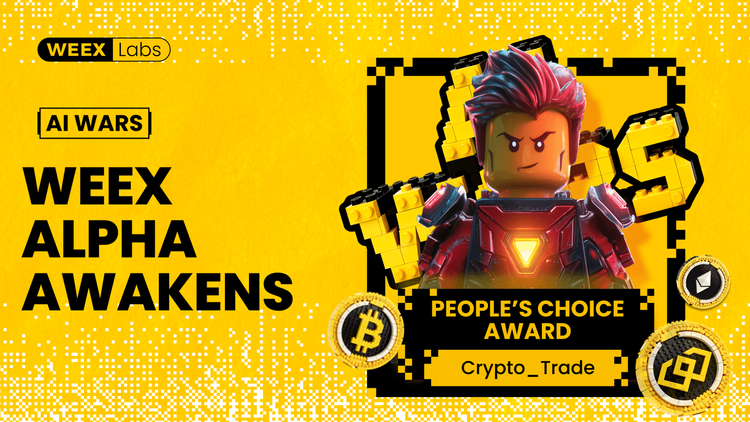
How a Structured AI Crypto Trading Bot Won at the WEEX Hackathon
Crypto_Trade shows how structured inputs and controlled adaptability can build a more stable and reliable AI crypto trading bot within the WEEX AI Trading Hackathon, highlighting a practical path toward scalable AI trading systems.
Particle Founder: The entrepreneurial insights I have gained the most from in the past year
Stop lean startup, stop lightning entrepreneurship, and think carefully about what your product aspirations are.
Huang Renxun's latest podcast transcript: The future of Nvidia, the development of embodied intelligence and agents, the explosion of inference demand, and the public relations crisis of artificial intelligence
The competition in the future is not just about whose model is larger or whose computing power is stronger, but also about who understands the industry better, who can embed AI more deeply into real processes, and who can organize these capabilities into a runnable and scalable system.
OKX Ventures Research Report: AI Agent Economic Infrastructure Research Report (Part 1)
The existing infrastructure is hostile to the Agent economy. Agents can think and act independently at the "capability level," but at the "economic level," they are still locked into infrastructure designed for humans.
The migration of settlement rights: B18 and the institutional starting point of on-chain banks
In the traditional system, banks decide the settlement; in the on-chain system, code begins to take over this responsibility.
From Tencent and Circle: Looking at the Simple and Difficult Questions of Investment
The AI narrative continues to ferment, but the recent performance of related stocks varies, with some in the midst of summer and others as if in winter.
The second half of stablecoins no longer belongs to the crypto circle
What Coinbase doesn't want, Mastercard is eager to buy.


 App
App