
 Buy Crypto
- Markets
 Futures
- Spot
- Copy Trade
- Earn
- More
Solana's "Phantom Tax"

A few years ago, an article titled "Payment for Order Flow on Solana" uncovered a dark corner of the Solana fee market, sparking a viral phenomenon on English Twitter.
PFOF (Payment for Order Flow) has long been a mature business model in traditional finance. Robinhood, through this model, played the "zero-commission trading" card, quickly breaking away from numerous old-school brokerages. This strategy not only filled Robinhood's coffers but also compelled industry giants like JPMorgan Wealth Management and E-Trade to follow suit, reshaping the landscape of the U.S. retail brokerage business.
In just 2021, Robinhood raked in nearly $1 billion in revenue through PFOF, accounting for half of its total revenue that year; even by 2025, its quarterly PFOF revenue still reaches hundreds of millions of dollars. This clearly demonstrates the massive profits behind this business model.
In the traditional market, market makers greatly favor retail orders. The reason is simple—retail orders are often viewed as "non-toxic," typically based on emotion or immediate need, without precise predictions of future price movements. Market makers take these orders, ensuring a profit from the bid-ask spread, without the worry of facing informed traders (like institutional investors) on the other side.
To meet this demand, brokerages (like Robinhood) bundle users' order flow and sell it in bulk to market-making giants like Citadel, thereby receiving substantial rebates.
In the traditional financial market, regulation to some extent protects retail investors, with the SEC's "National Market System Regulation NMS" mandating that even orders sold in bulk must receive execution no worse than the market's best price.
However, in the unregulated world of blockchain, applications are leveraging information asymmetry, enticing users to pay priority fees and tips far above the actual on-chain demand, quietly siphoning off these premiums. This behavior fundamentally represents levying an invisible "tax" on unsuspecting users.
Monetizing Traffic
For apps holding a significant user gateway, the means of monetizing traffic are far richer than you might imagine.
Front-end applications and wallets can decide where users' transactions go, how they are executed, and even how quickly they get on-chain. Every "checkpoint" in a transaction's lifecycle conceals the business of "stripping users' value to the bone."
"Selling" Users to Market Makers
Just like Robinhood, applications on Solana can also sell "access rights" to liquidity providers.
RFQ (Request for Quote) is a direct embodiment of this logic. Unlike traditional AMMs, RFQ allows users (or applications) to directly request quotes from specific liquidity providers and execute trades. On Solana, aggregators like Jupiter have already integrated this model (JupiterZ). In this system, the application side can charge a connection fee to these liquidity providers, or even more directly, sell batches of retail orders flow. As the on-chain spread continues to narrow, the author expects this "selling order flow" business to become more common.
Furthermore, there is also a forming alliance of interest between DEXes and aggregators. Prop AMMs (proprietary liquidity providers) and DEXes heavily rely on the traffic brought in by the aggregator, and the aggregator is fully capable of charging these liquidity providers and returning a portion of the profits to the front-end application as a "rebate."
For example, when the Phantom wallet routes a user's trade to Jupiter, the underlying liquidity provider (such as HumidiFi or Meteora) may pay Jupiter in order to compete for the execution of that trade. After receiving this "routing fee," Jupiter then returns a portion of it to Phantom.
While this speculation has not been publicly confirmed, the author believes that, driven by self-interest, this "profit-sharing unwritten rule" within the industry chain is almost a natural phenomenon.
Vampire Market Order
When a user clicks "confirm" and signs in the wallet, this transaction is essentially a "market order" with a slippage parameter.
For applications, there are two ways to handle this order:
Benign Route: Selling the arbitrage opportunity generated by the transaction to professional trading firms, sharing the profits. The so-called Backrun refers to when a user's buy order on DEX1 drives up the token price in DEX1, arbitrage bots then buy in DEX2 in the same block (without affecting the user's buy price on DEX1) and sell on DEX1.
Malicious Route: Assisting sandwichers (sandwich arbitrageurs) to attack their own users, driving up the user's execution price.
Even taking the benign route does not mean the application side is ethical. To maximize the value of "arbitrage tailgating," the application side has an incentive to deliberately slow down transaction on-chain speed. Driven by profit motives, the application side may also intentionally route users to pools with lower liquidity in order to artificially create greater price fluctuations and arbitrage opportunities.
According to reports, some well-known front-end applications on Solana are engaging in the above practices.
Who Took Your Tip?
If the above methods still have some technical barriers, then the clandestine operation in "transaction fees" can be considered a full-blown performance.
On Solana, the fee users pay is actually divided into two parts:
- Priority Fee: This is the protocol fee paid directly to validators.
- Transaction Tip: This is an amount of SOL sent to any address, usually paid to a "Landing Service" like Jito. The service provider then decides how much to give to the validator and how much to rebate back to the application end.
Why the need for a Landing Service? Because communication on the Solana network is highly complex during congestion, ordinary transaction broadcasts easily fail. Landing services play the role of a "VIP channel," promising users on-chain transaction success through a specially optimized pathway.
Solana's complex Builder Market and fragmented routing system have given rise to this unique role, creating excellent rent-seeking opportunities for the application end. Applications often entice users to pay high tips for a "guaranteed" transaction and then share this premium with the Landing Service provider.
Transaction Traffic and Fee Landscape
Let's look at some data. During the week of December 1-8, 2025, the entire Solana network generated 450 million transactions.
Among them, Jito's Landing Service processed 80 million transactions, dominating the market (93.5% Builder Market share). And within these transactions, the vast majority were related to swaps, oracle updates, and liquidity provider operations.
In this massive pool of traffic, users often pay high fees in pursuit of speed. But was all this money truly spent to expedite transactions?
Not necessarily. Data indicates that low-activity wallets (usually retail investors) paid exorbitantly high Priority Fees. Considering the blocks were not full at the time, these users were evidently overcharged.
Applications leverage users' fear of "transaction failure," enticing them to set extremely high tips, and then, through an agreement with the Landing Service provider, pocket this surplus income.
Anti-Pattern Axiom
To illustrate this "harvesting" pattern more intuitively, the author conducted an in-depth case study of the Axiom top app on Solana.
The transaction fees generated by Axiom lead the entire network, not only because of its large user base but also because it is the most ruthless in milking its users.
Data shows that the median (p50) priority fee paid by Axiom users is as high as 1,005,000 lamports. In comparison, high-frequency trading wallets pay only about 5,000 to 6,000 lamports. There is a 200x difference between them.
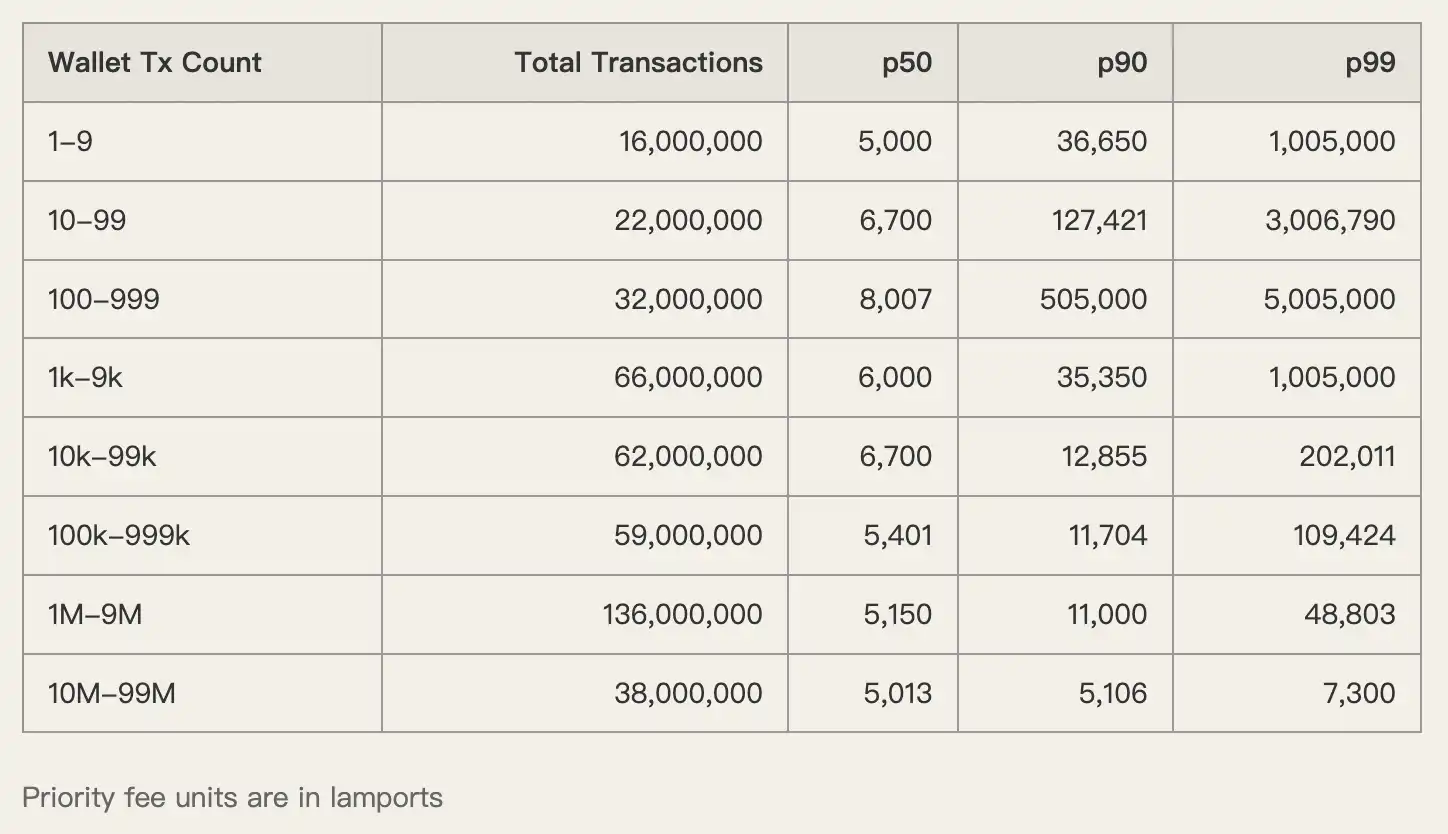
The same is true for tips.
Axiom users pay significantly higher tips on landing services such as Nozomi and Zero Slot compared to the market average. The app side cleverly exploits users' extreme sensitivity to "speed" and, without any negative feedback, achieves double charging of users.
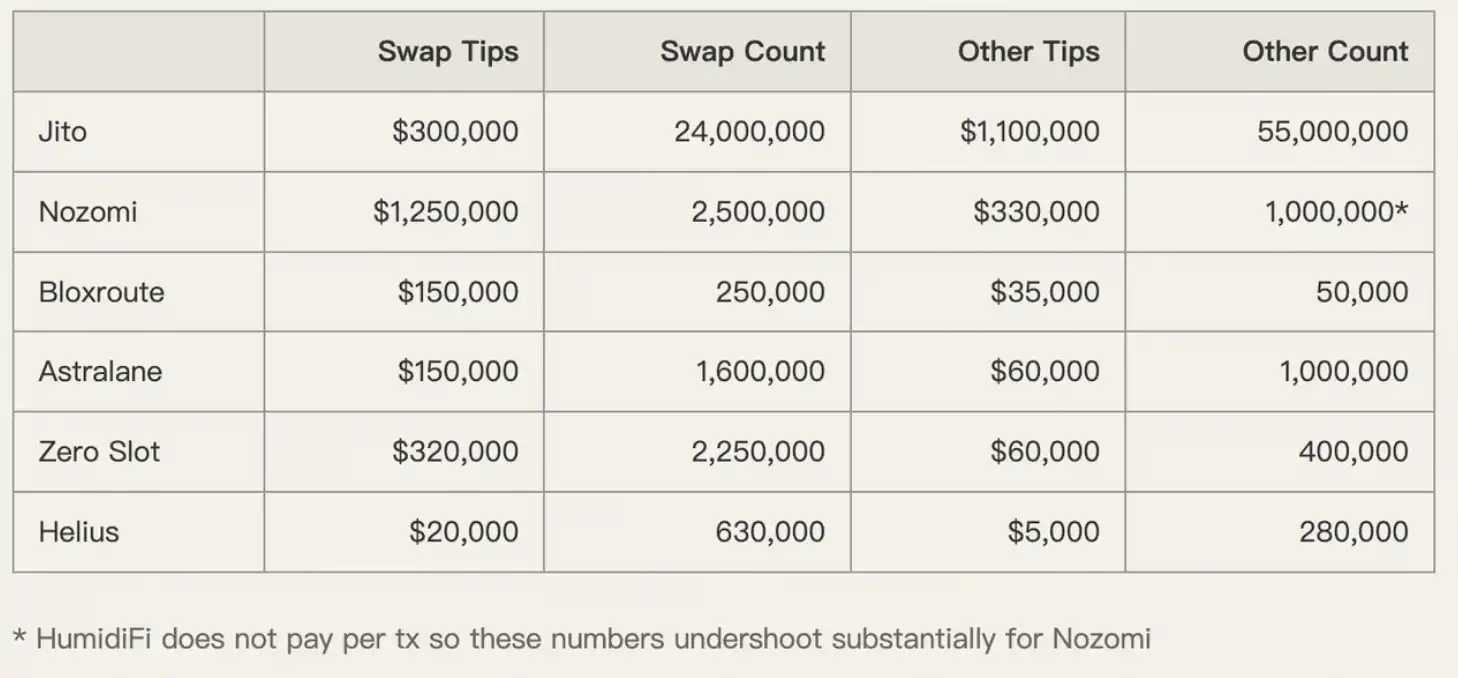
The author boldly speculates, "The vast majority of transaction fees paid by Axiom users ultimately end up back in the pockets of the Axiom team."
Reclaiming Fee Setting Power
The severe misalignment between user incentives and app incentives is the root cause of the current chaos. Users do not know what a reasonable fee is, and the app side is happy to maintain this chaos.
To break this deadlock, we need to start from the fundamental market structure. The introduction of Solana's Multiple Concurrent Proposers (MCP) and Priority Ordering around 2026, along with the widely proposed dynamic base fee mechanism, may be the key to solving the problem.
Multiple Concurrent Proposers
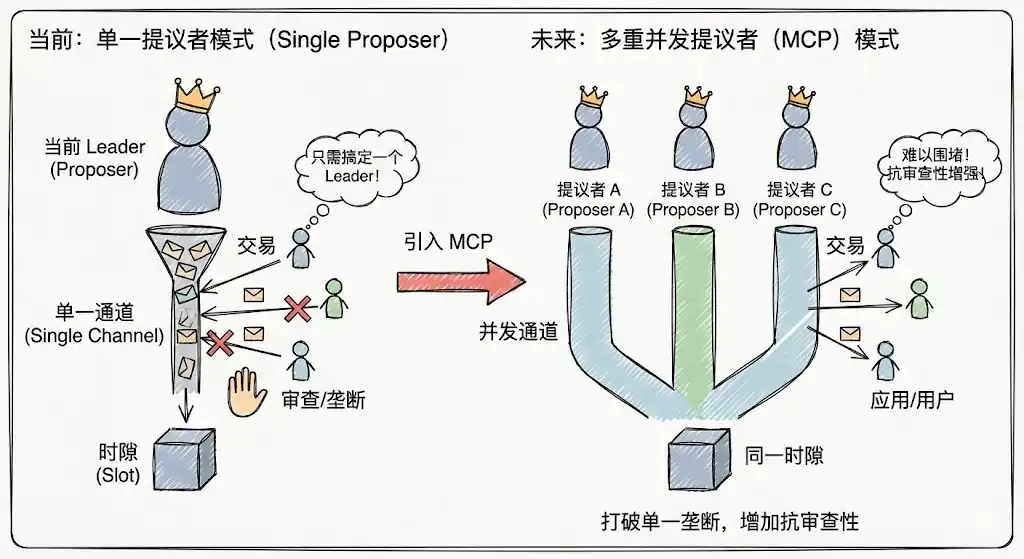
The current Solana single proposer model is prone to temporary monopolies, where the app side only needs to handle the current Leader to quickly control transaction packaging. With the introduction of MCP, multiple proposers work concurrently in each slot, significantly increasing the cost of attacks and monopolies, enhancing censorship resistance, making it difficult for the app side to block users by controlling a single node.
Priority Ordering Mechanism
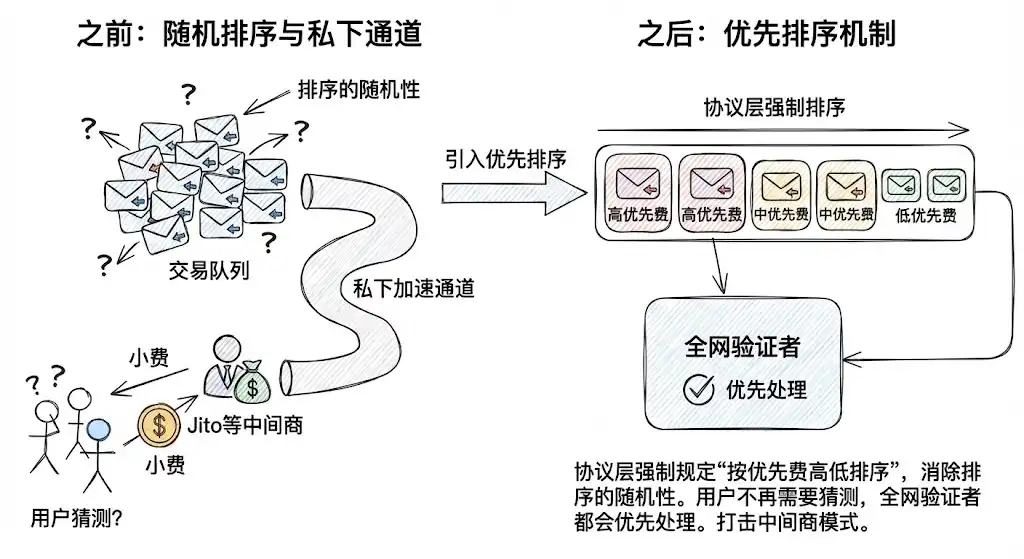
By protocol-level enforcement of "ordering by fee priority," the randomness of ordering (Jitter) is eliminated. This reduces the need for users to rely on private acceleration channels like Jito just to ensure transaction inclusion. For regular transactions, users no longer need to guess how much fee to provide. They simply send the payment within the protocol, and all network validators will prioritize transactions based on deterministic rules.
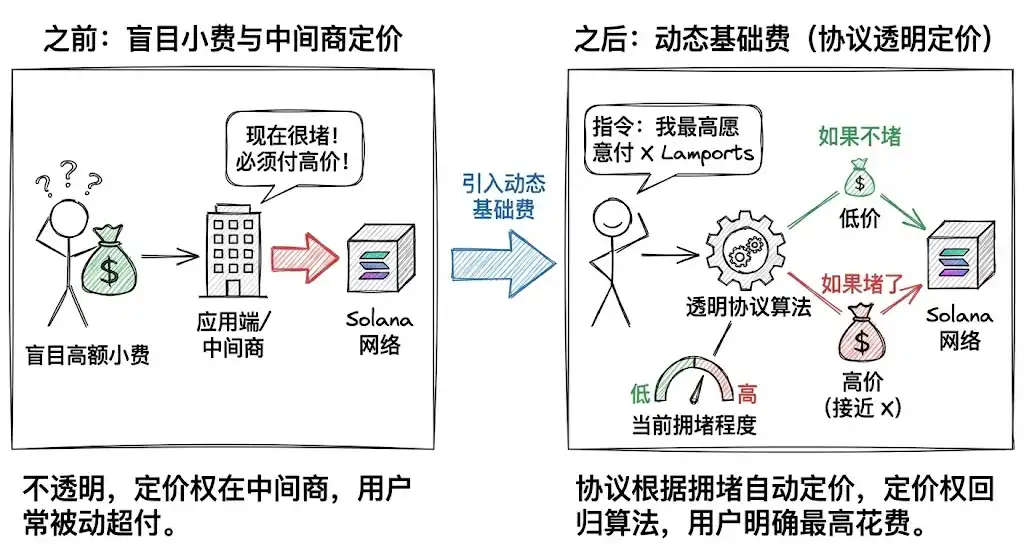
Dynamic Base Fee
This is the most critical step. Solana is attempting to introduce a concept similar to Ethereum's Dynamic Base Fee.
Users no longer blindly tip but instead explicitly instruct the protocol: "I am willing to pay up to X Lamports as the fee for this on-chain transaction."
The protocol automatically prices transactions based on the current level of congestion. If uncongested, only a low fee is charged; if congested, a higher fee is collected. This mechanism takes the pricing power away from the application side and intermediaries, returning it to a transparent protocol algorithm.
Memes have brought prosperity to Solana but have also left behind a deep-rooted problem, fostering a restless profit-seeking gene. For Solana to truly realize the vision of an ICM, it cannot allow applications controlling frontend traffic and protocols controlling infrastructure to act recklessly and selfishly.
As the saying goes, "Clean the house before inviting guests." Only by upgrading the underlying technical architecture, using technological means to eradicate rent-seeking behavior, and developing a market structure that is fair, transparent, and prioritizes user welfare, can Solana truly have the confidence to integrate and compete with the traditional financial system.
You may also like

Is XRP a Good Investment in 2026? Why Is It Stuck at $1.45
XRP is up 6.7% this week, but exchange reserves remain high. Is a volatility spike imminent? We analyze price trend, ETF inflows, whale activity, and regulatory catalysts to answer: will XRP go up, why is XRP dropping, and is XRP a good investment right now?
TL; DR
What is XRP: XRP is a digital asset built for fast, low-cost international payments. It runs on the XRP Ledger and is used by Ripple for its On-Demand Liquidity (ODL) service. Unlike Bitcoin, XRP settles transactions in 3-5 seconds with near-zero fees.Why is XRP Dropping: XRP is not actively dropping, but it is struggling to rise. On the monthly chart, XRP has seen six consecutive months of decline. Currently, the price faces an additional supply wall at $1.45. About 1.24 billion XRP were bought in that range, and those holders sell when the price approaches, creating selling pressure that prevents a recovery.Will XRP Go Up: Potentially yes. XRP is trading near $1.43 and showing its best weekly performance since September 2025. If the price breaks above the $1.45 resistance, analysts expect a move toward $1.90, supported by strong institutional demand.Is XRP a Good Investment: The answer is not simple. Short-term traders may see opportunity in the coming volatility spike. Long-term investors face a bigger question that depends on one key regulatory event. However, the data reveals a surprising signal that most retail buyers are missing right now. To understand whether XRP is a smart buy or a trap at $1.43, you will need to read the full analysis below.What is XRP? A Digital Asset for Global SettlementBefore analyzing the charts, it is crucial to understand the asset in question. What is XRP? Unlike Bitcoin, which was designed as a decentralized digital gold, XRP operates on the XRP Ledger (XRPL). It was created to facilitate fast, low-cost international payments. Traditional bank transfers take days and incur high fees. XRP transactions settle in 3-5 seconds, costing fractions of a penny.
Ripple, the company associated with XRP, uses this asset for its "On-Demand Liquidity" (ODL) service. Banks and financial institutions use ODL to source liquidity during cross-border transactions without pre-funding accounts. This utility is the primary driver for institutional interest. Recently, the network hit a milestone of over 8 million active wallets, signaling growing usage despite recent price stagnation . Furthermore, Ripple is proactively preparing for the future, releasing a four-stage roadmap to make the XRPL "quantum-resistant," aiming to secure the ledger against future quantum computing threats by 2028 .
XRP Price Analysis: The Battle for $1.45The XRP price trend over the last month tells a story of exhaustion followed by cautious recovery. On the monthly chart, XRP experienced six consecutive months of decline. However, April shows signs of a bottoming process. Weekly charts reinforce this view: after four weeks of lower closes, the last two weeks have seen small rebounds.
According to data from April 22, 2026, XRP is trading at approximately $1.44. Over the last seven days, XRP has outperformed both Bitcoin and Ethereum, rising 6.7% while the broader market rose only 3.2%. Spot trading volume surged 23% to $3.79 billion, and derivative markets saw $40 billion in futures volume on a single day.
Despite this, the price remains 60% below its July 2025 high of $3.65. The current technical picture shows a "low volatility grind" higher. The 20-day EMA is at $1.3924, and the 50-day EMA is at $1.4119, both acting as support . However, the immediate hurdle is the $1.45 resistance level. This price point has rejected every rally attempt in 2026.
Why is XRP Dropping? And Will XRP Go Up?The primary reason for the recent "drop" (or lack of upward momentum) is not active selling, but rather the "supply wall." Data indicates that roughly 1.24 billion XRP tokens were purchased by investors in the $1.45 to $1.47 range. These investors have been waiting months to "break even." Every time the price approaches $1.45, these holders sell to exit their positions, creating a massive wall that retail buying cannot easily absorb.
However, the underlying momentum is shifting. Analysts suggest a xrp volatility spike imminent because the absorption capacity of buyers is increasing. Historically, when exchange reserves are high but the price refuses to drop significantly, it signals that buyers are absorbing the supply. The price has held above $1.39 despite the overhang, which is a sign of relative strength.
So, will XRP go up? Yes, potentially. But it needs a catalyst, if the price closes a daily candle above $1.45. If that happens, the next targets are $1.60 to $1.65, and eventually $1.90 .
XRP Exchange Netflow and XRP ETF Netflow: A Tale of Two MarketsThe current market dynamic is best understood by looking at two opposing data streams: XRP Exchange netflow and XRP ETF flows.
Exchange Dynamics (Retail / Whales):
Data shows a complex pattern of "large inflows and increasing reserves." Recently, a Ripple-associated wallet moved 75 million XRP (approx. $108 million) to Coinbase. This initially looks like a dump, but context matters. These transfers are likely to provide liquidity for Ripple’s ODL business, not necessarily spot market selling. However, the result is that exchange reserves have climbed to 2.76 billion XRP .
The Good News: While reserves are high, the rate of increase is slowing. Specifically, "whale" transfers to exchanges have dropped 98% from their April 11 peak. The Binance reserve has slightly decreased from 27.7 to 27.6 billion. The aggressive selling from large holders appears to have stopped.
Institutional Dynamics (ETF):
While whales were sending coins to exchanges, institutions were buying XRP ETF products. XRP ETF net flow is strongly positive.
US-listed XRP ETFs recorded four consecutive days of inflows totaling $38.86 million recently .The weekly inflow for mid-April hit $119.6 million, a multi-month high .Cumulative net inflows stand at $12.8 billion, with Assets Under Management (AUM) at roughly $10.8 billion.Analyzing the Divergence: Why Both Flows Are PositiveIt seems contradictory that exchange reserves are high (suggesting selling) while ETFs are buying (suggesting buying). However, this phenomenon reveals the current market structure.
Different Investor Profiles: The exchange inflows likely come from short-term traders, market makers, or Ripple itself providing ODL liquidity. These are "hot" coins ready to be sold. The ETF inflows represent "sticky" capital. Institutions buying ETFs are typically long-term holders (LTHs) or asset managers who do not day-trade. They are removing liquidity from the spot market by buying through custodians.The "De-risking" Trade: Sophisticated funds might be engaging in basis trading. They buy the ETF (taking a long position) while simultaneously shorting XRP futures or selling spot inventory to capture the funding rate. This keeps the price stable while volume increases.Absorption: The most likely scenario is that the market is simply absorbing the excess supply. The fact that the price is stable ($1.43) and not collapsing to $1.20 despite 2.76 billion coins sitting on exchanges is a massive win for the bulls. The ETF inflows are acting as a sponge, soaking up the selling pressure from the ODL wallets.The Regulatory Catalyst: The SEC and the CLARITY ActFundamentally, the recent price action cannot be separated from regulation. For years, the primary answer was the SEC lawsuit. That narrative is dying.
Ripple CEO Brad Garlinghouse recently praised SEC Chair Paul Atkins as "a breath of fresh air and sanity" . This regulatory thaw is critical. The SEC is reportedly considering dropping the long-standing lawsuit, and five XRP ETF applications are awaiting review.
The major catalyst on the horizon is the CLARITY Act. A Senate markup is expected before the end of April. Standard Chartered analysts project that if the bill advances, it could unlock $4 to $8 billion in institutional flows . Polymarket gives the bill a 60-66% chance of passing in 2026. If the CLARITY Act classifies XRP as a non-security (commodity), the institutional floodgates will open, likely overwhelming the $1.45 supply wall instantly.
Is XRP a Good Investment in 2026?Given all this data, is XRP a good investment? The answer depends entirely on your risk tolerance and time horizon.
The Bull Case (Why it is a good investment): The risk/reward ratio is asymmetrical to the upside. The price is near multi-year lows relative to its utility. Whale selling has stopped, ETF demand is rising, and the network is expanding (8 million wallets, quantum resistance roadmap). If the CLARITY Act passes, XRP could realistically trade between $1.60 and $1.80 in the short term, with a potential run to $3.00+ if the lawsuit is officially dropped.The Risk Case (Why it is NOT a good investment): There is a clear resistance wall at $1.45. If the CLARITY Act fails or is delayed past May (due to midterm election dynamics), the "buy the rumor, sell the news" dynamic could reverse. If the price fails to break $1.45 and loses support at $1.33, a drop back to $1.15 is technically possible .Verdict: XRP is a speculative buy for traders looking for a volatility spike. It is a hold for current investors. For new investors, it is only a good investment if you believe in regulatory clarity within the next 30 days. Technically, waiting for a confirmed break above $1.55 (to avoid the fakeout) is safer than buying at $1.43.
FAQQ: Will XRP go up if the CLARITY Act passes?
A: Yes, historically. Analysts predict that if the CLARITY Act passes, signaling that XRP is a commodity, it would remove the regulatory overhang. This could trigger a surge in institutional buying, pushing the price from the current $1.43 range to test the $1.80 - $2.00 resistance levels quickly.
Q: Why is XRP dropping when Bitcoin is going up?
A: XRP has specific supply dynamics. Unlike Bitcoin, which has a fixed supply issuance, XRP faces periodic sell-pressure from Ripple's treasury wallets used to fund ODL (liquidity) services. Additionally, the $1.45 "break-even" wall causes XRP to drop relative to BTC when short-term traders exit.
Q: Is a volatility spike imminent for XRP?
A: Yes. The Bollinger Bands on the daily chart are squeezing. The price is stuck between support at $1.33 and resistance at $1.45. Historically, when XRP volume surges 23% in a week (as it did on April 21), it precedes a violent move. The direction depends on whether the $1.45 resistance breaks.
Q: What is the XRP ETF netflow status?
A: As of late April 2026, XRP ETFs are seeing positive netflows. The US ETFs recorded a single week inflow of $119.6 million in mid-April. Cumulative inflows are strong at $12.8 billion, indicating that institutions are accumulating during this dip, which is a long-term bullish signal for price stabilization.
Q: Is XRP a good investment for beginners?
A: XRP is less volatile than "meme coins" but more volatile than Bitcoin. For beginners, it is a moderate-risk investment. Its value is tied to real utility (bank payments). However, beginners should wait to see if the price can close a weekly candle above $1.55 before entering, to avoid buying into the current resistance wall.
Disclaimer: None of the information in this article constitutes, or is intended to constitute, investment advice. Trading cryptocurrencies carries a high level of risk and may not be suitable for all investors. Always do your own research.
About WEEXFounded in 2018, WEEX has developed into a global crypto exchange with over 6.2 million users across more than 150 countries. The platform emphasizes security, liquidity, and usability, providing over 1,200 spot trading pairs and offering up to 400x leverage in crypto futures trading. In addition to the traditional spot and derivatives markets, WEEX is expanding rapidly in the AI era — delivering real-time AI news, empowering users with AI trading tools, and exploring innovative trade-to-earn models that make intelligent trading more accessible to everyone. Its 1,000 BTC Protection Fund further strengthens asset safety and transparency, while features such as copy trading and advanced trading tools allow users to follow professional traders and experience a more efficient, intelligent trading journey.
Follow WEEX on social mediaX: @WEEX_Official
Instagram: @WEEX Exchange
Tiktok: @weex_global
Youtube: @WEEX_Official
Discord: WEEX Community
Telegram: WeexGlobal Group

FC Barcelona vs Celta Vigo: Can Anyone Stop Barcelona at Home?
FC Barcelona vs Celta Vigo lineups, standings, and stats for April 22, 2026. FC Barcelona need a win to stay on track for the La Liga title. Full preview inside.

Carl Moon & WEEX Head to Mugello: The Crypto Trader's Ferrari Challenge
Forget the sidelines. WEEX is hitting the 300km/h mark at Mugello this weekend. Witness Carl Moon’s transformation from a supermarket cashier to a Ferrari racer, and discover why the world’s fastest trading floor belongs on the world’s most technical track at the official Ferrari Challenge.

How to Become a Pro Crypto Trader: WEEX Interview with Ferrari Racer Carl Moon
Ferrari racer Carl Moon on mastering crypto trading: 80/20 rule, AI tools, Bitcoin at $95K, and risk lessons from the track.

Morning Report | Amazon increases investment in Anthropic up to $25 billion; SEC plans to introduce an "innovation exemption" mechanism to support compliant on-chain trading of tokenized securities

Jeff Hoffman, founder of Booking.com: How Web3 and AI are reshaping the trillion-dollar social travel market

Top 12 Cryptocurrencies to Invest in April 2026
Key Takeaways: Bitcoin remains the dominant player with a $1.42 trillion market cap. Hyperliquid’s HYPE token gains traction,…
18 Best Crypto & Bitcoin Casinos in March 2026
Key Takeaways: Cryptocurrencies offer faster, cheaper, and more private payment options in online casinos. Top crypto casinos include…

Full Post-Mortem of the KelpDAO Incident: Why Did Aave, Which Was Not Compromised, End Up in Crisis Situation?
Key Takeaways: The KelpDAO incident exposed vulnerabilities in collateral pricing and cross-chain bridge operations, affecting Aave’s liquidity. rsETH…

Is MicroStrategy’s STRC Bitcoin’s Savior or Destroyer?
Key Takeaways: MicroStrategy’s STRC offers an annualized yield of 11.5%, driving significant Bitcoin buying pressure. Michael Saylor’s financial…

Ceasefire Expiration and Market Response: Bitcoin Defies Market Trends
Key Takeaways: The current ceasefire agreement is anticipated to expire on Wednesday in Washington, with low likelihood of…

Oil Price Dilemma: More Than a Price Hike
Key Takeaways: Global oil market has surpassed its breaking point, not solving with price hikes but facing significant…

On the Day Aave Launched rsETH, Spark Strategically Exited
Key Takeaways: Aave enabled rsETH lending at a 93% LTV, while Spark withdrew due to low utilization by…

Nasdaq Breaks Record and Crypto Transactions Surge
Key Takeaways: Nasdaq’s rise to a new intraday high indicates strong market momentum. A significant transfer of 35,000…

Powell: Fed Requires a Brand New Inflation Blueprint
Key Takeaways: Powell aims for transformative policy overhauls within the Fed if appointed. Past inflation response mistakes during…

Without Cook’s Apple, Can it Still Grow in the AI Era?
Key Takeaways: John Ternus acts more like a systematic integrator within Apple rather than a solo visionary. Apple’s…

Iran Stock Market and Crypto Developments in Focus
Key Takeaways: The Iranian stock market is set to reopen in 10 to 12 days, excluding companies impacted…
ZachXBT vs. RAVE: Seeking the Truth Behind Crypto Market Volatility
Key Takeaways: In April 2026, RAVE surged by 4500%, later collapsing 90% after investigations by ZachXBT, Binance, and…
Is XRP a Good Investment in 2026? Why Is It Stuck at $1.45
XRP is up 6.7% this week, but exchange reserves remain high. Is a volatility spike imminent? We analyze price trend, ETF inflows, whale activity, and regulatory catalysts to answer: will XRP go up, why is XRP dropping, and is XRP a good investment right now?
TL; DR
What is XRP: XRP is a digital asset built for fast, low-cost international payments. It runs on the XRP Ledger and is used by Ripple for its On-Demand Liquidity (ODL) service. Unlike Bitcoin, XRP settles transactions in 3-5 seconds with near-zero fees.Why is XRP Dropping: XRP is not actively dropping, but it is struggling to rise. On the monthly chart, XRP has seen six consecutive months of decline. Currently, the price faces an additional supply wall at $1.45. About 1.24 billion XRP were bought in that range, and those holders sell when the price approaches, creating selling pressure that prevents a recovery.Will XRP Go Up: Potentially yes. XRP is trading near $1.43 and showing its best weekly performance since September 2025. If the price breaks above the $1.45 resistance, analysts expect a move toward $1.90, supported by strong institutional demand.Is XRP a Good Investment: The answer is not simple. Short-term traders may see opportunity in the coming volatility spike. Long-term investors face a bigger question that depends on one key regulatory event. However, the data reveals a surprising signal that most retail buyers are missing right now. To understand whether XRP is a smart buy or a trap at $1.43, you will need to read the full analysis below.What is XRP? A Digital Asset for Global SettlementBefore analyzing the charts, it is crucial to understand the asset in question. What is XRP? Unlike Bitcoin, which was designed as a decentralized digital gold, XRP operates on the XRP Ledger (XRPL). It was created to facilitate fast, low-cost international payments. Traditional bank transfers take days and incur high fees. XRP transactions settle in 3-5 seconds, costing fractions of a penny.
Ripple, the company associated with XRP, uses this asset for its "On-Demand Liquidity" (ODL) service. Banks and financial institutions use ODL to source liquidity during cross-border transactions without pre-funding accounts. This utility is the primary driver for institutional interest. Recently, the network hit a milestone of over 8 million active wallets, signaling growing usage despite recent price stagnation . Furthermore, Ripple is proactively preparing for the future, releasing a four-stage roadmap to make the XRPL "quantum-resistant," aiming to secure the ledger against future quantum computing threats by 2028 .
XRP Price Analysis: The Battle for $1.45The XRP price trend over the last month tells a story of exhaustion followed by cautious recovery. On the monthly chart, XRP experienced six consecutive months of decline. However, April shows signs of a bottoming process. Weekly charts reinforce this view: after four weeks of lower closes, the last two weeks have seen small rebounds.
According to data from April 22, 2026, XRP is trading at approximately $1.44. Over the last seven days, XRP has outperformed both Bitcoin and Ethereum, rising 6.7% while the broader market rose only 3.2%. Spot trading volume surged 23% to $3.79 billion, and derivative markets saw $40 billion in futures volume on a single day.
Despite this, the price remains 60% below its July 2025 high of $3.65. The current technical picture shows a "low volatility grind" higher. The 20-day EMA is at $1.3924, and the 50-day EMA is at $1.4119, both acting as support . However, the immediate hurdle is the $1.45 resistance level. This price point has rejected every rally attempt in 2026.
Why is XRP Dropping? And Will XRP Go Up?The primary reason for the recent "drop" (or lack of upward momentum) is not active selling, but rather the "supply wall." Data indicates that roughly 1.24 billion XRP tokens were purchased by investors in the $1.45 to $1.47 range. These investors have been waiting months to "break even." Every time the price approaches $1.45, these holders sell to exit their positions, creating a massive wall that retail buying cannot easily absorb.
However, the underlying momentum is shifting. Analysts suggest a xrp volatility spike imminent because the absorption capacity of buyers is increasing. Historically, when exchange reserves are high but the price refuses to drop significantly, it signals that buyers are absorbing the supply. The price has held above $1.39 despite the overhang, which is a sign of relative strength.
So, will XRP go up? Yes, potentially. But it needs a catalyst, if the price closes a daily candle above $1.45. If that happens, the next targets are $1.60 to $1.65, and eventually $1.90 .
XRP Exchange Netflow and XRP ETF Netflow: A Tale of Two MarketsThe current market dynamic is best understood by looking at two opposing data streams: XRP Exchange netflow and XRP ETF flows.
Exchange Dynamics (Retail / Whales):
Data shows a complex pattern of "large inflows and increasing reserves." Recently, a Ripple-associated wallet moved 75 million XRP (approx. $108 million) to Coinbase. This initially looks like a dump, but context matters. These transfers are likely to provide liquidity for Ripple’s ODL business, not necessarily spot market selling. However, the result is that exchange reserves have climbed to 2.76 billion XRP .
The Good News: While reserves are high, the rate of increase is slowing. Specifically, "whale" transfers to exchanges have dropped 98% from their April 11 peak. The Binance reserve has slightly decreased from 27.7 to 27.6 billion. The aggressive selling from large holders appears to have stopped.
Institutional Dynamics (ETF):
While whales were sending coins to exchanges, institutions were buying XRP ETF products. XRP ETF net flow is strongly positive.
US-listed XRP ETFs recorded four consecutive days of inflows totaling $38.86 million recently .The weekly inflow for mid-April hit $119.6 million, a multi-month high .Cumulative net inflows stand at $12.8 billion, with Assets Under Management (AUM) at roughly $10.8 billion.Analyzing the Divergence: Why Both Flows Are PositiveIt seems contradictory that exchange reserves are high (suggesting selling) while ETFs are buying (suggesting buying). However, this phenomenon reveals the current market structure.
Different Investor Profiles: The exchange inflows likely come from short-term traders, market makers, or Ripple itself providing ODL liquidity. These are "hot" coins ready to be sold. The ETF inflows represent "sticky" capital. Institutions buying ETFs are typically long-term holders (LTHs) or asset managers who do not day-trade. They are removing liquidity from the spot market by buying through custodians.The "De-risking" Trade: Sophisticated funds might be engaging in basis trading. They buy the ETF (taking a long position) while simultaneously shorting XRP futures or selling spot inventory to capture the funding rate. This keeps the price stable while volume increases.Absorption: The most likely scenario is that the market is simply absorbing the excess supply. The fact that the price is stable ($1.43) and not collapsing to $1.20 despite 2.76 billion coins sitting on exchanges is a massive win for the bulls. The ETF inflows are acting as a sponge, soaking up the selling pressure from the ODL wallets.The Regulatory Catalyst: The SEC and the CLARITY ActFundamentally, the recent price action cannot be separated from regulation. For years, the primary answer was the SEC lawsuit. That narrative is dying.
Ripple CEO Brad Garlinghouse recently praised SEC Chair Paul Atkins as "a breath of fresh air and sanity" . This regulatory thaw is critical. The SEC is reportedly considering dropping the long-standing lawsuit, and five XRP ETF applications are awaiting review.
The major catalyst on the horizon is the CLARITY Act. A Senate markup is expected before the end of April. Standard Chartered analysts project that if the bill advances, it could unlock $4 to $8 billion in institutional flows . Polymarket gives the bill a 60-66% chance of passing in 2026. If the CLARITY Act classifies XRP as a non-security (commodity), the institutional floodgates will open, likely overwhelming the $1.45 supply wall instantly.
Is XRP a Good Investment in 2026?Given all this data, is XRP a good investment? The answer depends entirely on your risk tolerance and time horizon.
The Bull Case (Why it is a good investment): The risk/reward ratio is asymmetrical to the upside. The price is near multi-year lows relative to its utility. Whale selling has stopped, ETF demand is rising, and the network is expanding (8 million wallets, quantum resistance roadmap). If the CLARITY Act passes, XRP could realistically trade between $1.60 and $1.80 in the short term, with a potential run to $3.00+ if the lawsuit is officially dropped.The Risk Case (Why it is NOT a good investment): There is a clear resistance wall at $1.45. If the CLARITY Act fails or is delayed past May (due to midterm election dynamics), the "buy the rumor, sell the news" dynamic could reverse. If the price fails to break $1.45 and loses support at $1.33, a drop back to $1.15 is technically possible .Verdict: XRP is a speculative buy for traders looking for a volatility spike. It is a hold for current investors. For new investors, it is only a good investment if you believe in regulatory clarity within the next 30 days. Technically, waiting for a confirmed break above $1.55 (to avoid the fakeout) is safer than buying at $1.43.
FAQQ: Will XRP go up if the CLARITY Act passes?
A: Yes, historically. Analysts predict that if the CLARITY Act passes, signaling that XRP is a commodity, it would remove the regulatory overhang. This could trigger a surge in institutional buying, pushing the price from the current $1.43 range to test the $1.80 - $2.00 resistance levels quickly.
Q: Why is XRP dropping when Bitcoin is going up?
A: XRP has specific supply dynamics. Unlike Bitcoin, which has a fixed supply issuance, XRP faces periodic sell-pressure from Ripple's treasury wallets used to fund ODL (liquidity) services. Additionally, the $1.45 "break-even" wall causes XRP to drop relative to BTC when short-term traders exit.
Q: Is a volatility spike imminent for XRP?
A: Yes. The Bollinger Bands on the daily chart are squeezing. The price is stuck between support at $1.33 and resistance at $1.45. Historically, when XRP volume surges 23% in a week (as it did on April 21), it precedes a violent move. The direction depends on whether the $1.45 resistance breaks.
Q: What is the XRP ETF netflow status?
A: As of late April 2026, XRP ETFs are seeing positive netflows. The US ETFs recorded a single week inflow of $119.6 million in mid-April. Cumulative inflows are strong at $12.8 billion, indicating that institutions are accumulating during this dip, which is a long-term bullish signal for price stabilization.
Q: Is XRP a good investment for beginners?
A: XRP is less volatile than "meme coins" but more volatile than Bitcoin. For beginners, it is a moderate-risk investment. Its value is tied to real utility (bank payments). However, beginners should wait to see if the price can close a weekly candle above $1.55 before entering, to avoid buying into the current resistance wall.
Disclaimer: None of the information in this article constitutes, or is intended to constitute, investment advice. Trading cryptocurrencies carries a high level of risk and may not be suitable for all investors. Always do your own research.
About WEEXFounded in 2018, WEEX has developed into a global crypto exchange with over 6.2 million users across more than 150 countries. The platform emphasizes security, liquidity, and usability, providing over 1,200 spot trading pairs and offering up to 400x leverage in crypto futures trading. In addition to the traditional spot and derivatives markets, WEEX is expanding rapidly in the AI era — delivering real-time AI news, empowering users with AI trading tools, and exploring innovative trade-to-earn models that make intelligent trading more accessible to everyone. Its 1,000 BTC Protection Fund further strengthens asset safety and transparency, while features such as copy trading and advanced trading tools allow users to follow professional traders and experience a more efficient, intelligent trading journey.
Follow WEEX on social mediaX: @WEEX_Official
Instagram: @WEEX Exchange
Tiktok: @weex_global
Youtube: @WEEX_Official
Discord: WEEX Community
Telegram: WeexGlobal Group
FC Barcelona vs Celta Vigo: Can Anyone Stop Barcelona at Home?
FC Barcelona vs Celta Vigo lineups, standings, and stats for April 22, 2026. FC Barcelona need a win to stay on track for the La Liga title. Full preview inside.
Carl Moon & WEEX Head to Mugello: The Crypto Trader's Ferrari Challenge
Forget the sidelines. WEEX is hitting the 300km/h mark at Mugello this weekend. Witness Carl Moon’s transformation from a supermarket cashier to a Ferrari racer, and discover why the world’s fastest trading floor belongs on the world’s most technical track at the official Ferrari Challenge.
How to Become a Pro Crypto Trader: WEEX Interview with Ferrari Racer Carl Moon
Ferrari racer Carl Moon on mastering crypto trading: 80/20 rule, AI tools, Bitcoin at $95K, and risk lessons from the track.


 App
App