
- Buy Crypto
- Markets
 Futures
- Spot
- Copy Trade
 Earn
Earn- More
The Evolution of Funding Rates: From the Golden Age of 2021 to the Arbitrage Renaissance of 2024-2025

Abstract
This paper explores the development and importance of funding rates in the cryptocurrency derivatives market, focusing on the origins of funding rates, their operating mechanisms, and the arbitrage strategies they inspire. The paper reviews the "golden age" of funding rate arbitrage in the spring of 2021 and its decline due to market adjustments; it also analyzes the resurgence of funding rate arbitrage opportunities in 2024-2025 with the emergence of innovative stablecoins such as USDe and USDX. In addition, this paper explores the key role of the Chicago Mercantile Exchange (CME) in funding rate pricing, revealing the intersection between traditional finance (TradFi) and decentralized finance (DeFi). Finally, the paper proposes that the dynamics of funding rates are more determined by institutional investors and CME than by emerging stablecoins, calling for a re-examination of the narrative logic of the crypto ecosystem.
Origins of Funding Rates
The origins of funding rates are in the cryptocurrency derivatives market, and in particular, they have evolved from perpetual futures contracts. It acts as a mechanism to keep the price of a perpetual futures contract close to the spot price of the underlying asset. The concept was developed to address issues inherent in traditional futures contracts such as expiration and settlement, which can lead to divergences between the futures price and the spot price.
Key Background on Funding Rates:
· Introduced by Crypto Exchanges: Funding rates became widely recognized and used with the rise of cryptocurrency exchanges like @BitMEX (founded by @CryptoHayes in 2016). BitMEX popularized the perpetual futures contract, a derivative with no expiration date, allowing traders to hold positions indefinitely. To ensure that the contract price remains close to the spot price, funding rates were introduced.
· Mechanism:The funding rate is a fee paid (or received) periodically between longs (buyers) and shorts (sellers) in the market. It is determined by the difference between the perpetual futures contract price and the spot price of the underlying asset. If the perpetual contract price is above the spot price (indicating a bullish market), longs pay shorts; if the price is below the spot price (indicating a bearish market), shorts pay longs.
· Purpose:The funding rate incentivizes traders to take positions that help align the perpetual futures price with the spot price. This reduces the potential for large discrepancies and keeps the market efficient.
· Calculation:The calculation of the funding rate is based on two main components: an interest rate (usually negligible) and a premium index (the difference between the futures price and the spot price). The specific formula may vary between different exchanges.
· Evolution:The funding rate has become a standard feature on major cryptocurrency exchanges, including Binance, OKX, Bybit, Deribit Exchange, and others. It has impacted traditional financial derivatives by introducing innovative approaches to managing price tracking and trader behavior.
The funding rate plays a key role in ensuring the stability and efficiency of the cryptocurrency perpetual futures market, keeping it closely aligned with the underlying spot market.
What is Funding Rate Arbitrage?
Funding Rate Arbitrage is a trading strategy where traders exploit the difference between the funding rate of a perpetual futures contract and the spot price of the underlying asset. The goal is to profit from regular funding payments between long and short positions.
Key Elements:
· Long Spot + Short Perpetual Futures:Traders buy a cryptocurrency (e.g. Bitcoin) on the spot market and simultaneously take a short position on a perpetual futures contract for the same cryptocurrency. This creates a hedged position where the trader is not exposed to asset price fluctuations.
· Profit from High Funding Rates:When funding rates are high (bullish market), traders with short positions receive funding payments from traders with long positions.
Spring 2021 - The Golden Age of Arbitrage
The spring of 2021 is often referred to as the “Golden Age of Funding Rate Arbitrage” for the cryptocurrency market, as funding rates were unusually high at the time, creating opportunities for traders to earn profits using arbitrage strategies. Explaining why this period stands out and how funding rate arbitrage works: · Explosive Market Growth The cryptocurrency market experienced unprecedented growth in early 2021, driven by: 1. Institutional adoption of Bitcoin and other cryptocurrencies (e.g. Tesla, MicroStrategy). 2. The boom in DeFi and the increase in retail participation.
3. Bullish sentiment driving Bitcoin and Ethereum to new peaks.
This has led to a persistent premium on perpetual futures contracts as bullish traders dominate the market.
· Abnormally high funding rates
With long positions greatly outweighing short positions, funding rates have surged to all-time highs. For example:
On exchanges like Binance and Bybit, Bitcoin perpetual funding rates have regularly exceeded 0.1% to 0.3% every 8 hours.
On an annualized basis, this equates to returns of 36% to 108%, far exceeding traditional fixed income investments.
· Arbitrage-friendly market conditions
Market inefficiencies:The large premium on perpetual futures prices creates consistent funding payments.High liquidity:Major exchanges have abundant liquidity, allowing traders to efficiently execute arbitrage strategies.Low counterparty risk:The introduction of insured custody solutions and exchange-provided wallets reduces the risk of holding large amounts of cryptocurrencies for arbitrage.
How traders can take advantage of this opportunity
· Hedging via spot or traditional futures:Traders collect funding payments by taking long positions in the spot market and short positions on perpetual futures contracts without taking on price risk.
· Institutional players enter arbitrage:Hedge funds, proprietary trading firms, and savvy individual investors actively enter the funding rate arbitrage space, deploying large amounts of capital to lock in stable profits.
· Annualized Returns:In some cases, annualized returns exceed 100%, making funding rate arbitrage one of the most attractive risk-free strategies in the crypto markets.
Boom followed by bust
By mid-2021, funding rates normalized as:
· The market experienced a correction after Bitcoin reached $64,000 in April 2021, followed by a sharp drop in May.
· Increased arbitrage competition reduced profitability.
· The emergence of more efficient market participants (e.g., automated market makers, quantitative funds) began to stabilize funding rates.
The Legacy of Spring 2021: Scaling
The Golden Age of Funding Rate Arbitrage in the Spring of 2021 left an indelible mark on the crypto ecosystem, demonstrating both the potential and fragility of exponential market growth. While this period highlighted lucrative opportunities amid bullish market conditions, it also laid the foundation for significant systemic risks that would unfold in the following years.
Opportunities and Market Growth
· Highlighting Funding Rate Dynamics:The high funding rates during this period highlighted the unique role of perpetual futures contracts as a speculative and price discovery tool in crypto markets. Traders and fund managers took advantage of arbitrage opportunities created by the divergence between spot and perpetual prices driven by bullish sentiment.
· The Rise of Institutional Participation:Arbitrage-friendly conditions attracted institutional players and sophisticated fund managers, who began deploying significant amounts of capital in crypto markets. This influx of institutional interest has boosted the legitimacy of cryptocurrencies as an asset class and accelerated innovation in financial products.
· USDT Circulating Supply Surges:One of the most notable results of the period was the dramatic increase in the circulating supply of the key stablecoin, @Tether_to Tether (USDT). From early to mid-2021, USDT supply surged from $4 billion to over $60 billion, reflecting a massive influx of fiat capital into crypto markets. This facilitated trading, arbitrage, and liquidity provision across exchanges.
Chain of Events Post-2021
While the spring of 2021 was filled with optimism, its legacy also includes exposing vulnerabilities that led to a series of catastrophic events:
· Inflows intoAnchor Protocol (Terra/Luna founded byDo Kwon):As fund managers sought higher yields, a significant portion of capital flowed into high-yield platforms like Anchor Protocol, the flagship DeFi project on the Terra blockchain. Anchor attracted capital through Terra’s UST algorithmic stablecoin system, offering unsustainably high APYs (up to 20%). This created a fragile structure that required new capital inflows to maintain yields.
· May 2022 Crypto Market Crash:Terra’s collapse in May 2022 marked one of the largest financial collapses in crypto history. When Anchor Protocol was unable to maintain its gains, UST’s decoupling triggered a death spiral for LUNA, causing over $50 billion in market value to evaporate, wiping out a large portion of the cryptocurrency’s supply.
· Impact on FTX and Alameda (founded by SBF):FTX/Alameda, as important players in the crypto ecosystem, became significant victims of Terra’s collapse. Alameda’s exposure to Terra and role in providing “exit liquidity” for Terra/Luna losses resulted in billions of dollars in losses. This set the stage for FTX’s collapse in November 2022, exposing a house of cards built on opaque trading practices and fund management missteps.
· Impact on Crypto Lenders:Terra’s collapse has far-reaching implications for crypto lenders and hedge funds:
Three Arrows Capital (3AC) (founded by Su Zhu), Genesis (founded by Barry), BlockFi (founded by Zac Prince), Celsius (founded by Alex Mashinsky), and Babel Finance (founded by Flex Yang, who, it’s worth highlighting, retired from Babel Finance in November 2021, returned to restructure the company after the crash, and achieved the only successful restructuring case in 2022) all had significant exposure to Terra and the broader market downside.
The failure of these entities created a ripple effect, further eroding market confidence and draining liquidity.
Key Lessons Learned from the Legacy
· Stablecoins and Liquidity Risk:The rapid growth of stablecoins like USDT in 2021 highlights their critical role in providing liquidity. However, over-reliance on algorithmic stablecoins like UST has exposed systemic vulnerabilities without proper risk management.
· Sustainability of DeFi Yields:Projects like Anchor show the dangers of unsustainable yield promises, especially when those promises are backed by circular economy models or insufficient reserves.
· The interconnectedness of the crypto ecosystem:The 2022 crash revealed the deep interconnectedness of crypto companies, with failures in one link (such as Terra/Luna) rippled through lending, trading, and investment platforms.
· The importance of risk management:These events highlight the need for improved risk management and transparency across crypto companies, including better regulation of stablecoins, lending practices, and centralized exchanges.
Reflections on the 2021 Golden Age
The “Golden Age” of spring 2021 not only symbolized the peak of speculative frenzy and financial innovation in the crypto market, but also sowed the seeds of a series of subsequent failures. The surge in capital inflows, exemplified by the surge in USDT supply, fueled market growth while also creating systemic risks that later shook the entire ecosystem. These events highlight the need for sustainable growth, robust risk management, and more oversight as the cryptocurrency industry matures.
**2024-2025: The Renaissance of Funding Arbitrage with USDe and USDX
Between 2024 and 2025, funding arbitrage sees a renaissance, fueled by the rise of innovative stablecoins like USDe by Ethena (founded by Guy) and USDX by Stables Labs (founded by Flex Yang). These next-generation stablecoins aim to address systemic weaknesses exposed by the collapse of algorithmic stablecoins like UST and create new opportunities for traders and institutions in the funding arbitrage space.
Key Drivers of the Renaissance
The Evolution of Stablecoins
USDe (Ethena):
USDe introduces a novel model that combines on-chain collateral and sophisticated risk management tools to ensure stability.
It is designed to provide the resilience of fiat-backed stablecoins like USDT while leveraging on-chain transparency and decentralization.
USDX (Stables Labs):
USDX uses a similar mechanism, but with a multi-currency strategy behind it. This strategy offers higher risk-adjusted returns than USDe and avoids negative funding rates.
Its dynamic stabilization mechanism mitigates the risk of cascading failures and provides a reliable medium for arbitrage strategies. These stablecoins are designed to maintain a consistent peg to the USD while offering competitive yields, making them ideal for funding rate arbitrage.
Market Maturity and Efficiency
Infrastructure Improvements:
Decentralized exchanges (DEXs) and derivatives protocols have made significant progress, providing higher liquidity, lower slippage, and better transparency compared to previous cycles.
Regulatory Clarity:
After the 2022 crash, the regulatory framework for stablecoins and derivatives markets has become clearer, restoring trust in the ecosystem and attracting institutional investors to re-engage in arbitrage strategies.
High Funding Rate Cycle
Rekindled interest in cryptocurrencies as an asset class has led to a resurgence in bullish sentiment, driving higher funding rates in the perpetual futures market.
The introduction of tokenized real-world assets (RWAs), including tokenized stocks, bonds, and commodities, expands the perpetual futures market beyond traditional crypto assets, creating arbitrage opportunities across multiple asset classes.
Institutional Participation
Hedge funds, proprietary trading firms, and other institutional participants have embraced funding rate arbitrage as a low-risk, high-yield strategy in the crypto derivatives market.
The support of sophisticated stablecoins like USDe and USDX provides reliable liquidity and stability for arbitrage trading.
Mechanics of the New Arbitrage Revival
Classic Arbitrage: Hold Spot, Sell Perpetual Contracts
Traders use USDe and USDX to execute hedging positions:
Hold Spot: Buy the underlying cryptocurrency (such as BTC or ETH).
Sell Perpetual Contracts: Sell a perpetual futures contract for the same cryptocurrency.
In bullish cycles, high funding rates in perpetual markets allow traders to profit from funding payments without taking on the risk of price volatility.
Enhanced Yields through Stablecoin Integration
Yield Enhancement: USDe and USDX offer integrated staking or yield generation mechanisms that allow traders to earn additional interest on their stablecoin holdings while engaging in arbitrage.
Capital Efficiency: These stablecoins are optimized for DeFi protocols, allowing traders to maximize leverage while maintaining lower risk levels.
Cross-Asset Arbitrage
Going beyond crypto, traders can now arbitrage between tokenized real-world assets and their traditional counterparts, using stablecoins as a bridge to liquidity.
Economic Impact
Rebuilding Trust in Stablecoins
The success of USDe and USDX highlights the crypto industry’s ability to learn from past failures and design resilient financial instruments.
This restored trust in stablecoins has attracted a large influx of fiat currencies, boosting liquidity across the crypto market.
Expansion of Arbitrage Opportunities
The rise of a diverse derivatives market, including RWAs, has greatly expanded funding rate arbitrage opportunities.
Arbitrage strategies now provide price stability for a wider range of assets.
Institutionalization of Crypto Arbitrage
Funding rate arbitrage has become a core strategy for hedge funds and asset managers, bridging traditional finance with crypto markets.
The entry of institutional capital has accelerated the growth and professionalization of the crypto derivatives ecosystem.
Stabilization of Cryptocurrency Supply
Unlike the uncontrolled expansion of UST in 2021, the supply growth of USDe and USDX is carefully managed to prevent hyperinflationary dynamics.
This controlled growth ensures a more sustainable arbitrage ecosystem.
Risks and Challenges
Over-reliance on stablecoins
While USDe and USDX provide innovative mechanisms, systemic risks may arise if their models come under pressure under extreme market conditions or regulatory changes.
Competition and Liquidity Fragmentation
The proliferation of stablecoins and derivatives protocols may lead to liquidity fragmentation, making it more difficult to execute arbitrage efficiently.
Market Saturation
As more participants enter the funding rate arbitrage space, returns may decrease due to increased competition, similar to the situation after 2021.
Regulatory Hurdles
As tokenized real-world assets and stablecoins increasingly merge with traditional markets, they may attract greater regulatory scrutiny, potentially impacting arbitrage strategies.
The rapid decline in funding rates is not due to USDe or USDX, but rather to the large positions of TradFi hedge funds on CME after IBIT’s listing
The pricing of funding rates in the cryptocurrency market is influenced by CME Group (Chicago Mercantile Exchange), reflecting the growing interaction between traditional finance (TradFi) and decentralized finance (DeFi) markets.
How CME Influences Funding Rates
CME as a Pricing Benchmark:
CME’s Bitcoin and Ethereum futures contracts are regulated and traded in traditional financial markets. These contracts are often used by institutional investors as a benchmark for pricing derivatives, including perpetual futures contracts in crypto-native markets.
Since CME futures reflect institutional sentiment and are traded in USD, they provide a reliable anchor for pricing differences between spot markets and crypto derivatives.
Arbitrage between CME and crypto futures markets:
Traders often arbitrage between CME futures and crypto perpetual markets on exchanges such as Binance, OKX, Bybit, Deribit Exchange, etc.
If CME futures are trading at a premium or discount to spot prices, it creates arbitrage opportunities that directly impact perpetual futures funding rates:
CME futures premium: indicates bullish sentiment, leading to higher funding rates for perpetual futures.
CME futures discount: indicates bearish sentiment, leading to lower or even negative funding rates.
Institutional participation drives funding rates:
As CME is the gateway for institutional capital to enter the crypto market, its futures prices set the tone for market behavior.
Large institutional investors often hedge CME positions with crypto-native perpetual contracts, aligning funding rate dynamics with CME's futures curve.
Mechanisms of CME's impact on funding rates
· CME basis vs. spot price:
CME basis (the difference between CME futures price and spot price) becomes a key driver of arbitrage flows:
High CME basis incentivizes traders to go short on CME futures while going long on spot or perpetual futures to close the gap and influence funding rates.
A low CME basis (or negative basis) triggers opposite trades, impacting funding rates accordingly.
· CME Futures Expiration:
The quarterly expiration of CME futures introduces a cyclical pattern to the crypto market:
As expiration approaches, large-scale hedging activity can impact funding rates as traders rebalance positions between CME and perpetual futures.
After expiration, the settlement price of CME contracts often resets market expectations, indirectly impacting perpetual futures pricing and funding rates.
· USD Pricing and Market Anchoring:
CME futures are denominated in USD, which provides stability, especially during periods of high volatility, providing a reference for crypto perpetual contracts.
This USD anchoring ensures that funding rates reflect not only crypto-native dynamics, but also broader macroeconomic factors that impact traditional markets.
Why CME’s influence matters
· Bridging traditional and crypto markets:
As a bridge between institutional capital and crypto markets, CME’s influence ensures that funding rates increasingly reflect broader market dynamics, not just those confined to the crypto ecosystem.
· Improving efficiency and price discovery:
Arbitrage between CME futures and crypto derivatives reduces market inefficiencies, ensuring tighter spreads and more accurate pricing across both markets.
· Standardization of derivatives pricing:
As CME sets the standard for regulated futures, its influence on funding rates helps align crypto perpetual contracts with more traditional derivatives pricing models, making the market more open to institutional investors.
So don’t blame USDe or USDX, blame traditional finance hedge funds that are taking advantage of their low cost of capital for arbitrage!
Here are some of the largest shareholders of the iShares Bitcoin Trust ETF (IBIT):
Top Institutional Holders of IBIT (iShares Bitcoin Trust ETF)
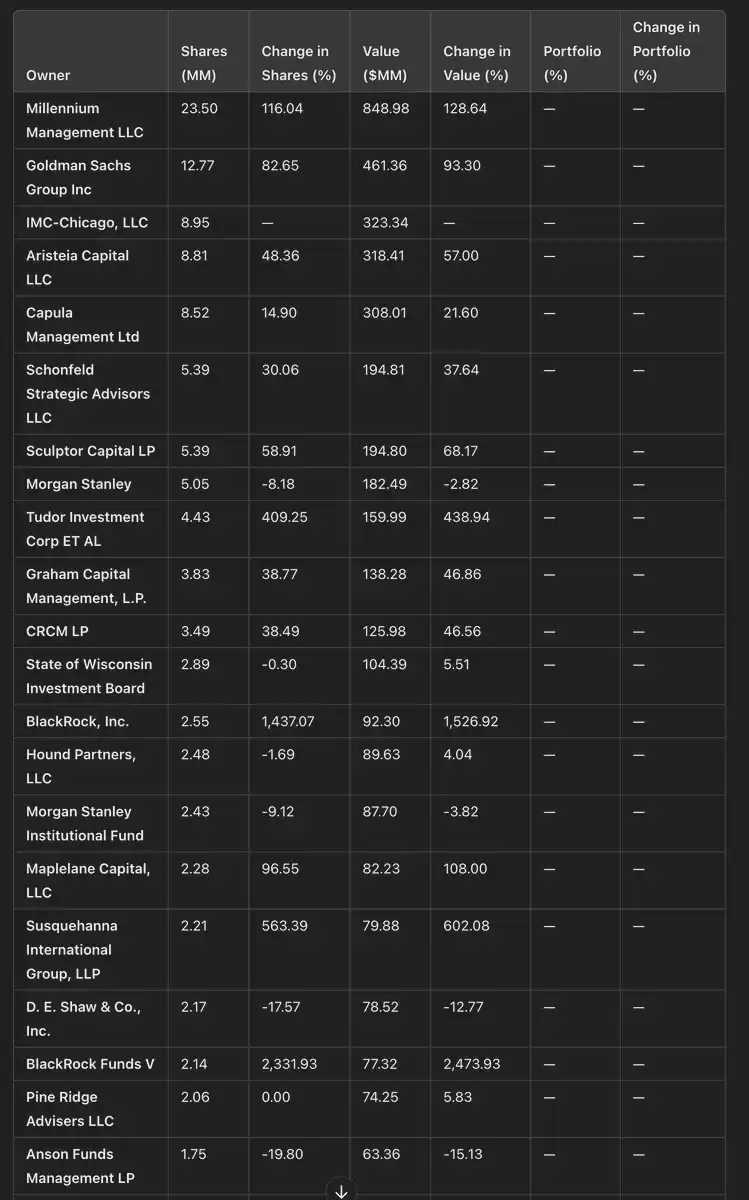
Data source
Some of them are holders, but most are actually arbitrageurs!
Conclusion
The evolution of funding rates and the strategies inspired by them highlight the dynamic intersection of TradFi and DeFi. The "golden age" of 2021 presented lucrative opportunities, but also exposed systemic weaknesses that led to major market crashes. In 2024-2025, the rise of robust stablecoins like USDe and USDX has brought a new wave of arbitrage opportunities, providing a more sustainable framework for market growth.
Ultimately, funding rate pricing is not determined by stablecoins, but rather shaped by institutional participation and CME’s benchmark futures. The interplay of these forces underscores the importance of market efficiency, transparency, and robust risk management to ensure the continued maturity of the crypto ecosystem. The blame for low funding rates should not be placed on stablecoins like USDe or USDX, but rather on traditional financial players who take advantage of their low capital costs and arbitrage strategies.
You may also like

Token Cannot Compound, Where Is the Real Investment Opportunity?

February 6th Market Key Intelligence, How Much Did You Miss?

China's Central Bank and Eight Other Departments' Latest Regulatory Focus: Key Attention to RWA Tokenized Asset Risk
Foreword: Today, the People's Bank of China's website published the "Notice of the People's Bank of China, National Development and Reform Commission, Ministry of Industry and Information Technology, Ministry of Public Security, State Administration for Market Regulation, China Banking and Insurance Regulatory Commission, China Securities Regulatory Commission, State Administration of Foreign Exchange on Further Preventing and Dealing with Risks Related to Virtual Currency and Others (Yinfa [2026] No. 42)", the latest regulatory requirements from the eight departments including the central bank, which are basically consistent with the regulatory requirements of recent years. The main focus of the regulation is on speculative activities such as virtual currency trading, exchanges, ICOs, overseas platform services, and this time, regulatory oversight of RWA has been added, explicitly prohibiting RWA tokenization, stablecoins (especially those pegged to the RMB). The following is the full text:
To the people's governments of all provinces, autonomous regions, and municipalities directly under the Central Government, the Xinjiang Production and Construction Corps:
Recently, there have been speculative activities related to virtual currency and Real-World Assets (RWA) tokenization, disrupting the economic and financial order and jeopardizing the property security of the people. In order to further prevent and address the risks related to virtual currency and Real-World Assets tokenization, effectively safeguard national security and social stability, in accordance with the "Law of the People's Republic of China on the People's Bank of China," "Law of the People's Republic of China on Commercial Banks," "Securities Law of the People's Republic of China," "Law of the People's Republic of China on Securities Investment Funds," "Law of the People's Republic of China on Futures and Derivatives," "Cybersecurity Law of the People's Republic of China," "Regulations of the People's Republic of China on the Administration of Renminbi," "Regulations on Prevention and Disposal of Illegal Fundraising," "Regulations of the People's Republic of China on Foreign Exchange Administration," "Telecommunications Regulations of the People's Republic of China," and other provisions, after reaching consensus with the Cyberspace Administration of China, the Supreme People's Court, and the Supreme People's Procuratorate, and with the approval of the State Council, the relevant matters are notified as follows:
(I) Virtual currency does not possess the legal status equivalent to fiat currency. Virtual currencies such as Bitcoin, Ether, Tether, etc., have the main characteristics of being issued by non-monetary authorities, using encryption technology and distributed ledger or similar technology, existing in digital form, etc. They do not have legal tender status, should not and cannot be circulated and used as currency in the market.
The business activities related to virtual currency are classified as illegal financial activities. The exchange of fiat currency and virtual currency within the territory, exchange of virtual currencies, acting as a central counterparty in buying and selling virtual currencies, providing information intermediary and pricing services for virtual currency transactions, token issuance financing, and trading of virtual currency-related financial products, etc., fall under illegal financial activities, such as suspected illegal issuance of token vouchers, unauthorized public issuance of securities, illegal operation of securities and futures business, illegal fundraising, etc., are strictly prohibited across the board and resolutely banned in accordance with the law. Overseas entities and individuals are not allowed to provide virtual currency-related services to domestic entities in any form.
A stablecoin pegged to a fiat currency indirectly fulfills some functions of the fiat currency in circulation. Without the consent of relevant authorities in accordance with the law and regulations, any domestic or foreign entity or individual is not allowed to issue a RMB-pegged stablecoin overseas.
(II)Tokenization of Real-World Assets refers to the use of encryption technology and distributed ledger or similar technologies to transform ownership rights, income rights, etc., of assets into tokens (tokens) or other interests or bond certificates with token (token) characteristics, and carry out issuance and trading activities.
Engaging in the tokenization of real-world assets domestically, as well as providing related intermediary, information technology services, etc., which are suspected of illegal issuance of token vouchers, unauthorized public offering of securities, illegal operation of securities and futures business, illegal fundraising, and other illegal financial activities, shall be prohibited; except for relevant business activities carried out with the approval of the competent authorities in accordance with the law and regulations and relying on specific financial infrastructures. Overseas entities and individuals are not allowed to illegally provide services related to the tokenization of real-world assets to domestic entities in any form.
(III) Inter-agency Coordination. The People's Bank of China, together with the National Development and Reform Commission, the Ministry of Industry and Information Technology, the Ministry of Public Security, the State Administration for Market Regulation, the China Banking and Insurance Regulatory Commission, the China Securities Regulatory Commission, the State Administration of Foreign Exchange, and other departments, will improve the work mechanism, strengthen coordination with the Cyberspace Administration of China, the Supreme People's Court, and the Supreme People's Procuratorate, coordinate efforts, and overall guide regions to carry out risk prevention and disposal of virtual currency-related illegal financial activities.
The China Securities Regulatory Commission, together with the National Development and Reform Commission, the Ministry of Industry and Information Technology, the Ministry of Public Security, the People's Bank of China, the State Administration for Market Regulation, the China Banking and Insurance Regulatory Commission, the State Administration of Foreign Exchange, and other departments, will improve the work mechanism, strengthen coordination with the Cyberspace Administration of China, the Supreme People's Court, and the Supreme People's Procuratorate, coordinate efforts, and overall guide regions to carry out risk prevention and disposal of illegal financial activities related to the tokenization of real-world assets.
(IV) Strengthening Local Implementation. The people's governments at the provincial level are overall responsible for the prevention and disposal of risks related to virtual currencies and the tokenization of real-world assets in their respective administrative regions. The specific leading department is the local financial regulatory department, with participation from branches and dispatched institutions of the State Council's financial regulatory department, telecommunications regulators, public security, market supervision, and other departments, in coordination with cyberspace departments, courts, and procuratorates, to improve the normalization of the work mechanism, effectively connect with the relevant work mechanisms of central departments, form a cooperative and coordinated working pattern between central and local governments, effectively prevent and properly handle risks related to virtual currencies and the tokenization of real-world assets, and maintain economic and financial order and social stability.
(5) Enhanced Risk Monitoring. The People's Bank of China, China Securities Regulatory Commission, National Development and Reform Commission, Ministry of Industry and Information Technology, Ministry of Public Security, State Administration of Foreign Exchange, Cyberspace Administration of China, and other departments continue to improve monitoring techniques and system support, enhance cross-departmental data analysis and sharing, establish sound information sharing and cross-validation mechanisms, promptly grasp the risk situation of activities related to virtual currency and real-world asset tokenization. Local governments at all levels give full play to the role of local monitoring and early warning mechanisms. Local financial regulatory authorities, together with branches and agencies of the State Council's financial regulatory authorities, as well as departments of cyberspace and public security, ensure effective connection between online monitoring, offline investigation, and fund tracking, efficiently and accurately identify activities related to virtual currency and real-world asset tokenization, promptly share risk information, improve early warning information dissemination, verification, and rapid response mechanisms.
(6) Strengthened Oversight of Financial Institutions, Intermediaries, and Technology Service Providers. Financial institutions (including non-bank payment institutions) are prohibited from providing account opening, fund transfer, and clearing services for virtual currency-related business activities, issuing and selling financial products related to virtual currency, including virtual currency and related financial products in the scope of collateral, conducting insurance business related to virtual currency, or including virtual currency in the scope of insurance liability. Financial institutions (including non-bank payment institutions) are prohibited from providing custody, clearing, and settlement services for unauthorized real-world asset tokenization-related business and related financial products. Relevant intermediary institutions and information technology service providers are prohibited from providing intermediary, technical, or other services for unauthorized real-world asset tokenization-related businesses and related financial products.
(7) Enhanced Management of Internet Information Content and Access. Internet enterprises are prohibited from providing online business venues, commercial displays, marketing, advertising, or paid traffic diversion services for virtual currency and real-world asset tokenization-related business activities. Upon discovering clues of illegal activities, they should promptly report to relevant departments and provide technical support and assistance for related investigations and inquiries. Based on the clues transferred by the financial regulatory authorities, the cyberspace administration, telecommunications authorities, and public security departments should promptly close and deal with websites, mobile applications (including mini-programs), and public accounts engaged in virtual currency and real-world asset tokenization-related business activities in accordance with the law.
(8) Strengthened Entity Registration and Advertisement Management. Market supervision departments strengthen entity registration and management, and enterprise and individual business registrations must not contain terms such as "virtual currency," "virtual asset," "cryptocurrency," "crypto asset," "stablecoin," "real-world asset tokenization," or "RWA" in their names or business scopes. Market supervision departments, together with financial regulatory authorities, legally enhance the supervision of advertisements related to virtual currency and real-world asset tokenization, promptly investigating and handling relevant illegal advertisements.
(IX) Continued Rectification of Virtual Currency Mining Activities. The National Development and Reform Commission, together with relevant departments, strictly controls virtual currency mining activities, continuously promotes the rectification of virtual currency mining activities. The people's governments of various provinces take overall responsibility for the rectification of "mining" within their respective administrative regions. In accordance with the requirements of the National Development and Reform Commission and other departments in the "Notice on the Rectification of Virtual Currency Mining Activities" (NDRC Energy-saving Building [2021] No. 1283) and the provisions of the "Guidance Catalog for Industrial Structure Adjustment (2024 Edition)," a comprehensive review, investigation, and closure of existing virtual currency mining projects are conducted, new mining projects are strictly prohibited, and mining machine production enterprises are strictly prohibited from providing mining machine sales and other services within the country.
(X) Severe Crackdown on Related Illegal Financial Activities. Upon discovering clues to illegal financial activities related to virtual currency and the tokenization of real-world assets, local financial regulatory authorities, branches of the State Council's financial regulatory authorities, and other relevant departments promptly investigate, determine, and properly handle the issues in accordance with the law, and seriously hold the relevant entities and individuals legally responsible. Those suspected of crimes are transferred to the judicial authorities for processing according to the law.
(XI) Severe Crackdown on Related Illegal and Criminal Activities. The Ministry of Public Security, the People's Bank of China, the State Administration for Market Regulation, the China Banking and Insurance Regulatory Commission, the China Securities Regulatory Commission, as well as judicial and procuratorial organs, in accordance with their respective responsibilities, rigorously crack down on illegal and criminal activities related to virtual currency, the tokenization of real-world assets, such as fraud, money laundering, illegal business operations, pyramid schemes, illegal fundraising, and other illegal and criminal activities carried out under the guise of virtual currency, the tokenization of real-world assets, etc.
(XII) Strengthen Industry Self-discipline. Relevant industry associations should enhance membership management and policy advocacy, based on their own responsibilities, advocate and urge member units to resist illegal financial activities related to virtual currency and the tokenization of real-world assets. Member units that violate regulatory policies and industry self-discipline rules are to be disciplined in accordance with relevant self-regulatory management regulations. By leveraging various industry infrastructure, conduct risk monitoring related to virtual currency, the tokenization of real-world assets, and promptly transfer issue clues to relevant departments.
(XIII) Without the approval of relevant departments in accordance with the law and regulations, domestic entities and foreign entities controlled by them may not issue virtual currency overseas.
(XIV) Domestic entities engaging directly or indirectly in overseas external debt-based tokenization of real-world assets, or conducting asset securitization activities abroad based on domestic ownership rights, income rights, etc. (hereinafter referred to as domestic equity), should be strictly regulated in accordance with the principles of "same business, same risk, same rules." The National Development and Reform Commission, the China Securities Regulatory Commission, the State Administration of Foreign Exchange, and other relevant departments regulate it according to their respective responsibilities. For other forms of overseas real-world asset tokenization activities based on domestic equity by domestic entities, the China Securities Regulatory Commission, together with relevant departments, supervise according to their division of responsibilities. Without the consent and filing of relevant departments, no unit or individual may engage in the above-mentioned business.
(15) Overseas subsidiaries and branches of domestic financial institutions providing Real World Asset Tokenization-related services overseas shall do so legally and prudently. They shall have professional personnel and systems in place to effectively mitigate business risks, strictly implement customer onboarding, suitability management, anti-money laundering requirements, and incorporate them into the domestic financial institutions' compliance and risk management system. Intermediaries and information technology service providers offering Real World Asset Tokenization services abroad based on domestic equity or conducting Real World Asset Tokenization business in the form of overseas debt for domestic entities directly or indirectly venturing abroad must strictly comply with relevant laws and regulations. They should establish and improve relevant compliance and internal control systems in accordance with relevant normative requirements, strengthen business and risk control, and report the business developments to the relevant regulatory authorities for approval or filing.
(16) Strengthen organizational leadership and overall coordination. All departments and regions should attach great importance to the prevention of risks related to virtual currencies and Real World Asset Tokenization, strengthen organizational leadership, clarify work responsibilities, form a long-term effective working mechanism with centralized coordination, local implementation, and shared responsibilities, maintain high pressure, dynamically monitor risks, effectively prevent and mitigate risks in an orderly and efficient manner, legally protect the property security of the people, and make every effort to maintain economic and financial order and social stability.
(17) Widely carry out publicity and education. All departments, regions, and industry associations should make full use of various media and other communication channels to disseminate information through legal and policy interpretation, analysis of typical cases, and education on investment risks, etc. They should promote the illegality and harm of virtual currencies and Real World Asset Tokenization-related businesses and their manifestations, fully alert to potential risks and hidden dangers, and enhance public awareness and identification capabilities for risk prevention.
(18) Engaging in illegal financial activities related to virtual currencies and Real World Asset Tokenization in violation of this notice, as well as providing services for virtual currencies and Real World Asset Tokenization-related businesses, shall be punished in accordance with relevant regulations. If it constitutes a crime, criminal liability shall be pursued according to the law. For domestic entities and individuals who knowingly or should have known that overseas entities illegally provided virtual currency or Real World Asset Tokenization-related services to domestic entities and still assisted them, relevant responsibilities shall be pursued according to the law. If it constitutes a crime, criminal liability shall be pursued according to the law.
(19) If any unit or individual invests in virtual currencies, Real World Asset Tokens, and related financial products against public order and good customs, the relevant civil legal actions shall be invalid, and any resulting losses shall be borne by them. If there are suspicions of disrupting financial order and jeopardizing financial security, the relevant departments shall deal with them according to the law.
This notice shall enter into force upon the date of its issuance. The People's Bank of China and ten other departments' "Notice on Further Preventing and Dealing with the Risks of Virtual Currency Trading Speculation" (Yinfa [2021] No. 237) is hereby repealed.

Former Partner's Perspective on Multicoin: Kyle's Exit, But the Game He Left Behind Just Getting Started
Why Bitcoin Is Falling Now: The Real Reasons Behind BTC's Crash & WEEX's Smart Profit Playbook
Bitcoin's ongoing crash explained: Discover the 5 hidden triggers behind BTC's plunge & how WEEX's Auto Earn and Trade to Earn strategies help traders profit from crypto market volatility.

Wall Street's Hottest Trades See Exodus

Vitalik Discusses Ethereum Scaling Path, Circle Announces Partnership with Polymarket, What's the Overseas Crypto Community Talking About Today?

Believing in the Capital Markets - The Essence and Core Value of Cryptocurrency

Polymarket's 'Weatherman': Predict Temperature, Win Million-Dollar Payout

$15K+ Profits: The 4 AI Trading Secrets WEEX Hackathon Prelim Winners Used to Dominate Volatile Crypto Markets
How WEEX Hackathon's top AI trading strategies made $15K+ in crypto markets: 4 proven rules for ETH/BTC trading, market structure analysis, and risk management in volatile conditions.

A nearly 20% one-day plunge, how long has it been since you last saw a $60,000 Bitcoin?

Raoul Pal: I've seen every single panic, and they are never the end.

Key Market Information Discrepancy on February 6th - A Must-Read! | Alpha Morning Report

2026 Crypto Industry's First Snowfall
The Harsh Reality Behind the $26 Billion Crypto Liquidation: Liquidity Is Killing the Market
Why Is Gold, US Stocks, Bitcoin All Falling?

Key Market Intelligence for February 5th, how much did you miss out on?

Wintermute: By 2026, crypto had gradually become the settlement layer of the Internet economy
Token Cannot Compound, Where Is the Real Investment Opportunity?
February 6th Market Key Intelligence, How Much Did You Miss?
China's Central Bank and Eight Other Departments' Latest Regulatory Focus: Key Attention to RWA Tokenized Asset Risk
Foreword: Today, the People's Bank of China's website published the "Notice of the People's Bank of China, National Development and Reform Commission, Ministry of Industry and Information Technology, Ministry of Public Security, State Administration for Market Regulation, China Banking and Insurance Regulatory Commission, China Securities Regulatory Commission, State Administration of Foreign Exchange on Further Preventing and Dealing with Risks Related to Virtual Currency and Others (Yinfa [2026] No. 42)", the latest regulatory requirements from the eight departments including the central bank, which are basically consistent with the regulatory requirements of recent years. The main focus of the regulation is on speculative activities such as virtual currency trading, exchanges, ICOs, overseas platform services, and this time, regulatory oversight of RWA has been added, explicitly prohibiting RWA tokenization, stablecoins (especially those pegged to the RMB). The following is the full text:
To the people's governments of all provinces, autonomous regions, and municipalities directly under the Central Government, the Xinjiang Production and Construction Corps:
Recently, there have been speculative activities related to virtual currency and Real-World Assets (RWA) tokenization, disrupting the economic and financial order and jeopardizing the property security of the people. In order to further prevent and address the risks related to virtual currency and Real-World Assets tokenization, effectively safeguard national security and social stability, in accordance with the "Law of the People's Republic of China on the People's Bank of China," "Law of the People's Republic of China on Commercial Banks," "Securities Law of the People's Republic of China," "Law of the People's Republic of China on Securities Investment Funds," "Law of the People's Republic of China on Futures and Derivatives," "Cybersecurity Law of the People's Republic of China," "Regulations of the People's Republic of China on the Administration of Renminbi," "Regulations on Prevention and Disposal of Illegal Fundraising," "Regulations of the People's Republic of China on Foreign Exchange Administration," "Telecommunications Regulations of the People's Republic of China," and other provisions, after reaching consensus with the Cyberspace Administration of China, the Supreme People's Court, and the Supreme People's Procuratorate, and with the approval of the State Council, the relevant matters are notified as follows:
(I) Virtual currency does not possess the legal status equivalent to fiat currency. Virtual currencies such as Bitcoin, Ether, Tether, etc., have the main characteristics of being issued by non-monetary authorities, using encryption technology and distributed ledger or similar technology, existing in digital form, etc. They do not have legal tender status, should not and cannot be circulated and used as currency in the market.
The business activities related to virtual currency are classified as illegal financial activities. The exchange of fiat currency and virtual currency within the territory, exchange of virtual currencies, acting as a central counterparty in buying and selling virtual currencies, providing information intermediary and pricing services for virtual currency transactions, token issuance financing, and trading of virtual currency-related financial products, etc., fall under illegal financial activities, such as suspected illegal issuance of token vouchers, unauthorized public issuance of securities, illegal operation of securities and futures business, illegal fundraising, etc., are strictly prohibited across the board and resolutely banned in accordance with the law. Overseas entities and individuals are not allowed to provide virtual currency-related services to domestic entities in any form.
A stablecoin pegged to a fiat currency indirectly fulfills some functions of the fiat currency in circulation. Without the consent of relevant authorities in accordance with the law and regulations, any domestic or foreign entity or individual is not allowed to issue a RMB-pegged stablecoin overseas.
(II)Tokenization of Real-World Assets refers to the use of encryption technology and distributed ledger or similar technologies to transform ownership rights, income rights, etc., of assets into tokens (tokens) or other interests or bond certificates with token (token) characteristics, and carry out issuance and trading activities.
Engaging in the tokenization of real-world assets domestically, as well as providing related intermediary, information technology services, etc., which are suspected of illegal issuance of token vouchers, unauthorized public offering of securities, illegal operation of securities and futures business, illegal fundraising, and other illegal financial activities, shall be prohibited; except for relevant business activities carried out with the approval of the competent authorities in accordance with the law and regulations and relying on specific financial infrastructures. Overseas entities and individuals are not allowed to illegally provide services related to the tokenization of real-world assets to domestic entities in any form.
(III) Inter-agency Coordination. The People's Bank of China, together with the National Development and Reform Commission, the Ministry of Industry and Information Technology, the Ministry of Public Security, the State Administration for Market Regulation, the China Banking and Insurance Regulatory Commission, the China Securities Regulatory Commission, the State Administration of Foreign Exchange, and other departments, will improve the work mechanism, strengthen coordination with the Cyberspace Administration of China, the Supreme People's Court, and the Supreme People's Procuratorate, coordinate efforts, and overall guide regions to carry out risk prevention and disposal of virtual currency-related illegal financial activities.
The China Securities Regulatory Commission, together with the National Development and Reform Commission, the Ministry of Industry and Information Technology, the Ministry of Public Security, the People's Bank of China, the State Administration for Market Regulation, the China Banking and Insurance Regulatory Commission, the State Administration of Foreign Exchange, and other departments, will improve the work mechanism, strengthen coordination with the Cyberspace Administration of China, the Supreme People's Court, and the Supreme People's Procuratorate, coordinate efforts, and overall guide regions to carry out risk prevention and disposal of illegal financial activities related to the tokenization of real-world assets.
(IV) Strengthening Local Implementation. The people's governments at the provincial level are overall responsible for the prevention and disposal of risks related to virtual currencies and the tokenization of real-world assets in their respective administrative regions. The specific leading department is the local financial regulatory department, with participation from branches and dispatched institutions of the State Council's financial regulatory department, telecommunications regulators, public security, market supervision, and other departments, in coordination with cyberspace departments, courts, and procuratorates, to improve the normalization of the work mechanism, effectively connect with the relevant work mechanisms of central departments, form a cooperative and coordinated working pattern between central and local governments, effectively prevent and properly handle risks related to virtual currencies and the tokenization of real-world assets, and maintain economic and financial order and social stability.
(5) Enhanced Risk Monitoring. The People's Bank of China, China Securities Regulatory Commission, National Development and Reform Commission, Ministry of Industry and Information Technology, Ministry of Public Security, State Administration of Foreign Exchange, Cyberspace Administration of China, and other departments continue to improve monitoring techniques and system support, enhance cross-departmental data analysis and sharing, establish sound information sharing and cross-validation mechanisms, promptly grasp the risk situation of activities related to virtual currency and real-world asset tokenization. Local governments at all levels give full play to the role of local monitoring and early warning mechanisms. Local financial regulatory authorities, together with branches and agencies of the State Council's financial regulatory authorities, as well as departments of cyberspace and public security, ensure effective connection between online monitoring, offline investigation, and fund tracking, efficiently and accurately identify activities related to virtual currency and real-world asset tokenization, promptly share risk information, improve early warning information dissemination, verification, and rapid response mechanisms.
(6) Strengthened Oversight of Financial Institutions, Intermediaries, and Technology Service Providers. Financial institutions (including non-bank payment institutions) are prohibited from providing account opening, fund transfer, and clearing services for virtual currency-related business activities, issuing and selling financial products related to virtual currency, including virtual currency and related financial products in the scope of collateral, conducting insurance business related to virtual currency, or including virtual currency in the scope of insurance liability. Financial institutions (including non-bank payment institutions) are prohibited from providing custody, clearing, and settlement services for unauthorized real-world asset tokenization-related business and related financial products. Relevant intermediary institutions and information technology service providers are prohibited from providing intermediary, technical, or other services for unauthorized real-world asset tokenization-related businesses and related financial products.
(7) Enhanced Management of Internet Information Content and Access. Internet enterprises are prohibited from providing online business venues, commercial displays, marketing, advertising, or paid traffic diversion services for virtual currency and real-world asset tokenization-related business activities. Upon discovering clues of illegal activities, they should promptly report to relevant departments and provide technical support and assistance for related investigations and inquiries. Based on the clues transferred by the financial regulatory authorities, the cyberspace administration, telecommunications authorities, and public security departments should promptly close and deal with websites, mobile applications (including mini-programs), and public accounts engaged in virtual currency and real-world asset tokenization-related business activities in accordance with the law.
(8) Strengthened Entity Registration and Advertisement Management. Market supervision departments strengthen entity registration and management, and enterprise and individual business registrations must not contain terms such as "virtual currency," "virtual asset," "cryptocurrency," "crypto asset," "stablecoin," "real-world asset tokenization," or "RWA" in their names or business scopes. Market supervision departments, together with financial regulatory authorities, legally enhance the supervision of advertisements related to virtual currency and real-world asset tokenization, promptly investigating and handling relevant illegal advertisements.
(IX) Continued Rectification of Virtual Currency Mining Activities. The National Development and Reform Commission, together with relevant departments, strictly controls virtual currency mining activities, continuously promotes the rectification of virtual currency mining activities. The people's governments of various provinces take overall responsibility for the rectification of "mining" within their respective administrative regions. In accordance with the requirements of the National Development and Reform Commission and other departments in the "Notice on the Rectification of Virtual Currency Mining Activities" (NDRC Energy-saving Building [2021] No. 1283) and the provisions of the "Guidance Catalog for Industrial Structure Adjustment (2024 Edition)," a comprehensive review, investigation, and closure of existing virtual currency mining projects are conducted, new mining projects are strictly prohibited, and mining machine production enterprises are strictly prohibited from providing mining machine sales and other services within the country.
(X) Severe Crackdown on Related Illegal Financial Activities. Upon discovering clues to illegal financial activities related to virtual currency and the tokenization of real-world assets, local financial regulatory authorities, branches of the State Council's financial regulatory authorities, and other relevant departments promptly investigate, determine, and properly handle the issues in accordance with the law, and seriously hold the relevant entities and individuals legally responsible. Those suspected of crimes are transferred to the judicial authorities for processing according to the law.
(XI) Severe Crackdown on Related Illegal and Criminal Activities. The Ministry of Public Security, the People's Bank of China, the State Administration for Market Regulation, the China Banking and Insurance Regulatory Commission, the China Securities Regulatory Commission, as well as judicial and procuratorial organs, in accordance with their respective responsibilities, rigorously crack down on illegal and criminal activities related to virtual currency, the tokenization of real-world assets, such as fraud, money laundering, illegal business operations, pyramid schemes, illegal fundraising, and other illegal and criminal activities carried out under the guise of virtual currency, the tokenization of real-world assets, etc.
(XII) Strengthen Industry Self-discipline. Relevant industry associations should enhance membership management and policy advocacy, based on their own responsibilities, advocate and urge member units to resist illegal financial activities related to virtual currency and the tokenization of real-world assets. Member units that violate regulatory policies and industry self-discipline rules are to be disciplined in accordance with relevant self-regulatory management regulations. By leveraging various industry infrastructure, conduct risk monitoring related to virtual currency, the tokenization of real-world assets, and promptly transfer issue clues to relevant departments.
(XIII) Without the approval of relevant departments in accordance with the law and regulations, domestic entities and foreign entities controlled by them may not issue virtual currency overseas.
(XIV) Domestic entities engaging directly or indirectly in overseas external debt-based tokenization of real-world assets, or conducting asset securitization activities abroad based on domestic ownership rights, income rights, etc. (hereinafter referred to as domestic equity), should be strictly regulated in accordance with the principles of "same business, same risk, same rules." The National Development and Reform Commission, the China Securities Regulatory Commission, the State Administration of Foreign Exchange, and other relevant departments regulate it according to their respective responsibilities. For other forms of overseas real-world asset tokenization activities based on domestic equity by domestic entities, the China Securities Regulatory Commission, together with relevant departments, supervise according to their division of responsibilities. Without the consent and filing of relevant departments, no unit or individual may engage in the above-mentioned business.
(15) Overseas subsidiaries and branches of domestic financial institutions providing Real World Asset Tokenization-related services overseas shall do so legally and prudently. They shall have professional personnel and systems in place to effectively mitigate business risks, strictly implement customer onboarding, suitability management, anti-money laundering requirements, and incorporate them into the domestic financial institutions' compliance and risk management system. Intermediaries and information technology service providers offering Real World Asset Tokenization services abroad based on domestic equity or conducting Real World Asset Tokenization business in the form of overseas debt for domestic entities directly or indirectly venturing abroad must strictly comply with relevant laws and regulations. They should establish and improve relevant compliance and internal control systems in accordance with relevant normative requirements, strengthen business and risk control, and report the business developments to the relevant regulatory authorities for approval or filing.
(16) Strengthen organizational leadership and overall coordination. All departments and regions should attach great importance to the prevention of risks related to virtual currencies and Real World Asset Tokenization, strengthen organizational leadership, clarify work responsibilities, form a long-term effective working mechanism with centralized coordination, local implementation, and shared responsibilities, maintain high pressure, dynamically monitor risks, effectively prevent and mitigate risks in an orderly and efficient manner, legally protect the property security of the people, and make every effort to maintain economic and financial order and social stability.
(17) Widely carry out publicity and education. All departments, regions, and industry associations should make full use of various media and other communication channels to disseminate information through legal and policy interpretation, analysis of typical cases, and education on investment risks, etc. They should promote the illegality and harm of virtual currencies and Real World Asset Tokenization-related businesses and their manifestations, fully alert to potential risks and hidden dangers, and enhance public awareness and identification capabilities for risk prevention.
(18) Engaging in illegal financial activities related to virtual currencies and Real World Asset Tokenization in violation of this notice, as well as providing services for virtual currencies and Real World Asset Tokenization-related businesses, shall be punished in accordance with relevant regulations. If it constitutes a crime, criminal liability shall be pursued according to the law. For domestic entities and individuals who knowingly or should have known that overseas entities illegally provided virtual currency or Real World Asset Tokenization-related services to domestic entities and still assisted them, relevant responsibilities shall be pursued according to the law. If it constitutes a crime, criminal liability shall be pursued according to the law.
(19) If any unit or individual invests in virtual currencies, Real World Asset Tokens, and related financial products against public order and good customs, the relevant civil legal actions shall be invalid, and any resulting losses shall be borne by them. If there are suspicions of disrupting financial order and jeopardizing financial security, the relevant departments shall deal with them according to the law.
This notice shall enter into force upon the date of its issuance. The People's Bank of China and ten other departments' "Notice on Further Preventing and Dealing with the Risks of Virtual Currency Trading Speculation" (Yinfa [2021] No. 237) is hereby repealed.
Former Partner's Perspective on Multicoin: Kyle's Exit, But the Game He Left Behind Just Getting Started
Why Bitcoin Is Falling Now: The Real Reasons Behind BTC's Crash & WEEX's Smart Profit Playbook
Bitcoin's ongoing crash explained: Discover the 5 hidden triggers behind BTC's plunge & how WEEX's Auto Earn and Trade to Earn strategies help traders profit from crypto market volatility.


 App
App