
 Buy Crypto
- Markets
 Futures
- Spot
- Copy Trade
- Earn
- More
Where Did $362 Million Go? Hyperliquid Counters FUD in Decentralization Showdown

Original Title: "Hyperliquid Personally Reconciles, Perfect PR Hides Underlying Competitor Sabotage"
Original Author: angelilu, Foresight News
On December 20, 2025, a technical article titled "Reverse Engineering Hyperliquid" was published on blog.can.ac, which decompiled Hyperliquid's binary file directly, accusing it of 9 serious issues ranging from insolvency to a "God Mode Backdoor." The article bluntly stated:
"Hyperliquid is a centralized exchange platform disguised as a blockchain."
Faced with FUD, Hyperliquid officially responded with a lengthy article. Perhaps this was not just a simple rebuttal but a declaration of war on the route of "who is the true decentralized trading facility." While the official statement successfully clarified the fund security issue, some intriguing "blank spaces" remain in certain sensitive areas of decentralization.
Where Did 3.62 Billion Dollars Go? The Audit Blind Spot of the "Dual Ledger"
The most damaging accusation is this: the user assets within the Hyperliquid system are $3.62 billion less than the on-chain reserves. If true, this would mean it is a "chain FTX" operating on partial reserves.
However, upon verification, this was an information asymmetry misinterpretation caused by an "architectural upgrade." The logic of the critics' audit is as follows: Hyperliquid reserves = USDC balance on the Arbitrum cross-chain bridge. Using this logic, they looked at the cross-chain bridge address and found that the balance was indeed less than the total user deposits.
In response, Hyperliquid stated that it is undergoing a complete evolution from an "L2 AppChain" to an "independent L1." During this process, the asset reserves shifted to a dual-track system as follows:
The accusers completely ignored the native USDC on HyperEVM. According to on-chain data (as of the time of writing):
· Arbitrum cross-chain balance: 39.89 billion USDC (Can be verified on Arbiscan)
· HyperEVM native balance: 3.62 billion USDC (Can be verified on Hyperevmscan)
· HyperEVM Contract Balance: 0.59 Billion USDC
Total Settlement Capacity = 39.89 Billion + 3.62 Billion + 0.59 Billion ≈ 43.51 Billion USDC
This number aligns perfectly with the Total User Balances on HyperCore. The so-called "3.62 Billion Gap" is precisely the native assets that have been migrated to HyperEVM. This is not a fund loss but a transfer of funds between different ledgers.
9-Point Allegation Reconciliation: What Has Been Clarified? What Has Been Avoided?
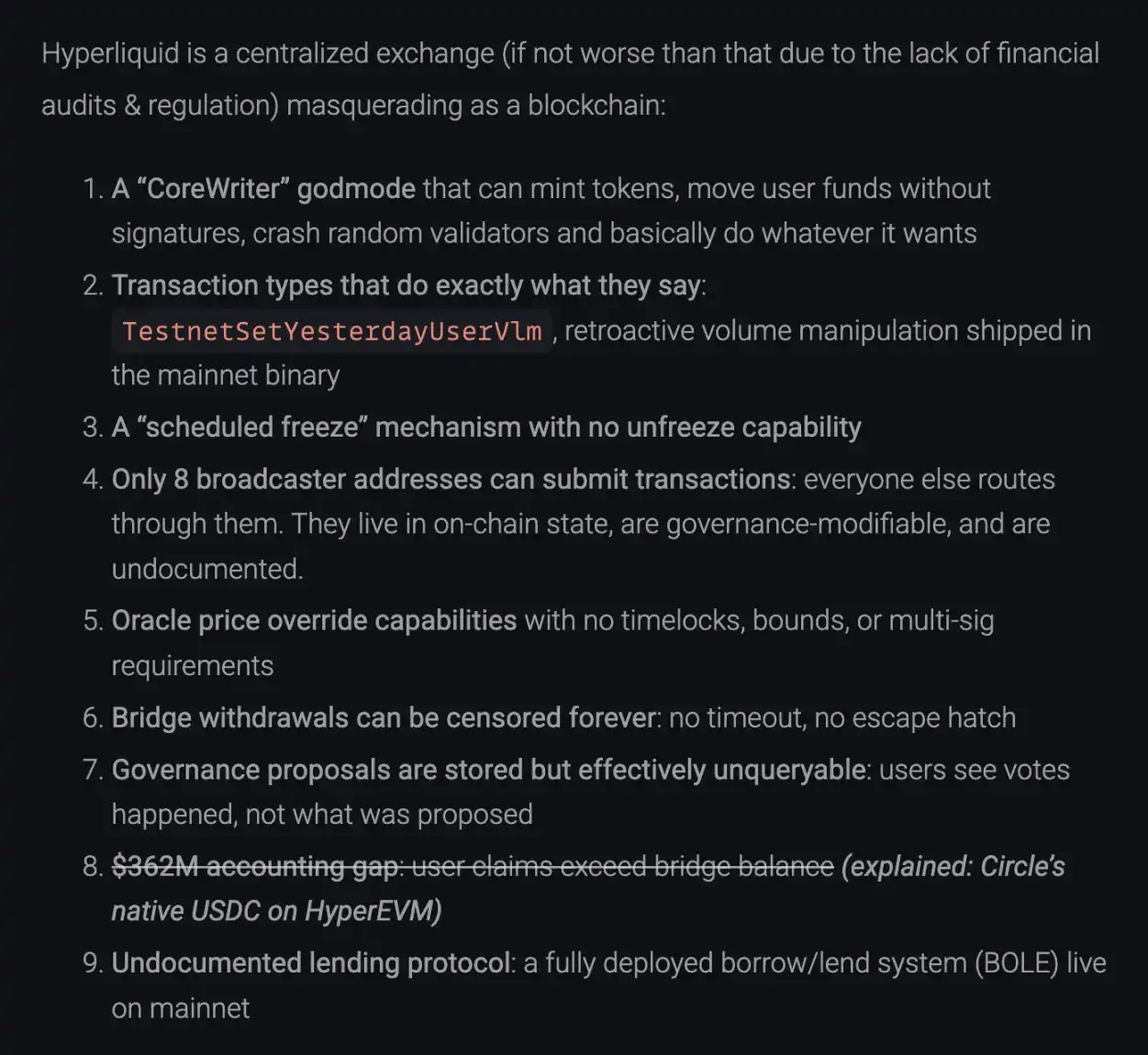
Allegations Clarified
Allegation: 'CoreWriter' God Mode: Allegation claims it can mint money out of thin air, misappropriate funds.
Response: Officially explained as the interface for L1 interacting with HyperEVM (e.g., staking), with limited permissions and no ability to misappropriate funds.
Allegation: 3.62 Billion Fund Gap.
Response: As mentioned above, this does not account for Native USDC.
Allegation: Undisclosed lending protocol.
Response: Officials pointed out that the Spot / Loan feature (HIP-1) documentation has been disclosed, in the pre-release stage, and not operated in secrecy.
Allegations Acknowledged with Reasonable Explanations
Allegation: Binary file contains "Volume Modification" code (TestnetSetYesterdayUserVlm).
Response: Acknowledged. But explained as residual code for the testnet, used to simulate fee logic. The mainnet node has physically isolated this path and cannot execute it.
Allegation: Only 8 broadcast addresses can submit transactions.
Response: Acknowledged. Explained as an MEV (Maximum Extractable Value) resistance measure to prevent users from being front-run. A commitment has been made to implement a "multi-propser" mechanism in the future.
Accusation: The chain can be "strategically frozen" with no possibility of reversal.
Response: Acknowledged. Explained as a standard process for network upgrades that require a full network pause to switch versions.
Accusation: Oracle prices can be instantly overwritten.
Response: Explained as a security system design feature. To promptly settle bad debt in extreme price swings like 10/10, validator oracles indeed do not have a time lock.
Missing / Ambiguous Responses
Upon our review, two accusations were not directly addressed or fully resolved in the official responses:
Accusation: Governance proposals are unqueryable; users can only see that a vote occurred, but on-chain data does not include the specific proposal text.
Response: The official response did not address this point in the lengthy document. This implies that Hyperliquid's governance is currently a "black box" to ordinary users, where you can see the outcome but not the process.
Accusation: The cross-chain bridge has no "Escape Hatch"; withdrawals may be subject to indefinite review, and users cannot forcibly withdraw back to L1.
Response: While the official response explained that the locked bridge during the POPCAT incident was for security, it did not refute the fact of "no Escape Hatch" in the architecture. This indicates that at the current stage, the movement of user assets is heavily reliant on the validator set's approval, lacking the anti-censorship forced withdrawal capability seen in L2 Rollups.
Competitor "Mud-Slinging"
The most intriguing aspect of this incident is how it forced Hyperliquid to reveal its hand and gave us the opportunity to reassess the Perp track landscape. The official response notably engaged in competitor "mud-slinging," targeting Lighter, Aster, and even industry giant Binance.
It stated, "Lighter uses a single centralized sequencer, with its execution logic and zero-knowledge proof (ZK) circuits not open to the public. Aster employs centralized matching and even offers dark pool trading, a feature achievable only with a single centralized sequencer and a non-verifiable execution process. Other protocols with open-source contracts lack a verifiable sequencer."
Hyperliquid bluntly categorizes these competitors as all relying on a "Centralized Sequencer." The team emphasizes: on these platforms, apart from the sequencer operator, no one can see a full state snapshot (including order book history, position details). In contrast, Hyperliquid attempts to eliminate this "privilege" by having all validators execute the same state machine.
And perhaps this wave of "pulling the rug" is precisely because Hyperliquid has raised concerns about the current market share, according to DefiLlama's transaction volume data from the past 30 days, the market landscape has become a three-way standoff:
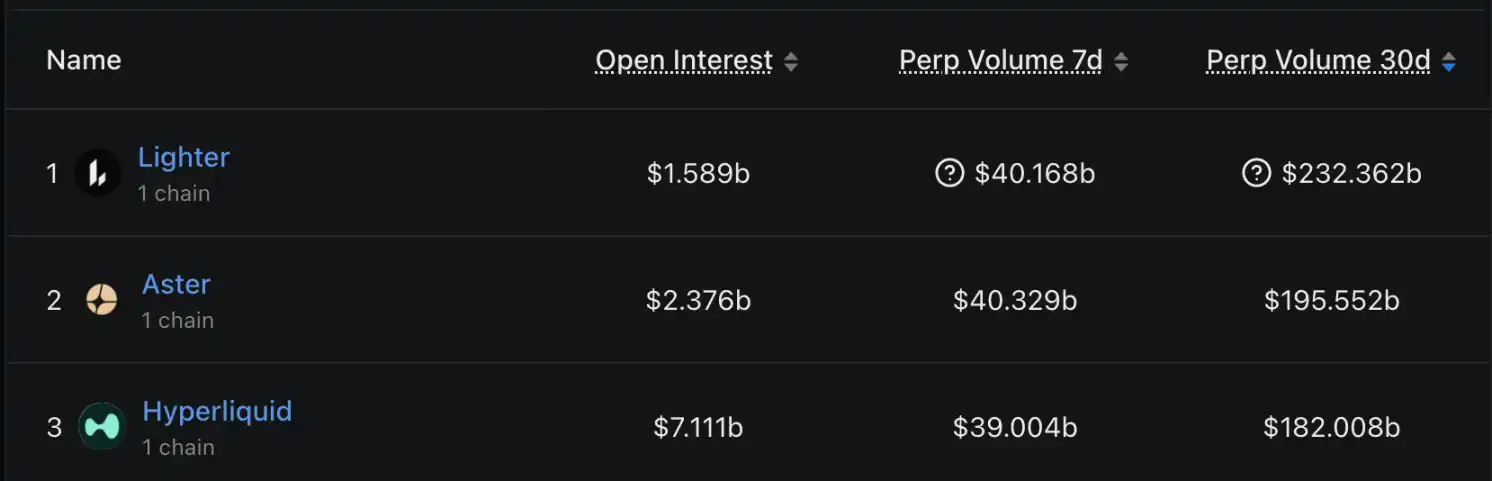
· Lighter: with a transaction volume of $232.3 billion, currently in the first place, holding approximately 26.6%.
· Aster: with a transaction volume of $195.5 billion, in second place, holding approximately 22.3%.
· Hyperliquid: with a transaction volume of $182.0 billion, in third place, holding approximately 20.8%.
Facing the transaction volumes of Lighter and Aster leading from behind, Hyperliquid attempts to play the "transparency" card—meaning "although I have 8 centralized broadcasting addresses, my full state is on-chain and verifiable; while you can't even verify." However, it is worth noting that although Hyperliquid slightly lags behind the top two in transaction volume, in Open Interest (OI), Hyperliquid shows overwhelming strength.
Sentiment Response: Who Is Shorting HYPE?
In addition to technical and financial issues, the community's most pressing concern is the recent rumors of HYPE token being seemingly shorted and price manipulated by "insiders." In response, a Hyperliquid team member first provided a qualitative response on Discord: "The shorting address starting with 0x7ae4 belongs to a former employee," who was once a team member but was dismissed in early 2024. The former employee's personal trading activities are unrelated to the current Hyperliquid team. The platform emphasizes that they currently enforce extremely strict HYPE trading restrictions and compliance checks on all employees and contractors, prohibiting the exploitation of their positions for insider trading.
This response attempts to downgrade the accusation of "team wrongdoing" to "former employee's personal behavior," but in terms of transparency in token distribution and unlocking mechanisms, the community may still expect more detailed disclosures.
Don't Trust, Verify
This clarification tweet by Hyperliquid is a textbook example of crisis PR—not relying on emotional output, but on data, code links, and architectural logic. It didn't just stop at clearing its name but went on the offensive, strengthening its brand and advantage of "on-chain full state" through a comparison with competitors' architectures.
While the FUD has been debunked, the reflection this incident has left on the industry is profound. As DeFi protocols evolve towards Application-Specific Chains (AppChains), the architecture is becoming more complex, and asset distribution is becoming more fragmented (Bridge + Native). The traditional way of "checking contract balances at a glance" has become ineffective.
For Hyperliquid, proving that the "money is there" is just the first step. The real challenge lies in gradually transferring control of those 8 commit addresses while maintaining high performance and MEV resistance, truly achieving the transition from "transparent centralization" to "transparent decentralization." This is the essential path for it to become the "ultimate DEX."
And for users, this incident once again confirms the golden rule of the crypto world: don't trust any narrative; verify every byte.
You may also like

Major Upgrade on Web: 10+ Advanced Chart Styles for Deeper Market Insights
To deliver more powerful and professional analysis tools, WEEX has rolled out a major upgrade to its web trading charts—now supporting up to 14 advanced chart styles.

Morning Report | Aethir secures a $260 million enterprise contract with Axe Compute; New Fire Technology acquires Avenir Group's trading team; Polymarket's trading volume surpassed by Kalshi

Why a Million-Follower Crypto KOL Chooses WEEX VIP?
Discover why top crypto KOL Carl Moon partnered with WEEX. Explore the WEEX VIP ecosystem, 1,000 BTC protection fund, and exclusive rewards for serious traders.

CoinEx Founder: The Crypto Endgame in My Eyes

Spark Coin (SPK): Explodes 73% as Aave Bleeds $15B, A Good Investment Now?
Spark coin (SPK) surged 73% as $15 billion fled Aave after the KelpDAO hack. This article explains what Spark is, why it’s pumping, and whether it is a good investment right now.

As Aave's building collapses, Spark's high-rise is rising

RootData: Q1 2026 Cryptocurrency Exchange Transparency Research Report

What Is Memecoin Trading? A Beginner's Guide to How It Works, the Risks, and 2026's Hottest Tokens
Memecoins surged 30%+ at the start of 2026 while Bitcoin was flat. RAVE spiked 4,500% then crashed 90% in days. MAGA jumped 350% overnight. This guide explains exactly how memecoin trading works — and how to not blow up your account doing it.

Trump Extends Ceasefire: Bitcoin Hits $79K — What Crypto Traders Need to Know Right Now
Bitcoin surged past $79,000 after Trump extended the ceasefire indefinitely. We break down exactly what happened, how every major crypto reacted, and what traders should watch next — including the one level that could unlock an $85,000 BTC rally.

CHIP Crypto Price Prediction 2026: Can USD.AI's GPU Lending Token Reach $1?
CHIP's 24-hour trading volume hit $1.87 billion on a $236 million market cap — an 8x ratio that almost never happens on legitimate tokens. We explain what's driving it, what USD.AI actually does for GPU tokenization, and whether CHIP belongs in your AI crypto portfolio.

RootData: Q1 2026 Web3 Industry Investment Research Report

USDC is the only AI token

The voice of a senior Polymarket user: In fact, we have already been surpassed by our competitors

Transcript of Dr. Han, founder of Gate, speaking at the University of Hong Kong: Breaking the Matthew Effect and Winning in Asymmetric Competition

Who will replace AAVE as the new king?
Fu Peng 2026 First Public Speech: What Exactly Are Crypto Assets? Why Did I Join the Crypto Asset Industry?
Lattice Capital Founder: Crypto VC, Seeing is Believing Because of Faith

The Pitch Is Set. So Is the Trade: CHZ, SportFi, and the UCL Window That Won't Wait
CHZ is gaining momentum as SportFi narratives accelerate alongside the UEFA Champions League(UCL) and global football cycles. This article explores how CHZ, fan tokens, and the broader SportFi ecosystem are driven by real-world events, market narratives, and capital flows—offering insights into why SportFi is emerging as one of the most dynamic sectors in crypto.
Major Upgrade on Web: 10+ Advanced Chart Styles for Deeper Market Insights
To deliver more powerful and professional analysis tools, WEEX has rolled out a major upgrade to its web trading charts—now supporting up to 14 advanced chart styles.
Morning Report | Aethir secures a $260 million enterprise contract with Axe Compute; New Fire Technology acquires Avenir Group's trading team; Polymarket's trading volume surpassed by Kalshi
Why a Million-Follower Crypto KOL Chooses WEEX VIP?
Discover why top crypto KOL Carl Moon partnered with WEEX. Explore the WEEX VIP ecosystem, 1,000 BTC protection fund, and exclusive rewards for serious traders.
CoinEx Founder: The Crypto Endgame in My Eyes
Spark Coin (SPK): Explodes 73% as Aave Bleeds $15B, A Good Investment Now?
Spark coin (SPK) surged 73% as $15 billion fled Aave after the KelpDAO hack. This article explains what Spark is, why it’s pumping, and whether it is a good investment right now.


 App
App