
With a single-day increase of over 40%, what is special about CoW Swap?

 Prefer us on Google

Original title: "COW doubled in one day to lead the DeFi track, what is the ability of V God's favorite swap?"
Original author: Luke
With Trump's victory, crypto assets rose across the board, but the most eye-catching project was COW, which had just been launched on Binance, with the highest increase of 204%.
Some people say that COW chose to be launched on Binance on a good day to reap such a high increase, and others say that COW is V God's favorite swap, and every time the market smashes the meme, it uses cowswap, so the cow itself is also a meme, but is this really the case?
In contrast, the maximum increase of CETUS, a DeFi project of the SUI ecosystem that was newly launched on Binance on the same day, was only 100%, which also benefited from the recent surge in SUI. So, why can COW, which was not discussed much before, lead DeFi so strongly? What advantages does the project itself have? Marsbit takes you to a quick look at CoW Swap in this article.
What is CoW Swap?
CoW Protocol is a DEX aggregation protocol deployed on Ethereum and Gnosis, integrating exchange protocols, batch transactions (Batch Auctions), intentions (Trade Intents) and MEV protection. CoW Swap is the front end of CoW Protocol. To avoid confusion, both are referred to as CoW Swap in this article.
The predecessor of CoW Swap, Gnosis Protocol V1, was launched in 2020. It is the first DEX to provide ring transactions through batch auctions. These are order settlements that share liquidity between all orders. It was followed by V2 launched in April 2021. The innovation of V2 has led to the renaming of Gnosis Protocol to CoW Swap.
The pain point of current DEX: MEV
To understand the advantages of CoW Swap, we must first understand the pain points of current DEX. The current transaction sequence is:
1. The user creates a transaction.
2. The transaction is sent to the memory pool through the RPC endpoint.
3. The validator gets the transaction and executes it.
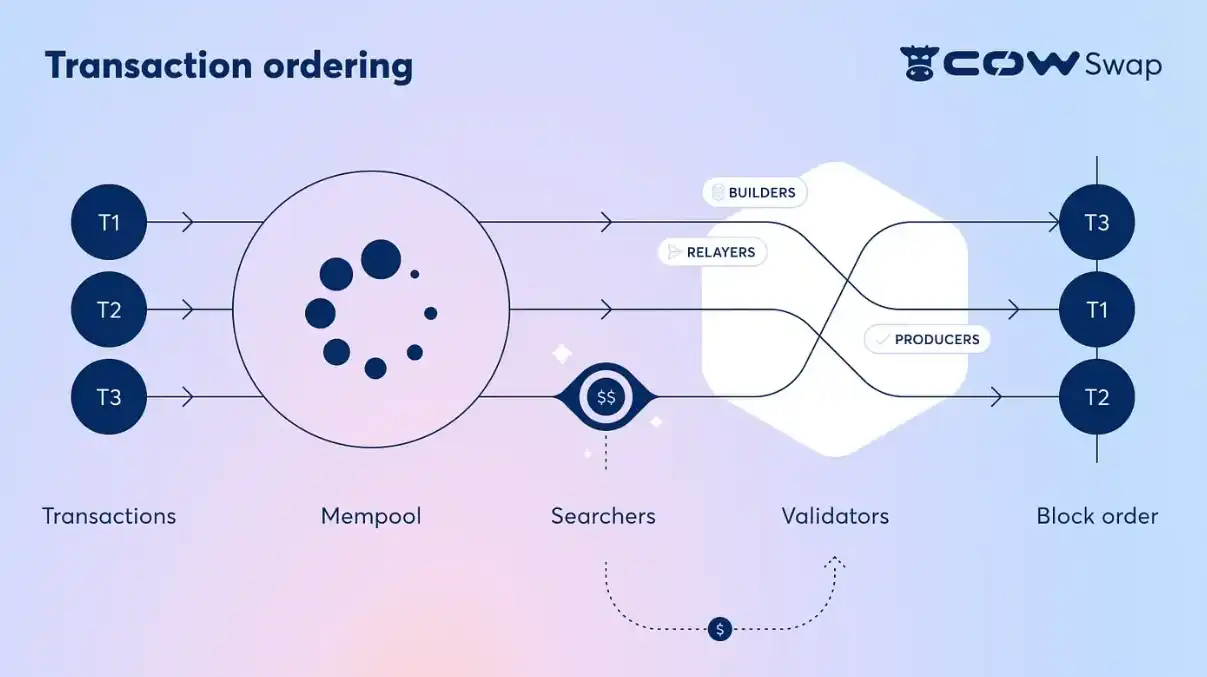
However, there is a significant problem with this process: it makes the end user vulnerable to MEV (maximum extractable value). This not only leads to a serious degradation of the user experience, such as front-running, sandwich attacks, etc., but also may cause poor order execution.
Specifically, MEV robots constantly scan the Ethereum network for users who are ready to buy tokens. Once the target is found, these robots will quickly jump the queue and place large orders before the user, artificially raising the price. After the victim's transaction is completed, the price rises further, and the robot then sells the token at a higher price to make a profit.
The harm of this behavior cannot be underestimated. According to a report released by investment company Galaxy Digital in June last year, it is estimated that MEV robots have extracted up to $300 million to $900 million from Ethereum traders using these strategies.
Faced with this severe challenge, the CoW protocol stands out. One of its main advantages is that it provides comprehensive MEV protection for each order, and this attack is difficult to avoid in most major DEXs. Through its unique trading model, the CoW protocol has built a solid defense system for users mainly from the following three aspects:
· Unified clearing price batches:Innovatively introduces the "unified clearing price" mechanism. When the same token pair (such as ETH-USDC) is traded multiple times in the same batch, the assets of each transaction will be cleared at the same market price. This mechanism cleverly makes the order of transactions irrelevant, effectively preventing MEV robots from profiting by reordering transactions. More importantly, it provides the Ethereum DeFi ecosystem with a way to establish consistent prices for the same token pair within the same block, solving the price inconsistency problem caused by the constant function market maker (CFMM) design such as the traditional Uniswap liquidity pool.
· Delegated Transaction Execution:The CoW protocol introduces secured third parties called Solvers who execute transactions on behalf of users. This means that users are no longer directly exposed to MEV risk on the chain (although Solvers may be exposed). The winning Solvers must ensure that users are provided with execution results that are no less than the price they signed, which actually transfers the price risk of all potential MEV attacks to Solvers. As professionals, Solvers will accurately calculate the optimal slippage for each transaction and match liquidity off-chain through CoW or private market makers as much as possible, thereby significantly reducing MEV risk.
· Coincidence of Demand:The CoW protocol cleverly exploits the principle of "coincidence of demand". Traditional MEV attacks mainly rely on the price dynamics of automated market makers (AMMs). However, when orders are matched peer-to-peer through CoW, they completely bypass on-chain liquidity, fundamentally eliminating the possibility of MEV attacks. This innovative trading method not only improves efficiency, but also provides users with a safe and fair trading environment.
Core Detailed Explanation: CoW Coincidence of Demand
The Cow in the name of CoW Swap is not a groundless imitation of Uniswap or 1inch to make an animal head as the logo of the protocol. In fact, Cow is the abbreviation of Coincidence of Wants, which means coincidence of demand. Coincidence of demand is an economic phenomenon in which two parties exchange assets peer-to-peer. On CoW Swap, coincidence of demand occurs when two (or more) traders exchange cryptocurrencies with each other without having to use on-chain liquidity.
To better understand this concept, let's take Alice and Bob as an example:
Alice wants to exchange 0.5 ETH for $1,000 DAI. At the same time, Bob wants to exchange 0.75 ETH for $1,500 DAI. On a traditional exchange like Uniswap, both Alice and Bob would trade using the ETH/DAI liquidity pool.
However, on CoW Swap, there is another possibility. CoW Swap orders start as signed "intention to trade" messages, which are batched together before being sent to on-chain liquidity sources such as Uniswap. In this way, CoW Swap can match orders peer-to-peer.
This also means that Alice and Bob both have something the other wants. Alice can give her ETH directly to Bob, and Bob can send his DAI directly to Alice. This transaction does not need to go through the liquidity pool, but is a spontaneous peer-to-peer transaction. This saves liquidity providers fees and gas costs, avoids slippage, and prevents MEV attacks.
At its core, what CoW demand coincidence does is order matching.
In addition, Bob needs 0.75 ETH, but Alice only has 0.5 ETH, which cannot meet Bob's needs. In this case, if no one else can make a second CoW transaction with him during the current trading session, then Bob's transaction will have to be routed to the on-chain liquidity pool through services such as Uniswap or Balancer to fill his remaining transactions.
The second design of CoW is to bundle these orders that have to go to the liquidity pool for trading together and send them to the chain, so that everyone can share the gas fee. A similar design is very similar to Layer2 in the public chain. Yes, this model can be said to be rollup in DEX, which is very clever.
The third design of CoW is off-chain batch trading, which can not only find "demand coincidences", but also create ring trades. Ring trades share liquidity among all orders, rather than a single token pair. This enables the protocol to break down transactions into multiple parts, thereby reducing user costs.
Now let's take the example of 4 traders trying to exchange different token pairs. Alice tries to sell DAI to OWL, Daniel tries to sell OWL to USDC, and Bob & Carry tries to sell USDC to DAI. Instead of routing all transactions through AMM, the Cowswap protocol forms a ring that directly matches three different currency pairs with each other.
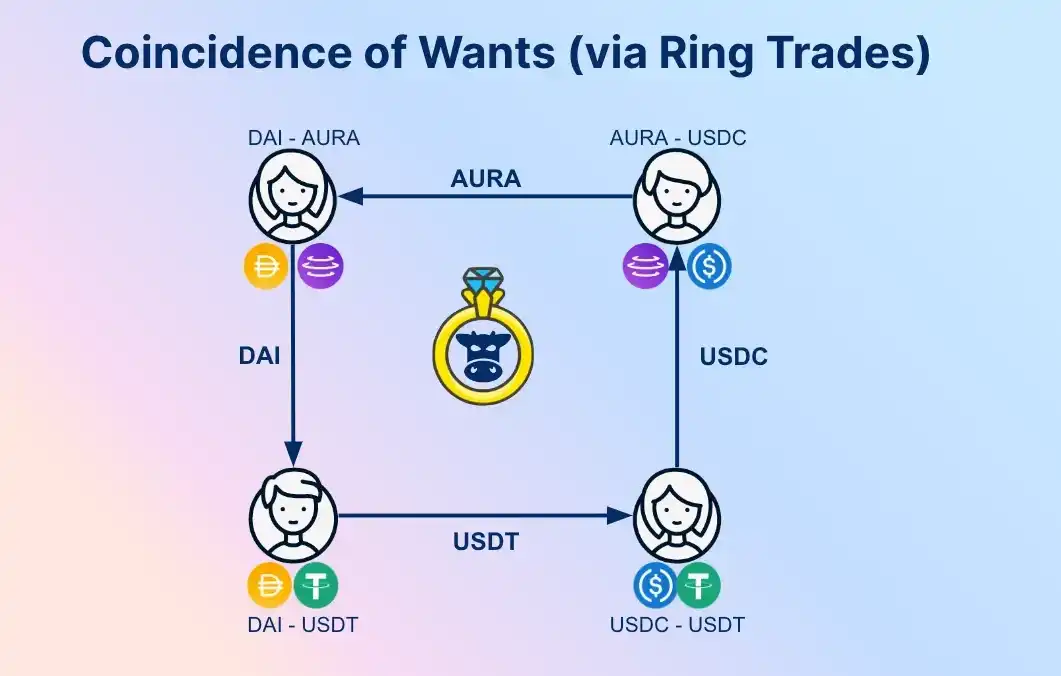
The corresponding is that traditional AMM needs to jump between different pools and routes. The more steps of jumping, the more expensive the handling fee is, and the ring transaction solves this problem well.
-- Price
Innovative trading mechanism: intention trading
CoW Protocol introduces a revolutionary trading method-intention trading. Instead of sending transactions directly, users submit a signed order, which is the so-called trading intention. This order precisely defines the assets that users want to trade within a specific time frame. It is worth noting that users do not need to care about the specific execution details of the transaction, such as slippage or the choice of liquidity pool. These signed orders are then passed off-chain to professional participants called Solvers. These solvers will compete fiercely during the order period, striving to find the best execution path, and the winning solver will win the right to execute the transaction.
This innovative mechanism brings significant improvements to the user experience: the Gas fee required for the transaction is borne by the Solver, which means that even if the transaction fails to be successfully executed (for example, a path that meets the promised price cannot be found before the deadline), the user does not need to pay any Gas fee, which effectively reduces the user's transaction risk.
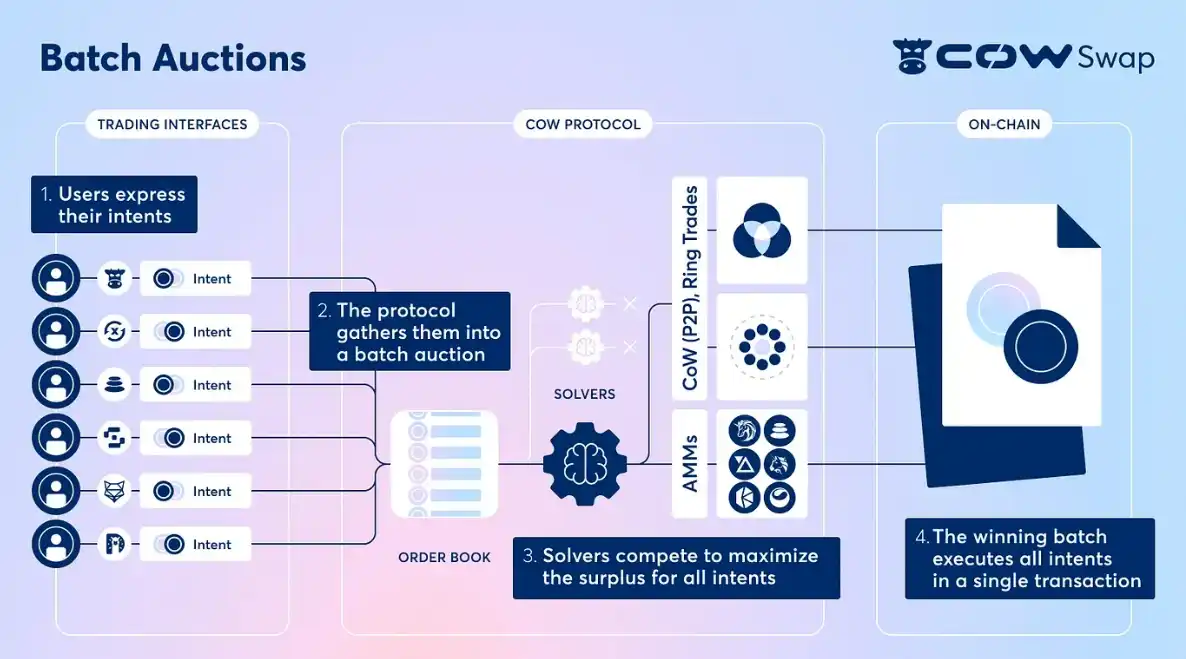
In the CoW Swap trading interface, users can clearly see the minimum guaranteed price they will get when executing a transaction. What's more exciting is that thanks to its unique batch trading and CoW (Coincidence of Wants) mechanism, traders can often get returns beyond their expectations. This pleasant phenomenon is officially called "Price Improvement", which further demonstrates CoW Swap's outstanding performance in improving user trading experience.
Economic model and market value
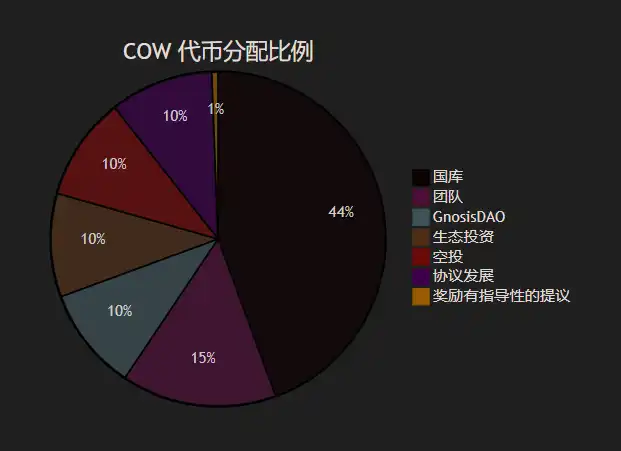
COW is the governance token of Cow Protocol, with a total of 1 billion tokens, 90.25 million tokens in circulation, accounting for 9.02% of the total tokens, and a market value of 142 million US dollars; the token distribution is as follows
· 44.4% belongs to the treasury
· 15% belongs to the team
· 10% belongs to GnosisDAO
· 10% for ecological investment
· 0.6% for rewarding guiding proposals
· 10% for airdrops
· 10% for protocol development
Governance:COW token holders can participate in CoW DAO
Incentive Mechanism: COW tokens are used to reward Solvers who provide the best transaction paths in the protocol, encouraging them to continuously optimize transaction execution and improve user experience.
Fee Allocation: CoW Protocol plans to introduce a protocol fee mechanism, and part of the revenue will be used to repurchase and destroy COW tokens, reduce market supply, and potentially increase token value.
Market Analysis and Price Prediction
Cow Swap stands out for its outstanding innovative performance, providing practical solutions for on-chain trading users in key areas such as MEV resistance, gas-free transactions, and advanced orders. With its superb design concept and excellent user experience, Cow Swap has performed well in the highly competitive DEX aggregator market. The latest data shows that the protocol's transaction volume exceeded the $3 billion mark last month, achieving a considerable revenue of $870,000, fully demonstrating its strong market appeal and growth potential.
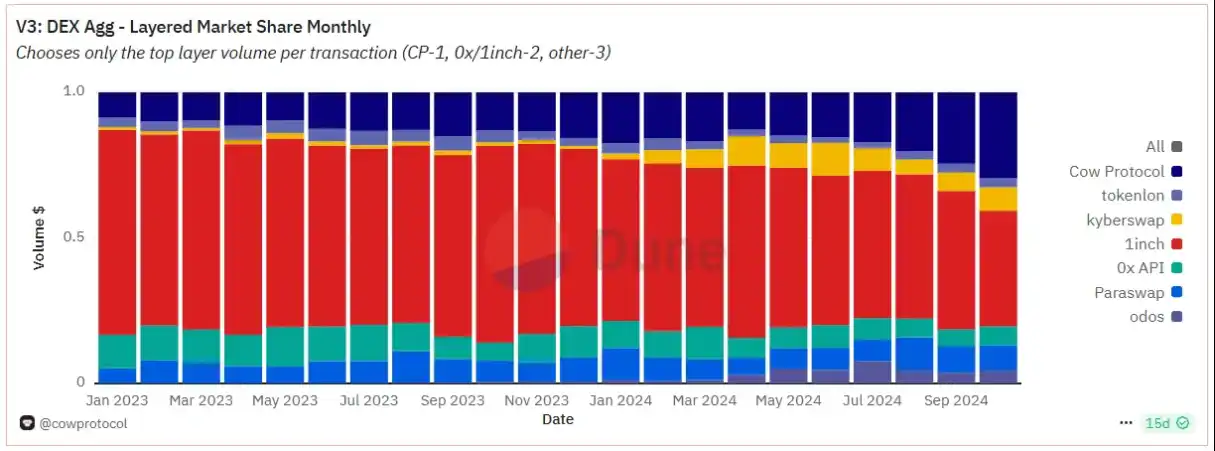
What is even more striking is that Cow Swap's market share in the field of aggregated trading has shown a steady upward trend. It has jumped from 17% at the beginning of the year to 30%, and the gap with the industry leader 1inch has narrowed to only 9 percentage points. However, despite Cow Swap's strong growth momentum, its current market value of US$140 million is still less than half of 1inch. This significant valuation difference has triggered market discussions about the underestimation of Cow Swap's potential value. Analysts generally believe that as Cow Swap continues to expand its market influence and further improve its ecosystem, its valuation is expected to increase significantly.
This content is provided for general informational purposes only and doesn't constitute financial, investment, legal, or tax advice. Any events, rewards, online promotions, or related information mentioned herein should not be considered a recommendation, solicitation, or invitation to purchase, sell, trade, or otherwise deal in any crypto assets. Crypto assets are highly volatile and may result in loss. The availability of WEEX services, products, and related events may vary by region. You are responsible for ensuring that your participation is in accordance with applicable local laws and regulations.
You may also like

Secret Network lost 4.67 million dollars due to a cross-chain vulnerability, and the attack went undetected for seven days
CoW Swap released a report on the attack incident, stating that the domain was hijacked for several hours, resulting in an estimated loss of 1.2 million dollars

A user lost approximately 50 million dollars in a single transaction due to slippage, and the founder of Aave stated that the interface had issued multiple warnings
Market Downturn: Which Assets Are Worth Watching?

Why Moderna (MRNA) Stock More Than Doubled: The INTerpath-001 Cancer Vaccine Result, Explained
Moderna shares more than doubled on 19 August 2026 after Merck and Moderna said the Phase 3 INTerpath-001 trial of intismeran autogene plus KEYTRUDA met its recurrence-free survival endpoint in resected melanoma. This page explains what the result is, why the stock reacted this hard, what is still unknown, which dates come next (presentation and earnings, both unconfirmed), and what a trader can actually do on WEEX — which does not list Moderna; the nearest instrument is the XBI-USDT biotech ETF perpetual. No price targets, no forecasts.
Web3: Foreign Media Reports that the Altcoin Market in 2026 May Depend on ISM Recovery

CoinFerenceX and the best event join forces to launch “CoinFerenceX The Best Event Singapore,” the decentralized summit

BCCC Introduces JPYC for Annual Membership Fee Payments

Modernizing Financial Infrastructure for Digital Assets by 2026

Web3: Foreign Media Reports Three Changes That May Boost SHIB
"I received an airdrop, but will I have to pay taxes next year?"... How to calculate in advance with a coin calculator

Critical Patch for Decred: Those Who Don't Update Risk a Network Fork

UnitedHealth Discloses Tax Dispute with the IRS

HeyBreez Raises $2.5 Million for Global Expansion in Voice AI

Web3 Wallets in a "Season of Turmoil": Understanding the Evolution of Crypto Security's "Sword and Shield" in the AI Era

Congress Members Raise Concerns Over AI Errors in New Legislation — Politico

Unitree Robotics Stock: How to Buy 688836 After Its 629% IPO Surge

DGrid AI: Reconstructing AI Infrastructure with On-Chain Verification and Open Markets
Ripple Prioritizes Institutional Financial Infrastructure Strategy Over IPO
Treasury Yields Surge to 5.3%, Hitting Tech Stocks WEEX TradFi Daily | Aug 19
Long-end U.S. Treasury yields surged to multi-year highs, pressuring technology, semiconductor, storage, and optical communication stocks and driving a clear cooling in market risk appetite. At the same time, Anthropic’s revenue came in below some bullish expectations, prompting investors to reassess the AI growth narrative; Unitree Robotics officially listed on the STAR Market, extending momentum in robotics and embodied AI; while SpaceX and other commercial space names showed relative resilience. Investors are now focused on tonight’s Federal Reserve minutes for clearer signals on the policy path and broader market sentiment.
ServiceNow Expands Security Portfolio with $7.75 Billion Acquisition

Ethereum’s 12-GPU proving problem just got a 4-GPU answer
How to Join WEEX 牛来 Airdrop: 50,000 USDT Rewards Guide

Fabrinet Earnings Beat Expectations: Why Did FN Stock Fall?
Non-consensus Decisions in the Robotics Sector: Why Sequoia Chose to Double Down on Yushu at Its Most Difficult Time?

牛来 Coin After the Rally: Opportunity or Meme Coin Risk?

AI: Five ECB Economists Consider a Correction of Tech Values Likely
Toyota Tokenized Bonds: Is 1 Billion Yen Finance Coming to Your Smartphone?
Is NEAR's trading volume at zero: can staking on NEAR Protocol revive it?
Crypto-Backed Loans in Australia: Rates Ranging from 0.9% to 21.9% with Nexo
Secret Network lost 4.67 million dollars due to a cross-chain vulnerability, and the attack went undetected for seven days
CoW Swap released a report on the attack incident, stating that the domain was hijacked for several hours, resulting in an estimated loss of 1.2 million dollars
A user lost approximately 50 million dollars in a single transaction due to slippage, and the founder of Aave stated that the interface had issued multiple warnings
Market Downturn: Which Assets Are Worth Watching?
Why Moderna (MRNA) Stock More Than Doubled: The INTerpath-001 Cancer Vaccine Result, Explained
Moderna shares more than doubled on 19 August 2026 after Merck and Moderna said the Phase 3 INTerpath-001 trial of intismeran autogene plus KEYTRUDA met its recurrence-free survival endpoint in resected melanoma. This page explains what the result is, why the stock reacted this hard, what is still unknown, which dates come next (presentation and earnings, both unconfirmed), and what a trader can actually do on WEEX — which does not list Moderna; the nearest instrument is the XBI-USDT biotech ETF perpetual. No price targets, no forecasts.
Web3: Foreign Media Reports that the Altcoin Market in 2026 May Depend on ISM Recovery