
x402 and AI Agents: An Emerging Data Economy

 Prefer us on Google


Original Title: An x402 Wishlist
Original Author: David Christopher, Bankless
Original Translation: Block unicorn
While reading a recent report released by Galaxy Research, I gained one of the clearest visions of the future value of x402.
One example that caught my attention: an AI agent helps a user book a trip, queries high-quality weather data through x402 to find the best date and destination, provides flight and hotel options, and then passes all information to the booking process. Each query is equivalent to a micropayment. Each data source gets rewarded. The AI agent aggregates all information and ultimately makes the booking decision.
What impressed me the most is the perfect integration of x402 with data aggregation and management. Someone aggregates disparate data sources into proprietary data, making it more valuable than any single provider and sells access through x402. Data managers incur integration costs only once. Callers pay per query. Everyone benefits from it (provided that the data volume is large enough, which we will discuss later).
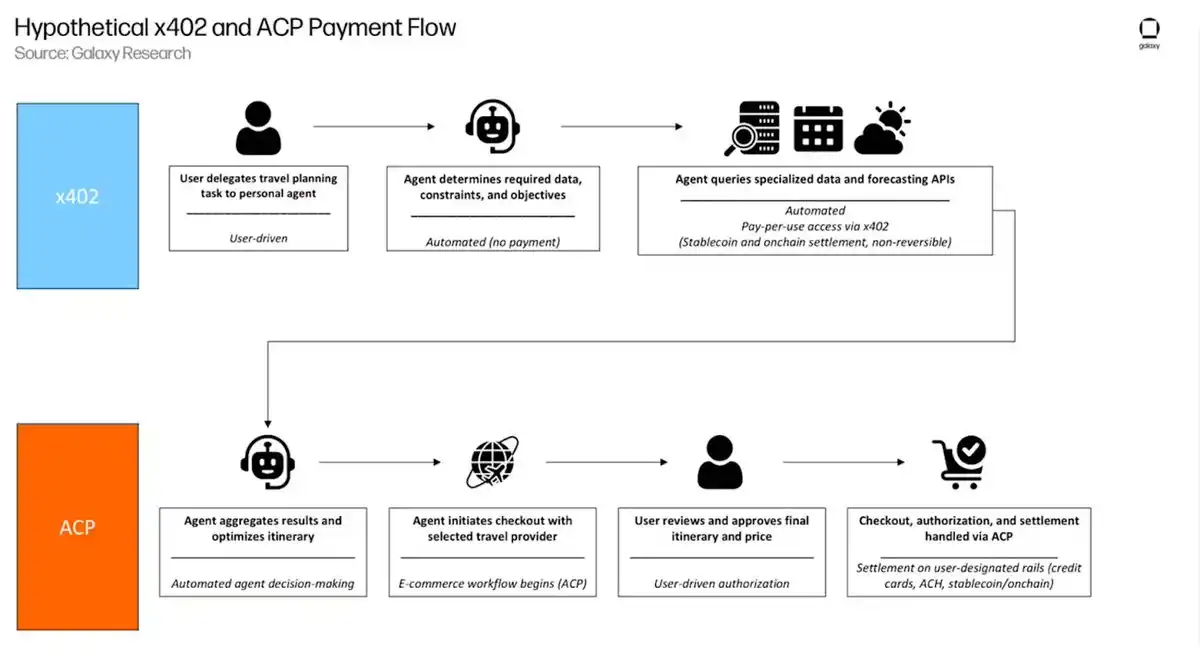
From Galaxy Research
Before similar services become widespread, I still believe x402 is in its early stages. If you are a developer who hopes to use x402 for development but is struggling with a lack of inspiration, here are some theoretical products I would eagerly try if I could use them immediately!
Skills Endpoint
A skill is a carefully crafted set of instructions by humans for an AI agent to perform a specific task.
Currently, most skill markets operate on a fixed fee model: prices for permanent access are $5, $15, and $20, respectively. This model creates a misalignment of incentives. Occasional users of skills overpay, while power users underpay, and skill creators cannot capture value proportional to usage. A truly useful skill, much like a truly useful consultant (if there ever was one), should be worth far more than a one-time $15.
x402 provides an alternative. Skill creators can publish their work through the x402 interface and price it on a case-by-case basis: pay-per-use (one-time), monthly subscription (new feature in x402 V2), or a combination of both. The payment system supports both models. Skills that are called thousands of times per month can generate ongoing revenue for creators. Skills with lower usage frequency do not require upfront payment from users.
Niche Cryptocurrency News Aggregator Pack
Cryptocurrency news is scattered across platforms like Twitter, Telegram groups, podcasts, RSS feeds, and Substacks. Tracking specific ecosystems becomes even trickier. Keeping up with all the developments in Sui or Starknet means monitoring a dozen sources and checking daily.
An x402 data feed tailored to an ecosystem can address this issue. Someone aggregates Twitter user profiles, articles from website RSS feeds, and Telegram messages into a curated feed for a specific ecosystem through an API. The query could be: "What has happened with Starknet in the last 24 hours?" with a structured response obtained. No more switching between tabs and apps.
Aggregating Ecosystem Data
Measuring developer activity has always been challenging.
Electric Capital's annual report and its continuously updated dashboard are excellent open-source resources, but they have limitations. For instance, I just looked at the ecosystem that topped the developer growth charts in the past year, and it showed PancakeSwap, Monad, and Aleo. This is, of course, because I filtered for one metric—however, it also reflects a broader issue: developer activity data in the cryptocurrency space is highly fragmented, with no single source offering a comprehensive view.
If there were an x402 data source that aggregated Electric Capital data, GitHub activity, Artemis metrics, and protocol-specific sources into a quality-weighted developer activity stream, it would fill a real void. An agent could query: "How has Solana's developer momentum been in the past quarter?" and receive information more valuable than raw commit counts.
-- Price
Newsletter and Podcast Performance Tracker
One idea I personally would use is to offer a service that can clearly track the points raised in a podcast or news briefing and measure their evolution.
Citron has done something similar in the stock market by releasing its annual forecast scorecard and performance at year-end. However, for most news briefings and podcasts, if you want to know if a media outlet's predictions have actually been profitable over time, you can only manually research this.
An x402 service could benchmark media predictions to fill this gap. Just provide a news briefing or podcast, and it will track each prediction, add a timestamp, monitor subsequent price movements, and rate the media's past performance. Query: "How has Media X's asset forecasting performed over the past year?" and get a verified answer.
Security and Audit Tracker
Protocols usually do not proactively announce when they come under attack. Moreover, the news cycle is fast-paced, and if you were not online on the day a vulnerability occurred, you likely missed it entirely. By the time you need to take action, what should have been a significant event has long been overshadowed by weeks of news coverage.
The situation with security audits is no better. Audit reports are scattered across audit firm websites, protocol documentation, and GitHub code repositories. Reviewing an audit history for a protocol is much more challenging than imagined.
If there could be an x402 feed aggregating this information into a searchable endpoint, users could access this feed for just a few extra cents before deciding on profit sharing, especially when operating through a proxy interface.
Is this really feasible?
All the points I mentioned above have two main questions: Can the economic benefits support the teams building these feeds? Can they legally develop them?
In terms of economic benefits, historical experience is not optimistic. Since the early days of the internet, the pay-per-project model has always struggled. The cognitive cost of deciding if something is worth paying for often exceeds the cost of payment itself. This is why the internet has shifted to a subscription model: predictable bills, avoidance of decision fatigue, and reduced user churn.
However, the advent of proxies has changed everything. You top up your wallet, the proxy consumes on your behalf, and you top up again when the balance is low. The operation of API points is similar. The question has shifted from "Are these few cents worth it?" to "Can the endpoint provider recoup costs in a scalable application?" This depends on the traffic.
In terms of legality, x402 is responsible for handling payments and metering. It does not alter the upstream data ownership. If using an authorized API, public data, or a first-party x402 endpoint, this is just straightforward product development. However, if relying on web scraping or operating in a gray area of terms of service, persistence and scale may be limited. Once the upstream provider discovers and objects, you are in the danger zone.
x402 V2 introduces dynamic payment routing, enabling revenue sharing. Data stewards can return a portion of the revenue to the original data provider, aligning incentives between both parties and transforming potential terms-of-service conflicts into a cooperative relationship, albeit at the cost of reduced profit margins.
Whether the economics and legality can both scale remains to be seen. But if they do, those are the data streams I would be willing to pay for.
Whether this economic and legal mechanism can operate effectively at scale in production is yet to be seen. But if it does, those are the data streams I would be willing to pay for.
This content is provided for general informational purposes only and doesn't constitute financial, investment, legal, or tax advice. Any events, rewards, online promotions, or related information mentioned herein should not be considered a recommendation, solicitation, or invitation to purchase, sell, trade, or otherwise deal in any crypto assets. Crypto assets are highly volatile and may result in loss. The availability of WEEX services, products, and related events may vary by region. You are responsible for ensuring that your participation is in accordance with applicable local laws and regulations.
You may also like

Kylie Jenner Deletes Solana Meme Coin Post on X Account

Fidelity allows 100% crypto staking for ETFs with exit delay risks

Solana Fee Vote: Resource Charging Proposal Under Review

Solana stakers face yield cuts as a treasury firm fights to protect 99.4% of its revenue

SUI Enhances AI Wallet Functionality with Introduction of Squid Mode
Solana Prepares to Expand v1 Transaction Limit to 4096 Bytes
Solana DApp Revenue Reaches $35 Million, Hitting a 29-Week High

Virtuals Supports Agent Token Issuance on Solana

New Issuance of 250 Million USDC on Solana
Allegations of FOMO App Hacking Spark Controversy Over 662 SOL Transfer Records

Flowra launches Open Orderflow Auction for Solana validators

Solana Burn Surges to 87,000 SOL: Does This Change Token Scarcity?

Solana RWA Total Value Reaches $4 Billion, Number of Holders Surpasses 350,000

Solana Network REV Surpasses $1 Million, Reaches Six-Month High

Stablecoin Card Recharge Amount Increases by 38% in One Year, Reaching $13.8 Billion

Shinhan Financial Group Partners with Solana for KRW Tokenized Fund Verification

Phantom ends Sui support on Sept. 24

Voting Open for Solana Validator Governance Proposals SGP-0001 to SGP-0003
Solana Co-founder Calls PRAW the Best Base Fee Proposal

Bitwise Asset Management Secures 1.8 Billion in H1 2026

Crypto: Solana Reduces Block Creation Time to 350 Milliseconds
Brave Browser Reaches 122.6 Million Monthly Active Users, BAT Demand Fails to Keep Up

Solana Tokenized Stock Deposits Reach $75.4 Million, Ranking First

Cardano Development Transitions to External Teams: Input Output Reduces Its Role in the Network

Bonk Guy: Major Public Chains Compete for Retail Investors and Liquidity
Circle Tokenized Stocks Market Cap Increases by $47.6 Million

SOL Spot ETF Sees Daily Net Inflow of $10.072 Million

Etherscan Integrates Web3 Identity Cards into Wallet Address

SOL Treasury Company Supports Solana Constitution, Opposes Inflation and Fee Adjustments
Illuvium Team Cuts Wages To Extend Runway
Kylie Jenner Deletes Solana Meme Coin Post on X Account
Fidelity allows 100% crypto staking for ETFs with exit delay risks
Solana Fee Vote: Resource Charging Proposal Under Review
Solana stakers face yield cuts as a treasury firm fights to protect 99.4% of its revenue
SUI Enhances AI Wallet Functionality with Introduction of Squid Mode
Solana Prepares to Expand v1 Transaction Limit to 4096 Bytes

Contents
Latest articles



Latest coin listings on WEEX


