
POLYX Price Prediction: Can Polymesh Reach $1 in 2026?


KEY TAKEAWAYS
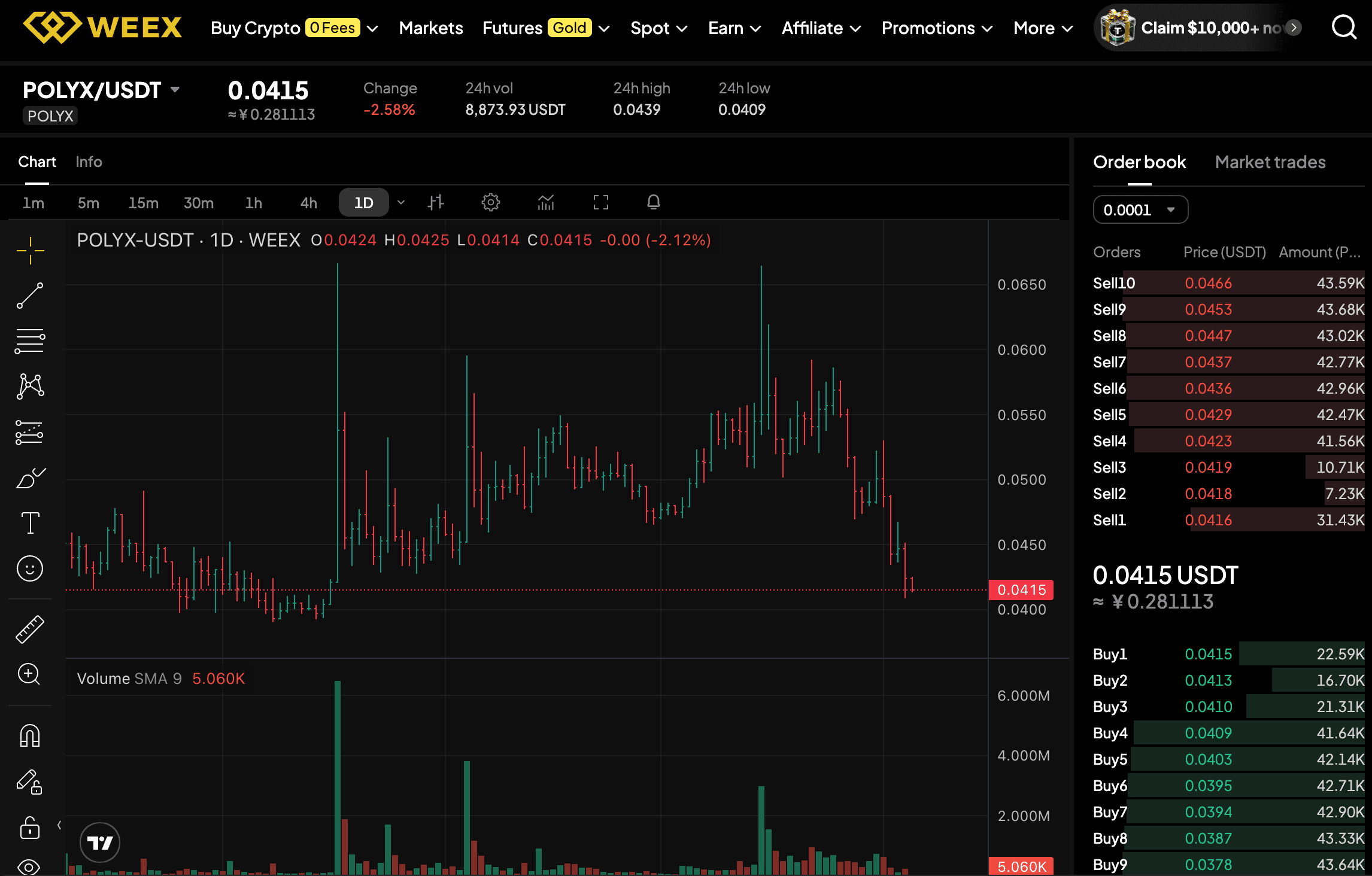
- POLYX trades around $0.0415, meaning a move to $1 would require roughly a 24x rally from current levels.
- At $1, POLYX would imply a circulating market cap of about $1.04 billion based on roughly 1.04 billion tokens in circulation.
- Using a total supply near 1.27 billion POLYX, a $1 price would imply a fully diluted valuation of about $1.27 billion, although POLYX does not have a fixed maximum supply.
- Polymesh is an institutional-focused blockchain built for regulated assets, security tokens, identity, compliance, governance, and settlement.
- POLYX reaching $1 in 2026 is possible only under a strong bull-market scenario with renewed demand for real-world asset and regulated-finance infrastructure tokens.
Users who want to monitor Polymesh directly can check the POLYX/USDT spot pair on WEEX, where POLYX is available for trading against USDT. This gives WEEX users a direct market page to review price movement, liquidity, and trading activity before making any decision.
What is Polymesh?
Polymesh is a blockchain built for regulated assets and institutional finance use cases. Instead of focusing mainly on general-purpose smart contracts or meme-driven activity, Polymesh is designed around identity, compliance, governance, settlement, and asset issuance.
The network is often discussed in connection with security tokens, tokenised securities, real-world assets, capital markets infrastructure, and regulated financial products. That gives Polymesh a different market identity from broader Layer 1 chains that focus on DeFi, NFTs, gaming, or consumer apps.
POLYX is the native token of the Polymesh network. It is used for transaction fees, staking, governance participation, network security, and blockchain operations. For beginners, POLYX is not only a speculative ticker. Its long-term value story depends on whether Polymesh can attract real institutional and regulated-asset activity.
POLYX price today and market data
As of early June 2026, POLYX trades around $0.0415. Its market cap is near $43 million, with daily trading volume in the multi-million-dollar range. The circulating supply is roughly 1.04 billion POLYX, while total supply is around 1.27 billion tokens.
These numbers matter because POLYX is still a relatively small asset compared with major Layer 1 and RWA tokens. A lower market cap gives it more upside room than large-cap assets, but it also comes with higher volatility and weaker liquidity.
POLYX previously traded much higher during stronger market conditions, with its past high below $1 but close enough to make the $1 target psychologically important. However, past highs do not guarantee future recovery. The market needs a fresh reason to value POLYX more highly.
Can POLYX reach $1 in 2026?
POLYX can reach $1 in theory, but it is an aggressive target for 2026.
From around $0.0415, POLYX would need to rise by roughly 24x to reach $1. That is a major rally. It is not impossible for a smaller crypto asset during a strong bull market, but it requires more than ordinary price momentum.
For POLYX to reach $1, the real-world asset and tokenised securities narrative would likely need to strengthen. Polymesh would also need broader market visibility, stronger liquidity, more user activity, and clearer demand for its regulated-asset infrastructure.
Without those conditions, $1 looks difficult within a single year. A move toward $0.10 or $0.20 would already represent meaningful recovery from current levels.
The math behind $1 POLYX
The $1 target becomes clearer when looking at the numbers.
If POLYX trades around $0.0415, reaching $1 would require a gain of roughly 24 times. That is a large move, especially for a token that already has more than 1 billion coins in circulation.
Using a circulating supply of about 1.04 billion POLYX, a $1 price would imply a circulating market cap of about $1.04 billion. Using a total supply near 1.27 billion POLYX, the fully diluted valuation would be about $1.27 billion.
That valuation is not impossible in crypto, but it is demanding. POLYX would need to move from a smaller RWA infrastructure token into a much more widely followed market asset. The lack of a fixed maximum supply also means traders should monitor future issuance and staking-related supply growth.
What could help POLYX reach $1?
The first factor is stronger real-world asset momentum. If tokenised securities, regulated assets, and on-chain capital markets become major themes again, Polymesh could benefit because its network is built specifically for that category.
The second factor is institutional interest. Polymesh’s value proposition depends heavily on regulated finance use cases. More institutional participation, asset issuance, or compliance-focused blockchain activity could strengthen the POLYX narrative.
The third factor is market liquidity. POLYX would need higher trading volume and deeper order books to support a larger move. Stronger exchange access and more active markets could help.
The fourth factor is a broader altcoin bull market. Smaller infrastructure tokens often need strong overall risk appetite before traders are willing to price in aggressive upside scenarios.
What could stop POLYX from reaching $1?
The biggest obstacle is the required multiple. A roughly 24x move is a large rally, even for a smaller token. It requires sustained buying demand, not just a short-term spike.
The second risk is competition. Polymesh competes with other RWA networks, tokenisation platforms, Layer 1 chains, compliance-focused infrastructure projects, and traditional financial technology providers.
The third risk is adoption speed. Regulated-asset infrastructure can take longer to grow than meme coins or consumer crypto apps because institutions move slowly and compliance requirements are complex.
The fourth risk is supply. POLYX does not have a fixed maximum supply, so future issuance and staking rewards can affect valuation. Supply growth is not automatically bad, but demand must grow fast enough to absorb it.
How beginners can evaluate POLYX
Beginners should start with market cap and supply. POLYX may look cheap by unit price, but with more than 1 billion tokens circulating, a $1 target already implies a billion-dollar valuation.
Next, review Polymesh adoption. Look at whether the network is gaining activity from regulated assets, tokenised securities, identity tools, governance usage, and institutional infrastructure.
Then compare POLYX with other real-world asset and tokenisation tokens. A strong POLYX thesis should explain why Polymesh can stand out in a crowded sector.
Finally, watch liquidity. If trading volume remains thin, price moves may be unstable. A serious move toward $1 would likely need much stronger market depth.
How to trade POLYX on WEEX
POLYX is available on WEEX through the POLYX/USDT spot market. Users can monitor price action, review market conditions, and trade POLYX against USDT where supported.
A simple process for WEEX users:
- Create or log in to a WEEX account.
- Deposit USDT or another supported crypto asset.
- Search for the POLYX/USDT trading pair.
- Choose a market order for immediate execution or a limit order for a selected price.
- Monitor the position, manage risk, or withdraw assets to self-custody if preferred.
Users researching the WEEX ecosystem can also review WEEX Token (WXT), the platform token of WEEX. New users may also check the WEEX welcome bonus, which may include trading bonuses, coupons, or task-based rewards tied to account setup, deposits, or trading activity.
Conclusion
Can POLYX reach $1 in 2026? It is possible in theory, but it is not a conservative target.
At around $0.0415, POLYX would need to rise roughly 24x to hit $1. That would imply a circulating market cap of about $1.04 billion and a fully diluted valuation near $1.27 billion based on total supply. Those numbers are achievable only if the market becomes much more bullish on Polymesh and regulated-asset infrastructure.
For WEEX users, the balanced view is simple. POLYX has a real utility story because Polymesh focuses on regulated assets, identity, compliance, and tokenised securities. But $1 in 2026 depends on adoption, liquidity, RWA market momentum, and whether traders return to smaller infrastructure tokens.
FAQ
1. What is POLYX?
POLYX is the native token of Polymesh, a blockchain designed for regulated assets, tokenised securities, compliance, identity, governance, and settlement.
2. Can POLYX reach $1 in 2026?
POLYX can reach $1 only under a strong bullish scenario. From around $0.0415, it would need to rise roughly 24x.
3. What market cap would POLYX need to reach $1?
With about 1.04 billion POLYX in circulation, a $1 price would imply a circulating market cap of about $1.04 billion.
4. What would POLYX’s FDV be at $1?
Using total supply near 1.27 billion POLYX, a $1 price would imply a fully diluted valuation of about $1.27 billion. Because POLYX does not have a fixed maximum supply, users should also monitor future issuance.
5. Why are traders watching POLYX?
Traders watch POLYX because Polymesh is tied to regulated assets, real-world asset tokenisation, security tokens, and institutional blockchain infrastructure.
6. What could help POLYX rise?
Stronger RWA demand, more institutional use, higher network activity, better liquidity, and a broader altcoin bull market could support POLYX demand.
7. What are the main risks of POLYX?
Main risks include slow adoption, competition, supply growth, weak liquidity, market volatility, and the possibility that regulated-asset tokenisation grows more slowly than traders expect.
8. Can users trade POLYX on WEEX?
Yes. POLYX is available on WEEX through the POLYX/USDT spot market.
DISCLAIMER: WEEX and affiliates provide digital asset exchange services, including derivatives and margin trading, only where legal and for eligible users. All content is general information, not financial advice. Seek independent advice before trading. Cryptocurrency trading is high risk and may result in total loss. By using WEEX services you accept all related risks and terms. Never invest more than you can afford to lose. See our Terms of Use and Risk Disclosure for details.
You may also like

Inside HBF: How SanDisk's High Bandwidth Flash Loads LLMs Straight Onto Hardware
What is HBF (High Bandwidth Flash)? Inside SanDisk and SK hynix's new AI memory technology that loads LLMs directly on hardware to cut inference lag, with timeline, specs, and how it differs from HBM.
Missed NVDA? Why SNDK's $1,500+ Surge Could Be the Start of the AI Storage Supercycle
Missed NVDA? See why SanDisk (SNDK) stock surged past $1,500 toward $2,000 in 2026, the AI storage supercycle driving NAND prices, analyst price targets, and key risks before you trade.
Elon Musk Reclaims Trillionaire Status: What It Means for Tesla and SpaceX Stock
Both Tesla and SpaceX stocks rallied in tandem on June 29, lifting Elon Musk back above the trillionaire…
SPCX Stock 52-Week Range: What $147 to $225 Tells You About Investor Sentiment
SPCX Stock shows a 52-week range from $147.11 (June 23) to $225.64 (June 16). That is a dramatic…
SPCX Stock and Government Contracts: How Much of SpaceX’s Revenue Actually Comes From NASA
SPCX stock is a popular search for investors hunting SpaceX exposure. While SpaceX remains private, understanding its revenue…
SPCX Stock Net Loss Explained: Why SpaceX Lost $4.28 Billion Last Quarter
SpaceX reportedly posted a $4.28 billion net loss last quarter, a sharp jump from a $0.528 billion loss…
Is Tesla Stock a Buy Before Q2 Delivery Numbers?
Tesla stock is heading into Q2 delivery numbers with a raised bar—and that’s the real story. Two major…
SPCX Stock Insider Lockup: What Happens When Early Investors Can Finally Sell
SPCX Stock is approaching a key phase: the insider lockup window. This article explains how lockup expiration can…
Should You Buy Amazon Stock Now? AI Boom and 2026 Forecast
Explore Amazon Stock (AMZN) outlook for 2026 and beyond, including AI growth, AWS expansion, retail performance, and key risks shaping future market expectations.
USWR Crypto Price Analysis 2026: Can USWR Memecoin Reach $1?
USWR crypto price analysis 2026: Can this AI-water narrative memecoin sustain momentum? Get USWR price targets, tokenomics, and key risks before investing.
$AI Airdrop on WEEX: Complete Guide to Gensyn and Claim Free $AI
Learn Gensyn tokenomics, machine-intelligence network utility, and how to claim free tokens in the WEEX 50,000 USDT AI airdrop before July 7, 2026.
What is NuScale Power(SMR) Coin: Comprehensive Guide to SMR/USDT Perpetual Futures and Investment Insights
This guide explains what NuScale Power (SMR) “coin” means in crypto markets, how SMR/USDT futures work, and practical…
What is NuScale Power(SMR) Coin: everything you need to know and how to trade SMR/USDT futures
This guide explains what NuScale Power (SMR) means for crypto market participants, how SMR/USDT derivatives work, and how…
What is Arista Networks(ANET) Coin: a comprehensive guide for USDT-settled stock futures traders
Arista Networks (ANET) on WEEX refers to a USDT-settled stock futures market that tracks the price of Arista…
SPCX Stock and the Cathie Wood Sell-Off: Why ARK Invest Is Cutting Its Position
SPCX stock drew fresh attention after ARK Invest trimmed its position as the price slid from around $225…
SPCX Stock vs AST SpaceMobile: Is There a Better Way to Play Satellite Connectivity?
SPCX Stock and AST SpaceMobile represent two very different paths to bet on satellite connectivity. SPCX Stock is…
SPCX Stock and the Charter Communications Deal: What a Mobile Partnership Would Mean
SPCX stock jumped after reports that SpaceX and Charter Communications discussed a mobile partnership. This piece explains what…
What is Hela Wood(HWOOD) Coin? Everything you need to know about the GameFi resource token and where to buy
Hela Wood (HWOOD) is the in-game resource token of World of Hela, newly listed on WEEX with HWOOD/USDT…
Inside HBF: How SanDisk's High Bandwidth Flash Loads LLMs Straight Onto Hardware
What is HBF (High Bandwidth Flash)? Inside SanDisk and SK hynix's new AI memory technology that loads LLMs directly on hardware to cut inference lag, with timeline, specs, and how it differs from HBM.
Missed NVDA? Why SNDK's $1,500+ Surge Could Be the Start of the AI Storage Supercycle
Missed NVDA? See why SanDisk (SNDK) stock surged past $1,500 toward $2,000 in 2026, the AI storage supercycle driving NAND prices, analyst price targets, and key risks before you trade.
Elon Musk Reclaims Trillionaire Status: What It Means for Tesla and SpaceX Stock
Both Tesla and SpaceX stocks rallied in tandem on June 29, lifting Elon Musk back above the trillionaire…
SPCX Stock 52-Week Range: What $147 to $225 Tells You About Investor Sentiment
SPCX Stock shows a 52-week range from $147.11 (June 23) to $225.64 (June 16). That is a dramatic…
SPCX Stock and Government Contracts: How Much of SpaceX’s Revenue Actually Comes From NASA
SPCX stock is a popular search for investors hunting SpaceX exposure. While SpaceX remains private, understanding its revenue…
SPCX Stock Net Loss Explained: Why SpaceX Lost $4.28 Billion Last Quarter
SpaceX reportedly posted a $4.28 billion net loss last quarter, a sharp jump from a $0.528 billion loss…