
What is International Oil Supply (IOS) Coin?

You see a token named International Oil Supply. Sounds official. Sounds like oil reserves, supply chains, real energy data on-chain.
But here’s the first thing you need to know: IOS crypto is not a verified oil-backed token. The project says so itself in its own disclaimer—it's an independent community project.
That doesn't make it a scam. But it does mean you should treat the oil narrative as a concept, not a confirmed fact.

What Is IOS Crypto?
International Oil Supply (IOS) runs on Solana. The idea: use blockchain to record oil reserve data, supply chain logs, and energy verification. Think of it as an experiment in making energy data transparent.
But here's the gap—what is IOS crypto actually used for right now? Based on public info, the working product isn't visible yet. You'll find a website, a token address, tokenomics, and a roadmap. What you won't easily find: verified team identities, audits, energy partnerships, or proof of real oil reserve access.
So if someone asks "is IOS coin safe," the honest answer is: not enough proof yet.
IOS Crypto Details
Fake tokens are everywhere. For IOS, the reported contract address is:
ioSEni9v3w2avsHAYMdpiewfnayykfWQPsE73cX4Jh7
Before buying International Oil Supply (IOS) coin, check this address on Solana explorer, the project's site, and DEX tracker. One wrong move and you're holding a copycat token. That's not FUD—that's basic crypto hygiene.
What Is IOS Token Used For?
The project says IOS will be used for:
- Public ledgers of oil reserves
- Supply chain custody records
- Validator activity on Solana
But here's where what is IOS crypto gets tricky: most of this isn't live yet. You're not buying oil rights. You're not getting energy revenue. You're buying a narrative token that aspires to connect with energy data.
For now, treat the use case as speculative. If real dashboards and independent validators show up later, that changes the picture.
International Oil Supply (IOS) Tokenomics
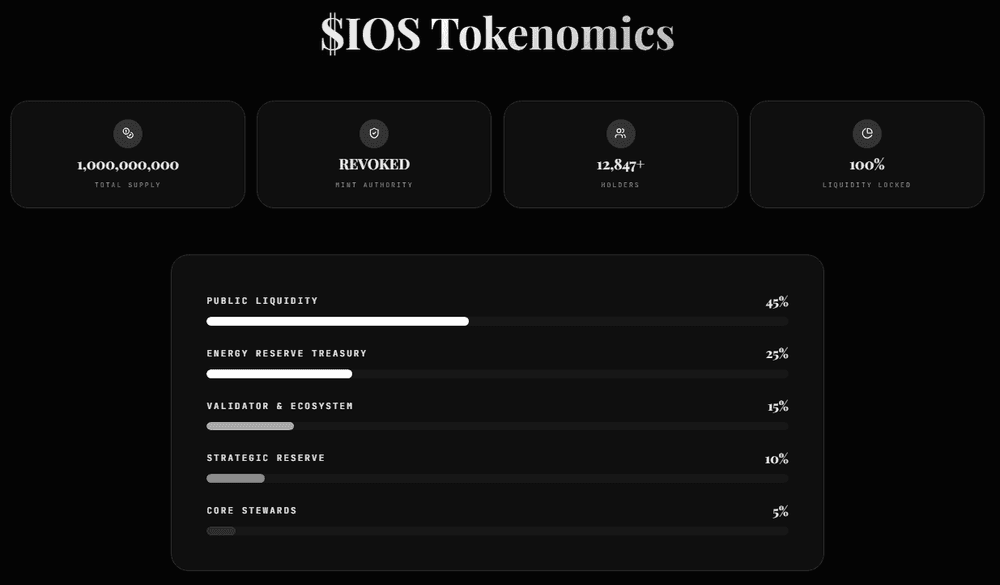
Total supply: 1,000,000,000 IOS
Allocation:
- Public Liquidity: 45%
- Energy Reserve Treasury: 25%
- Validator & Ecosystem: 15%
- Strategic Reserve: 10%
- Core Stewards: 5%
The project claims mint authority is revoked and liquidity is locked. That's good if true. But don't just read it—verify it on Solana explorers. Check if large treasury wallets can move tokens. See if vesting is transparent.
IOS tokenomics on paper means nothing unless on-chain data backs it up.
Is IOS Crypto Safe?
Let's be direct. Is IOS coin safe? Right now, too many pieces are missing:
- No verified team identities
- No independent audit
- No public proof of oil reserve partnerships
- No working product dashboard
- Liquidity lock needs on-chain confirmation
The project's own disclaimer admits it's an independent community project. That's actually rare honesty. But honesty about being unverified doesn't make something safe—it just means you know the risk going in.
For beginners: avoid rushing into IOS just because the name sounds official or the chart moves fast.
Conclusion
International Oil Supply (IOS) is a Solana token with an energy-data concept. It has a public contract address, clear tokenomics, and a roadmap. It also has a disclaimer admitting it's not an official oil-backed project. So if you're asking "what is IOS crypto" as a trader, treat it as high-risk, unverified, and narrative-driven. If you're asking as an investor, wait for audits, team transparency, and a working product.
Before you buy IOS, do three things. First, verify the contract address directly on a Solana explorer—don't trust a screenshot. Second, check liquidity and holder distribution live; thin pools and concentrated wallets add risk. Third, read the project's own disclaimer carefully, then decide if that level of uncertainty fits your tolerance.
Ready to trade? WEEX offers zero fees, instant execution, and the security you need. Sign up on WEEX Now and Start Trading!
FAQ
What is International Oil Supply (IOS) crypto?
IOS coin is a Solana-based token built around an energy supply and oil reserve verification concept. The project says it's an independent community initiative, not a verified oil-backed asset.
What is the IOS token contract address?
The reported address is ioSEni9v3w2avsHAYMdpiewfnayykfWQPsE73cX4Jh7. Always verify this on a Solana block explorer and official project channels before trading.
Is International Oil Supply (IOS) crypto a real oil-backed token?
No. There is no verified public information confirming that IOS is legally backed by physical oil or gives holders rights to oil reserves. The project's own disclaimer states it's an independent community project.
Is IOS coin safe to buy?
Not enough public verification yet. Key missing pieces include team identities, independent audits, proof of energy partnerships, and a working product. Only suitable for users who understand high-risk crypto trading.
Latest Updates on WEEX
If you want to buy WXT now, you can sign up for a WEEX account.
Welcome Bonus from WEEX — Claim Up to 30,000 USDT! Join Now!
You may also like
What Is SAOS? Strategic American Oil Supply Token Explained
SAOS is a meme token on Solana with a 75,000 USD market cap and 22,000 USD locked liquidity, positioned around oil supply themes but lacking real asset backing
It thrives on pure narrative speculation, with no utility, website, or doxxed team, making it highly volatile and attention-dependent
Traders should distinguish SAOS from legitimate real-world asset projects, as its branding is speculative rather than substantive
Positive aspects include locked liquidity reducing rug pull risks, but low trading activity signals high uncertainty
How to Buy Public Asset Control (PAC) Token in 2026: Latest Solana Buying Guide
How to buy Public Asset Control (PAC) token in 2026, PAC contract address, Solana wallet setup, Jupiter swap guide, latest price, liquidity, and risks.

What Is Public Asset Control (PAC) Token and How Does It Work? Latest Solana PAC Token Guide
Public Asset Control (PAC) token explained. Learn what PAC is, how it works on Solana, current price snapshot, risks, and buying basics.

Can PAC Coin Reach $1 Soon? Analyzing Public Asset Control
PAC is a Solana-based meme token with a government-themed narrative, but it is highly speculative.
At its current price (~$0.0009) and 1B supply, reaching $1 would require a $1B market cap, which is very unlikely.
Short-term moves to $0.001 or $0.01 are more realistic, but the token is highly volatile due to low liquidity and hype-driven trading.
Overall, $1 is not a realistic target, and PAC is better suited for short-term speculation than long-term investment.

United Nations Oil Reserve (UNOS) Crypto: Solana Token, UN Links, and Risks
United Nations Oil Reserve (UNOS) Crypto explained: Solana token basics, UN links, oil-backing claims, market risks, contract checks, and buying cautions.
What Is Public Asset Control (PAC) Coin? Explained for Beginners
Public Asset Control (PAC) is a Solana-based token that uses a “government asset control” narrative involving oil and gold themes, but it has no verified ties to any real institutions or governments. It is mainly an entertainment-focused, speculative meme coin.
The project’s claims about links to entities like BlackRock or Palantir are unverified, and its own disclaimer states it is not a real financial or institutional asset. Like many new Solana tokens, PAC is highly volatile, with low liquidity and limited transparency, including no fully verified audit.
Overall, PAC is a high-risk speculative token driven by hype and storytelling rather than real utility. Beginners are advised to be cautious, verify contract details, and prioritize risk control before considering any trading.
What Is Official Saudi Oil Reserve (OSOR) Coin?
Learn what OSOR coin is, why its Saudi oil narrative matters, how to verify the contract, and what risks to check before trading.

Global Digital Oil Reserve (GDOR): What It Is, Risks, and How to Check It
Global Digital Oil Reserve (GDOR) is an oil-themed Solana token with unclear backing. Learn its risks, market data, and verification checklist.

Is OBC Crypto a Good Investment?
Is OBC crypto a good investment? We analyze the latest market data, holder concentration, liquidity risks, and short-term momentum. Read this before you invest in OBC token.

Can OSOR Reach $1? Full Price Analysis 2026
OSOR crypto price prediction 2026: Can Saudi Oil Reserve token reach 1? Read before buying.

What Is the Unified International Token (UNIT)? Is UNIT Crypto Legit or Scam?
what is UNIT crypto? Here’s a breakdown of the Unified International Token ($UNIT), how it ties to BRICS+ data, where to buy it, and why it’s a conceptual project—not an official currency.
What Is Stablecoin Business OS (SBOS) Coin?
What is SBOS crypto? We break down Stablecoin Business OS, its USDC invoicing tools, AI finance assistant, token contract address, and real utility for online businesses.

World Collective Oil Reserve ($WCOR) Price Prediction: May 2026 Rally Analysis and Future Outlook
Is $WCOR a good investment? Read our comprehensive World Collective Oil Reserve price prediction and market analysis for 2026-2030. Learn about the energy narrative on Solana and start your trading journey with WEEX rewards.

Is $PAC Token a Good Investment in 2026? Price, Risks, and Market Analysis
A data-driven analysis of Public Asset Control (PAC) token: current price, market cap, liquidity, $1 target feasibility, and risk factors. Is it a legitimate investment or a high-risk meme coin?
OPG Airdrop: Share 50,000 USDT and Enjoy 0-Fee Trading on WEEX
Join the OPG airdrop on WEEX to share a 50,000 USDT prize pool. New users earn rewards through spot trade and deposits. Trade OPG with zero fees now.

Is OSOR Token Next 10X Like WCOR or Just Market Hype?
Is OSOR the next 10X crypto like WCOR or just market hype? Compare OSOR vs WCOR on-chain data, price discrepancies, and holder risks in this deep dive into Saudi oil-backed tokens.
NEAR Airdrop: Join WEEX to Share 50,000 USDT in Crypto Rewards
Join the NEAR airdrop on WEEX from May 7 to May 14 to share a 50,000 USDT prize pool. New users can earn rewards through deposits and spot trades with zero-fee trading advantages.
What Is $PAC Token? Legitimate Crypto or Just A High-Risk Meme Coin?
Is Public Asset Control ($PAC) a real asset-backed token or just another meme coin narrative? We analyze its official website, market data, and risks.
What Is SAOS? Strategic American Oil Supply Token Explained
SAOS is a meme token on Solana with a 75,000 USD market cap and 22,000 USD locked liquidity, positioned around oil supply themes but lacking real asset backing
It thrives on pure narrative speculation, with no utility, website, or doxxed team, making it highly volatile and attention-dependent
Traders should distinguish SAOS from legitimate real-world asset projects, as its branding is speculative rather than substantive
Positive aspects include locked liquidity reducing rug pull risks, but low trading activity signals high uncertainty
How to Buy Public Asset Control (PAC) Token in 2026: Latest Solana Buying Guide
How to buy Public Asset Control (PAC) token in 2026, PAC contract address, Solana wallet setup, Jupiter swap guide, latest price, liquidity, and risks.
What Is Public Asset Control (PAC) Token and How Does It Work? Latest Solana PAC Token Guide
Public Asset Control (PAC) token explained. Learn what PAC is, how it works on Solana, current price snapshot, risks, and buying basics.
Can PAC Coin Reach $1 Soon? Analyzing Public Asset Control
PAC is a Solana-based meme token with a government-themed narrative, but it is highly speculative.
At its current price (~$0.0009) and 1B supply, reaching $1 would require a $1B market cap, which is very unlikely.
Short-term moves to $0.001 or $0.01 are more realistic, but the token is highly volatile due to low liquidity and hype-driven trading.
Overall, $1 is not a realistic target, and PAC is better suited for short-term speculation than long-term investment.
United Nations Oil Reserve (UNOS) Crypto: Solana Token, UN Links, and Risks
United Nations Oil Reserve (UNOS) Crypto explained: Solana token basics, UN links, oil-backing claims, market risks, contract checks, and buying cautions.
What Is Public Asset Control (PAC) Coin? Explained for Beginners
Public Asset Control (PAC) is a Solana-based token that uses a “government asset control” narrative involving oil and gold themes, but it has no verified ties to any real institutions or governments. It is mainly an entertainment-focused, speculative meme coin.
The project’s claims about links to entities like BlackRock or Palantir are unverified, and its own disclaimer states it is not a real financial or institutional asset. Like many new Solana tokens, PAC is highly volatile, with low liquidity and limited transparency, including no fully verified audit.
Overall, PAC is a high-risk speculative token driven by hype and storytelling rather than real utility. Beginners are advised to be cautious, verify contract details, and prioritize risk control before considering any trading.


