
CRWV Stock After Q2: Demand Is Fine, the Interest Bill Isn't

 Prefer us on Google



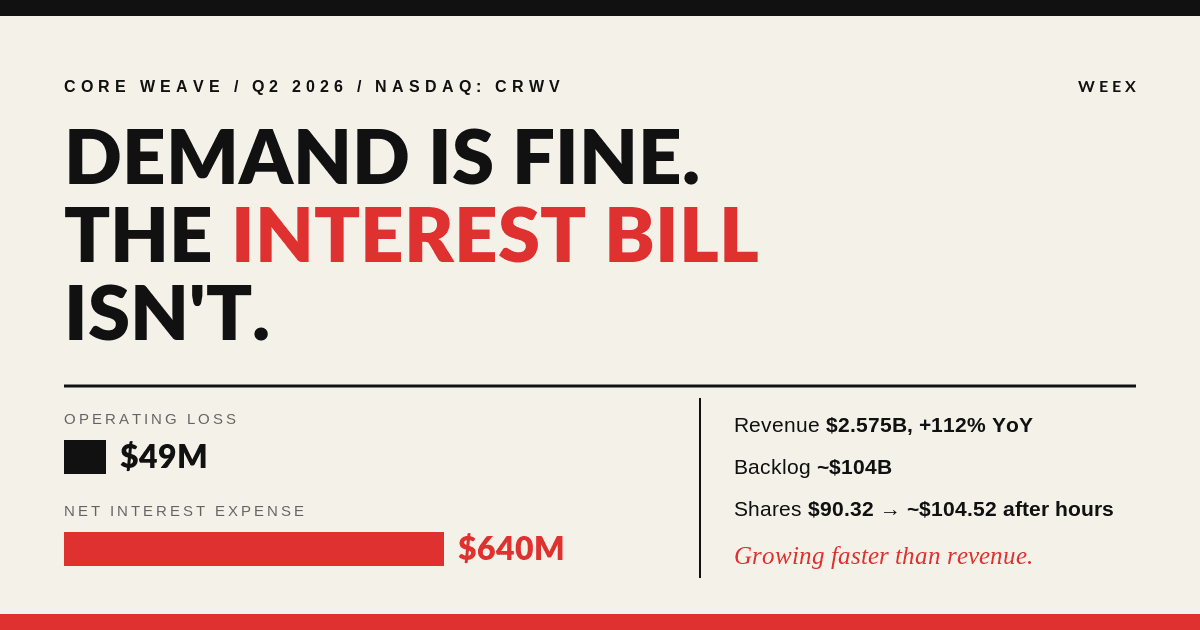
CoreWeave reported second-quarter 2026 results after the Nasdaq close on August 11, and CRWV stock jumped roughly 15% in extended trading, from a $90.32 close to about $104.52. Revenue rose 112% year over year to $2.575 billion and the revenue backlog hit approximately $104 billion. The demand argument, for now, is settled.
The argument that isn't settled sits three lines lower in the same press release. CoreWeave posted a $49 million operating loss for the quarter — and a $640 million net interest expense. That single line is now the central variable in CRWV stock, and it is growing faster than revenue.
What CRWV Stock Actually Priced In After Q2 2026
The beat was real but narrow; the reaction was about the backlog and the operating leverage commentary, not the headline numbers.
| Metric (Q2 2026) | Reported | Q2 2025 | Change |
|---|---|---|---|
| Revenue | $2,575M | $1,212M | +112% |
| Operating income (loss) | ($49M) | $19M | Swung negative |
| Net interest expense | ($640M) | ($267M) | +140% |
| Net loss per share | ($1.14) | ($0.60) | Consensus was ($1.20) |
| Adjusted EBITDA | $1,510M | $753M | Margin 59% vs 62% |
| Revenue backlog | ~$104B (Jun 30) | — | +$25B added in early Q3 |
Source: CoreWeave Q2 2026 results, August 11, 2026. CRWV also expanded active power by nearly 500 MW to 1.5 GW, grew contracted power to roughly 3.7 GW, and was selected for the Nasdaq-100.
Note the order of magnitude in that table. Revenue grew 112%. Interest expense grew 140%. That gap is the whole thesis.
What CoreWeave Sells, and Who Is Actually Paying
CoreWeave rents purpose-built GPU capacity — training and inference clusters, plus the software layer that keeps them busy — to AI labs, hyperscalers and enterprises. It is not a diversified cloud. It is a leveraged landlord for Nvidia silicon.
Q2 named Bentley Systems, Caterpillar, Grammarly, Isomorphic Labs and Sunday Robotics as new logos, with expanded contracts from Cognition, Databricks, Hudson River Trading and Runway ML. That customer list matters more than the revenue line, because a backlog is only as good as the counterparties behind it. Concentration among a handful of very large AI buyers has been the standing criticism of the neocloud model, and broadening the base is the direct answer to it.
The technical story is credible too: CoreWeave completed the industry's first bring-up and validation of Nvidia's Vera Rubin NVL72 and set MLPerf records on Grace Blackwell. Being first to stand up new Nvidia generations is CoreWeave's actual moat — it is why customers pay a premium instead of waiting for AWS capacity.
The $640 Million Line That Decides CRWV Stock
Here is the part most CRWV coverage skips. CoreWeave's balance sheet at June 30, 2026 carried roughly $35.1 billion of recourse and non-recourse debt against $77.1 billion of total assets and about $5.0 billion of stockholders' equity. Add $16.3 billion of operating lease liabilities and the fixed-obligation stack is larger still.
| Financing item | June 30, 2026 |
|---|---|
| Recourse debt (current + non-current) | $31.4B |
| Non-recourse debt (current + non-current) | $3.7B |
| Operating lease liabilities | $16.3B |
| Total liabilities | $72.0B |
| Cash and equivalents | $5.5B |
| Quarterly net interest expense | $640M |
Run the arithmetic. At $640 million a quarter, interest is a ~$2.6 billion annual charge against roughly $6 billion of annualized adjusted EBITDA — about 42 cents of every EBITDA dollar before a single dollar of growth capex. And because CoreWeave keeps funding buildout with new paper, that denominator has to keep compounding just to hold the ratio flat. The company closed a $2.6 billion delayed-draw term loan at SOFR plus 5.50% on August 10, a day before earnings; the spread tells you what the credit market thinks of the risk.
The better way to read CRWV stock, then, is not as an AI growth stock but as a spread trade: contracted revenue yield versus cost of capital. It works while contracts are signed at rates above financing costs and while lenders keep rolling the paper. It breaks if either leg moves — a funding market that reprices, or a customer that renegotiates. Neither is visible in a 112% revenue headline.
Is CRWV Stock a Good Buy at These Levels?
Wall Street says yes on average and is not especially unified about it. Across 38 analysts tracked by S&P Global as of August 12, 2026, the consensus rating is Buy with a 12-month average target of $138.51 — roughly 53% above the August 11 close of $90.32. TipRanks' narrower panel averages $129.77. JPMorgan raised its target to $110 from $105 on August 11 while keeping a Neutral rating.
That dispersion is the signal. Targets ranging from the high-$60s to $250 do not describe a stock with a knowable fair value; they describe an argument about financing risk.
| Scenario | What has to happen | Rough implication |
|---|---|---|
| Bull | Backlog converts, operating leverage holds, refinancing spreads tighten | Analyst-target zone, $130–$150 |
| Base | Growth continues, interest keeps absorbing operating income | Range-bound near the $90–$110 band |
| Bear | Hyperscaler capacity resale compresses pricing, or credit reprices | Retest of the $60.55 52-week low |
CRWV has traded between $60.55 and $153.20 over the past 52 weeks. A stock with that range and negative GAAP operating income is a position-sizing problem before it is a valuation problem.
Trading CRWV as a 24/7 Perpetual on WEEX
The August 11 print exposed a structural gap in how most people access this stock: the news landed at 4:05 pm ET and the Nasdaq was shut. Cash-equity holders could not act on a 15% move until the next session.
Perpetual futures do not have that constraint. The CRWV/USDT perpetual on WEEX was quoting 104.22 on August 12, 2026 — already carrying the post-earnings gap, roughly 15% above the last Nasdaq close, while US cash markets were closed. That is the practical case for USDT-margined stock perpetuals around a binary event: the exposure stays open when the underlying venue doesn't.
What the mechanics look like in practice:
- Fund a WEEX futures account in USDT — no US brokerage account, no share settlement.
- Open CRWV/USDT and set leverage. Up to 100x is available; for a stock that just moved 15% overnight, low single-digit leverage is the honest setting.
- Funding is exchanged every 8 hours, so a directional position carries a running cost or credit depending on which side is crowded.
- Check the current fee schedule before sizing — maker and taker rates vary by VIP tier and matter on short holds.
Two caveats that WEEX itself flags in its US stock perpetuals documentation: liquidity varies by session, so spreads widen outside US hours, and corporate actions or trading halts in the underlying can force early settlement. Availability is also region-dependent.
What CRWV Traders Usually Get Wrong
The recurring mistake is treating overnight liquidity as free optionality. It isn't. A perpetual that gaps 15% before the cash market opens is a perpetual where the spread is wide, funding is skewed against the crowded side, and a 20x position gets liquidated on noise that a cash holder would have slept through. The instrument solves the access problem and amplifies the sizing problem.
The second mistake is anchoring to the backlog. A $104 billion backlog is a revenue schedule, not cash, and it is recognized only as capacity is delivered — which is exactly what the debt is funding. Backlog and leverage are the same story told twice.
The Bottom Line on CRWV Stock
Q2 2026 answered the demand question and sharpened the financing one. CRWV stock now trades on whether CoreWeave can grow into a $2.6 billion annual interest charge that is compounding faster than its revenue, with about $5 billion of equity underneath $72 billion of liabilities. The bull case is intact and the bear case is arithmetic — both can be true, which is why the stock has a 52-week range wider than most crypto majors.
If you want exposure to that argument without a US brokerage account or a 16-hour blackout every night, CRWV/USDT perpetuals on WEEX are the direct route. Size the position for the volatility you just watched, not the volatility you hope for.
FAQ
1. What does CoreWeave (CRWV) actually do?
CoreWeave rents GPU-based cloud infrastructure purpose-built for AI training and inference, along with the orchestration software that runs it. Customers include AI labs, hyperscalers and enterprises such as Databricks, Grammarly and Caterpillar.
2. Why did CRWV stock jump after Q2 2026 earnings?
Revenue grew 112% to $2.575 billion, EPS of ($1.14) beat the ($1.20) consensus, and backlog reached about $104 billion with more than $25 billion of additional commitments added in early Q3. Shares rose roughly 15% in after-hours trading on August 11, 2026.
3. How much debt does CoreWeave have?
Approximately $35.1 billion of recourse and non-recourse debt as of June 30, 2026, plus $16.3 billion of operating lease liabilities, against $5.5 billion of cash. Net interest expense was $640 million in Q2 alone.
4. Is CRWV stock a good buy right now?
Analysts averaged a Buy rating and a $138.51 target as of August 12, 2026, but targets range from the high-$60s to $250 — an unusually wide spread that reflects disagreement about financing risk rather than about demand. This is not investment advice.
5. Can I trade CRWV outside US market hours?
Yes, through stock perpetual futures. The CRWV/USDT perpetual on WEEX trades 24/7 with 8-hour funding intervals, which is how the post-earnings move was accessible while the Nasdaq was closed.
6. What is the difference between CRWV stock and a CRWV perpetual?
Holding CRWV stock means owning shares settled through a broker. A CRWV/USDT perpetual is a USDT-margined derivative that tracks the price without share ownership — no voting rights, no dividends, plus funding costs and liquidation risk from leverage.
Risk Warning
CRWV is a high-volatility equity that has traded between $60.55 and $153.20 over the past 52 weeks, carries roughly $35 billion of debt against about $5 billion of equity, and reports negative GAAP operating income. Losses can be substantial. Derivative exposure adds materially to that risk: leveraged perpetual futures can result in partial or total loss of margin, and liquidation can occur quickly during earnings gaps or thin overnight sessions. Stock perpetuals also carry risks specific to the wrapper — liquidity that varies by market session, wider spreads outside US hours, funding-rate costs on held positions, potential early settlement around corporate actions or trading halts in the underlying, counterparty and custody risk at the exchange, and regional availability restrictions. Prices and figures cited are as of August 12, 2026 and change. Nothing here is investment advice; assess your own risk tolerance and never commit capital you cannot afford to lose.
This content is provided for general informational purposes only and doesn't constitute financial, investment, legal, or tax advice. Any events, rewards, online promotions, or related information mentioned herein should not be considered a recommendation, solicitation, or invitation to purchase, sell, trade, or otherwise deal in any crypto assets. Crypto assets are highly volatile and may result in loss. The availability of WEEX services, products, and related events may vary by region. You are responsible for ensuring that your participation is in accordance with applicable local laws and regulations.
You may also like

Kioxia Stock and SK Hynix: What Rivals Sharing the Same Shareholder Actually Means

Is HIMS Stock a Buy After the Earnings Selloff? What the Full-Year Guidance Raise Actually Implies

ASTS Stock Falls After Missing Q2 Estimates: What the Revenue Miss and Japan Launch Actually Mean

Intel Stock Is Up Over 170% in 2026: What the AI Foundry Turnaround Actually Required

Intel Stock Sale Draws Over $100 Billion in Demand: What the 5x Oversubscription Actually Signals

RKLB Stock Price Targets Range From $64 to $150: What the Analyst Disagreement Actually Reveals
RKLB Stock Has Fallen Sharply Since SpaceX's IPO: What History Says Happens to Number Two Players

SPCX Stock Price Target Raised to $450 by Arete Research: What the Upgrade After the Cursor Deal Actually Means
SPCX Stock Closes Above Its $135 IPO Price for the First Time in Weeks: What the Recovery Actually Signals
XST Coin: Which Token Is It, and How Thin Is the Market?

HOOD Stock at $94: Record Revenue, Crypto Slump, 24/7 Access
XRP News: Which August 2026 Headlines Actually Move Price
PROM on 12 August 2026: What Upbit Added and What the Price Did
What Is Prom (PROM)? The Polygon CDK Chain, the Token and Where It Trades
Best Crypto Trading Bot Strategies for Beginners
How High Can XST Reach? Buy, Hold, or Wait?
How to Backtest a Crypto Trading Strategy? A Beginner’s Guide
How to Build a Crypto Trading Bot With an Exchange API: A Beginner’s Guide
Crypto Trading Bot vs Manual Trading: Which Is Better?
Is Cronos (CRO) Still Worth Buying in 2026? Ecosystem Growth, Staking Yields and Risk Factors
Google Stock and the $200 Billion Anthropic Financing Program: What the Largest AI Deal in History Means for GOOG

Why Is Cronos (CRO) Gaining Trader Attention? Key Drivers Behind the Recent Volume Surge
Is Bitcoin Preparing for a Bullish Breakout? Key Technical Indicators and On-Chain Data
How to Avoid Liquidation During Market Crashes? Futures Risk Management Strategies

Which AI Crypto Tokens Are Surging Today? Top Decentralized AI Projects to Watch
Is Cronos (CRO) Preparing for a Major Rally? Catalysts, Risks and the 2026 Outlook
Which Major Tokens Face Massive Unlocks Tomorrow? Market Impact and Price Predictions
HIMS Stock Falls After Raising Guidance: What the GLP-1 Regulatory Uncertainty Actually Changes
What Are the New Crypto Regulation Laws? Essential Compliance Guide for Traders
ASTS Stock Price Prediction 2026-2027: Can AST SpaceMobile Recover After the Launch Bottleneck
Kioxia Stock and SK Hynix: What Rivals Sharing the Same Shareholder Actually Means
Is HIMS Stock a Buy After the Earnings Selloff? What the Full-Year Guidance Raise Actually Implies
ASTS Stock Falls After Missing Q2 Estimates: What the Revenue Miss and Japan Launch Actually Mean
Intel Stock Is Up Over 170% in 2026: What the AI Foundry Turnaround Actually Required
Intel Stock Sale Draws Over $100 Billion in Demand: What the 5x Oversubscription Actually Signals
RKLB Stock Price Targets Range From $64 to $150: What the Analyst Disagreement Actually Reveals
Contents
Popular coins
Latest articles





