
TSMC Stock After Record Q2: Price, Valuation and 24/7 Access

 Prefer us on Google

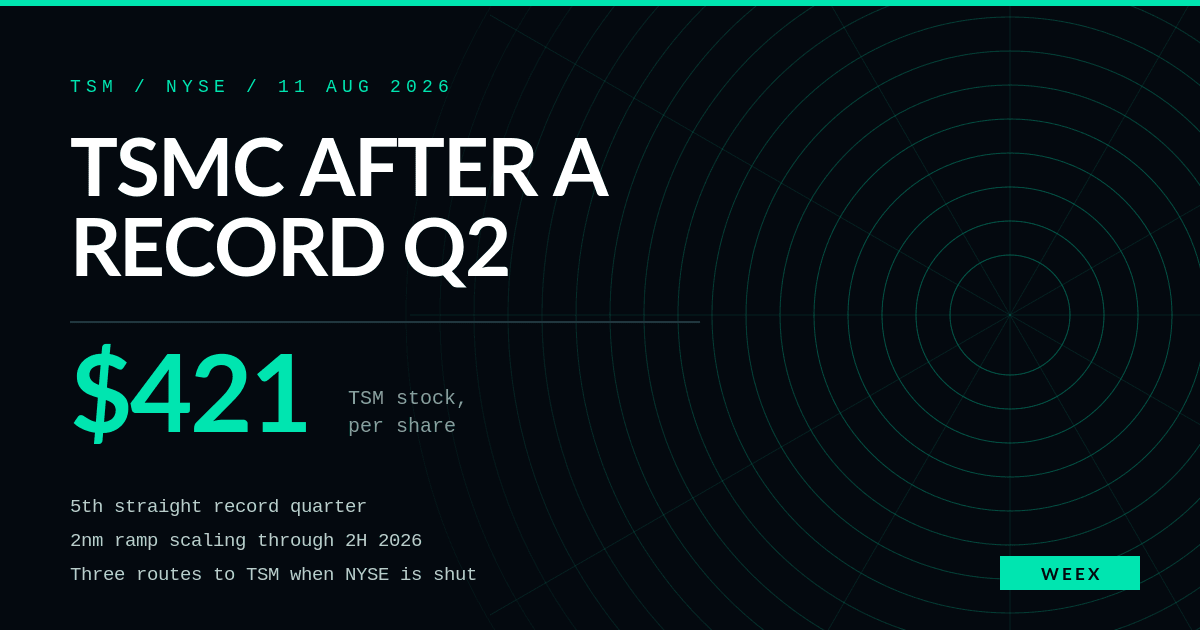
TSMC stock (NYSE: TSM) changed hands around $421 in early August 2026, roughly 12% below the $479 fifty-two-week high and up about 81% over the past year. The company that fabricates the silicon behind almost every frontier AI chip has just printed its fifth consecutive record quarter — and the stock still trades at a discount to what most of the sell side thinks it is worth.
That gap is the interesting part. Below: what the Q2 2026 numbers actually said, whether 27x trailing earnings is expensive for a business earning a 40% return on equity, and — the part the quote terminals skip — how a trader outside the US can hold TSM exposure on a Saturday.
TSMC stock price today and the numbers behind it
| Metric | Value | As of / source |
|---|---|---|
| TSM (NYSE ADR) price | ~$421.35 | 11 Aug 2026, public quote feeds |
| 52-week range | $223.70 – $479.00 | 11 Aug 2026 |
| 52-week return | ~+81% | 11 Aug 2026 |
| TSM/USDT perpetual, WEEX | 419.45 | 11 Aug 2026, WEEX contract page |
| Q2 2026 revenue | NT$1,270.38bn (US$40.20bn), +36.0% YoY | TSMC, reported 16 Jul 2026 |
| Q2 2026 net income | NT$706.56bn, +77.4% YoY | TSMC, 16 Jul 2026 |
| Q2 2026 gross / operating margin | 67.7% / 60.3% | TSMC, 16 Jul 2026 |
| Q3 2026 revenue guidance | US$44.6bn – US$45.8bn | TSMC, 16 Jul 2026 |
| July 2026 monthly revenue | NT$467.58bn (~US$14.49bn), +44.7% YoY | TSMC monthly filing, 10 Aug 2026 |
| Trailing / forward P/E | ~27x / ~19x | 11 Aug 2026, aggregators |
| Dividend | $2.76 annually, ~0.66% yield | 11 Aug 2026 |
| Net cash | ~$79.7bn | Latest reported balance sheet |
The single number worth remembering: the perpetual and the ADR were within two dollars of each other on the same day. That is the whole premise of stock perps working — when the tracking spread widens materially, something is wrong with the venue, not with TSMC.
Why TSMC's Q2 2026 earnings reset the bar
Revenue grew 36% year over year. Net income grew 77.4%. When profit grows at more than twice the rate of revenue, the company is not just selling more — it is selling a richer mix at better prices, and TSMC's 67.7% gross margin is the receipt.
Two structural facts sit underneath that:
Advanced nodes are carrying the P&L. N5 was about 33% of revenue, N3 about 30%, and N2 — the node that only started contributing this year — about 3%. TSMC hit 20,000 wafers per month on N2 and market estimates for its 2026 exit capacity have been revised up toward 140,000 wafers per month, well above the 100,000 figure circulating earlier in the year.
Capex is now a geopolitical instrument. Alongside Q2, TSMC committed an additional $100bn to its Arizona buildout. Read it as insurance rather than growth capex: it buys tariff relief and political cover, and it dilutes the single-island concentration risk that has capped TSMC's multiple for a decade.
The near-term thing to watch is the margin path. New-node ramps are dilutive before they are accretive, and management guided Q3 gross margin to 65–67% — a step down from 67.7%. If the N2 ramp costs more than 3–4 points of gross margin, the bull case gets a delay, not a cancellation.
Is TSMC stock expensive at 27x earnings?
Trailing P/E of roughly 27x against a ten-year average near 22x looks stretched on the surface. Forward P/E near 19x does not. Both are true; the difference is entirely the earnings growth the market is underwriting for the next twelve months, and JPMorgan's published 30% USD revenue growth call for 2026 is broadly in line with where the guidance is pointing.
Analyst targets clustered around a $540 average as of August 2026, with the visible range running roughly $430 to $700. That dispersion is the honest signal. A $270 spread on a $421 stock means the consensus is not confident — it is averaging two different worlds: one where AI capex keeps compounding through 2027, and one where hyperscaler orders digest.
The more useful framing than "cheap or expensive" is this: TSMC has no credible competitor at the leading edge, holds ~$79.7bn in net cash, and earns a ~40% ROE. What you are paying for is not the moat — it is the duration of the AI order book. That is a demand question, not a company-quality question, and nobody's model answers it well.
Three ways to get TSMC stock exposure without a US broker
This is where most "TSMC stock" pages stop being useful. If you are outside the US, the ADR is often the least accessible of the three routes.
| Route | What you own | Trading hours | Leverage | Dividends | Main risk |
|---|---|---|---|---|---|
| NYSE ADR (TSM) | Real depositary shares | NYSE session only | Margin, broker-set | Yes | Needs a US-market brokerage account; no weekend exit |
| Tokenized TSMC (e.g. TSMX xStock) | 1:1 custodied claim, no legal title | ~24/5 | None | Economic pass-through only | Very thin — TSMX market cap sat near $296K with ~$1.4M 24h volume; blocked in US/CA/UK/AU |
| TSM/USDT perpetual (WEEX) | No ownership — a price contract | 24/7 | Up to 50x per the contract page | No | Funding cost, gaps, liquidation |
The tokenized route is the one people over-rate. A ~$296K market cap on a $1.1trn company is not a market; it is a quote. Slippage on any size will exceed whatever you saved on access.
The perpetual is the honest instrument for short-horizon exposure, provided you price the carry. Funding settles every eight hours. At an illustrative 0.01% per interval, that is roughly 0.03% a day and near 11% annualised — against a dividend yield of 0.66% you do not receive. Perps are a trading tool, not a way to own TSMC.
One detail worth noticing, and you will not find it on a quote page: WEEX does not treat all stock perps identically. The TSM/USDT contract is listed with leverage up to 50x, while the NVDA/USDT contract goes to 100x. Leverage tiers track the venue's own liquidity and volatility assumptions, so the lower cap on TSM is a risk signal to read, not a limitation to work around.
How to trade the TSM perpetual on WEEX
- Fund a WEEX account with USDT. No separate brokerage onboarding is involved — this is the access argument WEEX makes for its TradFi product line.
- Open the TSM/USDT contract page and compare the mark price against the NYSE last close. A spread of more than a percent or so outside US hours usually means thin books, not information.
- Set leverage deliberately. The 50x cap is a ceiling, not a suggestion; at 10x, a 10% adverse move on a stock with a $223–$479 annual range is a liquidation.
- Check the funding countdown before holding overnight, and again before an earnings date. TSMC reports quarterly and publishes monthly revenue around the 10th — both are gap events.
- Size for the weekend. The ADR stops trading on Friday; the perp does not.
If you want the mechanics of how on-chain equity exposure is issued and custodied before choosing a route, WEEX's explainer on tokenized US stocks covers the issuance and rights-management side that this article treats as given.
What TSMC stock traders usually get wrong
The recurring mistake with TSM specifically is treating it as one instrument when it is three. TSMC's primary listing is 2330.TW in Taipei; the NYSE ADR is a derivative of it; the perpetual is a derivative of the ADR's price. Taiwan trades while New York sleeps. Material news — a monthly revenue release, a capacity report, a cross-strait headline — can move the Taipei line hours before the ADR reopens, and a 24/7 perp will reprice into that news against a closed reference market.
Traders read that as a broken feed. It is not. It is the perp doing its job, discovering price when the ADR cannot. The practical consequence: stops placed just outside "normal" ADR ranges get taken out during Asian hours far more often than people expect, and the position is gone before the thesis was ever tested.
The second one is simpler. Perp holders do not receive the $2.76 dividend and do not vote. For anyone whose actual view on TSMC stock is measured in years rather than weeks, the funding drag will quietly eat the thesis.
The bottom line on TSMC stock
TSMC stock is not a story about whether the company is good — Q2 2026 settled that with a 67.7% gross margin and a fifth straight record quarter. It is a story about what you are willing to pay for the length of the AI capex cycle, and about the fact that a $430-to-$700 target range is the sell side admitting it does not know.
Rank the risks honestly: the N2 margin dilution is a 2026 issue, the AI-demand duration is a 2027 issue, and Taiwan concentration is the permanent one that Arizona only partly offsets. If you want short-horizon exposure without a US broker, the TSM/USDT perpetual is the cleanest of the three routes — check the live mark price and current leverage tier on the TSM/USDT contract page before you size anything.
FAQ
1. What is TSMC stock trading at right now?
TSM traded around $421 on the NYSE in early August 2026, inside a 52-week range of $223.70 to $479.00. The WEEX TSM/USDT perpetual printed 419.45 on 11 August 2026. Both move constantly — check a live feed before acting on any figure in this article.
2. Did TSMC beat expectations in Q2 2026?
TSMC reported Q2 revenue of NT$1,270.38bn (US$40.20bn), up 36.0% year over year, and net income of NT$706.56bn, up 77.4% — a record for the fifth consecutive quarter. Gross margin came in at 67.7%. Q3 guidance is US$44.6bn to US$45.8bn with gross margin of 65–67%.
3. Is TSMC stock a good buy in 2026?
That depends on your view of AI capex duration, not on TSMC's execution. As of August 2026 the stock trades near 27x trailing and 19x forward earnings, with analyst targets ranging from roughly $430 to $700. The wide spread reflects genuine disagreement about 2027 demand. This is not investment advice.
4. Can I buy TSMC stock without a US brokerage account?
There are two non-brokerage routes: tokenized TSMC shares such as TSMX, which are 1:1 custodied but extremely thin (a ~$296K market cap as of August 2026) and unavailable in the US, Canada, UK and Australia; and USDT-margined stock perpetuals such as TSM/USDT on WEEX, which give price exposure with no ownership, no dividend and a funding cost.
5. Does the TSM perpetual pay TSMC's dividend?
No. A perpetual contract tracks price only. TSMC's $2.76 annual dividend (about a 0.66% yield as of August 2026) goes to holders of the underlying shares. Perp holders instead pay or receive funding every eight hours, which over a long hold is a cost, not an income.
6. Why does the TSM perpetual move when US markets are closed?
TSMC's primary listing is 2330.TW in Taipei, and the NYSE ADR is a secondary listing on top of it. Taiwan-session news and monthly revenue filings can reprice the underlying while the ADR is shut, and a 24/7 perpetual will follow. Liquidity is thinner in those hours, so spreads widen and stops trigger more easily.
Risk Warning
TSM/USDT perpetual contracts and tokenized equities are leveraged or synthetic instruments and can result in partial or total loss of capital. Specific risks in this article: at 50x, a 2% adverse move can liquidate a position; funding is charged every eight hours and compounds against long holds; liquidity in stock perps thins sharply outside US market hours, widening spreads and increasing slippage and stop-out risk; the underlying ADR gaps across weekends and earnings while the perpetual keeps trading; tokenized shares such as TSMX carry issuer, custodian and smart-contract risk and confer no legal share ownership or voting rights; and availability of tokenized equity products is restricted in the US, Canada, UK and Australia. Prices, leverage tiers, fees and product availability shown here were current on 11 August 2026 and change without notice — verify on the live product page. Nothing here is investment advice.
This content is provided for general informational purposes only and doesn't constitute financial, investment, legal, or tax advice. Any events, rewards, online promotions, or related information mentioned herein should not be considered a recommendation, solicitation, or invitation to purchase, sell, trade, or otherwise deal in any crypto assets. Crypto assets are highly volatile and may result in loss. The availability of WEEX services, products, and related events may vary by region. You are responsible for ensuring that your participation is in accordance with applicable local laws and regulations.
You may also like

RKLB Stock After Q2: Record Revenue, Wider Loss, Narrower Window

Metaplanet (3350): What the Japanese Retail Boards Argue About — and How to Check Each Claim

How Euro-Area Macro Moves Bitcoin: ECB Rates, Energy, and the Euro-Denominated View (2026)
Hardware Wallet Security After the Coldcard Exploit: Custody Options Explained (2026)

What Is the Yen Carry Trade? How It Moves Bitcoin, Explained
Stock Market Futures: What They Price and When They Go Dark
Meme Coin Guide: Opportunities, Risks, and Strategy in 2026
Circle Stock Analysis: Business Model and Valuation in 2026

WEEX Trade to Earn Phase 2: Trade More but Pay Less in Futures Trading Markets

What is Canton Network: Pioneering Institutional Crypto with Canton Coin (CC) and Privacy-Preserving Blockchain Innovation
Introduction to Canton Network: A New Era for Institutional-Grade Digital Assets

What Is Recall Coin Crypto? A Deep Dive Into RECALL Token & the Recall Network
One-Click Margin Mode Setup for All Futures Pairs
Get Up To 100% APR On WEEX Auto Earn USDT
Crypto Trading vs.Traditional Investment, What's the Difference?
Why Celebrity Memecoins Often End in scandal and What Traders Can Learn?

What Is Swing Trading in Crypto?
Market Insight: Will ETH Break to New Highs?








RKLB Stock After Q2: Record Revenue, Wider Loss, Narrower Window
Metaplanet (3350): What the Japanese Retail Boards Argue About — and How to Check Each Claim
How Euro-Area Macro Moves Bitcoin: ECB Rates, Energy, and the Euro-Denominated View (2026)
Hardware Wallet Security After the Coldcard Exploit: Custody Options Explained (2026)
What Is the Yen Carry Trade? How It Moves Bitcoin, Explained
Stock Market Futures: What They Price and When They Go Dark
Contents
Popular coins
Latest articles


