
WEEX EDGE Airdrop 2026: Share 30,000 USDT


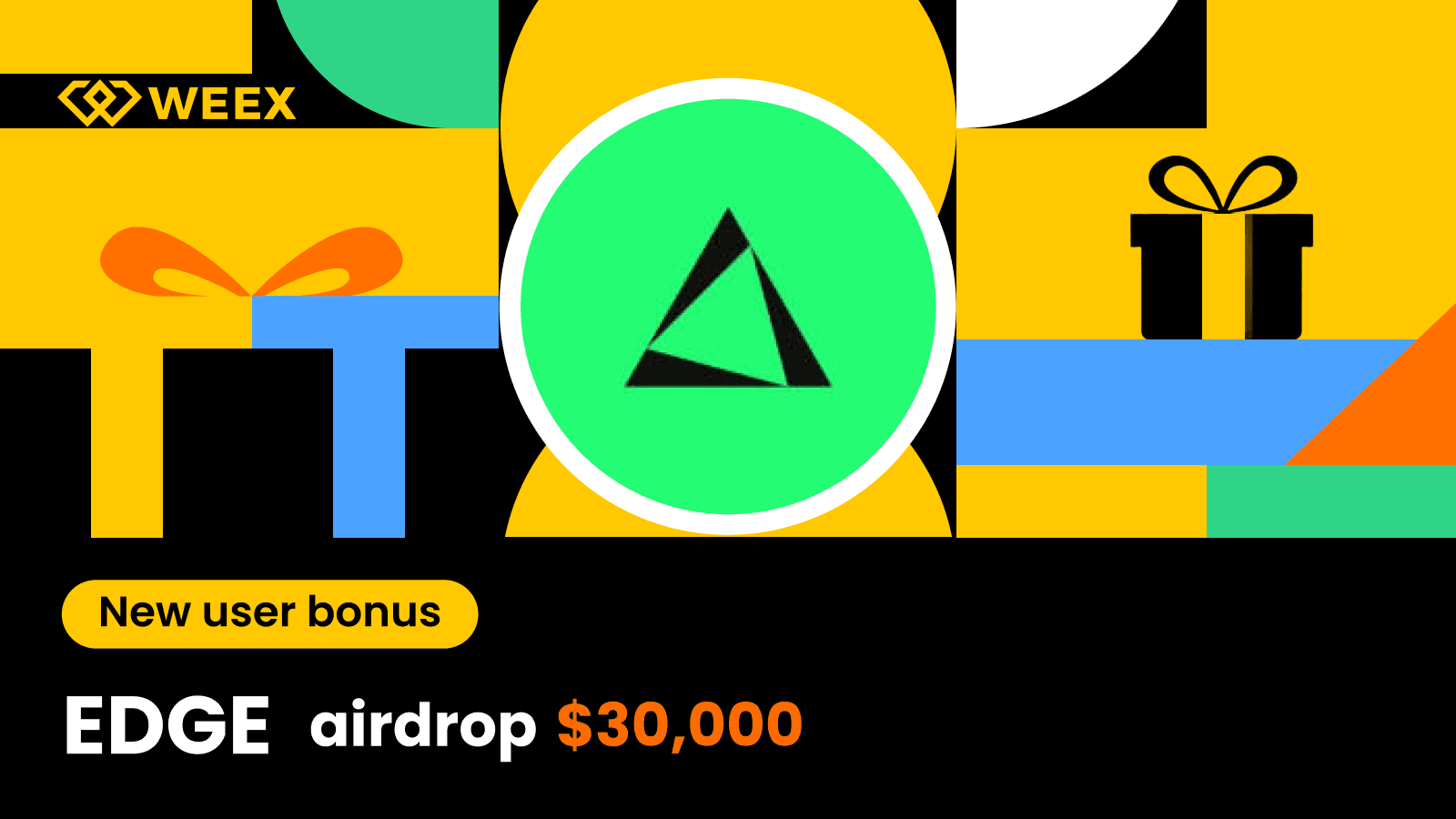
From April 8, 2026, 18:00 to April 15, 2026, 18:00 (UTC+8), WEEX is running an EDGE airdrop campaign with a headline prize pool of 30,000 USDT. The event is built around new-user deposit and spot trading tasks, with additional daily spot and futures rewards available during the campaign period.
If you are looking for a straightforward EDGE airdrop guide, this campaign focuses on a single token, EDGE, where users can earn rewards by completing deposit, spot trading, and futures trading tasks on WEEX.
Event Overview: EDGE Airdrop on WEEX
The EDGE airdrop runs from April 8, 2026, 18:00 to April 15, 2026, 18:00 (UTC+8). Based on the event page, users must click “Register Now” to join the campaign, and new users must complete their first deposit and first spot trade in sequence to become eligible for the main rewards.
Key event highlights include:
- 5,000 USDT for eligible users who complete the first deposit task
- 5,000 USDT for eligible users who complete the first EDGE/USDT spot trading task
- 1 to 10 USDT in random futures bonus funds for daily spot trading, with up to 50 USDT
This event is designed specifically for new users who register during the campaign period and have never traded before. Participants must complete identity verification or bind a mobile number to qualify for rewards.
Reward Pool 1: First Deposit Task & Share 5,000 USDT
The first reward pool is tied to deposits. New users who complete a net deposit greater than 100 USDT can qualify to share 5,000 USDT.
Your reward is calculated as:
(Your deposit ÷ Total deposits of all participants) × Prize pool
The event page also lists extra deposit benefits:
First Quick Buy deposit: 5 USDT cashback
Buy USDT via SEPA bank transfer: first deposit earns 10 USDT, 0 fees, and favorable conversion rates
Reward Pool 2: First Spot Trading Task & Share 5,000 USDT
The second main reward pool is for users who complete their first EDGE/USDT spot trade. Once eligible users place their first spot trade, they can share another 5,000 USDT reward pool.
Your reward is calculated as:
(First spot trade volume ÷ Total participant volume) × Prize pool
This structure means the size of your first eligible EDGE/USDT spot trade affects your share of the pool relative to other participants.
Reward Pool 3: Daily Spot Trading Earn 1 to 10 USDT
In addition to the two main pools, WEEX also offers a daily spot trading reward. Users who reach daily spot trading volume of at least 100 USDT in the designated token can receive 1 to 10 USDT in random futures bonus funds.
The maximum total reward for this task is 50 USDT.
This part of the campaign is useful for users who want ongoing rewards instead of participating only once.
Futures Trading Bonus: Complete Volume to Earn
In addition to the three main reward pools, WEEX is offering a futures trading bonus. New users who complete specified trading volumes on USDT-M futures can claim corresponding rewards directly. Futures trading volume is calculated as opening volume plus closing volume.
Important note: The futures trading bonus is available for direct claiming, while USDT rewards from other pools will be distributed within 10 working days after the event ends.
How to Participate: Step-by-Step Guide
Step 1: Register on WEEX
Create a WEEX account during the campaign period. The main EDGE airdrop tasks are aimed at new users with no prior trading history.
Step 2: Click “Register Now”
You must click the “Register Now” button on the event page to join the activity officially. Without registration, your deposit and trading activity may not be counted.
Step 3: Complete KYC or Link Your Phone Number
According to the event rules, users must complete identity verification or bind a mobile number to claim rewards.
Step 4: Make a Qualifying Deposit
Complete a net deposit above 100 USDT to qualify for the first deposit reward pool. Net deposit is calculated as deposit minus withdrawal.
Step 5: Complete Your First EDGE/USDT Spot Trade
After the deposit step, complete your first EDGE/USDT spot trade to qualify for the second main reward pool.
Step 6: Continue With Daily Spot or Futures Tasks
If you want more rewards, continue trading to reach the daily spot requirement or finish the futures trading task.
Compliance and Risk Management for Airdrop Participants
Adhering to the technical requirements is the only way to guarantee reward eligibility in the ROBO airdrop. One critical rule is that the tasks must be completed in order: first deposit, then spot trade, then futures trade. Skipping a step or performing them out of sequence will result in the user being ineligible for the subsequent rewards. Additionally, "New Users Only" refers strictly to those who sign up during the event period. Market makers and institutional accounts are explicitly barred from participation to ensure that the 30,000 USDT pool remains accessible to individual retail traders.
Risk management is also a vital component of any crypto airdrop strategy. While the rewards provide a buffer, users should still practice disciplined trading, especially in the futures market. The use of stop-loss orders and a clear understanding of liquidation prices are essential when trading with leverage to meet volume goals. The zero-fee trading benefit should be seen as a tool to maximize net profits rather than a reason to take excessive risks. By focusing on high-liquidity pairs and maintaining a consistent daily volume, participants can navigate the event with a balanced approach to risk and reward.
Ready to claim EDGE airdrop? Register on WEEX today, complete KYC in under 60 seconds, and start earning your share of 30,000 USDT.
FAQ
Q1: What is the EDGE airdrop?
The EDGE airdrop is a WEEX promotional campaign that rewards users for completing deposit, spot trading, daily trading, and futures trading tasks during the event period.
Q2: Who can participate in this event?
Only new users who register on WEEX during the event period (April 8–15, 2026) and have never traded before are eligible. Identity verification or mobile binding is required.
Q3: How do I qualify for the first deposit pool?
You need to complete a net deposit above 100 USDT during the event period.
Q4: How do I qualify for the first spot trading pool?
You must complete your first EDGE/USDT spot trade after joining the event.
Q5: What is the daily spot trading reward?
Users who reach daily spot trading volume of at least 100 USDT can receive 1 to 10 USDT in random futures bonus funds, with a total maximum of 50 USDT.
Q6: When will I receive my rewards?
Futures bonus funds can be claimed directly. Other USDT rewards will be distributed within 10 working days after the event ends.
You may also like

What Is SAOS? Strategic American Oil Supply Token Explained
SAOS is a meme token on Solana with a 75,000 USD market cap and 22,000 USD locked liquidity, positioned around oil supply themes but lacking real asset backing
It thrives on pure narrative speculation, with no utility, website, or doxxed team, making it highly volatile and attention-dependent
Traders should distinguish SAOS from legitimate real-world asset projects, as its branding is speculative rather than substantive
Positive aspects include locked liquidity reducing rug pull risks, but low trading activity signals high uncertainty
How to Buy Public Asset Control (PAC) Token in 2026: Latest Solana Buying Guide
How to buy Public Asset Control (PAC) token in 2026, PAC contract address, Solana wallet setup, Jupiter swap guide, latest price, liquidity, and risks.

What Is Public Asset Control (PAC) Token and How Does It Work? Latest Solana PAC Token Guide
Public Asset Control (PAC) token explained. Learn what PAC is, how it works on Solana, current price snapshot, risks, and buying basics.

Can PAC Coin Reach $1 Soon? Analyzing Public Asset Control
PAC is a Solana-based meme token with a government-themed narrative, but it is highly speculative.
At its current price (~$0.0009) and 1B supply, reaching $1 would require a $1B market cap, which is very unlikely.
Short-term moves to $0.001 or $0.01 are more realistic, but the token is highly volatile due to low liquidity and hype-driven trading.
Overall, $1 is not a realistic target, and PAC is better suited for short-term speculation than long-term investment.

United Nations Oil Reserve (UNOS) Crypto: Solana Token, UN Links, and Risks
United Nations Oil Reserve (UNOS) Crypto explained: Solana token basics, UN links, oil-backing claims, market risks, contract checks, and buying cautions.

What Is Public Asset Control (PAC) Coin? Explained for Beginners
Public Asset Control (PAC) is a Solana-based token that uses a “government asset control” narrative involving oil and gold themes, but it has no verified ties to any real institutions or governments. It is mainly an entertainment-focused, speculative meme coin.
The project’s claims about links to entities like BlackRock or Palantir are unverified, and its own disclaimer states it is not a real financial or institutional asset. Like many new Solana tokens, PAC is highly volatile, with low liquidity and limited transparency, including no fully verified audit.
Overall, PAC is a high-risk speculative token driven by hype and storytelling rather than real utility. Beginners are advised to be cautious, verify contract details, and prioritize risk control before considering any trading.

What Is Official Saudi Oil Reserve (OSOR) Coin?
Learn what OSOR coin is, why its Saudi oil narrative matters, how to verify the contract, and what risks to check before trading.

Global Digital Oil Reserve (GDOR): What It Is, Risks, and How to Check It
Global Digital Oil Reserve (GDOR) is an oil-themed Solana token with unclear backing. Learn its risks, market data, and verification checklist.

Is OBC Crypto a Good Investment?
Is OBC crypto a good investment? We analyze the latest market data, holder concentration, liquidity risks, and short-term momentum. Read this before you invest in OBC token.

Can OSOR Reach $1? Full Price Analysis 2026
OSOR crypto price prediction 2026: Can Saudi Oil Reserve token reach 1? Read before buying.

What is International Oil Supply (IOS) Coin?
Wondering what is IOS crypto? Here’s a straight look at International Oil Supply (IOS) coin—the Solana token tied to oil reserve data. Contract address, risks, and what’s still unverified.

What Is the Unified International Token (UNIT)? Is UNIT Crypto Legit or Scam?
what is UNIT crypto? Here’s a breakdown of the Unified International Token ($UNIT), how it ties to BRICS+ data, where to buy it, and why it’s a conceptual project—not an official currency.
What Is Stablecoin Business OS (SBOS) Coin?
What is SBOS crypto? We break down Stablecoin Business OS, its USDC invoicing tools, AI finance assistant, token contract address, and real utility for online businesses.
World Collective Oil Reserve ($WCOR) Price Prediction: May 2026 Rally Analysis and Future Outlook
Is $WCOR a good investment? Read our comprehensive World Collective Oil Reserve price prediction and market analysis for 2026-2030. Learn about the energy narrative on Solana and start your trading journey with WEEX rewards.
Is OSOR Token Next 10X Like WCOR or Just Market Hype?
Is OSOR the next 10X crypto like WCOR or just market hype? Compare OSOR vs WCOR on-chain data, price discrepancies, and holder risks in this deep dive into Saudi oil-backed tokens.

How to Buy $WCOR Coin: Should I Invest or Is It Just Hype?
Learn how to buy $WCOR coin on Solana and explore its latest 57% price surge. This expert guide analyzes whether WCOR is a solid investment or speculative hype.

Is $PAC Token a Good Investment in 2026? Price, Risks, and Market Analysis
A data-driven analysis of Public Asset Control (PAC) token: current price, market cap, liquidity, $1 target feasibility, and risk factors. Is it a legitimate investment or a high-risk meme coin?
NEAR Airdrop: Join WEEX to Share 50,000 USDT in Crypto Rewards
Join the NEAR airdrop on WEEX from May 7 to May 14 to share a 50,000 USDT prize pool. New users can earn rewards through deposits and spot trades with zero-fee trading advantages.
What Is SAOS? Strategic American Oil Supply Token Explained
SAOS is a meme token on Solana with a 75,000 USD market cap and 22,000 USD locked liquidity, positioned around oil supply themes but lacking real asset backing
It thrives on pure narrative speculation, with no utility, website, or doxxed team, making it highly volatile and attention-dependent
Traders should distinguish SAOS from legitimate real-world asset projects, as its branding is speculative rather than substantive
Positive aspects include locked liquidity reducing rug pull risks, but low trading activity signals high uncertainty
How to Buy Public Asset Control (PAC) Token in 2026: Latest Solana Buying Guide
How to buy Public Asset Control (PAC) token in 2026, PAC contract address, Solana wallet setup, Jupiter swap guide, latest price, liquidity, and risks.
What Is Public Asset Control (PAC) Token and How Does It Work? Latest Solana PAC Token Guide
Public Asset Control (PAC) token explained. Learn what PAC is, how it works on Solana, current price snapshot, risks, and buying basics.
Can PAC Coin Reach $1 Soon? Analyzing Public Asset Control
PAC is a Solana-based meme token with a government-themed narrative, but it is highly speculative.
At its current price (~$0.0009) and 1B supply, reaching $1 would require a $1B market cap, which is very unlikely.
Short-term moves to $0.001 or $0.01 are more realistic, but the token is highly volatile due to low liquidity and hype-driven trading.
Overall, $1 is not a realistic target, and PAC is better suited for short-term speculation than long-term investment.
United Nations Oil Reserve (UNOS) Crypto: Solana Token, UN Links, and Risks
United Nations Oil Reserve (UNOS) Crypto explained: Solana token basics, UN links, oil-backing claims, market risks, contract checks, and buying cautions.
What Is Public Asset Control (PAC) Coin? Explained for Beginners
Public Asset Control (PAC) is a Solana-based token that uses a “government asset control” narrative involving oil and gold themes, but it has no verified ties to any real institutions or governments. It is mainly an entertainment-focused, speculative meme coin.
The project’s claims about links to entities like BlackRock or Palantir are unverified, and its own disclaimer states it is not a real financial or institutional asset. Like many new Solana tokens, PAC is highly volatile, with low liquidity and limited transparency, including no fully verified audit.
Overall, PAC is a high-risk speculative token driven by hype and storytelling rather than real utility. Beginners are advised to be cautious, verify contract details, and prioritize risk control before considering any trading.


